Attractions & Natural Wonders · United Kingdom
Why is the Giant's Causeway made of hexagons?
Cooling lava shrinks and cracks, and as the cracks sink deeper they settle into the most economical pattern there is, a grid of six-sided columns
By Globeway Editorial · 13 October 2026
The short answer
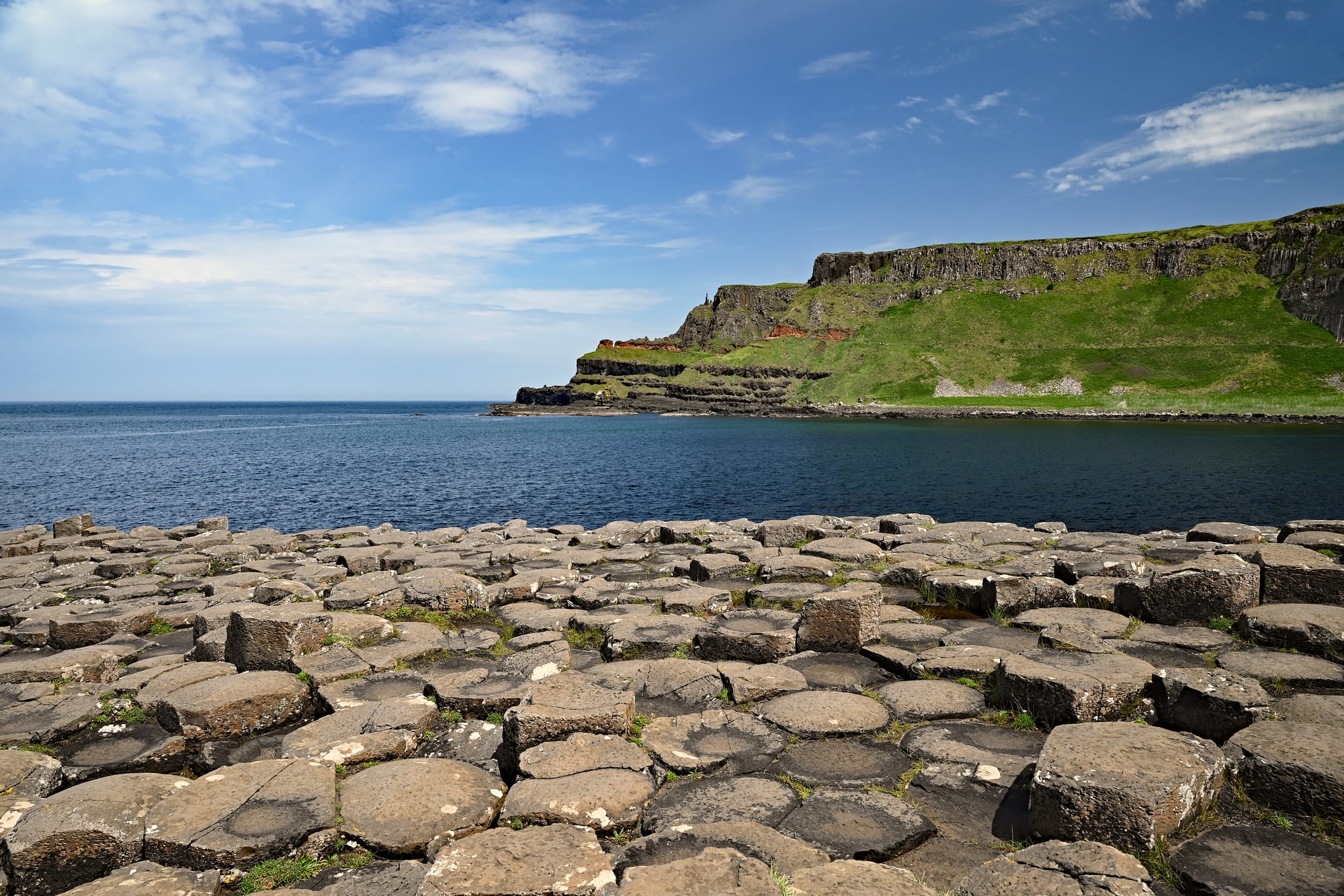
The Giant's Causeway is made of basalt, a volcanic rock that poured out as highly fluid lava around 50 to 60 million years ago. As a thick sheet of that lava cooled, it shrank. It could shrink downwards without breaking, but not sideways, so it cracked, much as a puddle of mud cracks when it dries. Those cracks spread down through the cooling rock and split it into roughly 40,000 upright columns.
The columns are mostly hexagonal because six sides is the pattern a cracking surface settles into when it can relax. The first cracks meet at untidy right angles, but as the cracking front moves deeper, the network rearranges itself into a grid of evenly sized six-sided cells, a lower-energy arrangement. Not every column is perfect: some have four, five, seven or eight sides. But six is by far the most common.
A sheet of lava that ran out of room
The Causeway sits on the north coast of County Antrim, about three miles northeast of the town of Bushmills. It belongs to a far larger event. In the Paleogene period, as the crust stretched and the North Atlantic Ocean began to open, fissures split the ground in a line running from Ireland to the Hebrides. Magma hotter than 1,000 °C welled up and spread in flow after flow, burning forests, filling valleys and burying hills. The result was the Thulean Plateau, a basalt plain that covered at least 1.3 million square kilometres. When the ocean opened, the plateau was torn apart, and its remnants survive in Northern Ireland, western Scotland, the Faroe Islands, Iceland, east Greenland and western Norway.
At the Causeway, molten basalt pushed up through beds of chalk and built a volcanic plateau. In places the solidified lava in the cliffs is 28 metres (92 feet) thick. A layer like that holds a great deal of heat, and it loses it slowly, from the top and the bottom.
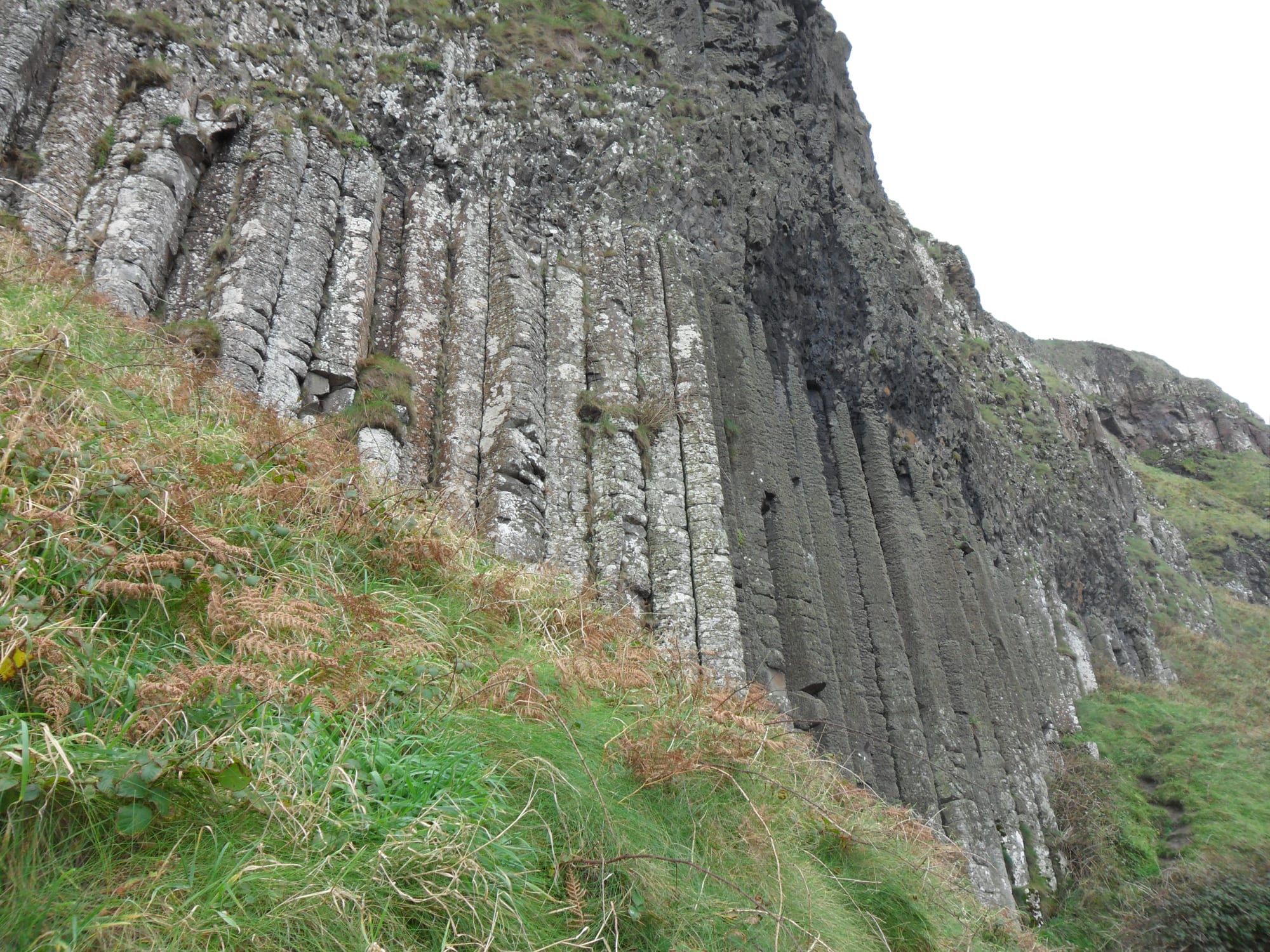
In the cliffs, the columns can be seen side on, standing like pipes. The tallest at the Causeway reach about 12 metres (39 feet). Each one marks the path a set of cracks took as it travelled through the cooling lava.
Why the cracks choose six sides
Geologists call the effect columnar jointing; a joint is simply a crack in rock. When the cracks first open at the cooling surface, each one runs until it hits an older crack and stops, so they meet in T-shaped junctions, the same pattern seen in fresh mud cracks. That surface pattern is often blocky and four-sided.
Then the cracking moves inward as a front, roughly parallel to the surface, following the cold as it creeps into the rock. As it advances, the pattern anneals, meaning it reorganises itself into a lower-energy arrangement. After the front has moved a few metres, the T-junctions have given way to three-way Y-junctions, and the network has become a hexagonal grid of cells of roughly equal width. Mud that is wetted and dried over and over does the same thing, swapping T-junctions for Y-junctions because that arrangement is favoured by the physics.
There is a neat piece of mathematics behind the hexagon's success. The honeycomb theorem, proved by the mathematician Thomas Hales in 1999, states that of all the ways to divide a flat surface into cells of equal area, a regular hexagonal grid uses the least total length of boundary. In the 17th century, the scholar Jan Brożek used a similar idea to explain why bees build hexagonal combs. A cooling lava flow is not perfectly even, which is why its columns wander from the ideal, with between three and eight sides elsewhere in the world and four to eight at the Causeway.
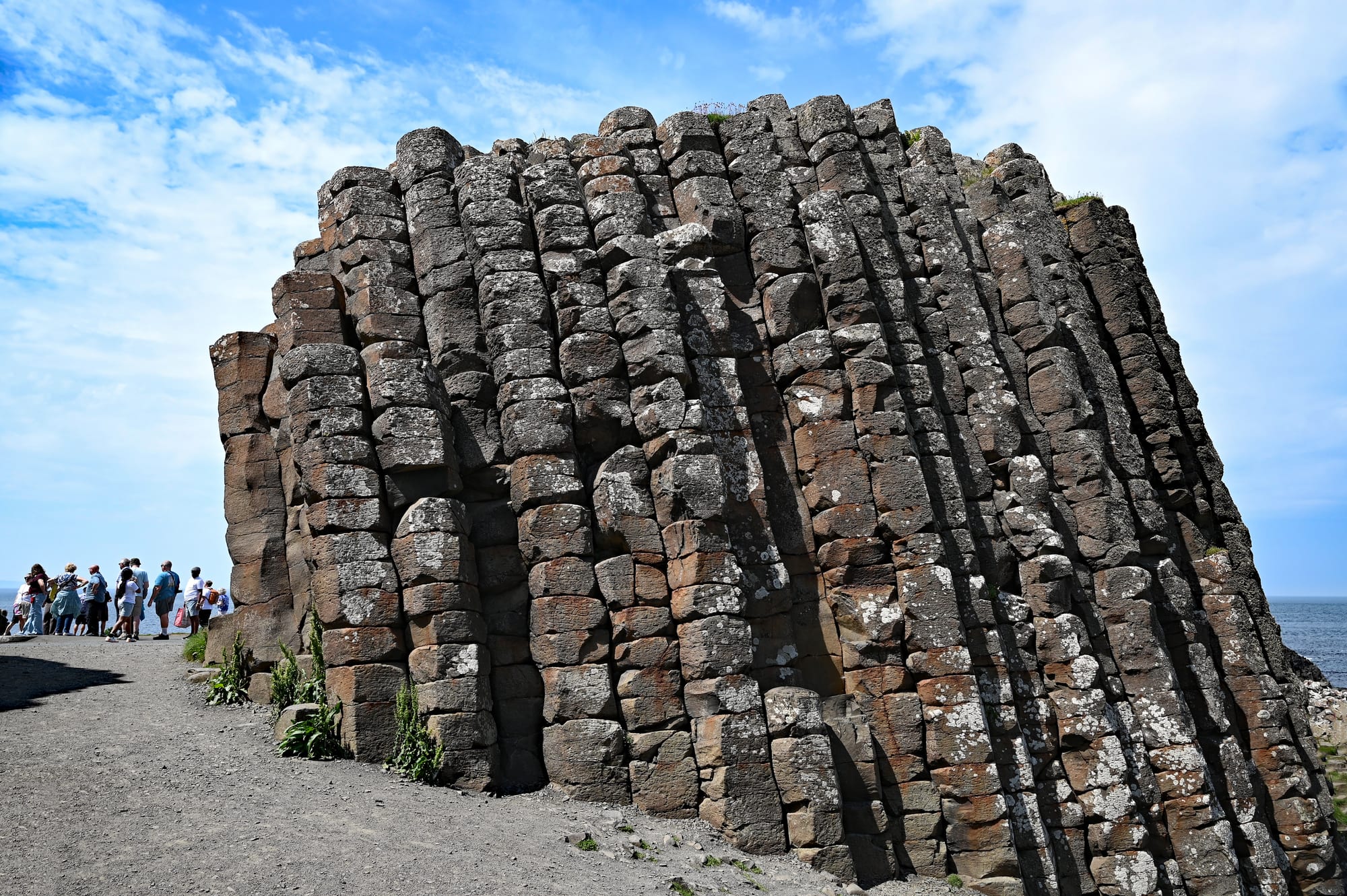
The columns also cracked across, into short segments known as biscuits. Often the bottom of one segment is rounded and the top of the one below is cupped to match, forming what geologists call a ball-and-socket joint.
Fast cooling, thin columns
The size of each column was set mainly by how fast the lava cooled. Very rapid cooling can produce columns only a few centimetres across; slow cooling produces big ones, up to about 3 metres wide. Physicists have found that the width of the columns and the speed of the cracking front are linked in a consistent way across all known examples, so the process can be copied on a kitchen table. A layer of cornstarch about a centimetre thick, left to dry, cracks into columns about a millimetre wide.
The same lava sheet shows up across the water. Fingal's Cave, on the uninhabited Scottish island of Staffa, is cut entirely from hexagonally jointed basalt in a Paleocene lava flow of the same family. There, cooling from the upper and lower surfaces of the flow started a blocky, four-sided pattern that became regular hexagons as the cracks grew towards the centre.
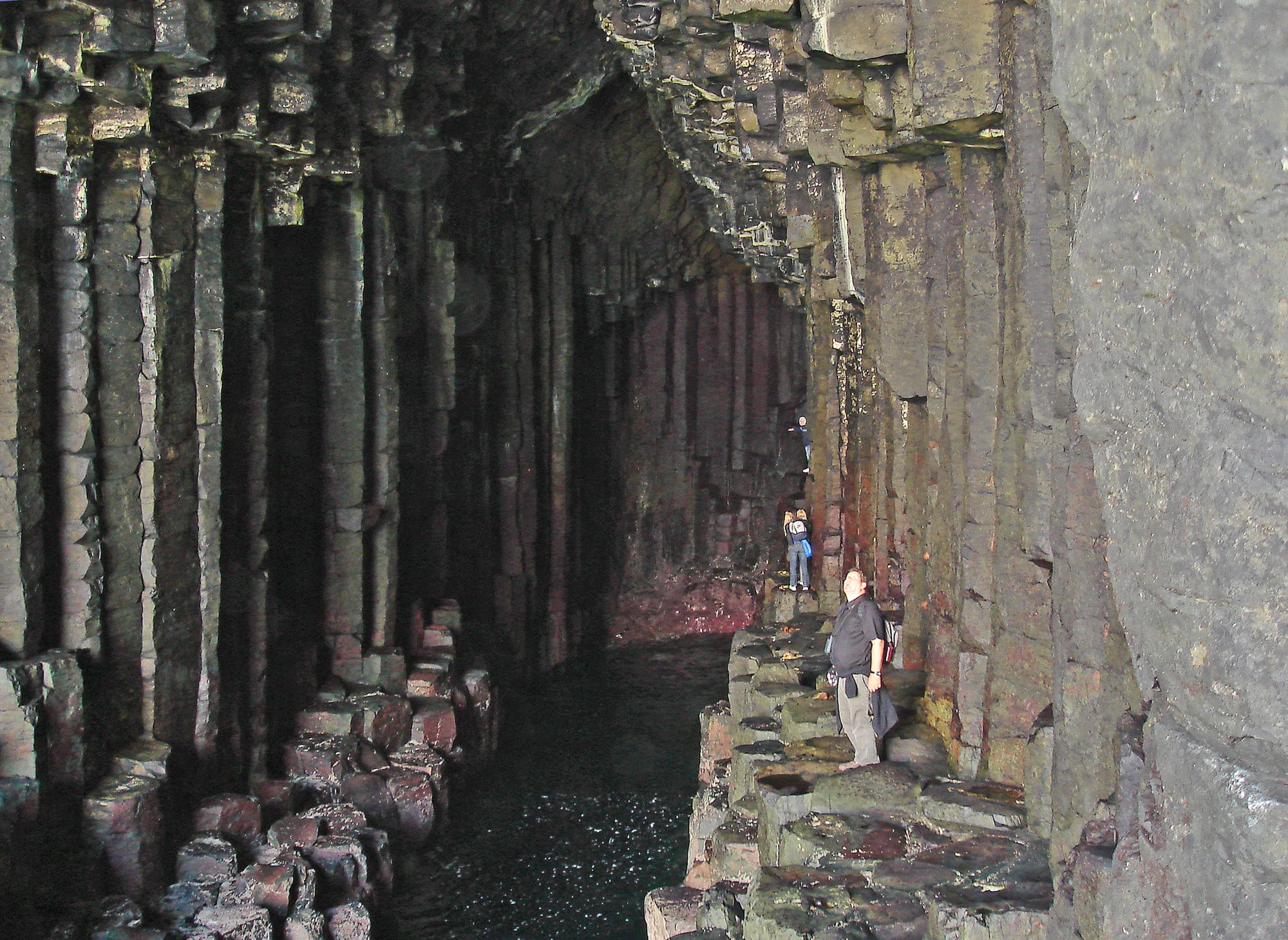
Staffa lies off the west coast of Scotland, and its columns are the far end of the story told about the Causeway.
A giant's road to Scotland
Long before anyone talked about cooling lava, the shapes needed an author. In the best-known legend, the Irish hero Fionn mac Cumhaill, or Finn McCool, was challenged by the Scottish giant Benandonner and built a causeway across the North Channel so they could fight. In one telling, Fionn realises his rival is far bigger and hides, and his wife Sadhbh disguises him as a baby in a cradle. Seeing the size of the baby, Benandonner imagines the father must be enormous and flees home, tearing up the causeway behind him. The matching columns of Staffa may well have inspired the tale.
In older Irish tradition, Fionn was a hero with supernatural powers rather than a giant. The site's Irish name, Clochán na bhFomhórach, means "stepping stones of the Fomhóraigh", a race of mythological beings sometimes described as giants, which hints that the site may once have been linked with them in stories that have not survived.
The rocks that taught volcanology
The Causeway also helped settle a scientific argument. William King, Bishop of Derry, visited in 1692, and the next year a paper on it was presented to the Royal Society. The Dublin artist Susanna Drury spent several months on the coast painting two precise views, which won her an award from the Dublin Society in 1740 and were engraved and widely circulated in scientific circles. An engraving of her work later appeared in a volume of plates for the French Encyclopédie, with a caption by the geologist Nicolas Desmarest proposing, for the first time in print, that such columns were volcanic in origin. Desmarest had compared the Causeway with the prism-shaped basalts of Auvergne, in France, which he recognised as old lava streams.
That role is why, in October 2022, the International Union of Geological Sciences named the Causeway's rocks among its first 100 geological heritage sites, citing their importance in working out the origin of basalt.
Seeing the columns today
The Causeway became a UNESCO World Heritage Site in 1986 and a national nature reserve in 1987, and much of it is cared for by the National Trust. It drew nearly a million visitors in 2019. The column tops form stepping stones that lead from the foot of the cliffs and disappear under the sea. Weathering has shaped some groups into named features, such as the Organ, the Giant's Boot, the Honeycomb, the Giant's Harp and the Chimney Stacks.
The cliffs are also home to seabirds including fulmars, cormorants, shags, guillemots and razorbills. A coastal walk of about 7 miles runs to the Causeway from Portrush, passing Dunluce Castle.