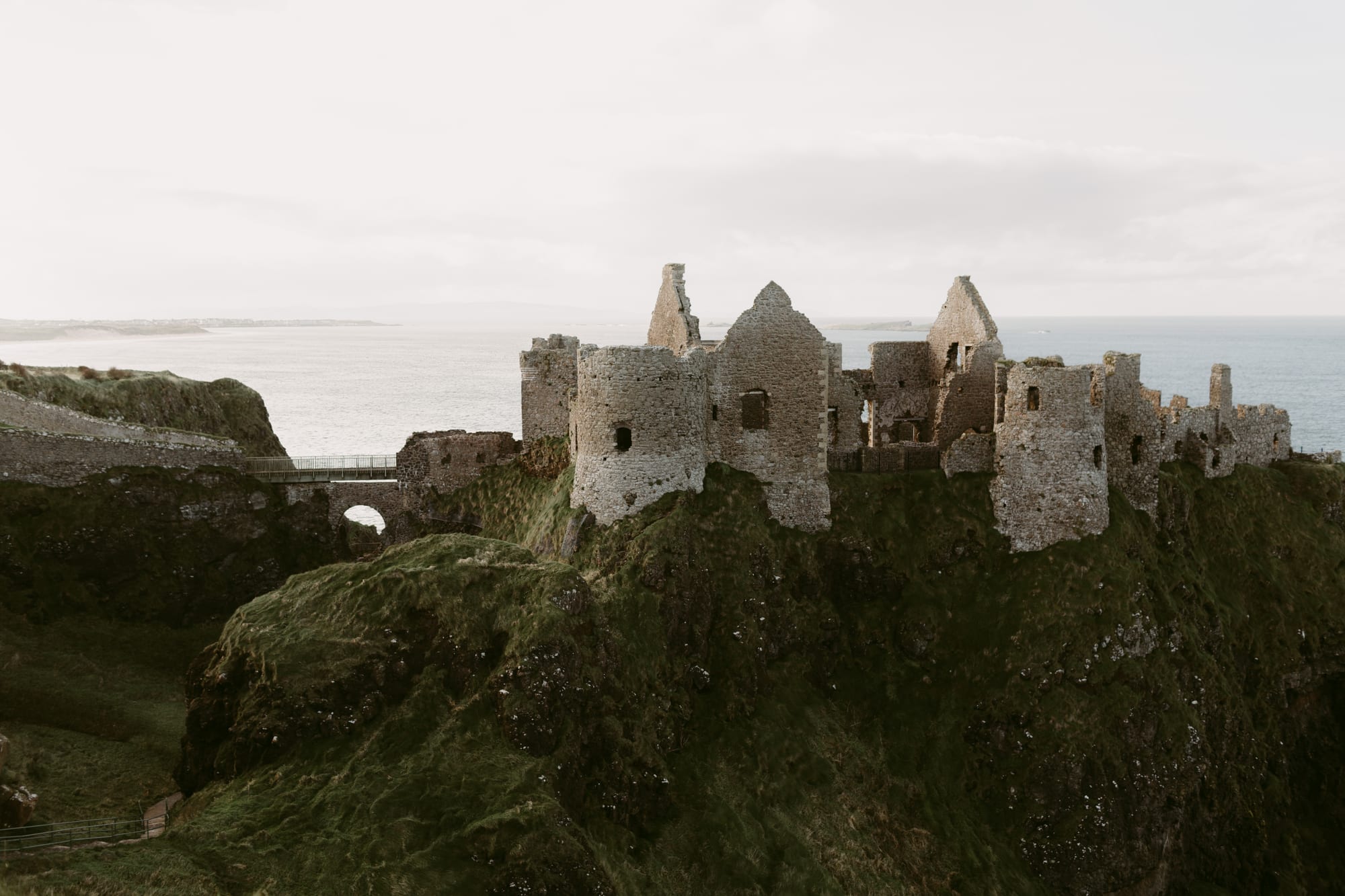
Ruined stone towers and gables of a castle on a grassy clifftop above a pale sea and distant coastline

United Kingdom

Northern Ireland

The ruins of Dunluce Castle on the Causeway Coast of County Antrim. (Iain Irwin / Wikimedia Commons · CC BY-SA 4.0)

The part of the UK on the island of Ireland, six counties of north-east Ulster around Lough Neagh, from Belfast and the Antrim coast to Derry-Londonderry, the Mournes and the Fermanagh lakes. Shaped by plantation, industry, partition and the Troubles, it has been at peace since 1998 and holds a coast of basalt cliffs and ruined castles.

Explore Northern Ireland

History

People lived at Mount Sandel near Coleraine around 9,000 years ago, among the earliest known settlers in Ireland. Navan Fort near Armagh was the ancient royal site of Ulster, the setting of the Ulster Cycle of heroic tales, and in the 5th century St Patrick made Armagh the centre of Irish Christianity; he is traditionally said to be buried at Downpatrick. The Normans built Carrickfergus Castle in the late 12th century, but Gaelic lords such as the O'Neills held most of Ulster until the Nine Years' War and the Flight of the Earls in 1607.

The Plantation of Ulster from 1609 settled English and Scottish Protestants on confiscated land, and London's livery companies walled Derry, renaming it Londonderry. The Catholic rising of 1641 and the Siege of Derry of 1688–89, when apprentice boys shut the gates against James II's army, became lasting symbols on each side.

In the 19th century Belfast grew into an industrial city of linen mills, ropeworks and the Harland and Wolff shipyard, which built the Titanic. When Ireland was partitioned in 1921 the six counties stayed in the UK with their own parliament, later housed at Stormont. The civil rights movement of 1968, the Battle of the Bogside and Bloody Sunday in Derry in 1972 opened the Troubles, about three decades of conflict that killed around 3,500 people, ended by the 1998 Good Friday Agreement. Power-sharing has collapsed several times since, but was restored in 2024 with Michelle O'Neill as the first nationalist First Minister.

Culture & Customs

Identity is the defining question. Unionists, mostly from a Protestant background, see themselves as British; nationalists, mostly from a Catholic background, as Irish; and a growing number call themselves Northern Irish. People can hold British or Irish passports, or both. Place names, sports and even the name of Derry-Londonderry can signal allegiance, so locals tend to tread carefully in conversation.

The calendar reflects both traditions. The Orange Order marches on the Twelfth of July to mark the Battle of the Boyne, with bonfires the night before, and the Apprentice Boys parade in Derry each August, while west Belfast's Féile an Phobail is one of Ireland's largest community festivals. Gaelic football and hurling are played mainly in nationalist areas, football and rugby more widely, and Ulster Rugby and the Ireland rugby team draw support from both.

Irish is taught and spoken in parts of the region, alongside Ulster Scots, and both now have official recognition. Traditional music sessions fill pubs, especially in Derry and on the north coast. The region has produced writers from C. S. Lewis to Seamus Heaney, and a humour that is quick, dry and self-mocking. Wall murals, loyalist and republican, remain a striking part of the streetscape.

Daily Life

About 1.9 million people live in Northern Ireland. Belfast has about 350,000, with a wider urban area of over half a million, and Derry about 85,000; other towns include Lisburn, Newry, Bangor, Craigavon, Ballymena, Omagh and Enniskillen. Rural areas and farming remain important, especially west of the Bann.

The public sector is a large employer, alongside agrifood, manufacturing, tourism, and a growing sector in cybersecurity, software and film, helped by Game of Thrones and studios in Belfast. Under post-Brexit arrangements, Northern Ireland follows some EU single-market rules for goods, a subject of continuing political argument.

Everyday life is largely peaceful, though many schools and housing estates remain divided along religious lines and peace walls still separate some Belfast neighbourhoods. Hospital waiting lists and pressure on public services are the most pressing current issues. Pubs, sport, church and family remain the centre of social life, and cross-border shopping and commuting are ordinary.

Food

The Ulster fry is the classic breakfast: bacon, sausages and eggs with soda farls and potato bread fried in the pan. Potatoes run through the cooking — champ is mashed potato with spring onions and butter, and boxty, a potato pancake, is eaten mainly in Fermanagh. Belfast's chip shops sell the pastie supper, a battered patty of minced meat and potato with chips.

Several local products have protected status, including Armagh Bramley apples, Lough Neagh eels and Comber early potatoes. Portavogie prawns come from County Down. At Ballycastle's Ould Lammas Fair, dulse, a dried seaweed, is eaten alongside yellowman, a crunchy honeycomb toffee.

Soda farls and potato bread are sold in bakeries and shops everywhere. Tayto crisps are made at Tandragee in County Armagh. Bushmills, on the Causeway Coast, traces its whiskey-making to a distilling licence of 1608, and craft breweries, distilleries and cider makers have multiplied in recent years.

Attractions & Natural Wonders

Belfast's sights include Titanic Belfast in the old shipyard, the City Hall, the Ulster Museum and Botanic Gardens, St George's Market, Crumlin Road Gaol, and the murals and peace walls of the Falls and Shankill roads, with Cave Hill above the city and the Ulster Folk Museum at Cultra.

The Causeway Coast runs from Portrush past Dunluce Castle and the Bushmills distillery to the Giant's Causeway, then on to the Carrick-a-Rede rope bridge, Ballycastle and ferries to Rathlin Island. Mussenden Temple at Downhill stands on a clifftop to the west, and the Glens of Antrim and Carrickfergus Castle lie along the coast road towards Belfast.

In Derry-Londonderry, the complete city walls, the Guildhall, the Peace Bridge, the Bogside murals and the Museum of Free Derry tell the city's story.

In County Down, the Mourne Mountains rise to Slieve Donard above Newcastle, with the Mourne Wall, Tollymore Forest Park and the Silent Valley reservoir; Strangford Lough and the gardens of Mount Stewart lie to the north. Armagh has its two cathedrals and Navan Fort.

In the west, the Fermanagh lakes of Upper and Lower Lough Erne surround Enniskillen, with the round tower of Devenish Island, the Marble Arch Caves, Castle Coole, Florence Court and Belleek Pottery nearby.

Cities in Northern Ireland

Planning basics

Budget

Northern Ireland is one of the cheaper parts of the UK and much cheaper than Dublin. Belfast hotels and restaurants are moderately priced except during big concerts and events, and rural B&Bs are good value. The Causeway Coast becomes pricier in summer and during major golf tournaments at Portrush, and the main paid sights, such as Titanic Belfast, are the biggest costs.

Daily Budget Midrange
USD 160–290 (mid-range hotel or B&B, restaurant dinners, paid attractions, a hire car for the coast)
Daily Budget Shoestring
USD 65–110 (hostels, pub food and cafés, Translink buses and trains)

Book Titanic Belfast and Carrick-a-Rede tickets online in advance, and use Translink day tickets for bus and train travel.

Safety

Crime rates are low, especially outside Belfast, and visitors are rarely affected by its politics. Tension can rise during the July marching season, around bonfires on the eleventh night and near interface areas, and a residual paramilitary threat mainly targets the police. Outdoors, the cliffs, rope bridge and north-coast currents demand care.

Avoid parades and bonfire sites in July, and treat murals and memorials respectfully. Check current official travel advice before travelling.

Climate

Mild, damp and changeable, with no great extremes. The north coast is breezy and exposed to Atlantic weather, the Mournes and Sperrins catch more rain and occasional winter snow, and the Lough Neagh basin is a little warmer in summer. Rain falls on most days of the year, though often as light showers.

Summer
mild, about 15–20°C, with long evenings and frequent showers
Winter
cool and damp, about 3–8°C, with frost inland and snow on the Mournes

Transportation

Belfast has two airports, and ferries connect Belfast and Larne with Scotland and England. The Enterprise train links Belfast with Dublin in around two hours, and the railway runs along the coast to Derry. Buses reach most towns, but the Causeway Coast, the Glens of Antrim, the Mournes and Fermanagh are far easier by car. There are no checks at the land border with the Republic, but speed limits there change from miles to kilometres.

Allow a full day for the Causeway Coast by car and start early to beat the tour coaches.

Best Time to Visit

May to September for the coast, walking and island trips, with puffins on Rathlin Island in early summer. July is marching season, when the Twelfth brings parades and many businesses close. August has Belfast's Féile an Phobail festival and Ballycastle's Ould Lammas Fair, and Derry's Halloween carnival is one of the largest street parties in Ireland.