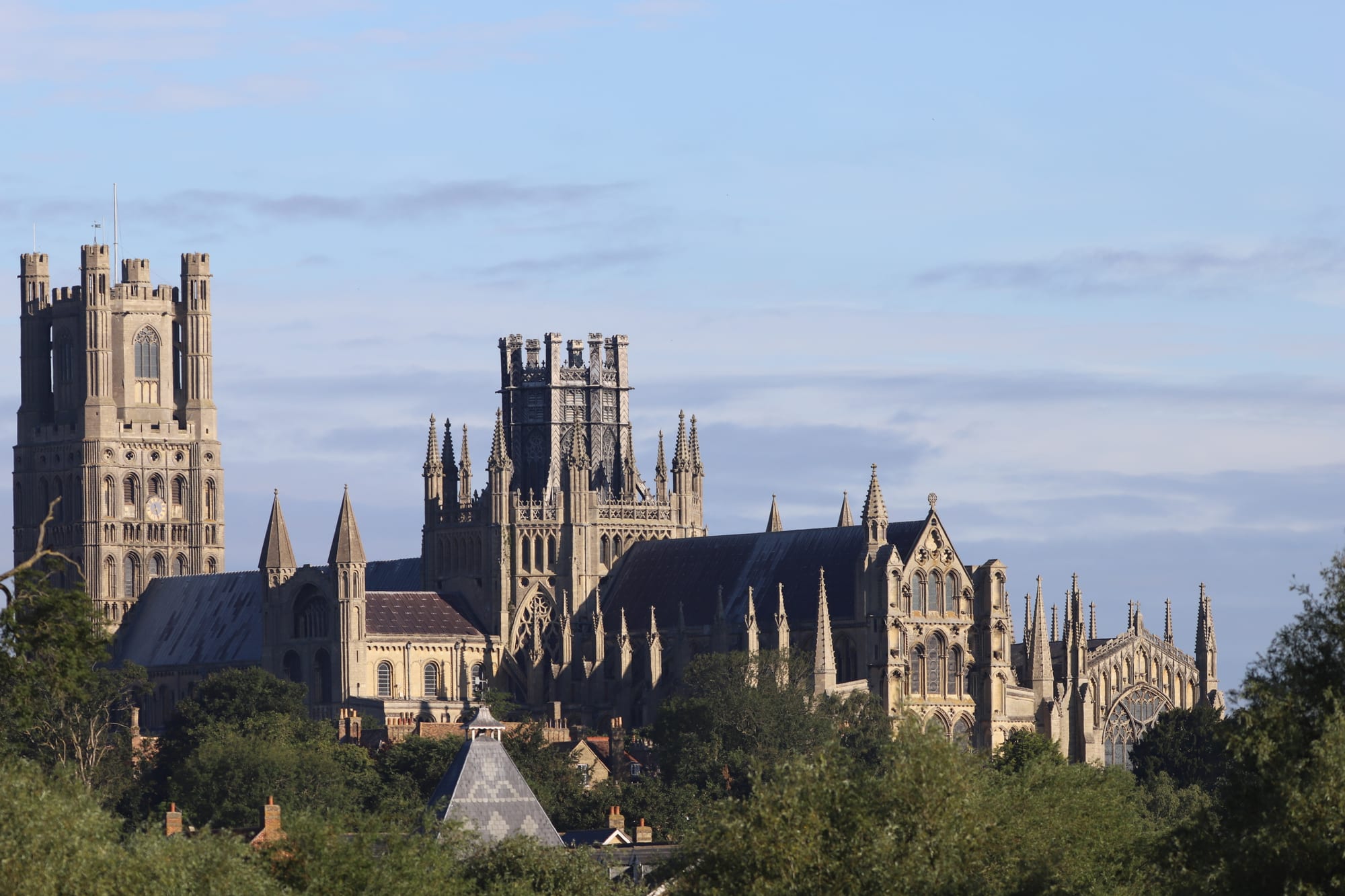
Ely Cathedral's square west tower and lantern-topped octagon rising above trees and rooftops under a pale blue sky

United Kingdom

East of England

Ely Cathedral seen from Middle Fen Bank, rising over the Cambridgeshire fens. (Verbcatcher / Wikimedia Commons · CC BY-SA 4.0)

The flat, big-skied bulge of England north-east of London, taking in Cambridgeshire, Norfolk, Suffolk, Essex, Hertfordshire and Bedfordshire — a land of drained fens, wool churches, waterways and a shingle coast, anchored by the university city of Cambridge and the medieval cathedral cities of Norwich and Ely.

Explore East of England

History

The East was one of Roman Britain's heartlands. Camulodunum, today's Colchester, was the capital of the Trinovantes and then the first Roman colony in Britain, until Boudica, queen of the Iceni of Norfolk, burned it around AD 60 during her revolt. Verulamium, beside modern St Albans, was a major Roman town, and the execution there of Alban made him Britain's first recorded Christian martyr.

After Rome, the Angles settled the area and gave it its name: the kingdom of East Anglia, whose royal ship burial at Sutton Hoo in Suffolk, uncovered in 1939, is one of the richest finds in English archaeology. Danish raiders killed its king Edmund in 869, and his shrine made Bury St Edmunds a great abbey town. After 1066 Hereward the Wake held out against the Normans from the island of Ely, and the Normans built the castles and cathedrals of Norwich and Ely.

In the Middle Ages wool and cloth made the region rich: Norwich was one of England's largest cities, and Suffolk towns such as Lavenham were built on the trade. Cambridge University grew from 1209. The region backed Parliament in the Civil War, and Oliver Cromwell, born in Huntingdon, lived in Ely. In the 17th century Dutch engineers drained the Fens into farmland. The Second World War filled East Anglia with airfields, many used by the US Army Air Forces, and in recent decades Cambridge has become a centre of science and technology.

Culture & Customs

The region has a quieter, rural identity than the North or London. Norfolk has its own dialect, and locals are proud of the idea of being apart from the rest of England. The flat landscape of big skies, windmills and church towers has drawn painters for centuries: John Constable painted Flatford Mill and Dedham Vale, and Thomas Gainsborough was born in Sudbury.

Music is strong on the Suffolk coast, where Benjamin Britten lived in Aldeburgh and founded the Aldeburgh Festival in 1948, now based at the Snape Maltings concert hall. Cambridge brings its college traditions — May Balls, gowns, chapel choirs, the Festival of Nine Lessons and Carols broadcast from King's College each Christmas Eve — alongside the Cambridge Folk Festival.

Horse racing is a local identity at Newmarket, the home of British flat racing, with its gallops, studs and sales. Colchester keeps an oyster feast each autumn, and Norwich's history of welcoming refugee Flemish weavers and Huguenots, known as the Strangers, is part of its self-image. Most towns are built around a market square, and the medieval churches in Norfolk and Suffolk — including many round-towered ones — are a point of local pride.

Daily Life

About 6.4 million people live in the East of England, the most in the south of Hertfordshire and Essex, whose commuter towns are tied to London. The largest places are Peterborough, Luton and Southend-on-Sea, with Norwich, Cambridge, Colchester, Ipswich, Chelmsford and Bedford among the other main towns and cities. St Albans, a small city of about 80,000 in its core, is a wealthy commuter centre.

The economy is split. Cambridge is a hub for technology and life sciences, Felixstowe is the UK's busiest container port, and Stansted and Luton are large airports. The Fens and the Norfolk plains are among England's most productive farmland, growing wheat, sugar beet and vegetables. The Suffolk coast has the Sizewell nuclear power stations, and ports such as Lowestoft and Great Yarmouth now serve offshore wind farms.

The daily contrast is sharp: packed commuter trains and high prices around Cambridge, where housing shortages are a constant issue, and quiet villages with few buses further north. Coastal erosion, which has swallowed Dunwich and threatens homes at Happisburgh, is a real local worry.

Food

The coast gives the region's best-known food. Cromer crab, small and sweet, is dressed and sold from the town's shops, samphire is picked on the Norfolk salt marshes in summer, and oysters come from Colchester and Mersea Island. Great Yarmouth gave its name to the bloater, a whole herring lightly smoked, and Aldeburgh's fish and chips have a strong reputation. Maldon on the Essex coast produces its flaky sea salt.

From the farmland come Norfolk turkeys, as well as asparagus and strawberries in early summer. Colman's Mustard was long made in Norwich, and Tiptree in Essex is known for its jams. The Bedfordshire clanger is a suet pastry roll with a savoury filling, to which modern recipes often add something sweet at one end, and Cambridge burnt cream is a local version of a baked custard with a caramelised top.

Barley from East Anglia goes into beer across Britain. Adnams brews in Southwold and Greene King in Bury St Edmunds, and Aspall makes cider in Suffolk; a growing number of vineyards in Essex produce English wine.

Attractions & Natural Wonders

Cambridge is the main draw: King's College Chapel, the lawns of the Backs, punting on the Cam, the Fitzwilliam Museum and the colleges of Trinity and St John's. Ely Cathedral, with its octagonal lantern, rises over the Fens a short train ride north, and Oliver Cromwell's house stands nearby. The Imperial War Museum at Duxford is close to Cambridge.

Norwich has its Norman cathedral and castle, the cobbled lanes of Elm Hill and a busy market. East of the city, the Norfolk Broads — rivers and shallow lakes with status equivalent to a national park — are explored by boat past windmills and reed beds, and the north Norfolk coast offers Cromer's pier, the seals near Blakeney, the wide beach at Holkham and the royal estate at Sandringham.

Along the Suffolk coast, Southwold has its lighthouse, pier and beach huts, and Aldeburgh its shingle beach, Scallop sculpture and the Snape Maltings, with the Minsmere bird reserve and the Sutton Hoo burial site not far off. Inland are Lavenham's timber houses, Bury St Edmunds and Constable's Flatford Mill.

In Essex, Colchester has its Roman walls and Norman castle, and in Hertfordshire, St Albans has its cathedral and the Roman remains of Verulamium. Nearby are Hatfield House, the Harry Potter studio tour at Leavesden and, in Bedfordshire, Woburn Abbey.

Cities in East of England

Planning basics

Budget

Costs sit around the national average. Cambridge is the expensive exception, with hotel prices close to London's, and the Norfolk and Suffolk coast fills up and charges accordingly in summer. Norwich, Colchester, Peterborough and the market towns are better value, and Broads boat hire is shared cost for groups.

Daily Budget Midrange
USD 170–320 (B&B or mid-range hotel, restaurant meals, college and museum entry, a day's boat hire)
Daily Budget Shoestring
USD 75–110 (hostel or budget room, market and pub food, trains and buses)

Visit Cambridge as a day trip or stay midweek, and book Broads cruisers well ahead for the summer holidays.

Safety

The region is safe for visitors. Cambridge and Norwich have the usual bike theft and petty crime, and nightlife in some larger towns gets rowdy at weekends. On the coast the hazards are strong currents off shingle beaches, fast tides and soft mud on the salt marshes, and crumbling cliffs at places such as Happisburgh and Dunwich.

Lock bicycles securely, and check tide times before walking on the Norfolk and Essex salt marshes. Check current official travel advice before travelling.

Climate

One of the driest parts of the UK, with relatively little rain each year. Summers are usually warm, but the North Sea brings cold easterly winds in winter and spring, and the Norfolk and Suffolk coast can be chilly and misty even when inland is warm.

Summer
warm and fairly dry, 20–25°C inland, cooler on the coast
Winter
cold and raw, 1–7°C, with biting easterly winds and occasional snow

Transportation

Fast trains run from London King's Cross and Liverpool Street to Cambridge and Norwich, with lines to Colchester, Ipswich and Ely. Stansted and Luton airports are within the region. Beyond the main lines, rural Norfolk and Suffolk have limited buses and a car or bicycle helps; the flat land suits cycling. The Broads are best seen from a hired cruiser or day boat.

Cambridge is best explored on foot or by bike; leave any car at a park-and-ride outside the centre.

Best Time to Visit

May to September for the Broads, the coast and punting in Cambridge; June brings the Aldeburgh Festival and the end of the university year. Spring and autumn are good for birdwatching on the Norfolk and Suffolk coast, when migrants pass through. Winter is quiet and bleak on the coast, but Cambridge and Norwich suit a city break, and King's College's Christmas Eve service is famous.