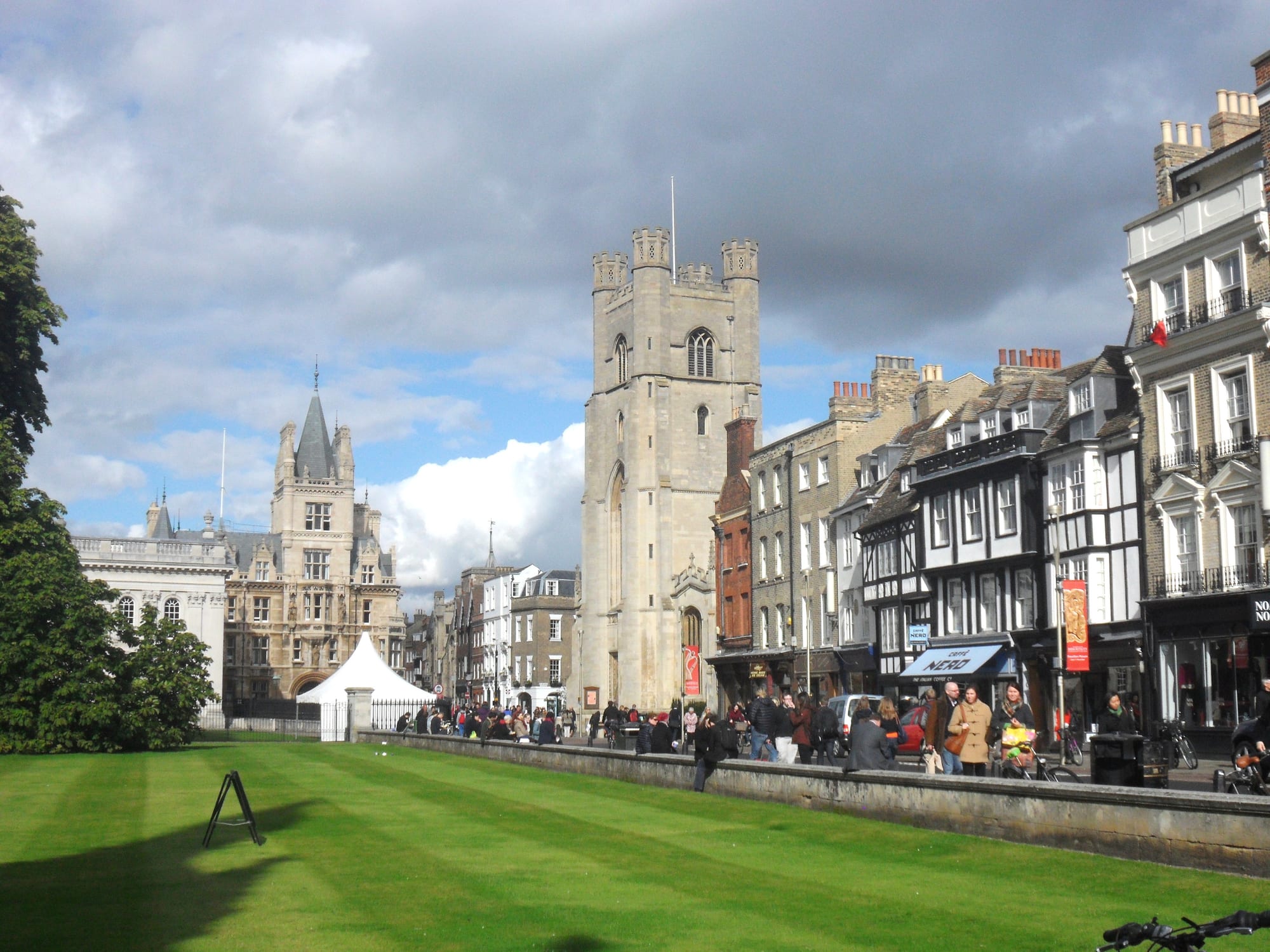
King's Parade in Cambridge, with the square stone tower of Great St Mary's, college buildings and shopfronts beside a striped lawn

East of England, United Kingdom

Cambridge

King's Parade in central Cambridge, with the tower of Great St Mary's Church. (Ben Keating / Wikimedia Commons · CC BY-SA 2.0)

A university city on the River Cam in Cambridgeshire, a town of Roman and Viking roots where the University of Cambridge was founded in 1209. Its colleges, chapels and riverside lawns draw visitors from around the world, while the science parks and biomedical campus of 'Silicon Fen' have made it one of Britain's leading centres of research and technology.

Neighbourhoods

  • The city centre and the colleges
    • First-time visitors
    • Historic district
    • Museums

    The compact core between the river and the green spaces of Parker's Piece and Midsummer Common, where the older colleges, King's Parade, the market square and the main museums stand close together. The Backs, where several colleges reach down to the Cam, lie along its western edge.

    Open in Maps
  • Chesterton
    • Quiet and residential
    • Riverside

    The district north of the river, once a separate parish that held the castle and joined the borough in 1912. Today it is mostly residential.

    Open in Maps
  • Newnham
    • Quiet and residential
    • Walks

    A residential district where evidence of a Roman village and farmsteads has been found, now covered in part by the city's air quality management area.

    Open in Maps
  • Romsey Town and Mill Road
    • Local life
    • Close to the station

    Streets that grew up on the eastern side of the city after the railway arrived in 1845, crossed by Mill Road, which runs south-east from near Parker's Piece over the main line towards the ring road.

    Open in Maps
  • Trumpington
    • Close to public transport
    • Families

    A former village brought into the borough in 1934, where new estates such as Trumpington Meadows have been built in the south of the city, with a park-and-ride at the end of a guided busway route.

    Open in Maps

Things to do

Colleges and landmarks

  • King's College Chapellandmark

    Built in phases by a succession of kings from 1446 to 1515, one of the finest examples of Perpendicular Gothic, with the world's largest fan vault.

    Open in Maps
  • Trinity Collegelandmark

    The college where Cambridge burnt cream, or Trinity cream, was introduced in 1879.

    Open in Maps
  • St John's Collegelandmark

    One of the university's older colleges, near Trinity in the centre of the city.

    Open in Maps
  • The Backsviewpoint

    The lawns and gardens where several colleges back on to the Cam, with grounds on both banks — the classic view of King's College Chapel.

    Open in Maps
  • Great St Mary'slandmark

    The parish and university church at the north end of King's Parade, a Late Perpendicular building constructed between 1478 and 1519, with its tower finished in 1608.

    Open in Maps
  • The Round Churchlandmark

    The Church of the Holy Sepulchre, generally known as the Round Church, a Grade I listed building on the corner of Round Church Street and Bridge Street.

    Open in Maps

Museums

  • Fitzwilliam Museummuseum

    The city's largest museum, founded in 1816 from the bequest of Viscount FitzWilliam, with antiquities, applied arts, coins, manuscripts and paintings; admission is always free.

    Open in Maps
  • Kettle's Yardmuseum

    An art gallery and house; both reopened in February 2018 after an expansion of the facilities.

    Open in Maps
  • Museum of Archaeology and Anthropologymuseum

    The university's collections of local antiquities and archaeological and ethnographic objects from around the world.

    Open in Maps
  • Sedgwick Museum of Earth Sciencesmuseum

    The university's geology museum on Downing Street, with fossils, minerals and rocks collected by Charles Darwin on the voyage of the Beagle.

    Open in Maps
  • Museum of Cambridgemuseum

    A social history museum of the city and county, in a former pub on Castle Street.

    Open in Maps

Parks, gardens and the river

  • Cambridge University Botanic Gardenpark

    A botanic garden open to the public since 1846, holding over 8,000 plant species, south of the centre on Trumpington Road.

    Open in Maps
  • Punting on the Camattraction

    Flat-bottomed punts, pushed along with a pole against the river bed, can be hired or taken with a guide along the Backs and upstream.

    Open in Maps
  • Midsummer Commonpark

    Open common land by the river, where cattle graze close to the centre and the city's fairs and festivals are held.

    Open in Maps

Markets

  • Market Hillmarket

    The market square in the centre, a marketplace since Saxon times, where a daily outdoor market still runs.

    Open in Maps

Stage and nights out

  • Cambridge Arts Theatreattraction

    The city's main traditional theatre, with 666 seats, in the centre.

    Open in Maps
  • ADC Theatreattraction

    The university-run theatre with two shows a night in term, where the Footlights, the student comedy troupe whose members came to dominate British comedy in the 1970s, stage shows.

    Open in Maps
  • Cambridge Corn Exchangeattraction

    The largest regular stage in the city, in a 19th-century former corn exchange, holding up to 1,800 standing.

    Open in Maps

Short trips from the city

  • Grantchesterneighborhood

    A village on the Cam about two miles upstream, reached on foot along the river or by punt, with thatched cottages and pubs.

    Open in Maps
  • Imperial War Museum Duxfordmuseum

    Britain's largest aviation museum, near Duxford in Cambridgeshire, with nearly 200 aircraft.

    Open in Maps
  • Anglesey Abbeylandmark

    A National Trust country house built on the remains of a priory, with 98 acres of gardens, 5.5 miles north-east of Cambridge.

    Open in Maps
  • Ely Cathedrallandmark

    The great cathedral of the Fens in the small city of Ely, a short train ride to the north.

    Open in Maps
  • Wicken Fenpark

    A fenland Site of Special Scientific Interest and National Nature Reserve west of the village of Wicken.

    Open in Maps

Seasonal events

  • Cambridge Beer Festivallate May

    The longest-running CAMRA beer festival in the UK, started in 1974 and held on Jesus Green.

  • Strawberry Fairfirst Saturday in June

    A free, volunteer-run festival of music, arts and crafts on Midsummer Common, held most years since 1974.

  • Midsummer Fairaround midsummer

    A fair on Midsummer Common whose charter was granted by King John in 1211.

  • Cambridge Folk Festivalsummer

    A long weekend of folk and roots music in the grounds of Cherry Hinton Hall, held since 1965.

  • A Festival of Nine Lessons and CarolsChristmas Eve

    The carol service sung in King's College Chapel and broadcast each Christmas Eve.

Eat and drink

Long-standing places and food districts in Cambridge. Hours, ratings and directions come from your maps app, always current.

Cambridge classics

  • Fitzbilliescafe

    A bakery-café founded in 1920 on Trumpington Street, near the Fitzwilliam Museum, known for its Chelsea buns.

    Open in Maps
  • The Eaglerestaurant

    A listed pub that opened in 1667, where Francis Crick announced to lunchtime drinkers in 1953 that he and James Watson had found the structure of DNA.

    Open in Maps

Markets and outings

  • Market Hillmarket

    The daily outdoor market in the main square, a trading place since Saxon times.

    Open in Maps
  • The Orchard Tea Gardencafe

    A tea garden in Grantchester, at the end of the riverside walk or punt from the city.

    Open in Maps

Experience Cambridge

History

People were farming here some 3,500 years ago, and an Iron Age settlement stood on Castle Hill from the 1st century BC. The Romans built a small fort, Duroliponte, on the same hill. The Anglo-Saxons called their settlement Grantebrycge, "Granta bridge"; Vikings arrived in 875 and held the town under the Danelaw, and the centre moved from Castle Hill to the Quayside across the river. After the Viking period the Saxons built churches such as St Bene't's, wharves and a mint, and in 1068 William the Conqueror raised a castle on Castle Hill, whose motte survives.

Henry I granted the first town charter between 1120 and 1131. In 1209 scholars fleeing hostility in Oxford founded the university; after the townspeople joined the Peasants' Revolt, a new charter of 1382 handed control of baking, brewing, and weights and measures to the university. In the Civil War Cambridge was headquarters of the Eastern Counties Association, mainstay of the Parliamentarian war effort, and its castle was refortified.

The railway arrived in 1845, after initial resistance, and the town spread into new districts such as Romsey Town; the borough later took in Chesterton, Cherry Hinton and Trumpington. Cambridge escaped relatively lightly from wartime bombing and was made a city in 1951, despite having no cathedral. In the following decades science parks and start-ups grew from the university, creating "Silicon Fen", and the Cambridge Biomedical Campus became one of the largest research clusters of its kind.

Culture & Customs

The university shapes the city's culture. Its museums range from the Fitzwilliam to the Sedgwick and the Polar Museum, and the college chapels keep a choral tradition known worldwide through the Festival of Nine Lessons and Carols, sung in King's College Chapel each Christmas Eve. Student life brings May Balls, rowing races and the ADC Theatre, where the Footlights comedy troupe stages shows; its members came to dominate British comedy in the 1970s. Science is part of the city's story too: Rutherford's pioneering work in nuclear physics was done here, and in 1953 Francis Crick announced the structure of DNA in the Eagle pub.

Beyond the colleges, the commons and greens host the city's festivals: Strawberry Fair on Midsummer Common on the first Saturday in June, the Midsummer Fair, whose charter dates from 1211, the Cambridge Beer Festival on Jesus Green, the longest-running CAMRA beer festival in the UK, and the Cambridge Folk Festival, held at Cherry Hinton Hall since 1965. The Arts Theatre and the Corn Exchange are the main stages.

Punting — propelling a flat-bottomed boat by pushing a pole against the river bed — is the city's signature pastime, and in summer the river is busy with punts. Cycling is a way of life, and cattle grazing on the commons a few hundred metres from the market square are part of the scene.

Daily Life

At the 2021 census about 145,700 people lived in the City of Cambridge and about 181,000 in the wider built-up area. Students and university staff form a large part of the population in term time, and the city's growth has brought new estates such as Great Kneighton and Trumpington Meadows in the south and developments near the station.

The economy is built on knowledge: research and development, software, high-value engineering, pharmaceuticals and the creative industries, alongside tourism. The Cambridge Biomedical Campus holds AstraZeneca's headquarters and the relocated Royal Papworth Hospital, and technology companies such as Arm and Abcam are based in and around the city. That success has a cost: Centre for Cities named Cambridge the UK's most unequal city in 2017 and 2018.

Daily life moves by bicycle along streets shared with buses and pedestrians, and much of the centre is covered by an air quality management area because of traffic pollution. Residents live in districts such as Chesterton, Romsey, Newnham, Cherry Hinton and Trumpington, while the centre keeps large green spaces such as Jesus Green, Parker's Piece and Midsummer Common.

Food

The city's most famous dish began in a college. Crème brûlée, a rich custard topped with a layer of hardened caramelised sugar, is also known as burnt cream, Cambridge burnt cream or Trinity cream: it was introduced at Trinity College in 1879, with the college arms branded on top of the cream with a hot iron.

Fitzbillies, founded as an independent bakery on Trumpington Street in 1920 and named for its location near the Fitzwilliam Museum, is known for its Chelsea buns; it survived bankruptcies in 1980 and 2011, reopening after a public appeal by the broadcaster Stephen Fry. The market on Market Hill, a trading place since Saxon times, still runs daily stalls in the centre of the city.

Pubs are part of the city's history as much as its eating. The Eagle opened in 1667 as a coaching inn and is remembered for the lunchtime in 1953 when Crick announced the structure of DNA. A walk or punt upriver ends at Grantchester's Orchard Tea Garden, and each spring the Cambridge Beer Festival fills Jesus Green with drinkers.

Planning tools

Budget

Cambridge is one of the more expensive places to stay in the East of England. Many sights are free, among them the Fitzwilliam Museum and the riverside commons; college entry, punting and a night's room are the main costs.

Daily Budget Midrange
USD 190–340 (B&B or mid-range hotel, restaurant meals, college entry and a punt, local transport)
Daily Budget Shoestring
USD 80–120 (hostel or budget room outside the centre, market food and pubs, bike hire and buses)

Stay midweek or visit as a day trip from London for lower prices, and use a park-and-ride rather than driving into the centre.

Best Time to Visit

May to September for punting, the riverside commons and the summer festivals. Christmas brings the King's College carol service. Winters are cold and raw but quieter.

Suggested Number of Days

Two days cover the colleges, the museums and the river. Three or four allow time for the villages, fens, country houses and cathedral city within easy reach by train, bus or bicycle.

First Visit
2 days
With Surroundings
3–4 days

Transportation

The city is flat and has the highest level of cycling in the UK; in 2001 a quarter of residents cycled to work. Buses are frequent except on Sundays and holidays, five park-and-ride sites ring the city, and the Cambridgeshire Guided Busway, opened in 2011, brings buses in from St Ives and Huntingdon and on to the station and the hospital.

Leave a car at a park-and-ride, and lock any bicycle securely.

Airport & Station Connections

Cambridge station, opened in 1845, has direct trains to London King's Cross, Liverpool Street and St Pancras; fast trains to King's Cross take 53 minutes. Cambridge North opened in 2017 and Cambridge South in 2026. London Stansted Airport is about 30 miles south, by the M11 or direct train.

Walkability

The centre is compact and flat, and the colleges, museums, market and river are all within walking distance. Riverside paths lead out across the commons and up to Grantchester.

Safety

The UK is generally safe, with the main risks being pickpocketing and phone theft in crowded parts of London and other cities, occasional late-night antisocial behaviour, and drink-related trouble around nightlife. In Cambridge bicycle theft is an ongoing problem.

Lock bicycles to fixed stands with a good lock, and watch for cyclists when crossing streets. Check current official travel advice before travelling.

Climate

Cambridge lies in the driest region of Britain, with rainfall around half the national average. Air frosts come on around 43 to 48 days a year.

Summer
warm and sometimes hot — the warmest day of the year averages 31.5°C, and the city recorded 39.9°C on 19 July 2022
Winter
cold, with frost; the coldest night of the year typically falls to about −8°C

Local Customs

The colleges are working communities of students and staff, and arrangements for visitors vary from college to college. The university keeps traditions such as chapel choirs, rowing races and May Balls. Cattle graze the commons close to the centre.

Check each college's visiting arrangements before going, and keep quiet in chapels during services.

Common Payment Methods

The currency is the pound sterling. Shops widely accept debit and credit cards, including foreign ones, and some no longer take cash at all. Scottish and Northern Irish banks issue their own banknotes, with their own designs.