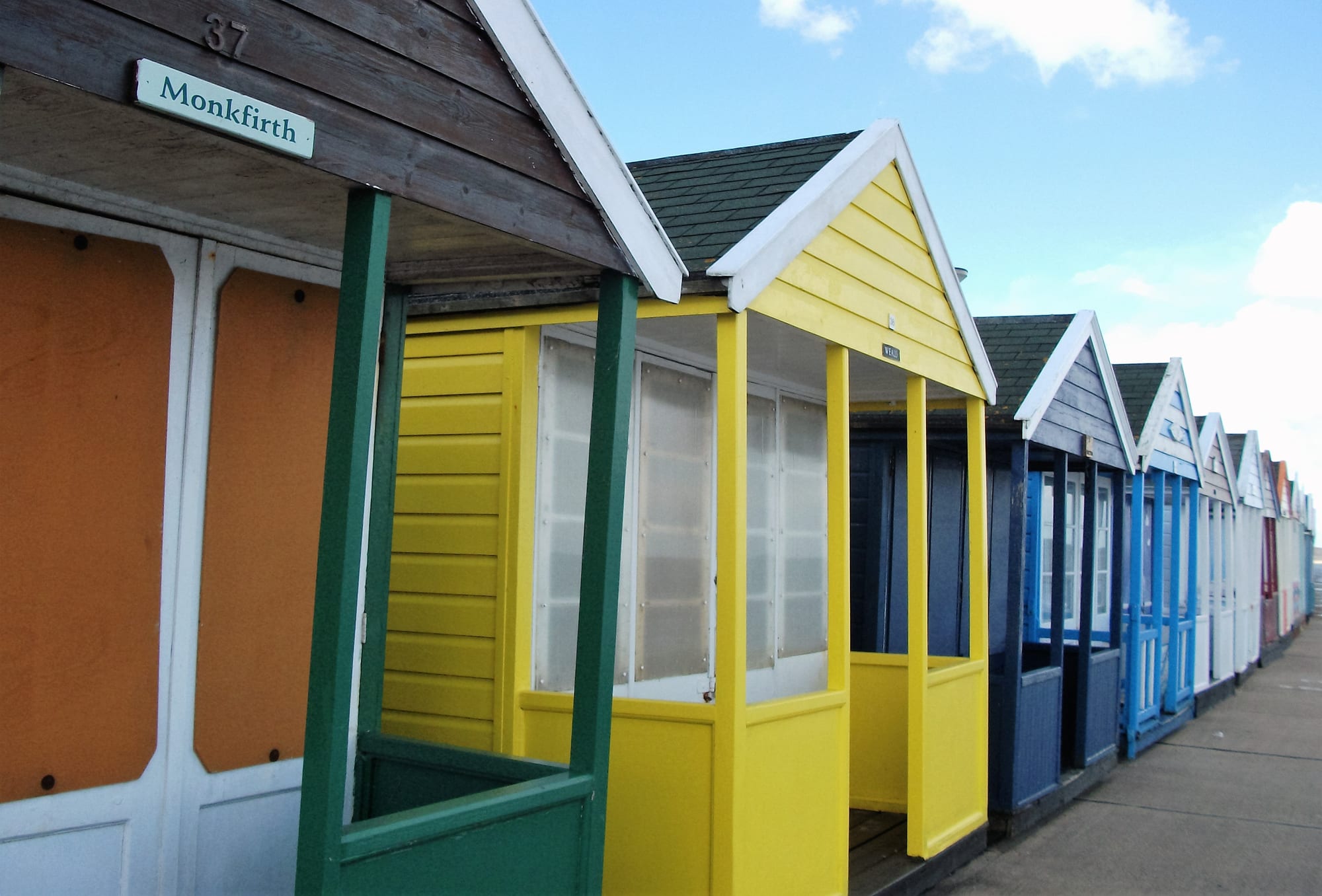
A row of wooden beach huts painted orange, yellow, blue and white along a seafront path under a blue sky

East of England, United Kingdom

Southwold

Painted beach huts along the seafront at Southwold. (michael ely / Wikimedia Commons · CC BY-SA 2.0)

A small Suffolk seaside town at the mouth of the River Blyth, granted its charter in 1489 and rebuilt around open greens after a fire in 1659. A white lighthouse stands among its houses, the Adnams brewery in its centre, and painted beach huts line the shore beside a rebuilt pier, with a fishing harbour on the river to the south.

Neighbourhoods

  • Town centre and the greens
    • First-time visitors
    • Historic district
    • Shops and pubs

    The High Street and Market Place, with independent shops, cafés and pubs, open out onto the greens left after the fire of 1659. St Edmund's Church, the museum, the brewery and the lighthouse all stand within a few minutes' walk of one another.

    Open in Maps
  • The seafront and Gun Hill
    • Beaches
    • Families

    A sand-and-shingle beach overlooked by rows of brightly painted beach huts, with the pier at the northern end and Gun Hill, where six old cannon face the sea, to the south. The Sailors' Reading Room stands on the front.

    Open in Maps
  • Southwold Harbour and Blackshore
    • Boats and fishing
    • Walks

    South of the town on the River Blyth, a working harbour of fishing boats, yachts and small pleasure boats stretching nearly a mile upstream. The quay at Blackshore has the sailing club, and the lifeboat station and Alfred Corry museum stand near the river mouth.

    Open in Maps
  • Walberswick
    • Quiet and residential
    • Walks
    • Village pubs

    A village about a mile away across the Blyth, reached on foot by the footbridge upstream or by the rowing-boat ferry near the river mouth. It was once a busy trading port and is now a quiet place of marshes, beach and village greens.

    Open in Maps

Things to do

Landmarks of the town

  • Southwold Lighthouselandmark

    A white brick lighthouse of 1890, 31 metres tall with 113 steps, standing among the houses in the centre of town; tours are run with the neighbouring Adnams brewery.

    Open in Maps
  • Southwold Pierattraction

    A pier first built in 1900 as a landing stage for steamships, cut back by storms in 1955 and 1979 and rebuilt in 2001, known for Tim Hunkin's homemade coin-operated novelty machines.

    Open in Maps
  • St Edmund's Churchlandmark

    A Grade I listed 15th-century church under one continuous roof, built over about sixty years and counted among the finest in Suffolk.

    Open in Maps
  • Gun Hillviewpoint

    A green above the beach where six 18-pounder cannon commemorate the Battle of Sole Bay, fought offshore in 1672 between the English and French and the Dutch.

    Open in Maps
  • Adnams brewery and distilleryattraction

    The brewery founded in the town in 1872, still its largest single employer, with tours of the brewery and the distillery.

    Open in Maps

Museums

  • Southwold Museummuseum

    A small museum of the town's local and natural history, with mementos of the Battle of Sole Bay.

    Open in Maps
  • Sailors' Reading Roommuseum

    A Grade II listed seafront room built in 1864 for fishermen and mariners, with model boats and other maritime objects in glass cases.

    Open in Maps
  • Alfred Corry Museummuseum

    A former lifeboat shed by the harbour mouth housing the Alfred Corry, Southwold's lifeboat from 1893 to 1918, restored by volunteers.

    Open in Maps

The river and the coast

  • Walberswick ferry and footbridgetrail

    A rowed ferry, run by the same family since the 1920s, crosses the mouth of the Blyth to Walberswick; upstream, a footbridge on the piers of the old railway swing bridge does the same.

    Open in Maps
  • Dunwichattraction

    A village about nine miles south, the remnant of a medieval port largely lost to the sea, with the heath and beach of Dunwich Heath beside it.

    Open in Maps
  • Benacre National Nature Reservepark

    Nearly 400 hectares of open-water lagoons and reed beds on the coast north of the town.

    Open in Maps

Seasonal events

  • Latitude Festivalmid-July

    A music and arts festival held each year since 2006 in the grounds of Henham Park, near the town.

  • Southwold Arts Festivalsummer

    An eight-day mix of literature, music, film and art exhibitions held since 2014.

  • Summer theatreJuly to September

    A season of plays by Suffolk Summer Theatres at the Southwold Arts Centre, continuing the town's long tradition of summer repertory.

  • Ways with WordsNovember

    A literature festival with talks by well-known speakers at venues around the town.

  • Model yacht regattasspring and summer, the largest at the end of the season

    Races on the boating pond beside the pier, held since the late Victorian period, some with boats up to 80 years old.

Eat and drink

Long-standing places and food districts in Southwold. Hours, ratings and directions come from your maps app, always current.

Southwold classics

  • Adnams pubsneighborhood

    Many of the town's pubs are run by the brewery and pour its cask ales, brewed a few streets away.

    Open in Maps
  • The Lord Nelsonrestaurant

    A pub on East Street in the town, one of its places to eat.

    Open in Maps
  • Fish and chips at the harbourneighborhood

    Fish and chips are sold on the harbour shore, where the town's remaining fishing boats tie up.

    Open in Maps

Markets and shops

  • Southwold marketmarket

    A market held on Mondays and Thursdays in the town centre.

    Open in Maps
  • High Street cafés and delisneighborhood

    Independent cafés, bakeries and delicatessens along the High Street and around Market Place, alongside the brewery's own shop.

    Open in Maps

Experience Southwold

History

Southwold appears in the Domesday Book of 1086 as a fishing port, long a small neighbour of the larger village of Reydon. Its fortunes changed when the River Blyth withdrew from Dunwich in 1328, bringing trade to the town, and in 1489 Henry VII granted it a charter. A shingle bar later built up across the harbour mouth and stopped it from becoming a major port. In the 1630s a group of Puritans left Southwold for the Massachusetts Bay Colony, and the 15th-century rebuilding of St Edmund's Church shows how wealthy the town had become.

In 1659 a fire destroyed most of the town. Some of the burnt ground was never built on again, and those spaces survive as the greens that give the centre its open feel; the marshes around the town have limited its growth ever since. In 1672 the Battle of Sole Bay was fought offshore between the English and French fleets and the Dutch under Michiel de Ruyter, and bodies washed up on the beach. The cannon on Gun Hill were given to the town by the Duke of Cumberland, who landed here in 1745.

The Victorian resort followed. A narrow-gauge railway to Halesworth opened in 1879, Adnams bought the local brewery in 1872, the lighthouse was lit in 1890 and the pier built in 1900. The railway closed in 1929. On 15 May 1943 German fighter-bombers attacked the town and killed eleven people. Storms in 1955 and 1979 left only a short stub of the pier; it was rebuilt in 2001. The town lost its borough status in 1974 but kept its own Town Council and Mayor.

Culture & Customs

The town's best-known literary resident was George Orwell, who lived at his parents' homes here at intervals between 1921 and 1939, wrote reviews, worked on Burmese Days and wrote A Clergyman's Daughter, partly set in a fictional East Anglian town. Penelope Fitzgerald drew on her time working in a Southwold bookshop in the 1950s for The Bookshop, W. G. Sebald described the town in The Rings of Saturn, and it has served as a setting for many films and television programmes.

Southwold has long hosted summer repertory theatre, now staged from July to September at the Southwold Arts Centre. The Ways with Words literature festival comes every November, and an arts festival of literature, music, film and art has run each summer since 2014. Latitude, a large music and arts festival in nearby Henham Park, has drawn crowds every July since 2006.

Older customs survive. The annual Trinity Fair opens with the reading of the town charter. Model yacht regattas, some with boats up to 80 years old, have been sailed on the pond by the pier since the late Victorian period. The pier is known for Tim Hunkin's homemade coin-operated machines, and the Electric Picture Palace, opened in 2002, recreates a cinema of 1912. The town's tidy appearance, preserved by its greens and the surrounding marshes, has been described as a series of very delightful village greens.

Daily Life

About 950 people lived in the town at the 2021 census. Neighbouring Reydon has more than twice as many, and the ward that joins the two with Walberswick had a little over 3,800.

The town once had several industries, but its economy now rests on services: hotels, holiday lets, catering and tourism. Adnams remains the largest single employer, with a modern brewery in the town and a distribution centre in Reydon, and the harbour is still one of the main fishing ports on the Suffolk coast, though its fleet is much smaller than it was. Southwold is also the shopping centre for the surrounding farmland, with a market on Mondays and Thursdays. In recent years retail chains and charity shops have taken over some units that were once independent.

Children attend the primary school beside St Edmund's Church, while older pupils travel to secondary schools in Lowestoft, Beccles or Bungay; a private school operates in Reydon. The town has an elected, non-partisan Town Council and Mayor based at Southwold Town Hall, and since 2019 it has formed a single district ward with Reydon and Walberswick.

Food

Beer is the town's most famous product. Adnams, founded in 1872 when George and Ernest Adnams bought the Sole Bay Brewery, brews cask ale and bottled beers in the centre of town, and since 2010 its Copper House distillery has made gin, vodka and English whisky. Many of the local pubs belong to the brewery and serve its ales, and the brewery runs tours and a shop selling its beers, spirits and wines.

The harbour's small fishing fleet still lands its catch on the Blyth, and fish and chips is the classic meal here, eaten at the harbour or on the seafront. Pubs across the town and in Walberswick serve traditional pub food alongside the local beer.

The brewery's shop in town sells its beers, spirits and a wide range of wines, as well as kitchen equipment. For everyday shopping there is the twice-weekly market, a bakery on the High Street, and cafés and delicatessens around Market Place. In 2012 new facilities for the fishing fleet were built at the harbour during the repair of its North Wall, and boats still go out from the Blyth to fish the coast.

Planning tools

Budget

Southwold is one of the dearer places on the Suffolk coast. Rooms and holiday lets fill up and rise in price in summer and during Latitude week, and much of the accommodation is in self-catering cottages rather than hotels. Walking the beach, the greens and the harbour costs nothing.

Daily Budget Midrange
USD 170–320 (B&B or mid-range room, restaurant meals, lighthouse and brewery tours)
Daily Budget Shoestring
USD 80–120 (budget room or shared let, fish and chips and pub meals, buses)

Book summer stays early, and come midweek outside the school holidays for lower prices and quieter streets.

Best Time to Visit

May to September for the beach, the summer theatre season, the regattas and the festivals, with July and August the busiest. Spring and autumn are quieter and good for walking the coast and marshes, and November brings the literature festival. Winter is cold and windy on the shore, and some attractions open only in season.

Suggested Number of Days

The town itself is small and most visitors see it in a day or two. Allow three or four days to take in the neighbouring villages, marshes and heaths along the coast. A visit without a car takes longer, as buses are infrequent.

First Visit
1–2 days
With Surroundings
3–4 days

Transportation

The town is small enough to explore on foot. Buses link it with Lowestoft, Halesworth, Beccles and Norwich, and a regional cycle route runs north from the town to Beccles. Across the Blyth, Walberswick is reached by the footbridge upstream of the harbour or by the rowed ferry near the river mouth.

In summer the town gets busy with cars; walking or cycling in from nearby villages avoids the parking.

Airport & Station Connections

The nearest railway station is Darsham, on the line between Ipswich and Lowestoft, about 9 miles south-west of the town, with no public transport on to Southwold, so a pre-booked taxi is usual. Trains to Halesworth or Beccles connect with buses to the town. By road it lies about 6 miles east of the A12, and Ipswich and Norwich are each roughly 35 miles away.

Walkability

Very walkable: the High Street, greens, lighthouse, pier and seafront are all close together, and the harbour is a short walk south across the common. Paths continue along the coast and over the river to Walberswick.

Safety

The UK is generally safe, with the main risks being pickpocketing and phone theft in crowded parts of London and other cities, occasional late-night antisocial behaviour, and drink-related trouble around nightlife. The East of England is safe for visitors. The main hazards are natural: strong currents off the shingle beaches, fast tides in the river mouth, and soft mud on the marshes.

Swim only in calm conditions and check tide times before walking on the marshes or near the river mouth. Check current official travel advice before travelling.

Climate

Nearby Lowestoft is among the driest areas of the United Kingdom, averaging under 600 mm of rain a year, spread fairly evenly through the year. Summers are mild to warm and winters cold.

Summer
mild to warm — in nearby Lowestoft mean daily temperatures peak at 21°C in August
Winter
cold and windy — in nearby Lowestoft winter minima average 2°C

Local Customs

Southwold keeps an elected Town Council and Mayor, and each year the Trinity Fair is opened with a reading of the town charter of 1489 by the Town Clerk. The pub is the centre of social life, and many of the town's pubs belong to the local brewery.

Brewery and distillery tours are for adults only, and the lighthouse has a minimum height for children; the alcohol purchase age is 18.

Common Payment Methods

The currency is the pound sterling. Most pubs now take contactless cards, though a few are still cash only, and some merchants no longer accept cash.