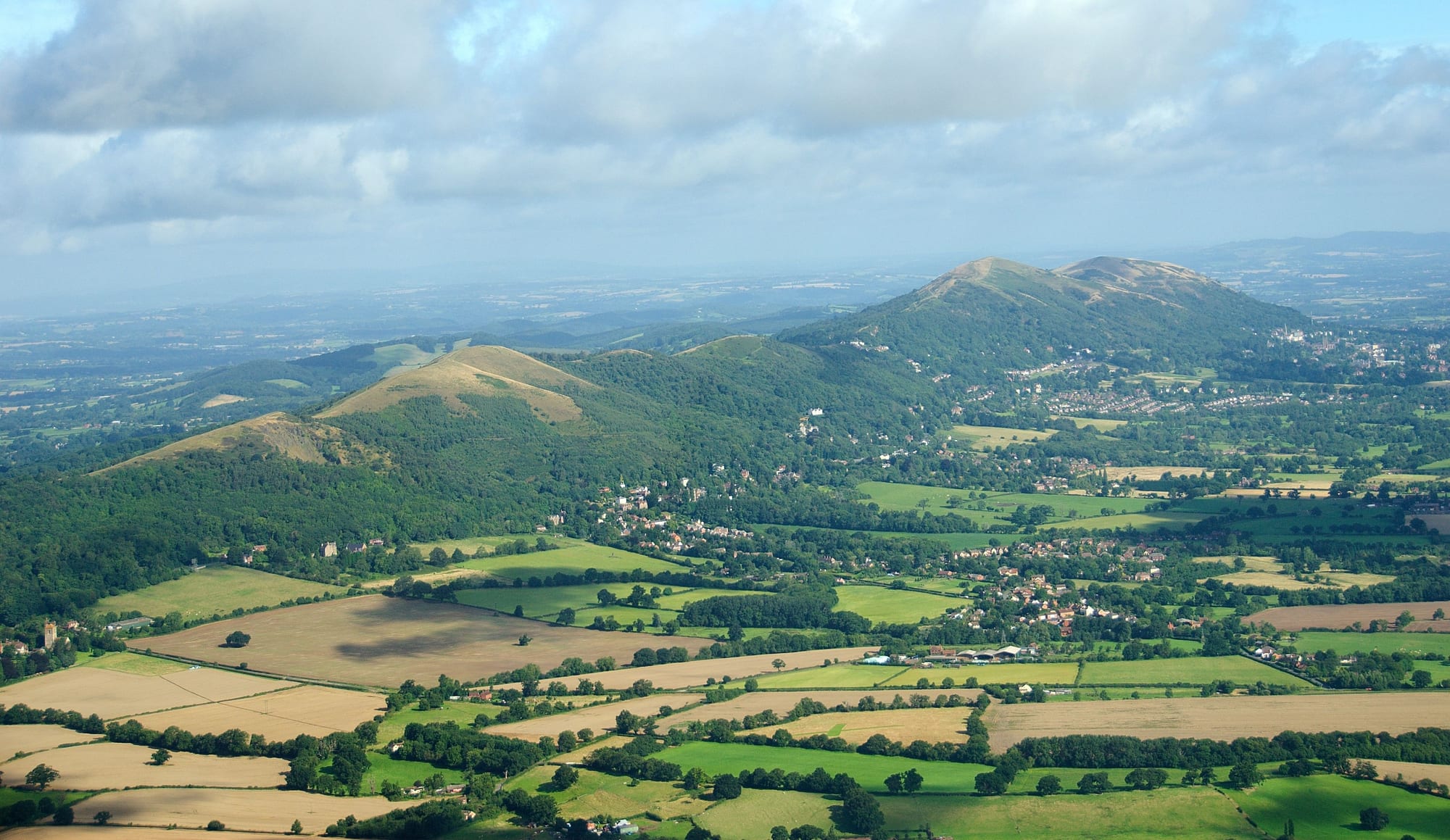
Aerial view of the green, wooded Malvern Hills rising above patchwork fields, villages and the town of Malvern

United Kingdom

West Midlands

The Malvern Hills from the air, rising above the farmland of Worcestershire and Herefordshire. (David Martyn Hunt / Wikimedia Commons · CC BY 2.0)

The western heart of England, from the Birmingham and Black Country conurbation out to the Welsh border counties of Shropshire and Herefordshire, with Staffordshire, Warwickshire and Worcestershire between — the birthplace of Shakespeare and a cradle of the Industrial Revolution, set among river valleys, orchards and hills.

Explore West Midlands

History

The region was the core of Mercia, the Anglo-Saxon kingdom that dominated central England in the 8th century under Offa, whose earthwork dyke ran along the Welsh border. The Staffordshire Hoard of gold and garnet war gear, found near Lichfield in 2009, is the largest hoard of Anglo-Saxon gold and silver metalwork yet found. After 1066 the Normans built castles at Warwick and Kenilworth, and border towns such as Shrewsbury, Ludlow and Hereford guarded against the Welsh.

William Shakespeare was born in Stratford-upon-Avon in 1564 and returned to die there in 1616. In the Civil War the region was fought over; the final battle, at Worcester in 1651, ended with the young Charles II fleeing and hiding in an oak tree at Boscobel in Shropshire.

The region then became a centre of the Industrial Revolution. In 1709 Abraham Darby smelted iron using coke at Coalbrookdale, and the Iron Bridge over the Severn was built in 1779. Birmingham grew into a manufacturing city of many trades, with Matthew Boulton and James Watt building steam engines, and the Black Country to its west became a landscape of mines, furnaces and foundries. Stoke-on-Trent's Potteries, led by Josiah Wedgwood, made china for the world. In the 20th century Coventry and Birmingham built cars, and Coventry's centre and cathedral were destroyed in the Blitz of 1940. After the war, immigrants from the Caribbean, India, Pakistan and Bangladesh reshaped the cities, while heavy industry declined from the 1970s.

Culture & Customs

Birmingham is one of the UK's most diverse cities, with large Pakistani, Indian, Bangladeshi, Caribbean and Irish communities, and the Sikh festival of Vaisakhi in Handsworth draws huge crowds. The Brummie and Black Country accents are distinct from each other and often mocked elsewhere, but locals are proud of them, and the Black Country has its own flag and a Black Country Day in July.

Music runs deep. Heavy metal grew from Birmingham with Black Sabbath, reggae band UB40 came from the city, and Coventry was the home of the Two-Tone ska of The Specials. The television drama Peaky Blinders revived interest in Birmingham's gang history. The city has a strong classical life through the City of Birmingham Symphony Orchestra.

The countryside keeps older traditions. Stratford celebrates Shakespeare's birthday each April, the Three Choirs Festival rotates between the cathedrals of Hereford and Worcester, and Gloucester, and Much Wenlock's Olympian Games, begun in 1850, helped inspire the modern Olympics. Edward Elgar, born near Worcester, drew on the Malvern Hills for his music. Football loyalties divide Aston Villa and Birmingham City, and Wolves and West Brom in the Black Country.

Daily Life

About 6 million people live in the West Midlands. Birmingham has about 1.1 million, making it the UK's largest city after London, and the conurbation including Wolverhampton, Walsall, Dudley and West Bromwich is much larger. Coventry has about 350,000 people and Stoke-on-Trent about 260,000, while Worcester, Shrewsbury, Hereford and Telford are smaller centres.

The region still makes things. Jaguar Land Rover builds cars and has major sites at Solihull and near Coventry, and aerospace, engineering, ceramics and food manufacturing remain important. Birmingham has grown as a centre for finance, law and universities, and hosted the Commonwealth Games in 2022. Herefordshire and Worcestershire are farming counties of orchards, hops and cattle.

Daily life in the conurbation involves long commutes on congested roads, while the rural counties are quiet and ageing. Current issues include Birmingham City Council's financial crisis, which led to cuts in services, deprivation in parts of the Black Country and Stoke, and the long delays to the HS2 railway to London.

Food

Birmingham's best-known dish is the balti, a curry cooked quickly and served in the thin steel bowl it is cooked in, which grew up in the city's Pakistani and Kashmiri restaurants in the 1970s. The Black Country is known for pork scratchings, faggots and peas, and grey peas and bacon, and Cadbury chocolate has been made at Bournville in Birmingham since the late 19th century.

Stoke-on-Trent's own food is the Staffordshire oatcake, a soft, savoury pancake made with oats and filled with cheese, bacon or sausage. Worcestershire sauce, a fermented condiment of vinegar, anchovies and tamarind, has been made in Worcester by Lea & Perrins since the 1830s. Herefordshire is known for its beef cattle, the Hereford breed, and for apples, pears and hops.

Drink is dominated by cider and beer. Herefordshire is one of England's main cider and perry regions, with farm producers as well as large firms in Hereford. Burton upon Trent in Staffordshire became famous for brewing pale ales in the 19th century, and brewing yeast from its breweries gave rise to Marmite, still made in the town. Ludlow's food festival and the farmers' markets in Shropshire show the region's farm produce.

Attractions & Natural Wonders

Birmingham has the Jewellery Quarter, the canal network around Gas Street Basin, the Birmingham Museum and Art Gallery, strong in Pre-Raphaelite painting and home to part of the Staffordshire Hoard, the Library of Birmingham and the Bullring. Cadbury World lies in Bournville, and the Black Country Living Museum in Dudley recreates an industrial village. Coventry has its bombed cathedral ruins beside the new cathedral of 1962.

In Warwickshire, Stratford-upon-Avon has Shakespeare's Birthplace, Anne Hathaway's Cottage, the Royal Shakespeare Theatre and his grave in Holy Trinity Church. Warwick Castle rises over the Avon nearby, with Kenilworth Castle's red sandstone ruins a few miles north.

In Shropshire, the Iron Bridge and the museums of Ironbridge Gorge line the Severn, and Shrewsbury, Charles Darwin's birthplace, keeps its Tudor timber buildings and abbey. The Shropshire Hills include the Long Mynd above Church Stretton, the jagged quartzite of the Stiperstones and Wenlock Edge, with Ludlow's castle to the south.

Worcester has its cathedral with King John's tomb, and the Malverns rise to the Worcestershire Beacon, with the Iron Age British Camp hillfort and Great Malvern's priory. Hereford Cathedral holds the Mappa Mundi, and Staffordshire offers Lichfield's three-spired cathedral, Alton Towers, Cannock Chase and the Potteries museums.

Cities in West Midlands

Planning basics

Budget

The West Midlands is good value compared with the South. Birmingham has plenty of mid-priced hotels and cheap places to eat, and the market towns of Shropshire, Herefordshire and Worcestershire are affordable. Stratford- upon-Avon is the pricey exception, especially on performance nights, and Warwick Castle and other big attractions charge high gate prices.

Daily Budget Midrange
USD 160–290 (mid-range hotel, restaurant meals, a theatre ticket, castle or museum passes)
Daily Budget Shoestring
USD 65–110 (hostel or budget hotel, balti and pub meals, local trains and buses)

Book theatre and attraction tickets online in advance for lower prices, and stay in Birmingham or Warwick rather than central Stratford.

Safety

The region is generally safe for visitors. Birmingham and Coventry have petty theft in crowded areas and some weekend nightlife trouble, as in any large city. In the countryside, the Malvern and Shropshire hills are easy but exposed in bad weather, and the Severn floods regularly in winter, affecting riverside roads in Shrewsbury, Ironbridge and Worcester.

Check flood warnings for the Severn in winter and keep to marked paths on the hills in poor visibility. Check current official travel advice before travelling.

Climate

Inland and fairly sheltered, the region has a mild climate with less rain than the west coast. The Welsh border hills of Shropshire and Herefordshire are wetter and cooler, and the higher ground of the Staffordshire Moorlands gets snow in most winters. Birmingham, on a plateau, can be a little cooler than surrounding valleys.

Summer
warm, 18–24°C, with occasional heatwaves
Winter
cool and damp, 1–7°C, with frost; snow on the Shropshire Hills and moorlands

Transportation

Birmingham is the hub, with trains from London Euston in about an hour and a half, a busy airport and links across the country. Local trains reach Coventry, Wolverhampton, Worcester, Shrewsbury and the Malverns, and Stratford-upon-Avon has trains from Birmingham and London Marylebone. The West Midlands Metro trams cross Birmingham and the Black Country. Rural Shropshire and Herefordshire are poorly served by buses, so a car or a bike helps there.

Use trains for Birmingham, Stratford, Warwick and Worcester, and hire a car only for the Shropshire Hills and Herefordshire.

Best Time to Visit

April to September suits walking in the Shropshire Hills and the Malverns, the Severn valley and the apple orchards of Herefordshire; late April brings celebrations of Shakespeare's birthday in Stratford. Autumn is good for food festivals, such as Ludlow's, and the harvest of cider apples. Birmingham suits any season, with a large German-style Christmas market.