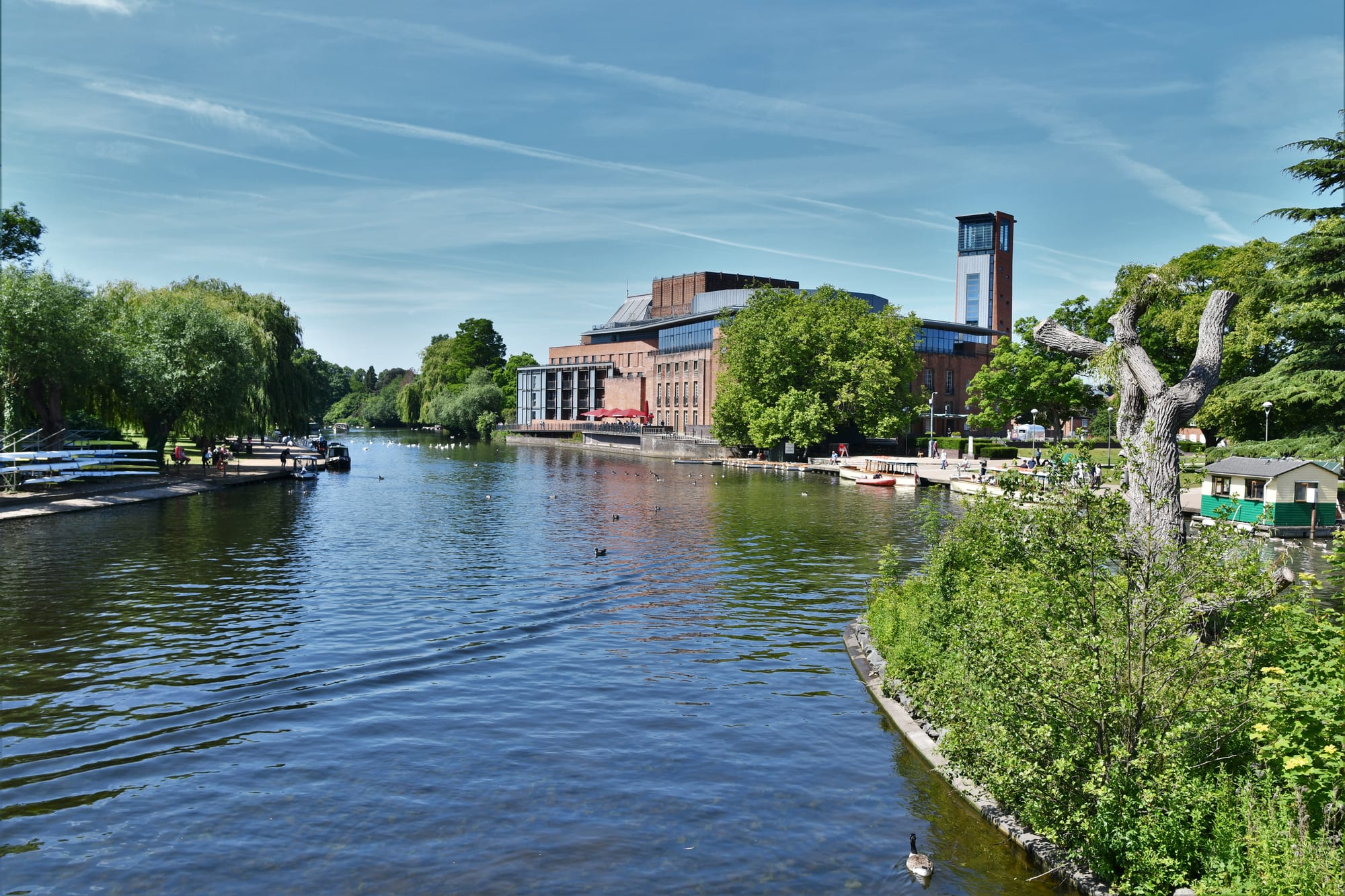
A wide, calm river lined with willows leading to a large red-brick theatre with a square tower under a blue sky

West Midlands, United Kingdom

Stratford-upon-Avon

The Royal Shakespeare Theatre on the River Avon at Stratford-upon-Avon. (Michael Garlick / Wikimedia Commons · CC BY-SA 2.0)

A Warwickshire market town on the River Avon, laid out on a grid in 1196 and granted a weekly market the same year. William Shakespeare was born and buried here, and his family houses, his grave and the Royal Shakespeare Company's riverside theatres draw some 2.5 to 3 million visitors a year to a town of about 30,000 people.

Neighbourhoods

  • The historic centre
    • First-time visitors
    • Historic district
    • Shopping

    The streets of the 1196 grid plan, where the Historic Spine runs from Shakespeare's Birthplace on Henley Street down Bridge Street and High Street, past Harvard House, Nash's House and New Place, and along Church Street's 15th-century Guild buildings.

    Open in Maps
  • Waterside and Bancroft Gardens
    • Theatre
    • River walks
    • Families

    The riverside where the Royal Shakespeare Theatre and Swan Theatre stand, with the Gower Monument in Bancroft Gardens, the canal basin and its narrowboats, and rowing boats and river cruises on the Avon in summer.

    Open in Maps
  • Old Town
    • Quiet and residential
    • Historic buildings

    The original settlement around Holy Trinity Church, south of the centre, with Hall's Croft and a quieter riverside path; the chain ferry crosses to the water meadows nearby.

    Open in Maps
  • Shottery
    • Village feel
    • Shakespeare sites

    A formerly separate village on the western edge of town, now part of Stratford, where Anne Hathaway's Cottage stands among newer housing.

    Open in Maps

Things to do

Shakespeare's town

  • Shakespeare's Birthplacemuseum

    The restored 16th-century half-timbered house on Henley Street where William Shakespeare is believed to have been born in 1564 and spent his childhood.

    Open in Maps
  • New Place and Nash's Housemuseum

    The site of the house Shakespeare owned and where he died, beside Nash's House, which stands alongside it on Chapel Street.

    Open in Maps
  • Hall's Croftmuseum

    The home of Shakespeare's daughter Susanna and her husband, the physician John Hall, in the Old Town.

    Open in Maps
  • Holy Trinity Churchlandmark

    The Grade I listed riverside church where Shakespeare was baptised and buried.

    Open in Maps
  • King Edward VI Schoollandmark

    The grammar school Shakespeare may have attended; the schoolroom where he is believed to have studied opened to visitors in 2016.

    Open in Maps
  • Anne Hathaway's Cottagemuseum

    The family home of Shakespeare's wife before her marriage, in Shottery on the edge of town.

    Open in Maps

Theatres

  • Royal Shakespeare Theatreattraction

    The riverside home of the Royal Shakespeare Company, designed by Elisabeth Scott, with a thrust stage of about 1,000 seats; the RSC was formed here in 1961.

    Open in Maps
  • Swan Theatreattraction

    A smaller theatre modelled on an Elizabethan playhouse, created in the 1980s from the shell of the original Memorial Theatre, used for plays by Shakespeare's contemporaries and European writers.

    Open in Maps

The town and the river

  • Clopton Bridgelandmark

    The masonry arch bridge of 1484, named after Hugh Clopton, that replaced a timber bridge at the old ford.

    Open in Maps
  • Gower Monumentlandmark

    A bronze statue of Shakespeare surrounded by four of his best-known characters, in Bancroft Gardens.

    Open in Maps
  • Harvard Houselandmark

    One of the Elizabethan buildings on High Street, part of the town's Historic Spine.

    Open in Maps
  • Stratford-upon-Avon Canaltrail

    The canal built between 1793 and 1816 to link the Avon with Birmingham, whose basin by the theatre fills with moored narrowboats.

    Open in Maps
  • Chain ferryattraction

    A hand-powered chain ferry opened in 1937, crossing the Avon from Waterside to the water meadows.

    Open in Maps
  • MAD Museummuseum

    The Mechanical Art and Design museum on Henley Street, full of kinetic machines.

    Open in Maps

Short trips from the town

  • Mary Arden's Farmmuseum

    The family home of Shakespeare's mother at Wilmcote, presented as a working Tudor farm with rare-breed animals.

    Open in Maps
  • Warwick Castlelandmark

    A medieval fortress on the Avon in Warwick, founded by William the Conqueror, about 8 miles north-east.

    Open in Maps

Seasonal events

  • Shakespeare's birthday celebrationslate April

    The town celebrates Shakespeare's birthday every year.

  • Stratford Mop Fair12 October (11 October if the 12th is a Sunday)

    One of the largest mop fairs in the country, a traditional autumn fair held in the town's streets.

  • Stratford-upon-Avon Literary Festivalspring and autumn

    A literary festival held since 2008, with a main event in spring and a shorter one in autumn.

  • Waterside craft marketmost Sundays in summer

    A craft market held beside the river near the theatres.

Eat and drink

Long-standing places and food districts in Stratford-upon-Avon. Hours, ratings and directions come from your maps app, always current.

Stratford classics

  • The Dirty Duckrestaurant

    A pub just south of the Royal Shakespeare Theatre with a lively theatrical atmosphere and inexpensive food, including rhubarb pie; its sign reads 'Dirty Duck' on one side and 'Black Swan' on the other.

    Open in Maps
  • Sheep Streetneighborhood

    The street running down from the Town Hall to Waterside, once where Cotswold sheep were bought and sold and now the town's restaurant centre.

    Open in Maps

Food districts

  • Watersideneighborhood

    Pubs, cafés and restaurants by Bancroft Gardens and the theatres, with a craft market on most summer Sundays.

    Open in Maps
  • Henley Street and the historic centreneighborhood

    Al fresco cafés along Henley Street, a tourist and shopping precinct by Shakespeare's Birthplace, and more places to eat in the streets of the historic centre.

    Open in Maps

Experience Stratford-upon-Avon

History

Britons lived here before the Anglo-Saxons, and a small Roman town grew up about a mile north-east of the centre at Tiddington, occupied from the 1st to the 5th century. The name joins the Old English for "street" — a Roman road — and "ford" with the Celtic word for river. An early monastery, probably on the site of Holy Trinity Church, gave rise to the Old Town. In 1196 the lord of the manor, John of Coutances, laid out a new town on a grid half a mile north, and Richard I granted it a weekly market. The Guild of the Holy Cross became its main institution, building the Guild Chapel in the 13th century and a Guildhall and almshouses around 1417; in 1484 Hugh Clopton paid for the stone bridge that still carries traffic over the Avon.

Wool from the nearby Cotswolds made Stratford a busy market town. The guild was abolished in 1547, and a borough charter then created a town council and refounded the school as King Edward VI School. John Shakespeare, a glover and town official, moved here in 1551; his son William was born in 1564, and later bought New Place, where he died in 1616. During the Civil War, in 1643, stored gunpowder blew up the Market Hall.

David Garrick's Shakespeare Jubilee of 1769 made the town a place of pilgrimage. The Avon had been made navigable in 1639, the canal to Birmingham was completed in 1816, and railways arrived between 1859 and 1861, bringing tourists. The Flower family, who opened a brewery in 1831, campaigned and raised funds for the Shakespeare Memorial Theatre of 1879, the forerunner of today's Royal Shakespeare Theatre. In 1974 the borough was merged into the wider Stratford-on-Avon District.

Culture & Customs

Shakespeare shapes almost everything here. The Shakespeare Birthplace Trust cares for five houses linked to his life — his birthplace, Nash's House and New Place, Hall's Croft, Anne Hathaway's Cottage in Shottery and Mary Arden's farmhouse at Wilmcote. His birthday is celebrated every year, and in 2016 events marked the 400th anniversary of his death.

The Royal Shakespeare Company, formed by Peter Hall in 1961, is the town's great institution. It runs the Royal Shakespeare Theatre, designed by Elisabeth Scott; the Swan Theatre, modelled on an Elizabethan playhouse; and The Other Place, a smaller studio space. Both main theatres reopened in 2010 after a refurbishment. Beyond the RSC, the ArtsHouse is home to the Orchestra of the Swan, a professional chamber orchestra, and there is a fringe theatre and a small community theatre.

Older customs survive too. The Mop fair, held on 12 October, is one of the largest in the country, and a literary festival has run every spring and autumn since 2008. Sheep Street recalls the centuries when Cotswold sheep were bought and sold in the town, and Scholars Lane was once Tinkers Lane, where tinkers gathered on market days to mend pots and pans. The town is the setting of the BBC detective series Shakespeare & Hathaway.

Daily Life

About 30,500 people lived in Stratford at the 2021 census, up from about 27,900 in 2011, and the town has grown with new housing, including 800 homes at Shottery with a relief road. The urban area takes in the former villages of Alveston, Shottery and Tiddington, alongside suburbs such as Bishopton, Bridge Town, Clopton and Old Town.

Tourism is the main source of the town's prosperity, with between 2.5 and 3 million visitors a year, and a major employer in hotels, hospitality and catering, while the RSC's three theatres bring large audiences and income. Other employers include NFU Mutual, the insurer, Pashley Cycles and the large supermarkets, and the area has boat building, engineering, food manufacture, market gardening and farming.

Most of the town lies on the west bank of the Avon, and its riverside position means flooding, including flash floods, is a recurring risk. The Stratford Town Trust, which holds the long-standing Guild and College estates, awards more than £2 million a year in grants to the local community. Daily life swings between the quiet of the residential suburbs and the crowds of the historic centre, which are thickest in summer and on performance evenings.

Food

Stratford's eating places are geared to theatre-goers. Sheep Street, once the sheep market and now the town's restaurant centre, Waterside facing the gardens and the streets around Shakespeare's Birthplace hold most of them, from cafés to gastropubs and restaurants.

The town's pubs have a long history. One on the High Street is reputedly the oldest in Stratford, on a site where there has been an inn since medieval times. The riverside pub known as the Dirty Duck, a short walk from the Royal Shakespeare Theatre, is known for its lively theatrical atmosphere; its sign reads "Black Swan" on the side facing the church. Beer was once a local industry: Edward Fordham Flower opened a large canal-side brewery in 1831, and Flower & Sons brewed in the town until 1967, when it was taken over by Whitbread.

The country around supplies the town. The Cotswolds to the south were long one of England's great sheep-rearing areas, with Stratford a centre for selling their sheep and wool, and the district still has market gardening, farming and food manufacture. On most summer Sundays a craft market sets up on the Waterside, and the villages and towns nearby have many more pubs and restaurants.

Planning tools

Budget

Stratford can be pricey, especially on performance nights and in summer. Theatre tickets for the best seats are a major cost, though cheaper standby tickets are sometimes sold on the day. Combined tickets cover several of the Shakespeare houses, and the river, gardens and streets cost nothing.

Daily Budget Midrange
USD 160–290 (mid-range hotel, restaurant meals, a theatre ticket, Shakespeare house passes)
Daily Budget Shoestring
USD 70–115 (hostel or budget room outside the centre, pub meals, standby theatre ticket, trains and buses)

Book theatre tickets well ahead for popular productions, and consider Warwick or Birmingham, both with direct trains, as alternative bases.

Best Time to Visit

April to September, when the river is busy with boats, the gardens are at their best and the RSC season is in full swing; late April brings the celebrations of Shakespeare's birthday. Summer is crowded. October has the Mop fair, and winter is quieter, with performances continuing and shorter queues at the houses.

Suggested Number of Days

One or two days cover the town and an evening at the theatre. Allow three or four to include the outlying Shakespeare houses and the castles, country houses and villages of Warwickshire and the Cotswolds nearby.

First Visit
1–2 days
With Surroundings
3–4 days

Transportation

The town centre is small and walkable. Buses connect Stratford with Banbury, Coventry, Evesham, Leamington and Redditch, and local trains call at Wilmcote for Mary Arden's Farm. The A46 links the town with the M40, Warwick and Coventry. On the water, narrowboats can travel the canal north towards Birmingham.

Leave the car outside the centre in summer, when the narrow streets are crowded, and walk between the sights.

Airport & Station Connections

Birmingham Airport is about 18 miles north-west. Direct trains run to Birmingham Snow Hill in about an hour and to Warwick, and a few direct trains each day reach London Marylebone in about two hours; otherwise the journey from London usually means changing at Leamington Spa or Birmingham.

Walkability

Very walkable. Shakespeare's Birthplace, the theatres, Holy Trinity Church and Hall's Croft are all within a short walk along the Historic Spine and the riverside. Anne Hathaway's Cottage is a walk or short ride west in Shottery; Mary Arden's Farm needs a train, bus or car.

Safety

The UK is generally safe, with the main risks being pickpocketing and phone theft in crowded parts of London and other cities, occasional late-night antisocial behaviour, and drink-related trouble around nightlife. Stratford is a small, generally safe town; watch bags in the crowds around the main sights, and note that the riverside is susceptible to flooding, including flash floods.

Check flood warnings in wet weather before walking the riverside paths and meadows. Check current official travel advice before travelling.

Climate

The town's lowland position in the Avon and Severn valleys makes it slightly warmer and drier than much of the Midlands, almost a microclimate. Summers are mild to warm and winters cool and damp.

Summer
mild to warm — July is the warmest month, with an average maximum of 22.8°C
Winter
cool and damp — January is the coldest month, with an average high of 7.7°C

Local Customs

Theatre shapes the town: Sheep Street, leading down to the Royal Shakespeare Theatre, is its restaurant centre, and the Dirty Duck on Waterside is frequented by actors, critics and theatregoers. Holy Trinity is a working parish church as well as Shakespeare's resting place.

Keep quiet in Holy Trinity during services, and book theatre seats early for popular productions.

Common Payment Methods

The currency is the pound sterling. Most pubs now take contactless cards, though a few are still cash only, and some merchants no longer accept cash.