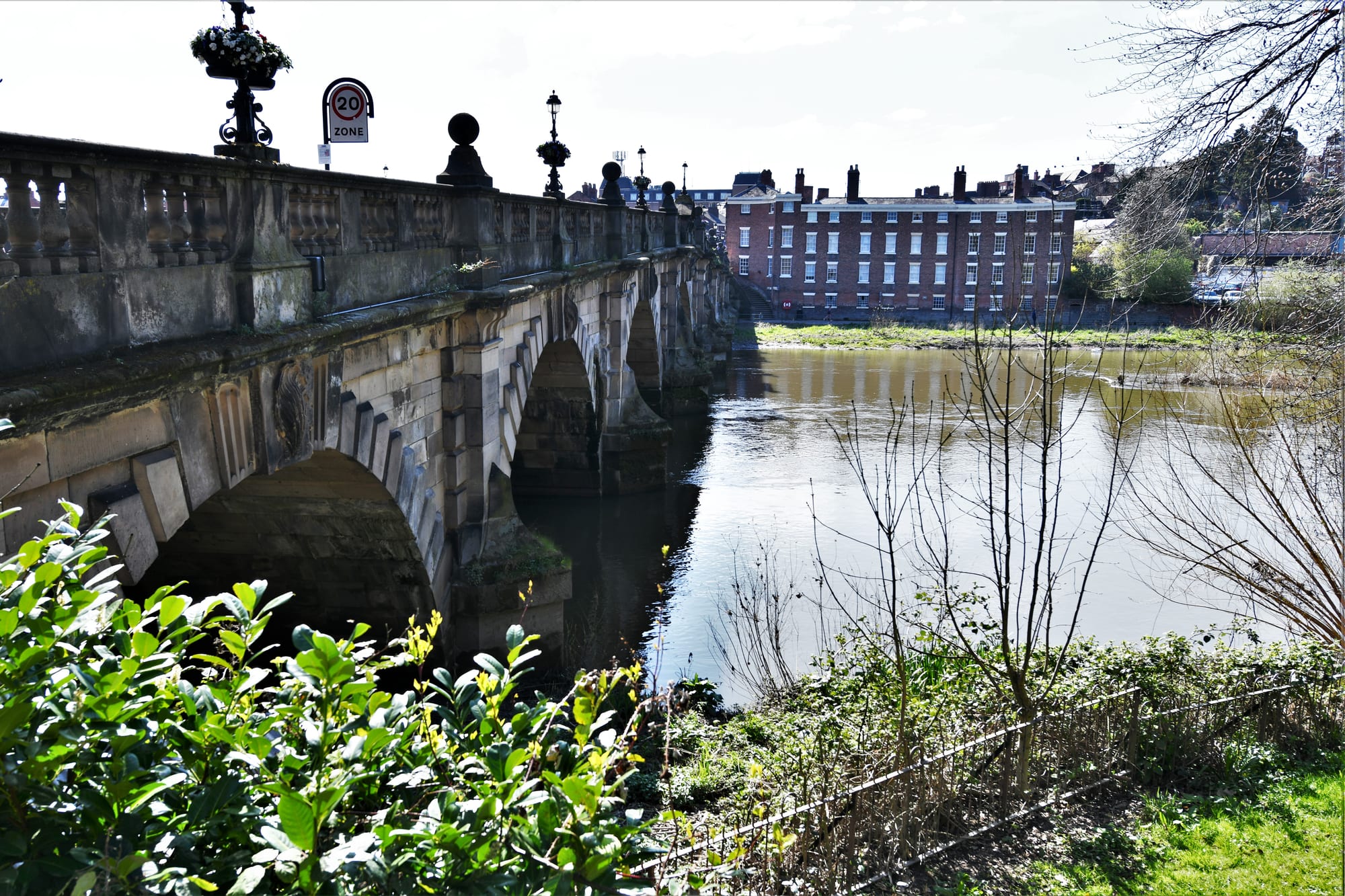
A stone arched bridge crossing the calm River Severn, with red-brick Georgian buildings on the far bank

West Midlands, United Kingdom

Shrewsbury

The English Bridge over the River Severn in Shrewsbury. (Michael Garlick / Wikimedia Commons · CC BY-SA 2.0)

The county town of Shropshire, set in a tight loop of the River Severn 9 miles from the Welsh border. A Saxon and Norman stronghold that grew rich on the Welsh wool trade, it keeps a largely medieval street plan, more than 660 listed buildings and many timber-framed houses, and is the birthplace of Charles Darwin.

Neighbourhoods

  • Town centre
    • First-time visitors
    • Historic district
    • Shopping

    The hilltop core inside the river loop, with a medieval street plan of lanes and narrow passages, the Square with its 1596 Old Market Hall, and timber-framed buildings along streets with names such as Mardol, Dogpole and Shoplatch.

    Open in Maps
  • Wyle Cop and Abbey Foregate
    • Independent shops
    • Pubs
    • Historic district

    Wyle Cop, said to have the longest unbroken row of independent shops, runs downhill from the centre to the English Bridge. Across the river, Abbey Foregate leads past the Norman abbey and the 16th-century Dun Cow inn.

    Open in Maps
  • Frankwell
    • Theatre
    • Riverside
    • Close to the centre

    The suburb across the Welsh Bridge on the west bank, home to Theatre Severn and the Guildhall. It flooded three times in six weeks in 2000, and flood defences were completed in 2003.

    Open in Maps
  • Kingsland and the Quarry
    • Parks and gardens
    • Quiet and residential

    South-west of the centre, the Quarry park runs down to the river below St Chad's round church, and the Porthill suspension footbridge crosses the river to Porthill, and in Kingsland Shrewsbury School stands on a large site overlooking the Severn.

    Open in Maps

Things to do

Historic town

  • Shrewsbury Abbeylandmark

    A Benedictine abbey founded in 1083 by Roger de Montgomery, whose nave survived the Dissolution as a parish church; it is the setting of Ellis Peters's Brother Cadfael novels.

    Open in Maps
  • Shrewsbury Castlelandmark

    A red sandstone castle begun around 1074 above the neck of the river loop, home to the Soldiers of Shropshire Museum.

    Open in Maps
  • St Chad's Churchlandmark

    A large neo-classical round church on Claremont Hill, built after the medieval St Chad's collapsed; Charles Darwin was baptised here.

    Open in Maps
  • St Mary's Churchlandmark

    A church that originated as a collegiate church, by tradition founded by King Edgar in the 10th century.

    Open in Maps
  • Shrewsbury Flaxmill Maltingslandmark

    Completed in 1797 in Ditherington, the world's first iron-framed building, called the 'grandfather of skyscrapers', now a workspace with an English Heritage exhibition.

    Open in Maps

Museums and culture

  • Shrewsbury Museum and Art Gallerymuseum

    The town's museum, in the Music Hall complex and Vaughan's Mansion on College Hill.

    Open in Maps
  • Old Market Hallattraction

    The Elizabethan market hall of 1596 in the Square, now a cinema and café.

    Open in Maps

Parks and the river

  • The Quarry and the Dinglepark

    The town's riverside park, with the Dingle, a landscaped sunken garden, long the site of the Shrewsbury Flower Show.

    Open in Maps
  • English Bridgelandmark

    The stone bridge carrying Wyle Cop over the Severn to Abbey Foregate, one of the town's two historic main crossings with the Welsh Bridge.

    Open in Maps

Short trips from the town

  • Attingham Parkattraction

    A National Trust country house of 1785 near Atcham, with large parkland and a walled garden; one of the most visited National Trust properties.

    Open in Maps
  • Ironbridge Gorgeattraction

    The Severn valley named after the Iron Bridge of 1779, the first of its kind in the world, at the heart of the early Industrial Revolution.

    Open in Maps

Seasonal events

  • Darwin FestivalFebruary

    An annual festival celebrating the town's links with Charles Darwin, born here in February 1809.

Eat and drink

Long-standing places and food districts in Shrewsbury. Hours, ratings and directions come from your maps app, always current.

Shrewsbury classics

  • Shrewsbury cakescafe

    Biscuits made from sugar, flour, egg, butter and lemon zest, often with dried fruit; the recipe is said to have been pioneered in the town in 1760.

    Open in Maps
  • Shrewsbury Market Hallmarket

    An indoor market of independent traders and food stalls, voted Britain's Favourite Market in 2018, 2023, 2024 and 2025.

    Open in Maps

Pubs

  • Historic pubs of the town centreneighborhood

    Traditional pubs serving real ales in old buildings such as the King's Head in Mardol, whose timbers date from around 1404.

    Open in Maps
  • Abbey Foregateneighborhood

    The street beyond the English Bridge with restaurants and the Dun Cow, a pub dating from the 16th century.

    Open in Maps

Experience Shrewsbury

History

Shrewsbury's roots are Anglo-Saxon. The name comes from the Old English Scrobbesburh, "Scrobb's fort" or "the fortified place of the scrubland", which also gave Shropshire its name, and it is claimed that Pengwern, at one time capital of the kingdom of Powys, was here. After 1066 the Norman earl Roger de Montgomery built the castle around 1074 at the neck of the river loop and founded the Benedictine abbey in 1083. The border town was fought over repeatedly: Llywelyn ab Iorwerth burned it in 1234, and in 1403 Henry IV defeated Henry Percy, Hotspur, at the Battle of Shrewsbury a few miles north of the centre.

The town's prosperity came from wool. Its position on the Severn and Watling Street let its merchants control the trade in Welsh wool with the rest of Britain and Europe, and they built the timber-framed houses that still line its streets. The abbey was closed in 1540, and Edward VI permitted the founding of the free school that became Shrewsbury School. In 1797 the Ditherington Flax Mill became the world's first iron-framed building, and Charles Darwin was born in the town in 1809 and educated at the school.

In the 20th century Shrewsbury remained a market and county town rather than an industrial one. Its medieval street plan survived largely undisturbed, with more than 660 listed buildings. From the late 1990s the Severn and the Rea Brook brought severe floods, and in 2000 Frankwell flooded three times in six weeks; defences completed in 2003 have since protected much of the centre. The restored flax mill was officially opened in 2022 as workspace with an exhibition.

Culture & Customs

The town is proud of its literary and dramatic past. Mystery plays were staged in a hollow of the Quarry before the Reformation, and in the mid-16th century the plays of Shrewsbury School attracted royal attention. A. E. Housman wrote of its bridges in A Shropshire Lad, the poet Wilfred Owen lived in the town before the First World War, and Ellis Peters's Brother Cadfael novels, set in the medieval abbey, made the town familiar to readers around the world. Theatre Severn, beside the Welsh Bridge, is the main stage today.

Darwin is the town's best-known son. Road signs once welcoming drivers to the "Town of Flowers" were changed in 2007 to "The birthplace of Charles Darwin", the Quantum Leap sculpture was unveiled in 2009 for his bicentenary, and a Darwin Festival is held every February. The two-day Flower Show, held in the Quarry each mid-August for more than 125 years, was not held in 2025 or 2026 because of rising costs, and the folk festival held since 2006 was not continued after losses in 2022.

The Severn shapes local life. The Pengwern Boat Club, founded in 1871 and named after the town's ancient British name, and the school's boat club row on the river, and a free weekly parkrun takes place in the Quarry. Shrewsbury Town play football in the town. The town lies 9 miles from the Welsh border and is the commercial centre for parts of Mid Wales.

Daily Life

The town had about 77,000 people at the 2021 census. It is the commercial centre for Shropshire and parts of Mid Wales, with a large retail trade for its size, the offices of Shropshire Council at the Guildhall in Frankwell, and light industry and distribution centres on the outskirts, such as the Battlefield Enterprise Park to the north.

Daily life centres on the hilltop town inside the river loop. Shoppers move between the chain stores of the Darwin Shopping Centre and the independent shops of Wyle Cop, said to be the longest unbroken row of independent shops. The indoor Market Hall, voted Britain's Favourite Market several times, gathers independent traders, and the town's many pubs fill in the evenings.

Most residents live in suburbs beyond the river: Frankwell to the west, Abbey Foregate and Monkmoor to the east, Castlefields and Ditherington to the north and Kingsland to the south. Winter flooding is the recurring worry, closing riverside car parks and roads and hurting trade in wet years. The A5 and A49 meet at the town's by-pass, and the railway station is a junction for lines across Wales and the Midlands.

Food

Shrewsbury gave its name to the Shrewsbury cake, or biscuit, made from sugar, flour, egg, butter and lemon zest, often with dried fruit added. The playwright William Congreve mentioned it in The Way of the World in 1700, and a plaque near the library at the corner of Castle Street and School Gardens marks where a Mr Pailin is said to have pioneered the recipe in 1760. The town also has its own recipe for simnel cake, one of several local versions in England.

Beer has a long history here. As early as about 1400 the Welsh bard Iolo Goch praised the ale of Shrewsbury served at Owain Glyndŵr's palace of Sycharth, and in 1900 the town had eight breweries, among them Southam's and Trouncer's, which owned their own maltings and many local pubs. The old breweries closed after takeovers in the 1960s, the last maltings at Ditherington in 1987, and the Salopian Brewery began brewing real ale in 1995.

Today the Market Hall is the best place for local produce, and the town's traditional pubs serve real ales. Some pubs are among the oldest buildings in town: the King's Head in Mardol has timbers dated to about 1404 and a 14th-century wall painting, and the Dun Cow in Abbey Foregate dates from the 16th century.

Planning tools

Budget

Shrewsbury is an affordable base by English standards, with guest houses, pubs and cafés across the centre. Rooms are scarcer and pricier at busy summer weekends. Walking the streets, the Quarry and the riverside costs nothing.

Daily Budget Midrange
USD 160–270 (mid-range hotel or B&B, restaurant dinners, museum entry, a trip to Ironbridge or Attingham)
Daily Budget Shoestring
USD 65–110 (budget hotel or guest house, pub meals and market lunches, local buses and trains)

Trains from Shrewsbury reach much of Wales and the West Midlands, so the town works as a base without a car for many day trips.

Best Time to Visit

Late spring to early autumn is best, when the Quarry's gardens are in flower and the riverside paths are dry. Winter is quieter, but the Severn often floods low-lying roads and car parks, and February brings the Darwin Festival.

Suggested Number of Days

One or two days suit the town itself, which is compact and best seen on foot. Allow three or four to add the surrounding countryside and industrial heritage; without a car, trips depend on train and bus times.

First Visit
1–2 days
With Surroundings
3–4 days

Transportation

The town centre is small enough to walk. Local buses, run mainly by Arriva, leave from the bus station beside the Darwin Shopping Centre, a short walk from the railway station, and smaller companies run country routes, including across the Welsh border. A car helps for the hills and the Ironbridge Gorge.

Expect flooded riverside roads and car parks in wet winters; check flood warnings for the Severn before driving in.

Airport & Station Connections

Five railway lines meet at Shrewsbury's mock-Tudor station, known as the Gateway to Wales, with frequent trains to Birmingham, Wolverhampton, Manchester and Crewe and services to Chester, Cardiff, Aberystwyth and the Welsh coast. The Heart of Wales line also runs to Swansea. By road the A5 and A49 meet at the town's by-pass.

Walkability

Very walkable: the historic centre sits on a hill inside the river loop, crossed by narrow lanes and passages, and the station, castle, Square, Quarry and Wyle Cop are all a few minutes apart. Streets such as Wyle Cop are steep, and riverside paths can be under water after heavy rain.

Safety

The UK is generally safe, with the main risks being pickpocketing and phone theft in crowded parts of London and other cities, occasional late-night antisocial behaviour, and drink-related trouble around nightlife. Shrewsbury is a quiet market town; the main hazard is the river, which floods regularly in winter, and the Quarry park is best avoided late at night.

Take care in the Quarry after dark and keep away from the riverbanks when the Severn is high. Check current official travel advice before travelling.

Climate

A mild, temperate climate, sheltered by higher ground to the west, south and east, which gives the area a wide temperature range. At nearby Shawbury, the warmest day of an average year reaches about 28°C and the coldest night falls to about −10°C.

Summer
mild to warm — at nearby Shawbury about nine days a year reach 25°C or more
Winter
cool and frosty — at nearby Shawbury the coldest night of an average year falls to about −10°C, with around 60 air frosts

Local Customs

People from Shrewsbury and Shropshire are Salopians, and the town's name is pronounced either 'Shrows-bree' or 'Shrooz-bree'. As the only sizeable town for a large area, especially to the west in Mid Wales, it draws shoppers from over the border. The town once called itself the 'Town of Flowers'.

Churches welcome visitors outside services; keep voices low and ask before photographing people inside.

Common Payment Methods

The currency is the pound sterling. Cards are widely accepted in shops, pubs and restaurants, and a little cash is useful at market stalls.