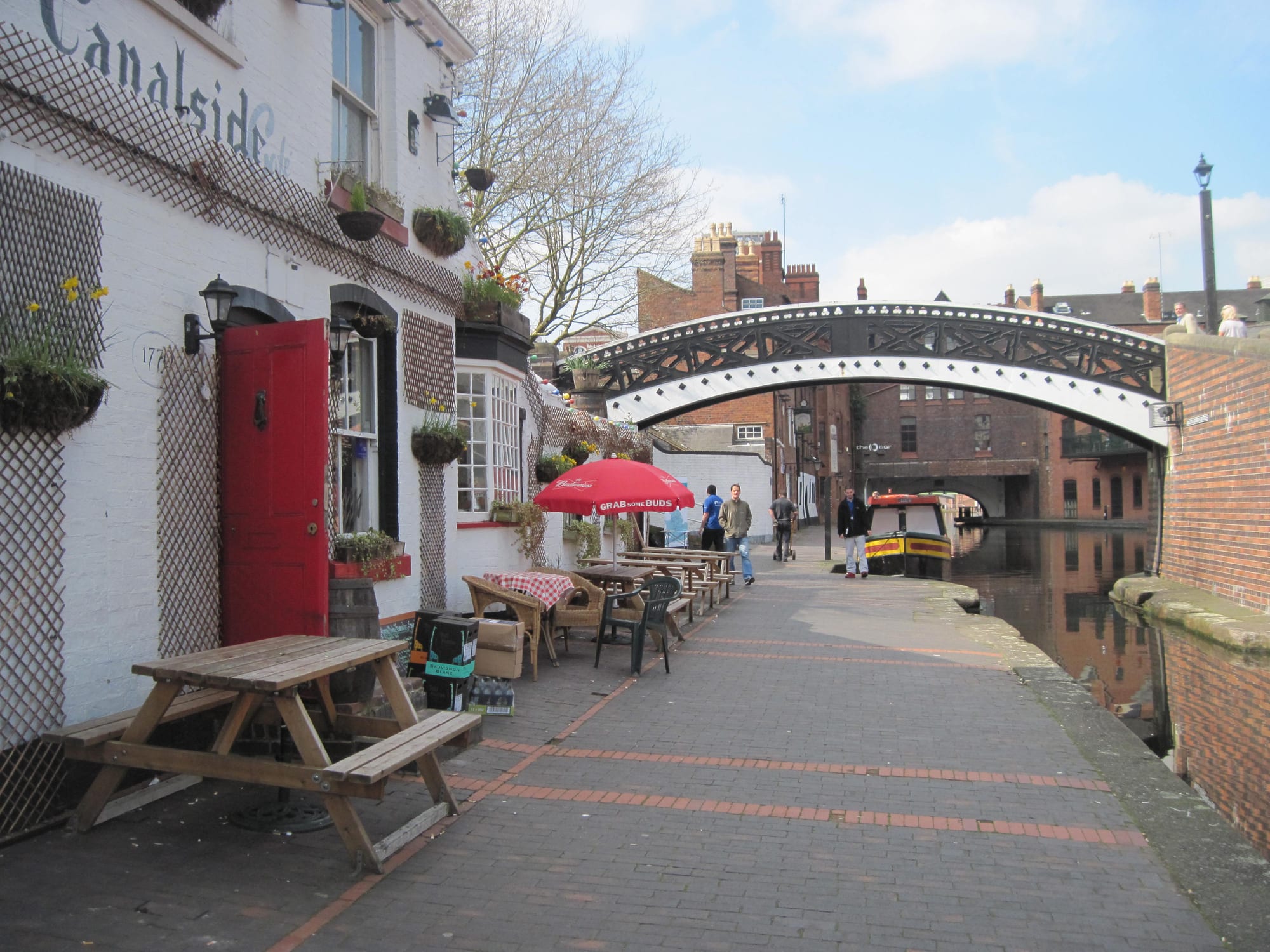
A brick towpath beside a canal with a white-painted pub, picnic tables and an iron footbridge over the water

West Midlands, United Kingdom

Birmingham

The towpath at Gas Street Basin, where the city's canals meet in central Birmingham. (Tricia Neal / Wikimedia Commons · CC BY-SA 2.0)

Britain's second city, at the centre of the West Midlands conurbation and the most inland major city in England. A medieval market town that grew into a manufacturing centre of many trades during the Industrial Revolution, it was rebuilt after wartime bombing and again from the 1990s around its canals, the Bullring and Brindleyplace, and is now one of Europe's youngest cities, with a highly diverse population.

Neighbourhoods

  • City Centre and Victoria Square
    • First-time visitors
    • Close to public transport
    • Shopping

    The core inside the old ring road, from New Street station and the Bullring up the sandstone ridge to Victoria Square, the Council House, the Town Hall and St Philip's Cathedral. Most museums, shops and the main stations are within a short walk of each other.

    Open in Maps
  • Brindleyplace and the canals
    • Canalside walks
    • Nightlife
    • Concerts

    A large canalside development begun in 1993 west of the centre, beside the International Convention Centre and Symphony Hall. Restaurants, bars, the Ikon Gallery and the Sea Life Centre face the water, and Gas Street Basin and Broad Street's bars are next door.

    Open in Maps
  • Jewellery Quarter
    • Historic district
    • Best for food
    • Bars

    Europe's largest concentration of jewellery businesses, north-west of the centre, still making around 40 per cent of the UK's jewellery. Red-brick workshops and showrooms share the streets with flats, bars and restaurants around St Paul's Square, and the world's largest Assay Office is here.

    Open in Maps
  • Digbeth
    • Arts and culture
    • Nightlife
    • Street art

    The old industrial district south-east of the Bullring, by tradition the city's Irish quarter and now its creative quarter. Converted factories such as the Custard Factory hold studios, independent shops, cafés, clubs and live music venues.

    Open in Maps
  • Chinatown and the Gay Village
    • Best for food
    • Nightlife
    • Theatre

    Around Hurst Street, Ladywell Walk and Pershore Street in Southside, Chinese supermarkets, restaurants, businesses and social clubs cluster around the Arcadian centre, while the Gay Village's bars and clubs line the same streets. The Back to Backs and the Hippodrome theatre are close by.

    Open in Maps
  • Edgbaston
    • Quiet and residential
    • Parks and gardens
    • Cricket

    A residential district south-west of the centre, long favoured by wealthier residents and home to the University of Birmingham, the Barber Institute, the Botanical Gardens and the Edgbaston cricket ground. It feels a world away from the city centre, under 2 miles away.

    Open in Maps
  • Moseley
    • Local life
    • Cafés and pubs
    • Quiet and residential

    A suburban village a few miles south of the centre with independent shops, pubs and restaurants, a monthly farmers' market and the woodland of Moseley Bog. Moseley Village station reopened in April 2026 on the Camp Hill line.

    Open in Maps

Things to do

Famous landmarks

  • Victoria Squarelandmark

    The civic square of the Council House and the Town Hall, with the large fountain sculpture The River and the Frankfurt Christmas Market in season.

    Open in Maps
  • Library of Birminghamlandmark

    Opened in 2013 on Centenary Square, a stacked building wrapped in metal rings, described as the largest public library in the United Kingdom.

    Open in Maps
  • St Philip's Cathedrallandmark

    A Baroque parish church by Thomas Archer, consecrated in 1715 and made a cathedral in 1905.

    Open in Maps
  • St Martin in the Bull Ringlandmark

    The city's original parish church, standing between the Bullring shopping centre and the markets.

    Open in Maps
  • Birmingham Back to Backsmuseum

    The city's last surviving court of back-to-back houses, built around a shared yard for industrial workers and now a National Trust museum.

    Open in Maps

Museums

  • Birmingham Museum and Art Gallerymuseum

    The city's main museum, with collections of international importance in fine art, ceramics, metalwork and local history; entry is free except for some major exhibitions.

    Open in Maps
  • Museum of the Jewellery Quartermuseum

    A preserved jewellery workshop on Vyse Street, run by Birmingham Museums Trust, telling the story of the quarter's trade.

    Open in Maps
  • Barber Institute of Fine Artsmuseum

    A small art gallery on the university campus in Edgbaston, with a collection ranging from Botticelli and Rubens to Gainsborough and Turner.

    Open in Maps
  • Thinktankmuseum

    The city's science museum, opened in 2001 in the Millennium Point building in Digbeth.

    Open in Maps
  • Soho Housemuseum

    Matthew Boulton's home in Handsworth from 1766 until his death in 1809, a meeting place of the Lunar Society, now a museum of the Midlands Enlightenment.

    Open in Maps

Canals, parks and gardens

  • Gas Street Basinattraction

    The canal basin in the centre of the city where the Worcester and Birmingham Canal meets the Birmingham Canal Navigations Main Line.

    Open in Maps
  • Birmingham Botanical Gardenspark

    Gardens in Edgbaston designed in 1829 by John Claudius Loudon, with a range of glasshouses.

    Open in Maps
  • Cannon Hill Parkpark

    The city's most popular park, 250 acres in Moseley, home to the MAC arts centre, formerly the Midlands Arts Centre.

    Open in Maps

Markets and shopping

  • Bull Ring markets and Bullringmarket

    The city's market place since the Middle Ages, with indoor, rag and open markets beside the Bullring shopping centre, opened in 2003.

    Open in Maps

Music, sport and nights out

  • Symphony Hallattraction

    The 2,262-seat home of the City of Birmingham Symphony Orchestra, opened in 1991 and known for its acoustics.

    Open in Maps
  • Custard Factoryattraction

    The former Bird's Custard works in Digbeth, now a complex of creative studios, independent shops, cafés and bars.

    Open in Maps
  • Villa Parkattraction

    The ground of Aston Villa, founded in 1874 and one of the country's oldest professional football clubs.

    Open in Maps
  • Edgbaston Cricket Groundattraction

    Home of Warwickshire County Cricket Club and a Test venue, the fourth-largest cricket ground in England after Lord's, Old Trafford and The Oval.

    Open in Maps

Short trips from the city

  • Cadbury Worldattraction

    In the Cadbury model village of Bournville in the south of the city, a self-guided exhibition on the history of chocolate and of the Cadbury business.

    Open in Maps
  • Black Country Living Museummuseum

    An open-air museum in Dudley, 8 miles west, of more than 50 rebuilt shops, houses and industrial buildings, focused on life between 1850 and 1950.

    Open in Maps

Seasonal events

  • VaisakhiApril

    The Sikh new year and harvest festival, celebrated with a large mela that draws big crowds in the city.

  • Birmingham Jazz FestivalJuly

    A festival of jazz held at venues across the city.

  • Frankfurt Christmas Marketmid-November to just before Christmas

    A German-style market in New Street and Victoria Square, begun in 2001 and the largest of its kind outside Germany and Austria, with bratwurst and Glühwein.

Eat and drink

Long-standing places and food districts in Birmingham. Hours, ratings and directions come from your maps app, always current.

Birmingham classics

  • The Balti Triangleneighborhood

    Ladypool Road, Stoney Lane and Stratford Road, south of the centre, where some 50 balti houses originally clustered; the balti, a curry cooked quickly in the manner of a stir-fry and served in a thin pressed-steel wok, was developed in the city in the 1970s.

    Open in Maps

Food districts and markets

  • Bull Ring marketsmarket

    The descendants of the market chartered in 1166, selling fish, meat, fruit, vegetables and household goods in the indoor, rag and open markets.

    Open in Maps
  • Chinatown and the Arcadianneighborhood

    Chinese supermarkets and restaurants around Hurst Street, Ladywell Walk and Pershore Street and in the open-air Arcadian centre.

    Open in Maps
  • Jewellery Quarterneighborhood

    Bars and restaurants in converted workshops around St Paul's Square, one of the centre's liveliest areas in the evening.

    Open in Maps

Cafés and bars

  • Digbethneighborhood

    Bars, clubs and cafés in the converted factories of the creative quarter, including the Custard Factory.

    Open in Maps
  • Moseley Villageneighborhood

    The suburban high street's independent cafés, pubs and restaurants, a short train or bus ride south of the centre.

    Open in Maps

Experience Birmingham

History

Birmingham's rise as a town began in 1166, when the lord of the manor, Peter de Bermingham, obtained a charter to hold a market at his castle and laid out a planned market town around it, on the site of today's Bull Ring. Its booming economy and high social mobility drew newcomers, and by 1700 it had grown fifteen-fold to become the fifth-largest town in England and Wales.

In the 18th century the town became a centre of the Midlands Enlightenment. The members of the Lunar Society met at Soho House, and Matthew Boulton opened his Soho Manufactory in 1765, then developed the industrial steam engine with James Watt in 1776. The town grew into a manufacturing centre of many trades, linked to the rest of the country by a dense network of canals. In 1855 Alexander Parkes invented the first man-made plastic in the Jewellery Quarter. A tradition of political radicalism, from Thomas Attwood to Joseph Chamberlain, mayor and later MP, gave the town a political influence unparalleled in Britain outside London.

The population peaked at about 1.1 million in 1951. The Birmingham Blitz of 1940 to 1943 left heavy damage, and post-war planners rebuilt the centre around a concrete Bull Ring and an inner ring road, destroying many Victorian buildings. In 1974 bombings in two city-centre pubs killed 21 people. From the 1990s the centre was remade again: Brindleyplace turned the canals into a destination, the Bullring was rebuilt in 2003, and the Library of Birmingham opened in 2013. The city hosted the Commonwealth Games in 2022, and in September 2023 the city council declared that it could not meet its financial commitments, effectively bankrupt after an equal pay claim.

Culture & Customs

Brummies are proud of an accent the rest of the country often mocks, and of a city that likes to call itself the second city of the United Kingdom. Birmingham's music runs from the City of Birmingham Symphony Orchestra in Symphony Hall to the heavy metal born in the city in the late 1960s and 1970s, when Black Sabbath, Judas Priest and half of Led Zeppelin came from here. The Birmingham Royal Ballet, the Repertory Theatre and the Hippodrome make it a major centre for the stage, and the Birmingham Museums Trust runs nine museums, among them historic houses such as Aston Hall and Soho House.

The city's population is highly diverse. The 2021 census found more than a quarter of residents born outside the UK and about 30 per cent Muslim, and the Vaisakhi Mela, the Bangla Mela and the Pride carnival in the Gay Village are among its biggest gatherings. Digbeth has long been the heart of the largest Irish community in mainland Britain. The Frankfurt Christmas Market, held since 2001, has become one of the largest outdoor Christmas markets in the country.

Sport has deep roots here. The Football League was founded in 1888 by William McGregor, a director of Aston Villa, and two of the country's oldest professional clubs, Villa and Birmingham City, still divide local loyalties. The modern game of lawn tennis was developed in Edgbaston between 1859 and 1865, and the Edgbaston cricket ground, where Brian Lara scored 501 not out in 1994, hosts Test matches. In June 2025 the World Crafts Council named Birmingham a World Craft City for its continuing jewellery trade.

Daily Life

About 1.2 million people lived in the city proper in 2024, making it the largest local authority in England, with 2.7 million in the urban area and about 4.3 million in the wider metropolitan area. It is one of the youngest cities in Europe, with a median age of 34. Neighbourhoods range from Sutton Coldfield in the north to the villas of Edgbaston, the inner-city districts of Sparkbrook, Small Heath and Handsworth and the outer council estates built when the back-to-back courts were cleared.

The economy has shifted from manufacturing to services, finance, law, universities and hospitals, among them the Queen Elizabeth Hospital, one of the largest teaching hospitals in the country. Making things still matters: Jaguar Land Rover builds cars at Castle Bromwich, Cadbury makes chocolate at Bournville, and some 300 independent firms in the Jewellery Quarter produce 40 per cent of the UK's jewellery. Yet unemployment is among the highest in the country, and Birmingham is the most deprived local authority in England by income and employment deprivation.

The council's financial crisis has meant cuts to local services. Transport is changing: tram lines are being extended, the Camp Hill railway line reopened in 2026, and the Curzon Street terminus of the HS2 high-speed line to London is under construction, though its first trains have been delayed beyond 2033.

Food

The balti is Birmingham's dish: a curry cooked quickly over high heat in vegetable oil, in the manner of a stir-fry, with meat off the bone, and served in the thin pressed-steel bowl it was cooked in. Pakistani restaurateurs are credited with inventing it in Birmingham in the 1970s, and the area of Ladypool Road, Stoney Lane and Stratford Road, where some 50 balti houses clustered, became known as the Balti Triangle. A bid to protect "Birmingham Balti" under European rules failed because its variations could not be precisely defined.

The city's food brands are part of its industrial story. Cadbury's chocolate, Bird's Custard, Typhoo tea and HP Sauce all began in Birmingham, and Cadbury still makes chocolate in its model village at Bournville. The Bull Ring markets, descended from the market chartered in 1166, sell meat, fish and produce, and Chinatown's restaurants and supermarkets cluster around Hurst Street.

At the other end of the scale, Birmingham is the only city outside London with five Michelin-starred restaurants, spread between the city centre, Edgbaston and Moseley. The bars and restaurants of the Jewellery Quarter, Digbeth and Brindleyplace fill in the evenings, and the Christmas market adds German bratwurst and mulled Glühwein to the centre every winter.

Planning tools

Budget

Birmingham is good value compared with London and the South of England, with plenty of mid-priced hotels and cheap places to eat, from the balti houses of Sparkbrook to the Bull Ring markets. Room prices rise for big events at the convention centre, the arenas and the National Exhibition Centre near the airport, and around the Christmas market. Many of the city's museums and the canals cost nothing to enjoy.

Daily Budget Midrange
USD 160–280 (city-centre hotel, restaurant meals, a concert or theatre ticket, museum entry)
Daily Budget Shoestring
USD 65–110 (hostel or budget hotel, balti and market meals, buses and trams)

Contactless taps on the buses are capped at the price of a day ticket, and the main art museum, the canals and Victoria Square are free.

Best Time to Visit

Any season works for a city visit. Late spring and summer bring the longest days, Vaisakhi, Pride and summer music festivals, and the best weather for the canal towpaths and Edgbaston's gardens and cricket. From mid-November the Christmas market fills the centre, which is busy but popular; winter is otherwise quiet and cheaper.

Suggested Number of Days

Two or three days suit a first visit to the city itself. Allow four or five to add the suburbs and the surrounding towns, or longer to use the city as a base for the wider region, which is well served by train.

First Visit
2–3 days
With Surroundings
4–5 days

Transportation

Buses run by National Express West Midlands cover the whole city, and contactless cards can be tapped on board with fares capped at the cost of a day ticket. The West Midlands Metro tram runs through the city centre and out to Wolverhampton, and local trains from New Street, Moor Street and Snow Hill reach the suburbs, including Moseley and Kings Heath on the Camp Hill line that reopened in 2026. Canal towpaths make useful walking and cycling routes.

New Street is known for late platform changes, so watch the screens closely before a train leaves.

Airport & Station Connections

Birmingham Airport is on the city's eastern edge in Solihull; a free people mover links it to Birmingham International station, from which trains run to New Street, and a taxi takes about 20–30 minutes. New Street is the busiest station in the UK outside London, with fast trains from London Euston and direct services across England, Wales and Scotland, and the national coach hub is in Digbeth.

Walkability

The centre is compact and mostly pedestrianised. The walk from the convention centre and Symphony Hall at the top of Broad Street to the Bullring takes around twenty minutes with little traffic to cross, and the Jewellery Quarter, Digbeth and Chinatown are each a short walk from the core. The centre sits on a ridge, so some streets are steep, and the suburbs need a bus, tram or train.

Safety

The UK is generally safe, with the main risks being pickpocketing and phone theft in crowded parts of London and other cities, occasional late-night antisocial behaviour, and drink-related trouble around nightlife. In Birmingham the busiest places are the Bullring, New Street and the shopping streets, and the late-night crowds of Broad Street and the club districts at weekends.

Keep phones and bags secure in the shopping streets and at New Street station, and take a licensed taxi home late at night. Check current official travel advice before travelling.

Climate

A temperate maritime climate like most of Britain. Being inland and on a plateau, the city gets more lying snow than London, and summers are warm rather than hot, although 37.4°C was recorded at Edgbaston in July 2022.

Summer
mild to warm — July days average about 21°C, and around 11 days a year reach 25°C or more
Winter
cool and damp — January days average about 7°C, with around 50 nights of air frost a year and some snow

Local Customs

People from Birmingham are Brummies, from the city's nickname Brum and its old name Brummagem, and the Brummie accent is distinctive and a source of local pride. The city's population is highly diverse: around a third of residents are Asian, with large Pakistani, Indian and Bangladeshi communities, and there are long-established Caribbean and Irish communities. Football loyalties split between Aston Villa and Birmingham City.

Remove shoes and cover the head when visiting a gurdwara, and dress modestly at mosques and temples; ask before photographing worshippers.

Common Payment Methods

The currency is the pound sterling. Contactless cards are accepted on the buses, and cards are widely used in shops and restaurants; a little cash is handy for market stalls.