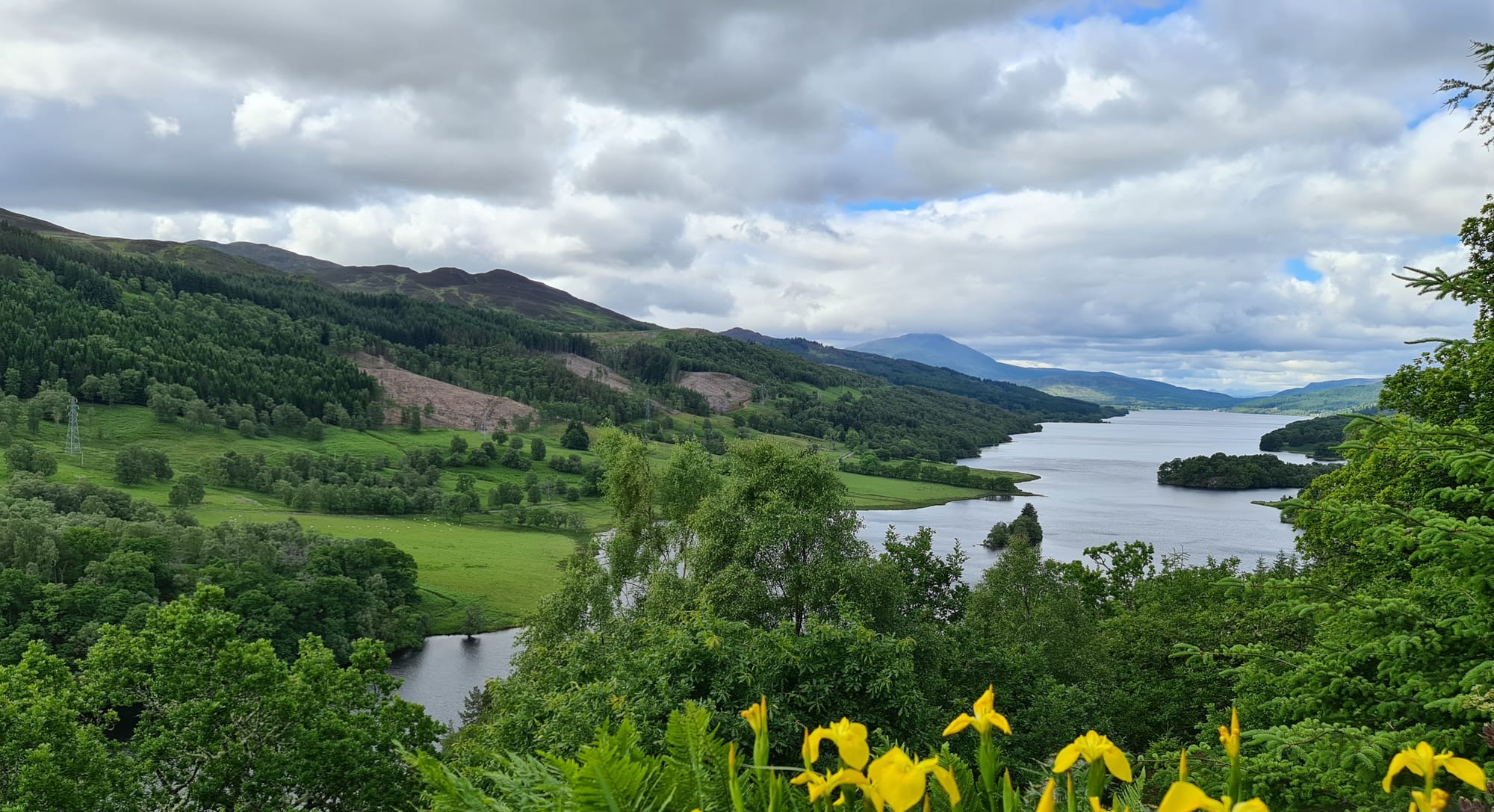
A long loch with small wooded islands winding between forested hills under a cloudy sky, yellow irises in front

United Kingdom

Perthshire, Aberdeen & Eastern Scotland

Loch Tummel from the Queen's View near Pitlochry in Highland Perthshire. (Chris Morgan / Wikimedia Commons · CC BY-SA 2.0)

Scotland's eastern side, from the wooded glens of Perthshire through Dundee and the farmland and glens of Angus to Aberdeen, Royal Deeside and the whisky country of Speyside in Moray. It was the Pictish heartland and the site of Scotland's coronations, and today it is shaped by North Sea oil, farming, fishing and malt whisky.

Explore Perthshire, Aberdeen & Eastern Scotland

History

This was the heartland of the Picts, whose carved symbol stones still stand at Aberlemno and elsewhere in Angus and Aberdeenshire. By the 9th century the Picts and the Gaelic Scots had merged into the kingdom of Alba, and Scone, outside Perth, became its ceremonial centre, where kings were inaugurated on the Stone of Destiny until Edward I carried it off in 1296. In 1320 Scottish barons sealed the Declaration of Arbroath at the abbey there, asserting the kingdom's independence to the Pope.

Perth was a leading royal burgh in the Middle Ages, and Aberdeen grew as a trading port whose university, King's College, was founded in 1495. The north east was royalist and Episcopalian in the 17th century, and the Jacobites drew strong support here: John Graham of Claverhouse, Viscount Dundee, won at Killiecrankie in 1689 but died in the battle.

The 19th century brought change on two fronts. Dundee boomed on whaling and jute, spun from Indian fibre, alongside marmalade and publishing, while Queen Victoria's love of Deeside and the building of Balmoral in the 1850s made the Highland estates fashionable. From the 1970s North Sea oil transformed Aberdeen into Europe's offshore energy capital, bringing wealth, rising prices and, after oil prices fell in 2014, a painful downturn. Dundee has since reinvented itself through design, universities and video games.

Culture & Customs

The north east has its own voice: the Doric, a broad form of Scots, is heard in Aberdeen and its hinterland, with "fit like?" as a greeting and "quine" for girl. Farming and fishing communities along the Buchan coast have a reputation for plain speaking and strong church traditions, and the Moray and Aberdeenshire fishing towns were long centres of church life, including Brethren congregations.

Highland Perthshire and Deeside are Highland games country. Summer gatherings bring caber tossing, hammer throwing, pipe bands and Highland dancing, and the Braemar Gathering is traditionally attended by the monarch. Blair Castle is home to the Atholl Highlanders, the duke's ceremonial regiment. Stonehaven marks Hogmanay by swinging balls of fire through its streets.

Dundee's culture has a creative bent: it is the home of D. C. Thomson, the publisher of the Beano and the Dandy, and a UNESCO City of Design. Pitlochry has its Festival Theatre, Perthshire has a summer fiddle and folk scene, and whisky, with its coopers and stillmen, is as much a craft tradition as an industry in Speyside.

Daily Life

Around a million people live in the region. Aberdeen has about 200,000, Dundee about 150,000 and Perth nearly 50,000; the rest live in market and fishing towns such as Arbroath, Montrose, Forfar, Stonehaven, Inverurie, Peterhead, Fraserburgh and Elgin, and on farms and estates.

Aberdeen's economy still turns on oil and gas, now shifting towards offshore wind and the energy transition, and the future of the North Sea is the region's biggest political question. Peterhead and Fraserburgh are among the UK's busiest fishing ports, Aberdeenshire and Angus grow barley, potatoes and soft fruit, and Speyside's distilleries and cooperages employ thousands. Dundee relies on universities, health research and games studios, and Perthshire on tourism, farming and estates.

Life is quieter than in the Central Belt. Aberdeen has an affluent, car-owning culture, and rural days follow the farming calendar, the fishing fleet and the tourist season.

Food

The coast gives the region's most famous foods. The Arbroath smokie is a haddock salted and hot-smoked in pairs over hardwood, and Cullen skink, from the Moray village of Cullen, is a thick soup of smoked haddock, potato and onion. Aberdeen Angus cattle were bred in these counties and give the region its beef.

Baking is distinctive. The Aberdeen buttery, or rowie, is a flaky, salty, very rich roll; the Forfar bridie is a meat turnover filled with minced steak, sometimes with onion. Dundee gave the world marmalade on a commercial scale and the almond-topped Dundee cake. Skirlie, oatmeal fried with onion, is a traditional side dish, and the berry fields around Blairgowrie and the Carse of Gowrie supply much of Scotland's raspberries and strawberries. Walkers shortbread is made at Aberlour on the Spey.

Speyside has the densest cluster of malt whisky distilleries in Scotland — names such as Glenfiddich and Balvenie in Dufftown, Macallan near Craigellachie, Glenlivet and Aberlour — and its whiskies are typically lighter and sweeter than those of the islands. Deeside has Royal Lochnagar, Perthshire distilleries include Glenturret at Crieff and Blair Athol at Pitlochry, and BrewDog began in Fraserburgh.

Attractions & Natural Wonders

In Perthshire, Perth has Scone Palace and the Moot Hill where kings were crowned. North on the Tay, Dunkeld has its part-ruined cathedral and the Hermitage woodland, and Pitlochry has its salmon ladder and Festival Theatre, with the Pass of Killiecrankie, Blair Castle and the Queen's View over Loch Tummel nearby. Further west lie Loch Tay, Aberfeldy and the mountain of Schiehallion, and in Kinross the island castle on Loch Leven where Mary, Queen of Scots was held.

Dundee's waterfront pairs the V&A Dundee with the RRS Discovery, the ship that carried Scott to Antarctica, built in the city. In Angus are Arbroath Abbey, Glamis Castle, Kirriemuir, J. M. Barrie's birthplace, and the Angus glens: Glen Clova and Glen Doll for hill walking, with Glen Isla, Glen Prosen and Glen Esk alongside.

Aberdeen offers its granite Marischal College, Old Aberdeen and the fishing quarter of Footdee. Nearby, Dunnottar Castle stands on a clifftop south of Stonehaven, and Royal Deeside runs west past Crathes and Drum to Ballater, Balmoral and Braemar, beneath Lochnagar and the Cairngorms. Aberdeenshire's castle trail adds Craigievar and Fyvie. In Moray, the Speyside whisky trail links Dufftown, Craigellachie and Aberlour, and Elgin has a ruined cathedral.

Cities in Perthshire, Aberdeen & Eastern Scotland

Planning basics

Budget

The east is generally cheaper than Edinburgh and the western Highlands. Aberdeen's hotels, once priced for the oil industry, have become better value since the 2014 downturn, and Dundee and Perth are moderate. Distillery tours, castle tickets and rural B&Bs in Deeside and Speyside are the main costs, and a car is close to essential in the glens.

Daily Budget Midrange
USD 170–320 (country hotel or B&B, restaurant dinners, distillery tours and castles, a hire car)
Daily Budget Shoestring
USD 75–120 (hostel or budget B&B, pub meals, trains and buses)

Book distillery tours in advance in summer, and base in Aberdeen or Perth for good-value rooms.

Safety

This is one of the safest parts of the UK. The main risks are rural: deer on the roads at dusk, black ice on the high passes, fast-changing mountain weather in the glens and Cairngorm foothills, and cold, powerful seas along the cliff coast. City centres are calm, with the usual weekend nightlife.

Carry proper clothing and a map for hill walks and keep back from cliff edges on the coast. Check current official travel advice before travelling.

Climate

The east lies in the lee of the mountains and is drier and often sunnier than western Scotland, but cold North Sea air brings haar to the coast and a sharp wind to Aberdeen. Inland, upper Deeside around Braemar is among the coldest places in Britain in winter, and the high roads over Glenshee and the Lecht are often closed by snow.

Summer
mild, about 15–20°C, with long evenings; cooler on the coast
Winter
cold, about 0–6°C, with frost and heavy snow in the glens and on the high passes

Transportation

Trains link Edinburgh and Glasgow with Perth, Dundee and Aberdeen, and the Highland Main Line runs from Perth through Dunkeld, Pitlochry and Blair Atholl towards Inverness; the Aberdeen–Inverness line serves Elgin and Keith in Moray. Aberdeen and Dundee have airports. Buses reach Deeside and Speyside, but the Angus glens and the distilleries are much easier by car.

Choose a designated driver or a guided tour for the distillery trail, and check the snow gates before crossing Glenshee in winter.

Best Time to Visit

May to September suits walking, castles and the glens, and July and August bring the soft-fruit harvest and the Highland games, including the Braemar Gathering in early September. The Spirit of Speyside whisky festival is held in spring. Autumn colour in Highland Perthshire is a draw in October, while winter brings skiing at Glenshee.