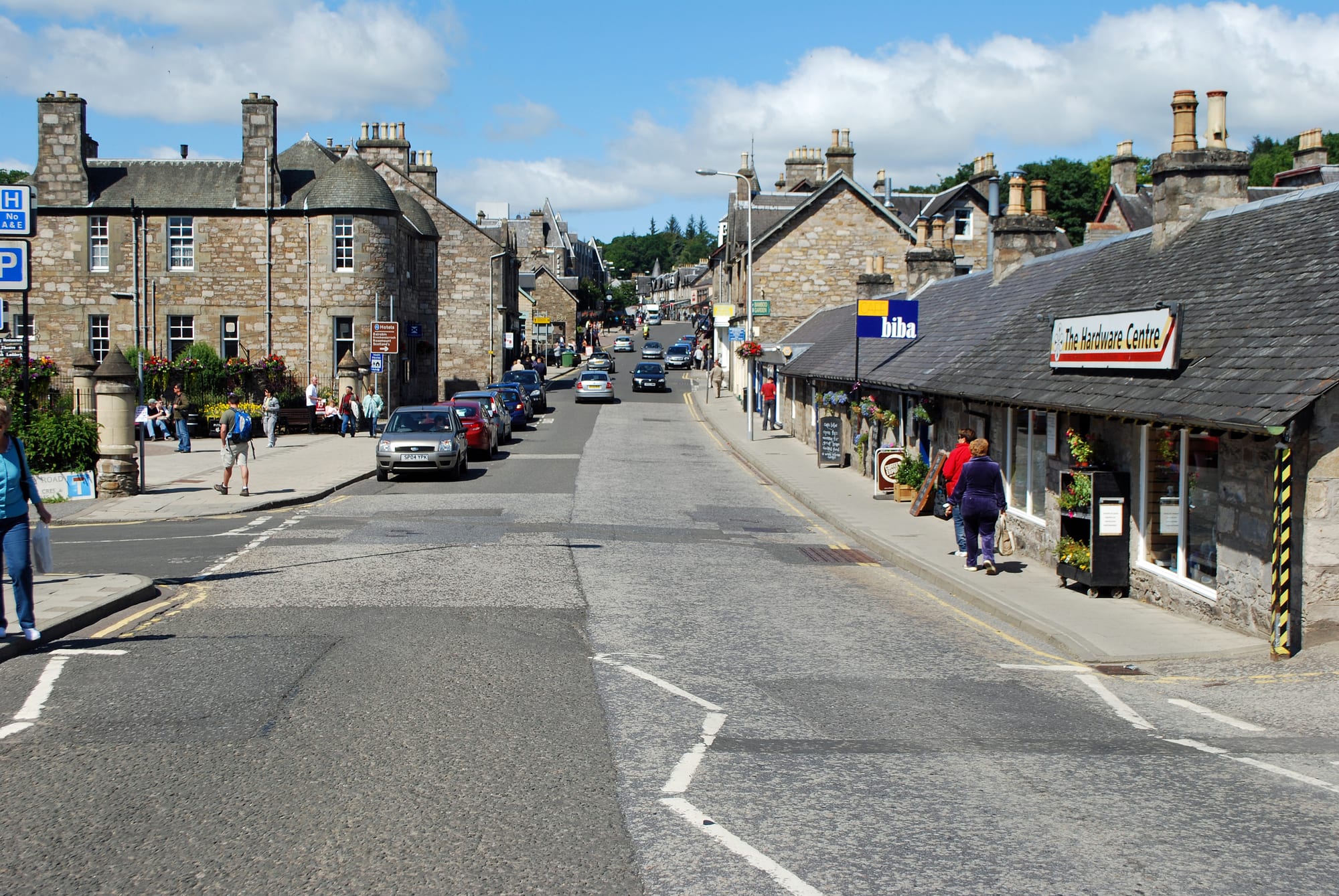
A sunny main street of grey stone Victorian buildings and low shops, with wooded hills beyond

Perthshire, Aberdeen & Eastern Scotland, United Kingdom

Pitlochry

Atholl Road, Pitlochry's main street, looking north-west through the town centre. (Brian Toner / Wikimedia Commons · CC BY-SA 2.0)

A small Victorian market town on the River Tummel in Highland Perthshire, which grew into a resort after Queen Victoria's visit of 1842 and the railway of 1863. Stone villas, a high street with a cast-iron canopy, a hydro-electric dam with a salmon ladder, a festival theatre and two whisky distilleries make it a base for the hills and glens around.

Neighbourhoods

  • Town centre and Atholl Road
    • First-time visitors
    • Close to public transport

    The Victorian main street, which follows the line of the 18th-century military road north, lined with stone buildings, shops and places to eat, and with a period cast-iron canopy over one side. The railway station on the Highland Main Line is a short walk away.

    Open in Maps
  • Port-na-craig and the riverside
    • Theatre
    • Riverside walks

    The old ferry crossing on the south bank of the Tummel, reached from the town by a suspension footbridge built in 1913. The Festival Theatre stands here, and paths lead along the river to the dam and Loch Faskally.

    Open in Maps
  • Moulin
    • Quiet and residential
    • Walking

    The older village on the slope above the town, a burgh of barony from 1511, with its kirk, a small brewery and the start of the path up Ben Vrackie. Robert Louis Stevenson stayed at a cottage here in 1881.

    Open in Maps

Things to do

In the town

  • Pitlochry Dam and fish ladderattraction

    The dam of the Tummel hydro-electric scheme, completed in 1951, with a 310-metre salmon ladder through which thousands of salmon pass each year; the visitor centre shows video of the fish in the ladder.

    Open in Maps
  • Pitlochry Festival Theatreattraction

    A theatre founded by John Stewart in 1951 in a tent, which moved into its present riverside building at Port-na-craig in 1981.

    Open in Maps
  • Blair Athol Distilleryattraction

    A Highland malt distillery on the south edge of the town, whose whisky goes into Bell's blends and is also bottled as a 12-year-old single malt; it has a visitor centre.

    Open in Maps
  • Edradour Distilleryattraction

    A very small traditional distillery east of the town at the foot of Moulin Moor, owned since 2002 by the independent bottler Signatory.

    Open in Maps
  • Dunfallandy Stonelandmark

    A carved Pictish cross-slab of the 8th century near the town, protected in a glass case.

    Open in Maps

Walks and the outdoors

  • Loch Faskallypark

    The reservoir created by the Pitlochry dam, which flooded a large area north of the town; it lies between steeply wooded hills.

    Open in Maps
  • Faskally Forestpark

    A mixed woodland beside the loch, first laid out as a model woodland in the 19th century and known for its autumn colours.

    Open in Maps
  • Ben Vrackietrail

    The hill above Moulin, 842 metres high, climbed on a path through woodland and open heath from the village.

    Open in Maps

Short trips from the town

  • Pass of Killiecrankieviewpoint

    A wooded gorge at the lower end of Glen Garry, part of the Loch Tummel National Scenic Area and the scene of the Jacobite victory of 1689.

    Open in Maps
  • Blair Castlelandmark

    The castle of the Dukes of Atholl at Blair Atholl, home of the Atholl Highlanders, the duke's private army.

    Open in Maps
  • Loch Tummel and the Queen's Viewviewpoint

    A long, narrow loch north-west of the town, part of a National Scenic Area, seen from the Queen's View on its north shore, made famous by Queen Victoria in 1866.

    Open in Maps
  • Dunkeld Cathedrallandmark

    The part-ruined medieval cathedral of Dunkeld, on the banks of the Tay to the south.

    Open in Maps

Seasonal events

  • Winter Words Festivalearly February

    A ten-day literary festival, first held in 2004, with most events at the Festival Theatre.

  • Vale of Atholl Pipe Band eveningsMonday evenings in summer

    A traditional evening of pipe music, dancing and song that begins and ends with a short parade along the high street.

  • Pitlochry Highland Gamessecond Saturday of September

    Held every year since 1852 and the last event of the Scottish Highland games calendar, ending with a massed pipe band parade.

  • The Enchanted ForestOctober into November

    A sound and light show in Faskally Forest that draws tens of thousands of visitors to the town.

Eat and drink

Long-standing places and food districts in Pitlochry. Hours, ratings and directions come from your maps app, always current.

Pitlochry classics

  • Blair Athol Distillerycafe

    The town's own distillery, with a visitor centre; its whisky is bottled as a 12-year-old single malt.

    Open in Maps
  • Moulin Breweryrestaurant

    A small brewery in Moulin making ales such as Ale of Atholl and Braveheart, sold in the public bar beside it.

    Open in Maps

Food streets

  • Atholl Roadneighborhood

    The main street holds most of the town's restaurants, pubs, cafés and takeaways, from pub food and fish and chips to Italian and Chinese.

    Open in Maps
  • Ferry Road and Port-na-craigneighborhood

    Restaurants along Ferry Road, the road down to the river and the Festival Theatre.

    Open in Maps

Experience Pitlochry

History

Pitlochry is largely a Victorian creation, but it grew between two much older places. Moulin, on the slope above, had a medieval kirk that was granted to the monks of Dunfermline Abbey, and became a burgh of barony in 1511; Port-na-craig, on the Tummel, was the site of the ferry across the river, which ran until a suspension footbridge replaced it in 1913. In the 18th century the military road north was built between them, and the present main street follows its line. The parish school at Moulin was attended by Alexander Mackenzie, later the second Prime Minister of Canada.

Queen Victoria's tour of Perthshire in 1842 drew attention to the area, and the arrival of the railway in 1863 made Pitlochry a favoured destination for tourists. Robert Louis Stevenson spent part of 1881 here and at Moulin, where he worked on stories including "Thrawn Janet". The town became a burgh in 1947, and the same year work began on a dam on the Tummel as part of the hydro-electric scheme; completed in 1951, it created Loch Faskally and flooded the old recreation park north of the town.

The postwar years also gave Pitlochry its theatre, founded in a tent in 1951 and moved to a purpose-built home by the river in 1981, the year the A9 was diverted onto a bypass. The town won a gold medal and its category in Britain in Bloom in 2009, and it remains above all a tourist resort.

Culture & Customs

Theatre is Pitlochry's distinctive cultural institution. The Festival Theatre, which spent its first thirty years under canvas, has its main season in summer, and it also hosts the Winter Words literary festival each February. In October the Enchanted Forest sound and light show in Faskally Forest brings tens of thousands of visitors and was named Scotland's best cultural event three years running, from 2011 to 2013.

The town keeps up Highland traditions with some pride. On summer Monday evenings the Vale of Atholl Pipe Band leads a parade along the high street and an evening of music, dancing and song, and the Pitlochry Highland Games, held since 1852 on the second Saturday of September, close the Scottish games season with a pipe band championship and a massed parade. The Vale of Atholl Football Club, founded in 1879, and the Atholl Highlanders rugby team play at the Recreation Park.

Local identity is bound up with Atholl, the old district of the Dukes of Atholl, and with the hills around — Ben Vrackie and Schiehallion are part of the town's view and its walking culture.

Daily Life

About 2,700 people lived in Pitlochry at the 2022 census, slightly fewer than in 2011. It is an older town than most: at the 2011 census nearly three in ten residents were 65 or over, compared with about one in six across Scotland. The town is part of the Perth and Kinross council area.

Tourism shapes the working year. Coach holidays, theatre-goers, walkers and whisky visitors fill the guesthouses and shops of Atholl Road from spring to autumn, the two distilleries and the hydro-electric station are local employers, and the station bookshop on Platform 1, set up in 2005, is a small local landmark. Winter is quieter, and many residents work in the hospitality trade that rises and falls with the seasons.

Daily life is that of a small Highland town: a main street of shops and cafés, churches of several denominations, the leisure centre and the Recreation Park, and paths straight from the town into woodland and up the hills.

Food

Whisky is the town's best-known product. Blair Athol, on the south edge of town and dating back to 1798, has belonged to Bell's since 1933 and is now part of Diageo; its whisky is used in Bell's blended whisky, and it is also bottled as a 12-year-old single malt. Edradour, east of the town, is a tiny traditional distillery producing only a few casks a week, owned by the independent bottler Signatory, which is also based in Pitlochry. In Moulin a small brewery makes ales including Ale of Atholl and Braveheart.

On the plate, Pitlochry's restaurants draw on Scottish home cooking. Cullen skink is a thick Scottish soup of smoked haddock, potatoes and onions, and cranachan, a dessert of cream, raspberries, oats and whisky, was originally made to celebrate the raspberry harvest in August.

Most eating happens along Atholl Road and on Ferry Road towards the theatre, where pubs and restaurants serve fish and chips and Italian and Chinese food; Indian and Thai restaurants lie a short way off. A small market is held on the third Saturday of the month from April to November.

Planning tools

Budget

Pitlochry is a coach-tour and theatre town, and rooms are the main cost; they fill up for the summer theatre season, the Highland Games and the Enchanted Forest in October. Eating out is moderately priced, and the walks, the dam and the riverside are free. Distillery tours and trips to the castles beyond the town add to the bill.

Daily Budget Midrange
USD 170–300 (B&B or guesthouse, restaurant dinners, a theatre ticket, distillery tours)
Daily Budget Shoestring
USD 75–120 (hostel bed or budget B&B, pub meals and takeaways, trains and buses)

Book rooms early for the Highland Games weekend and the Enchanted Forest season.

Best Time to Visit

May to October. The Festival Theatre's main season is in summer, the Highland Games close the Scottish season in September, and October brings autumn colour in Faskally Forest and the Enchanted Forest light show. Winter is quiet and cold, with ice on the hill paths.

Suggested Number of Days

The town itself needs a day or two. Allow three or four to take in the hills, glens and castles of Highland Perthshire around it; a hire car or careful use of the local buses and trains makes the difference.

First Visit
1–2 days
With Surroundings
3–4 days

Transportation

The town centre is small and walkable. Local buses run north to Killiecrankie and Blair Atholl and south to Dunkeld and Perth, but they are infrequent, and a car is the easiest way to reach the glens and viewpoints. Bikes can be hired in the town, and the old road through the Pass of Killiecrankie is a scenic route by bike.

Check bus times in advance — rural services run only a few times a day, and fewer on Sundays.

Airport & Station Connections

Pitlochry lies 26 miles north of Perth and has been bypassed by the A9 Perth–Inverness road since 1981. Its station is on the Highland Main Line, with trains from Edinburgh and Glasgow via Perth that continue to Aviemore and Inverness, and the overnight Highland Sleeper from London Euston stops here. Citylink coaches run along the A9 from Edinburgh, and Flixbus coaches from Edinburgh and Glasgow.

Walkability

Very walkable. The station, the high street, the footbridge to the theatre and the dam are all within a few minutes of each other, and a network of paths leads out to Moulin, Loch Faskally and the woods. Hill paths such as Ben Vrackie need boots and become icy in winter.

Safety

The UK is generally safe, with the main risks being pickpocketing and phone theft in crowded parts of London and other cities, occasional late-night antisocial behaviour, and drink-related trouble around nightlife. Pitlochry itself is a quiet resort town; the real hazards are on the hills and rural roads, where the weather changes fast and deer cross at dusk.

Carry warm layers and a map on hill walks and drive carefully on country roads at dusk. Check current official travel advice before travelling.

Climate

A maritime climate with mild summers and cool winters, like the rest of the British Isles, and the town is notable for one day's range: on 9 May 1978 the temperature rose from −7°C in the morning to 22°C in the afternoon, one of the biggest daily ranges recorded in the UK.

Summer
mild, with long evenings — the warmest day of a typical year reaches about 26°C
Winter
cool to cold — the coldest night of a typical year falls to about −11°C

Local Customs

Pitlochry is a Highland resort used to visitors, with many older travellers and coach parties, and a strong pipe-band and Highland games tradition. Life is unhurried and polite. Taxi fares paid in cash are often rounded up, though not every driver expects it.

Distilleries ask visitors who plan to taste the whisky to make suitable transport arrangements rather than drive.

Common Payment Methods

The currency is the pound sterling. The Bank of Scotland, the Royal Bank of Scotland and Clydesdale Bank issue their own sterling notes, which can be difficult to change outside the UK. Visa and Mastercard are accepted by most shops and restaurants, American Express less often, and a contactless Visa or Mastercard card is recommended. Cash machines are easy to find.