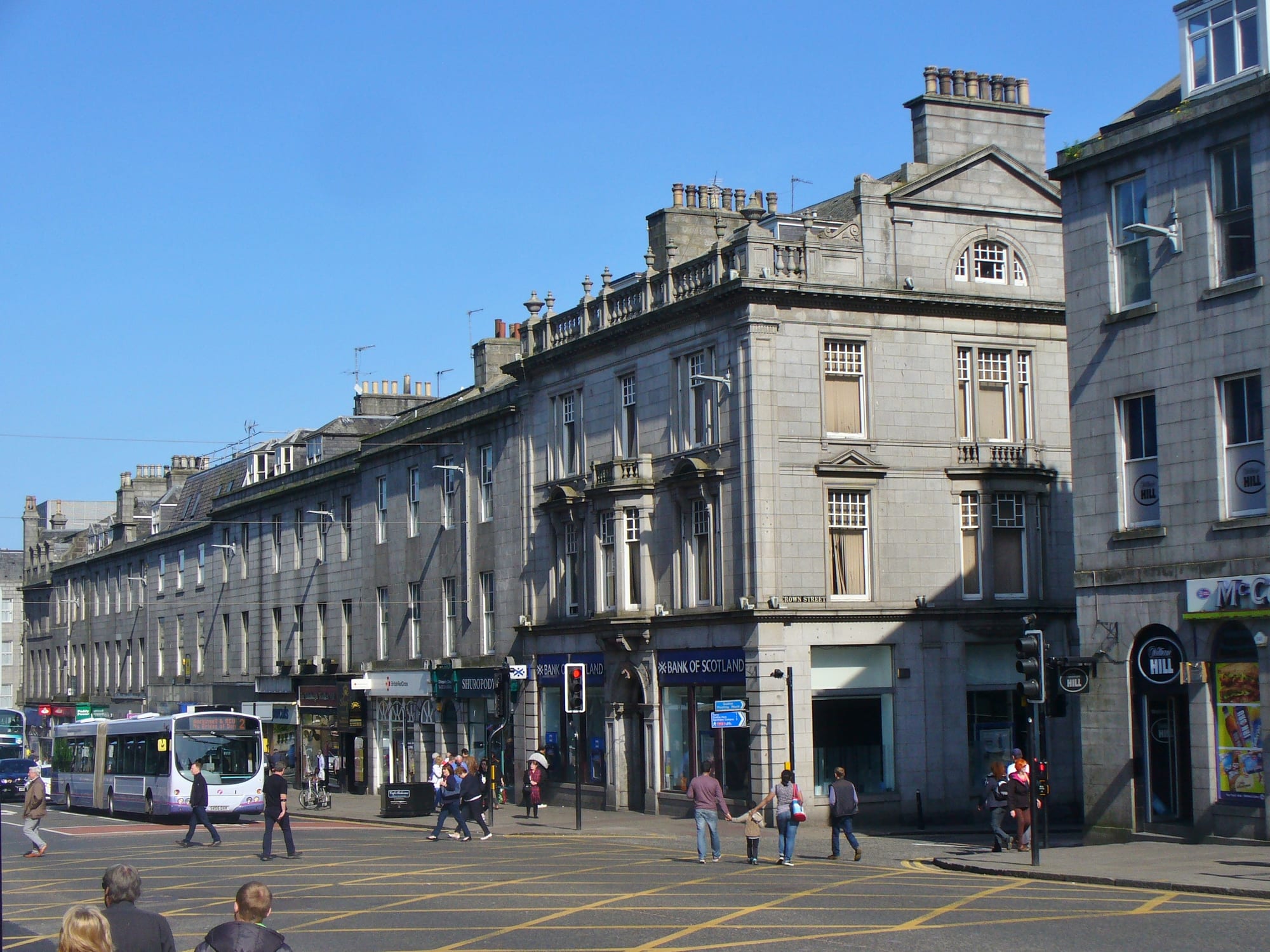
Grey granite buildings with balustrades and chimneys along a busy street corner under a clear blue sky, with a bus passing

Perthshire, Aberdeen & Eastern Scotland, United Kingdom

Aberdeen

Granite buildings on Union Street, Aberdeen's main street. (Colin Smith / Wikimedia Commons · CC BY-SA 2.0)

Scotland's third city, a port between the mouths of the Dee and the Don on the North Sea coast. A medieval royal burgh and university town built in local grey granite from the mid-18th to the mid-20th century, it grew rich on fishing and shipbuilding and, since the discovery of North Sea oil in 1969, as the offshore oil capital of Europe.

Neighbourhoods

  • City centre and Union Street
    • First-time visitors
    • Close to public transport
    • Shopping

    The granite main street running west from the Castlegate, lined with shops and the Music Hall, with the Town House at its eastern end on Castle Street. The railway and bus stations and the Union Square shopping centre lie just south, and Belmont Street, just north of it, is the city's main drinking strip.

    Open in Maps
  • Old Aberdeen
    • Historic district
    • Students
    • Quiet streets

    One of the two burghs the city grew from, near the mouth of the Don and separate until 1891. Its streets lead past King's College, founded in 1495, to St Machar's Cathedral and Seaton Park, with the medieval Brig o' Balgownie beyond.

    Open in Maps
  • Footdee and the beach
    • Seaside
    • Walks
    • Seafood

    Fittie, the fishing village laid out in 1808–9 at the harbour mouth, with cottages around small squares. North of it the beach curves towards the mouth of the Don, with a funfair, an ice rink and a leisure centre along it.

    Open in Maps
  • Rosemount
    • Local life
    • Independent shops

    An area reached from the centre over Rosemount Viaduct, past His Majesty's Theatre, with small shops lining almost the whole of Rosemount Place, among them butchers, fishmongers, cheese shops and bakers.

    Open in Maps
  • Torry
    • Harbour views
    • Local life

    The district on the south bank of the Dee, absorbed into the city in 1891, looking across the harbour. The Torry Battery, an artillery battery, has overlooked the harbour from here since 1860.

    Open in Maps

Things to do

Granite landmarks

  • Marischal Collegelandmark

    The university college founded in 1593, whose building, extended between 1893 and 1906, is the second largest granite building in the world; since 2011 it has been the headquarters of Aberdeen City Council.

    Open in Maps
  • King's Collegelandmark

    The founding college of the University of Aberdeen in Old Aberdeen, founded in 1495.

    Open in Maps
  • St Machar's Cathedrallandmark

    The medieval cathedral of Old Aberdeen, whose heraldic ceiling and western spires are the work of Bishop Gavin Dunbar; it is now a Church of Scotland church.

    Open in Maps
  • Aberdeen Town Houselandmark

    The towered civic building on Castle Street, designed by Peddie and Kinnear in the Scottish baronial style and completed in 1874.

    Open in Maps
  • Brig o' Balgownielandmark

    A 13th-century bridge of granite and sandstone over the Don, with a single Gothic arch — the oldest standing bridge in Scotland.

    Open in Maps

Museums

  • Aberdeen Art Gallerymuseum

    Works from Raeburn, Hogarth and Reynolds to Paul Nash, Francis Bacon, the Post-Impressionists and the Scottish Colourists, with applied arts, in a building that reopened in November 2019 after renovations begun in 2015.

    Open in Maps
  • Aberdeen Maritime Museummuseum

    A museum of the city's links with the sea, on the historic Shiprow near the harbour.

    Open in Maps
  • Provost Skene's Housemuseum

    A house built in 1545, now a museum.

    Open in Maps

Parks and the coast

  • Duthie Parkpark

    A Victorian park beside the Dee, opened in 1883, with the David Welch Winter Gardens and the start of the Deeside Way path.

    Open in Maps
  • Seaton Parkpark

    Former private grounds beside St Machar's Cathedral, bought for the city in 1947, running down to the Don.

    Open in Maps
  • Aberdeen Beachbeach

    A long sandy beach and esplanade running north from Footdee towards the mouth of the Don.

    Open in Maps

Music, sport and nights out

  • His Majesty's Theatreattraction

    The city's main theatre on Rosemount Viaduct, staging touring drama, musicals, opera and pantomime.

    Open in Maps
  • Music Hallattraction

    The main concert hall, on Union Street, built in 1822.

    Open in Maps
  • Pittodrie Stadiumattraction

    Home of Aberdeen FC, the Dons, winners of the European Cup Winners' Cup in 1983 and the Scottish Cup most recently in 2025.

    Open in Maps

Short trips from the city

  • Dunnottar Castlelandmark

    A ruined castle on a sheer clifftop headland south of Stonehaven.

    Open in Maps
  • Crathes Castlelandmark

    A castle on Deeside, west of the city, one of the stops on the way up the Dee valley.

    Open in Maps
  • Balmoral Castlelandmark

    The royal family's Scottish estate in upper Deeside, bought by Prince Albert, the husband of Queen Victoria, in 1852.

    Open in Maps

Seasonal events

  • SpectraFebruary

    A long weekend of indoor and outdoor illuminated artworks across the city.

  • Aberdeen Jazz Festivalusually March

    Live jazz in several city venues.

  • Nuart Aberdeenspring

    A street-art festival held since 2017, which has left murals across the city centre.

  • Aberdeen Highland Gamesa Saturday in late June

    Highland games in Hazlehead Park in the western suburbs.

Eat and drink

Long-standing places and food districts in Aberdeen. Hours, ratings and directions come from your maps app, always current.

Aberdeen classics

  • Butteries from a local bakerycafe

    The rowie or Aberdeen roll, a flaky, salty bread roll made with butter and lard, said to have been made for fishermen sailing from the harbour.

    Open in Maps
  • Seafood at Footdeeneighborhood

    Restaurants by the harbour mouth and the beach esplanade, including a seafood restaurant on Pocra Quay.

    Open in Maps

Food districts and markets

  • Belmont Streetneighborhood

    The city's main drinking strip just north of Union Street, with pubs, bars and restaurants, and a farmers' market on the last Saturday of the month.

    Open in Maps
  • Castlegate marketmarket

    A general outdoor market on Friday mornings in the old market square at the east end of Union Street.

    Open in Maps
  • Rosemount and the West Endneighborhood

    Independent shops along Rosemount Place, with traditional butchers, fishmongers, cheese shops and bakers, and more along Chapel Street and Rose Street.

    Open in Maps

Experience Aberdeen

History

The medieval city began as two separate burghs: Old Aberdeen at the mouth of the Don, where David I transferred the diocese in 1137, and New Aberdeen, a fishing and trading settlement where the Denburn met the Dee. David I made it a royal burgh, William the Lion confirmed its rights in 1179, and in 1319 Robert the Bruce's Great Charter made it a property-owning, financially independent community; he had destroyed the English-held castle in 1308. The harbour, established in 1136, has been called the oldest business in Britain.

The English burned the town in 1336, but it was rebuilt, and in 1495 King's College gave Old Aberdeen its university; Marischal College followed in 1593. The city was plundered by both sides in the 1640s, and plague in 1687–88 killed 8.5 per cent of its people. Costly building works left the council bankrupt in 1817, but shipbuilding, paper-making, textiles and fishing revived it — local entrepreneurs launched the first steam trawler, and by 1933 Aberdeen was Scotland's top fishing port. From the mid-18th to the mid-20th century it was built in local grey granite, which gave the Granite City its name.

In 1891 the city absorbed Old Aberdeen, Woodside and Torry. A German air raid on 21 April 1943 killed 98 civilians and 27 servicemen. North Sea oil, discovered in 1969, made Aberdeen Europe's offshore oil capital, and in 1988 the Piper Alpha platform disaster killed 165 men. As reserves decline, the city is trying to recast itself as an energy capital rather than an oil one.

Culture & Customs

Aberdeen speaks its own Doric, the north-east's dialect of Lowland Scots, heard in the city and across the countryside around; the local pronunciation of the city's name itself comes out close to "Aiberdeen". The motto Bon Accord and the leopards of the coat of arms turn up everywhere, from shopping centre names to the small cast leopards on the railings of Union Bridge, known as Kelly's Cats.

The city has two universities and a lively arts calendar. The Art Gallery and His Majesty's Theatre anchor the centre, and newer festivals have given the city a different look: Nuart has covered walls with street art since 2017, and Spectra lights up buildings each winter. Aberdeen is also notably secular — at the 2022 census 58 per cent of residents said they had no religion, the highest share of any Scottish city — even though its skyline is full of church spires and it has three cathedrals.

Sport centres on Aberdeen FC, the Dons, who won the European Cup Winners' Cup and the European Super Cup in 1983 and lifted the Scottish Cup for the eighth time in 2025. The university's shinty club, founded in 1861, is the oldest constituted shinty club in the world, and the city's ice hockey team, the Lynx, regularly sells out its home games.

Daily Life

The Aberdeen City council area had an estimated 231,780 people in 2024, about 232,000, and the main urban area about 199,000 in 2020. The city has become more international: by 2022 just over a fifth of residents had been born outside the UK, up from about one in sixteen in 2001.

Energy remains the backbone of the economy. Oil companies keep large offices here, the heliport at Dyce is one of the busiest commercial heliports in the world, and supply ships fill a harbour that also handles fishing boats, ferries to Orkney and Shetland and freight to Scandinavia and the Baltic. Research institutes in agriculture, soil science and fisheries, the University of Aberdeen and Robert Gordon University add jobs and students. Wealth is unevenly spread: one Aberdeen postcode has the second highest number of millionaires of any in the UK.

The city spreads from the granite terraces of the centre to suburbs such as Bridge of Don, Dyce and Cove Bay. The future of the North Sea and the shift towards new energy sources are the city's great debates.

Food

Aberdeen's best-known food is the buttery, also called the rowie or Aberdeen roll: a flaky savoury bread roll made from flour, butter, lard, salt, a little sugar and yeast, with a texture compared to a croissant and a distinct saltiness. Legend says it was made for the fishermen sailing from Aberdeen harbour. Butteries are often toasted and served with jam or butter, golden syrup, or plain with tea. The city also gives its name to the Aberdeen sausage.

The Aberdeen Angus, a small, naturally hornless black or red beef breed, derives from cattle native to the north-eastern counties, Aberdeen among them, and accounted for over 17 per cent of UK beef production in 2018. Cullen skink, a thick soup of smoked haddock, potatoes and onions, is served throughout Scotland.

Footdee, at the harbour mouth, has a seafood restaurant on Pocra Quay and the beach has restaurants in its leisure park, while the pubs, bars and restaurants of Belmont Street and the surrounding lanes form the centre of an evening out. A farmers' market fills Belmont Street on the last Saturday of the month, and a general market is held in the Castlegate on Friday mornings.

Planning tools

Budget

Aberdeen's rooms are the main cost, and the city fills up when the oil industry's Offshore Europe fair is held in September of odd-numbered years. Food and drink cost about the same as elsewhere in Scottish cities. Much of what the city offers — the granite streets, Old Aberdeen, Footdee, the beach and the parks — costs nothing, while day trips to Deeside castles add tickets and transport.

Daily Budget Midrange
USD 170–300 (city-centre hotel, restaurant dinners, a castle or two on Deeside, buses or a hire car)
Daily Budget Shoestring
USD 75–120 (hostel bed or budget room, bakery lunches and pub meals, buses)

Many of the city's pleasures — the granite streets, Old Aberdeen, Footdee and the beach — are free.

Best Time to Visit

May to September, when the parks and gardens are at their best and the days are long — close to eighteen hours of daylight around midsummer. Late June brings the Highland games, and spring the street-art and jazz festivals. Winter days are very short, but February's light festival brightens the city centre.

Suggested Number of Days

Two days cover the city centre, Old Aberdeen and the seafront. Allow four or five for the castles of Deeside, the coast south to Stonehaven and the villages of the Dee valley, which are far easier with a car.

First Visit
2 days
With Surroundings
4–5 days

Transportation

The centre is compact, and local buses connect it with Old Aberdeen, Bridge of Don and the suburbs from the Union Square transport hub beside the railway station. A self-service e-bike hire scheme opened in May 2026. Trains run south via Dundee and inland to Inverurie, Huntly and Inverness, and the Deeside Way path leads west to Banchory and Ballater; a car is the easiest way to see the Aberdeenshire castles.

Buses and trains leave from neighbouring stations at Union Square, beside the ferry terminal.

Airport & Station Connections

Aberdeen International Airport is at Dyce, about 6 miles north-west of the centre, with flights to UK cities and to Scandinavia, the Netherlands, France, Spain and Ireland; Stagecoach's Jet 727 bus runs to Union Square. Trains run from Edinburgh, Glasgow and London, and overnight ferries sail from the harbour to Orkney and Shetland.

Walkability

The centre is easy to walk, with Union Street, the Castlegate, Marischal College and the Maritime Museum close together, and the harbour and Footdee a short walk east. Old Aberdeen is about a mile north — a walk or a short bus ride.

Safety

The UK is generally safe, with the main risks being pickpocketing and phone theft in crowded parts of London and other cities, occasional late-night antisocial behaviour, and drink-related trouble around nightlife. In Aberdeen, the busiest late-night area is around Belmont Street and Union Street at weekends. The sea is cold and powerful, and the beach and harbour wall call for care in rough weather.

Use cash machines inside banks where possible and cover the keypad, and keep away from the water's edge in heavy seas. Check current official travel advice before travelling.

Climate

An oceanic climate with cool summers and mild, rainy winters — milder than its northern position suggests, though statistically Aberdeen is the coldest city in the UK. Daylight swings widely: about 18 hours at midsummer and under 7 at midwinter.

Summer
cool — summer days are around 17°C in most of the city, nearer 16°C on the coast
Winter
cold and dark — the shortest days have under 7 hours of daylight, and the city fell to −16.8°C in December 2010

Local Customs

The north-east has its own dialect of Scots, the Doric. The city motto is 'Bon Accord', said to recall a password used by Robert the Bruce, and it appears on street and business names across the city. Football loyalty to the Dons runs deep.

Taxi fares paid in cash are often rounded up, though not every driver expects it.

Common Payment Methods

The currency is the pound sterling. The Bank of Scotland, the Royal Bank of Scotland and Clydesdale Bank issue their own sterling notes, which can be difficult to change outside the UK. Visa and Mastercard are accepted by most shops and restaurants, American Express less often, and a contactless Visa or Mastercard card is recommended. Banks and cash machines cluster on Union Street and Union Square.