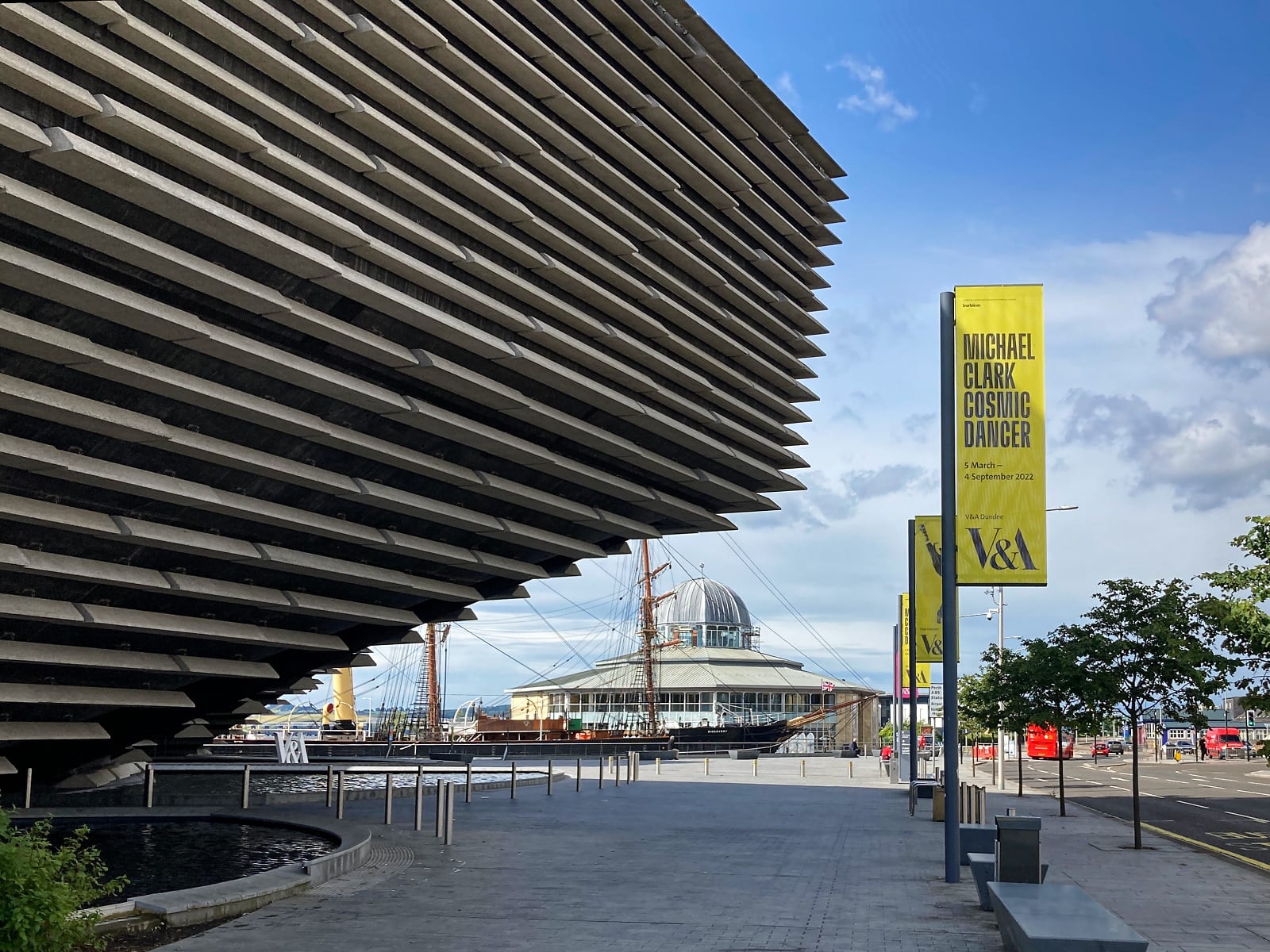
The layered concrete walls of the V&A museum overhang a waterfront walkway, with the masts of a sailing ship beyond

Perthshire, Aberdeen & Eastern Scotland, United Kingdom

Dundee

The V&A Dundee and Discovery Point on the city's regenerated Tay waterfront. (Julian Paren / Wikimedia Commons · CC BY-SA 2.0)

Scotland's fourth city, on the north bank of the Firth of Tay below the volcanic hill of the Law. In the 19th century it was the world centre of the jute industry, the city of 'jute, jam and journalism'; today it is a university and video-games city reinventing its waterfront around the V&A Dundee and Scott's ship Discovery.

Neighbourhoods

  • City centre and the waterfront
    • First-time visitors
    • Museums
    • Close to public transport

    The pedestrian streets around City Square and the Caird Hall, the Overgate and Wellgate shopping centres, and the redeveloped waterfront below, where the V&A, Discovery Point and the railway station stand together beside the Tay.

    Open in Maps
  • West End
    • Students
    • Best for food
    • Nightlife

    The university quarter along the Nethergate, Hawkhill and Perth Road, with Magdalen Green on the river and many of the city's bars and restaurants; Dundee Contemporary Arts and the Rep stand where it meets the centre.

    Open in Maps
  • Broughty Ferry
    • Seaside
    • Quiet and residential
    • Pubs

    A former fishing village and separate burgh about four miles east, absorbed by Dundee in 1913, with a 15th-century castle on the shore, a sandy beach and a main street of shops and pubs.

    Open in Maps
  • Lochee
    • Industrial heritage
    • Local life

    A west-side district built around the Camperdown Works of Cox Brothers, once the largest jute works in the world, whose ornate chimney, Cox's Stack, still stands over the area.

    Open in Maps

Things to do

The waterfront

  • V&A Dundeemuseum

    The first branch of the V&A outside London, opened in September 2018 as the centrepiece of the waterfront project, with a permanent gallery of Scottish design.

    Open in Maps
  • RRS Discoveryattraction

    The ship built in Dundee for Robert Falcon Scott's Antarctic expedition, launched in 1901 and now on display at Discovery Point.

    Open in Maps
  • HMS Unicornattraction

    A 19th-century wooden frigate moored in Victoria Dock, one of the oldest ships afloat.

    Open in Maps
  • Tay Road Bridgelandmark

    The road bridge to Fife, completed in 1966, with a walkway and cycle path across the firth.

    Open in Maps

Museums and the arts

  • The McManusmuseum

    The city's main museum and art gallery, in a Gothic Revival building on Albert Square.

    Open in Maps
  • Verdant Worksmuseum

    A museum of Dundee's jute industry in a former jute mill.

    Open in Maps
  • Dundee Contemporary Artsattraction

    An arts centre on the Nethergate, opened in 1999, with two galleries of modern art, an arthouse cinema and a print studio.

    Open in Maps
  • Mills Observatoryattraction

    The first purpose-built public astronomical observatory in the UK, on the summit of Balgay Hill, built in 1935 with a bequest from the Dundee linen and twine manufacturer John Mills.

    Open in Maps

Hills, parks and the coast

  • Dundee Lawviewpoint

    The 174-metre hill in the middle of the city, site of a Pictish settlement in the Iron Age, with a war memorial on its summit first unveiled in 1925.

    Open in Maps
  • Camperdown Parkpark

    The city's largest park, in the north-west, the former estate of Admiral Duncan's family and a venue for big outdoor music events.

    Open in Maps
  • Broughty Castlelandmark

    A castle completed around 1495 at Broughty Ferry, in military use until 1932, now with a museum.

    Open in Maps

Football

  • Dens Park and Tannadice Parkattraction

    The grounds of Dundee FC and Dundee United, just 100 metres apart — closer together than any other football stadiums in the UK.

    Open in Maps

Short trips from the city

  • Glamis Castlelandmark

    The castle of the Earls of Strathmore in Angus, north of the city.

    Open in Maps
  • Arbroath Abbeylandmark

    The ruined abbey up the coast in Arbroath, where the Declaration of Arbroath was sealed in 1320.

    Open in Maps
  • St Andrewsattraction

    The university and golfing town across the Tay in Fife, with its ruined cathedral and castle.

    Open in Maps

Seasonal events

  • Westfestearly June

    A music festival and community fair on Magdalen Green in the West End.

  • Discovery FestivalJuly

    A music event in Slessor Gardens on the waterfront.

  • Dundeadyearly

    A horror film festival at Dundee Contemporary Arts.

Eat and drink

Long-standing places and food districts in Dundee. Hours, ratings and directions come from your maps app, always current.

Dundee classics

  • Dundee cake from a city bakerycafe

    The traditional Scottish fruit cake named after the city, studded with sultanas and topped with almonds.

    Open in Maps
  • Farmers' market, City Squaremarket

    A farmers' market in City Square on the third Saturday of each month from February to December.

    Open in Maps

Food streets and bars

  • Perth Road and the West Endneighborhood

    Where most of the city's bars are, along Perth Road and Hawkhill, with Indian and Italian restaurants and a bar with a big selection of whisky.

    Open in Maps
  • Nethergateneighborhood

    A second strip of bars and restaurants between the city centre and the West End, near the Rep and Dundee Contemporary Arts.

    Open in Maps
  • Broughty Ferryneighborhood

    Pubs, cafés and restaurants along the main street and seafront of the old fishing village.

    Open in Maps

Experience Dundee

History

Dundee's name joins the Celtic dun, a fort, to an uncertain second element. Its growth as a seaport followed William the Lion's grant of the town to his brother David, Earl of Huntingdon, in the late 12th century, and it became a royal burgh when David's descendant John Balliol was crowned in 1292. English forces held it during the Wars of Independence until Robert the Bruce recaptured it in 1312. It was burned on English orders in 1548, besieged by Montrose in 1645 and sacked by George Monck's Parliamentarian army in 1651. In 1689 John Graham of Claverhouse, Viscount Dundee, raised the Stuart standard on the Law.

Medieval Dundee exported wool; its later fortune was jute. Discovering that the coarse Bengal fibre could be softened with whale oil, which the town's whaling fleet supplied, Dundee built mechanised mills, and at the industry's height it had 62 jute mills employing some 50,000 people, many of them Irish immigrants. Keiller's pioneered commercial marmalade from 1795, and DC Thomson began publishing in 1905: hence "jute, jam and journalism". Shipyards built some 200 ships a year at their peak, including Scott's Discovery. The first Tay Rail Bridge, opened in 1878, collapsed in a storm only 18 months later as a passenger train crossed, killing 75 people.

Dundee became the first Scottish place formally made a city, in 1889. Jute declined in the 20th century, unable to compete with Calcutta; whaling ended in 1912 and shipbuilding in 1981. Manufacturers such as NCR, which chose Dundee in 1945, then the universities, medical research and, from the 1980s, technology industries such as computer games took jute's place, and a £1 billion waterfront plan begun in 2001 produced the V&A Dundee in 2018.

Culture & Customs

In 2014 Dundee became the UK's first UNESCO City of Design, recognised for its contributions to medical research, comics and video games. DC Thomson still publishes The Beano and The Dandy here, and the city's gaming industry goes back to DMA Design, founded by an Abertay University student, which created Lemmings and the Grand Theft Auto series and became Rockstar North.

The arts scene is built around the V&A, the McManus, Dundee Contemporary Arts with its galleries and cinema, and the Rep theatre. Dundee has produced bands from the Average White Band and the Associates to the View, and big outdoor events fill Camperdown Park — BBC Radio 1's Big Weekend came in 2006 and 2023, and the local DJ Hannah Laing has run the Doof in the Park electronic festival there since 2025.

Football divides the city: Dundee FC, founded in 1893, and Dundee United, founded in 1909 as Dundee Hibernian, play at grounds just 100 metres apart. Dundee United reached the UEFA Cup final in 1987. In 2014 Dundee was one of four council areas to vote Yes in the Scottish independence referendum, with 57.3 per cent.

Daily Life

About 150,000 people live in Dundee City, according to a 2020 estimate — down from a peak of about 182,000 at the 1971 census. With two universities and around 20,000 students, roughly one resident in seven is a student, a higher share than in almost any other town in Europe.

The economy has moved from mills to research and technology: the universities, Ninewells Hospital and the School of Medicine, life sciences, software and games studios are major employers, and the city has one of the UK's largest fleets of electric vehicles. Much postwar housing, including high-rise blocks at Lochee, Kirkton and Whitfield, has been demolished since the 1990s, while old mills in the centre have been converted.

Life is lived across a hilly city split by the Law and Balgay Hill: the student West End, the old working-class streets of the Hilltown and Lochee, newer estates to the north and the quieter seaside of Broughty Ferry. The waterfront, long cut off from the centre by roads, is being reconnected, and an Eden Project attraction is planned for the 2030s.

Food

Dundee gave its name to two of Scotland's best-known sweet things. Commercial marmalade production was pioneered here by James Keiller and Sons, founded in 1795, and the Dundee cake is a traditional Scottish fruit cake, rich with sultanas and decorated with almonds. Both are sold in the city's bakeries and delicatessens.

The surrounding countryside supplies much of the rest. The Carse of Gowrie between Dundee and Perth and the fields around Blairgowrie are well known for growing raspberries and strawberries, and the fishing towns of Angus to the north-east produce the Arbroath smokie, a haddock smoked over a hardwood fire. The Forfar bridie, a meat turnover of minced steak, sometimes with onion, comes from the market town just to the north.

Most eating out happens in the West End, where Perth Road and the Hawkhill hold most of the bars, Indian and Italian restaurants and places with a student clientele. The Nethergate has another strip of bars, and Broughty Ferry has pubs and cafés by the shore. A farmers' market fills City Square on the third Saturday of the month from February to December.

Planning tools

Budget

Dundee is one of the cheaper Scottish cities, with moderate hotel prices and a large student population that keeps cafés and bars affordable. The waterfront, the Law, the parks and Broughty Ferry beach are free; the main costs are tickets for Discovery and the attractions, and day trips into Angus or Fife.

Daily Budget Midrange
USD 160–290 (city-centre hotel, restaurant dinners, museum and ship tickets, trains or a hire car for day trips)
Daily Budget Shoestring
USD 70–115 (hostel bed or budget room, café and pub meals, buses)

Stay near the railway station and the waterfront to walk to the main sights.

Best Time to Visit

May to September, when the waterfront and parks are at their best and the summer music events fill Magdalen Green and Slessor Gardens. Winter brings frost on dozens of days, but the museums and galleries make the city a reasonable winter stop.

Suggested Number of Days

One or two days cover the waterfront, the museums and the Law. Allow three or four to add the castles and coast of Angus and a crossing to Fife; rail links make several of these easy without a car.

First Visit
1–2 days
With Surroundings
3–4 days

Transportation

Local buses cover the city and run out to Broughty Ferry. There are five railway stations in the built-up area — Invergowrie, Dundee, Broughty Ferry, Balmossie and Monifieth — and local trains run along the coast towards Carnoustie and Arbroath. Bikes can be hired at a cycle hub beside the V&A, and a flat riverside path runs from the West End past the docks to Broughty Ferry.

The riverside path is the pleasant way to reach Broughty Ferry on foot or by bike.

Airport & Station Connections

Dundee railway station sits on the waterfront opposite Discovery, with trains from Edinburgh, Glasgow, Aberdeen and London. Dundee Airport, about 1.9 miles west of the centre beside the Tay, has Loganair flights to London Heathrow, Kirkwall and Sumburgh; Edinburgh Airport, the nearest major international airport, is about 59 miles south, linked by coaches. From Fife the A92 crosses the Tay Road Bridge into the centre.

Walkability

The compact centre and waterfront are easy on foot, and the station, the V&A, Discovery and City Square are a few minutes apart. The West End is a longer walk west along the Nethergate and Perth Road, and the Law is a steep climb.

Safety

The UK is generally safe, with the main risks being pickpocketing and phone theft in crowded parts of London and other cities, occasional late-night antisocial behaviour, and drink-related trouble around nightlife. In Dundee the busiest late-night streets are in the city centre and the West End at weekends; the waterfront paths are well used by day.

Keep phones out of sight late at night in the centre, and take care on the riverside in strong winds. Check current official travel advice before travelling.

Climate

Temperatures and rainfall typical of Scotland's east coast, with the city's sheltered position on the estuary giving slightly warmer days than the coast to the north, especially in spring and summer. Hot days are rare, and frost is common in winter. A record 30.5°C was reached in July 2022.

Summer
mild — the warmest day of an average year reaches about 25°C, and only one or two days a year pass that mark
Winter
cool, with about 48 days of air frost a year and a few nights each winter at or below −5°C

Local Customs

Football rivalry between Dundee and Dundee United is intense but neighbourly, with grounds a few steps apart. Dundee voted Yes in the 2014 independence referendum, and politics is discussed openly.

Taxi fares paid in cash are often rounded up, though not every driver expects it.

Common Payment Methods

The currency is the pound sterling. The Bank of Scotland, the Royal Bank of Scotland and Clydesdale Bank issue their own sterling notes, which can be difficult to change outside the UK. Visa and Mastercard are accepted by most shops and restaurants, American Express less often, and a contactless Visa or Mastercard card is recommended. Cash machines are easy to find in the centre.