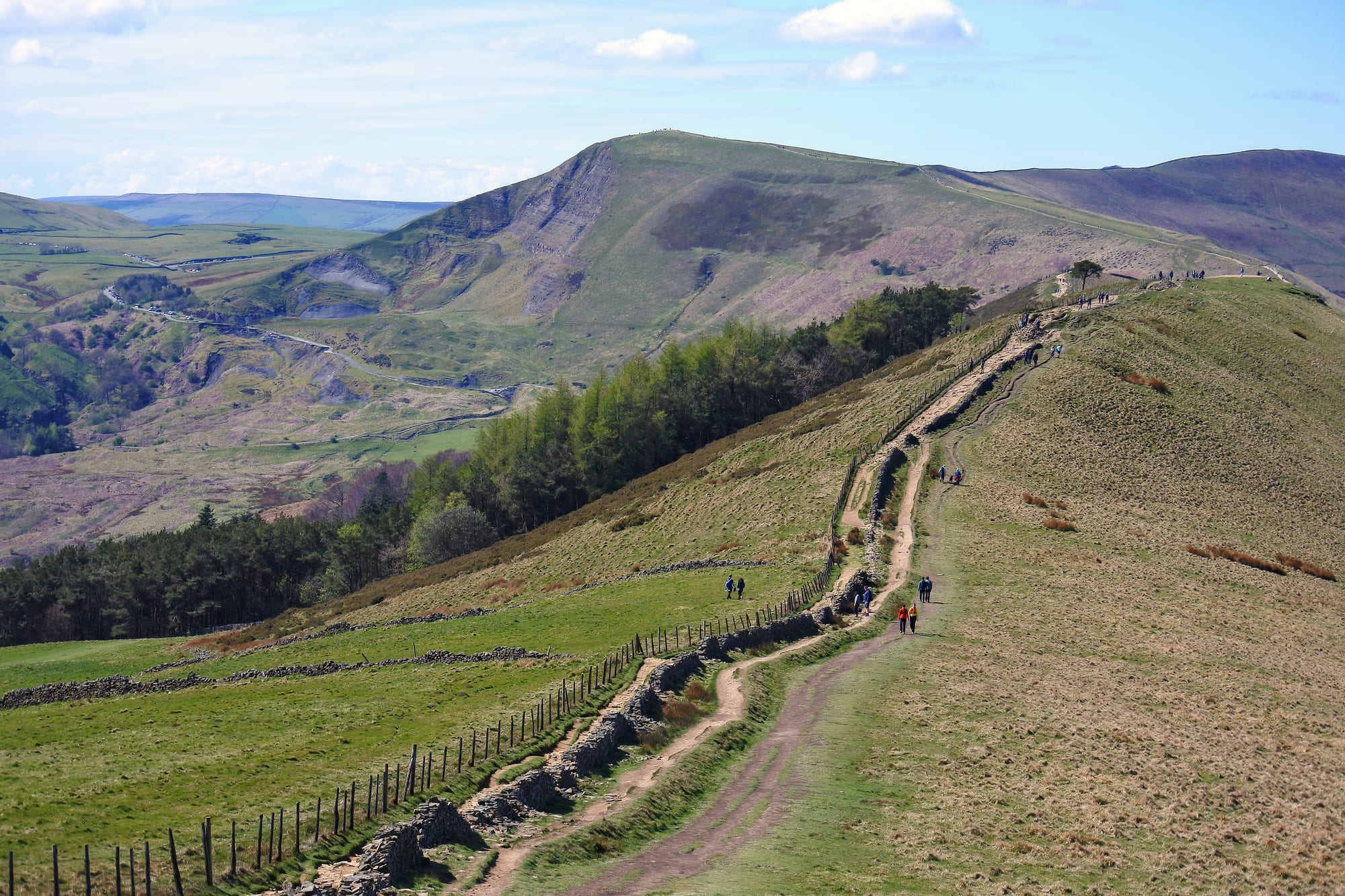
Walkers on a path beside a stone wall along a grassy ridge leading towards the rounded hill of Mam Tor above a green valley

United Kingdom

East Midlands

The Great Ridge path towards Mam Tor, between the Vale of Edale and the Hope Valley in the Derbyshire Peak District. (Donnchadh H / Wikimedia Commons · CC BY 2.0)

The heart of England between the Pennines and the North Sea, covering Derbyshire, Nottinghamshire, Leicestershire, Lincolnshire, Northamptonshire and Rutland — a region of Danish-founded county towns, early factories and coalfields, with the hills of the Peak District in the west and the flat farmland and coast of Lincolnshire in the east.

Explore East Midlands

History

The Romans built Lindum, today's Lincoln, as a legionary fortress and then a colony for veterans; its Newport Arch is still in use as a road gate. After Rome, most of the region became part of the Anglo-Saxon kingdom of Mercia, then fell to the Danes in the 9th century. Derby, Leicester, Lincoln, Nottingham and Stamford became the Five Boroughs of the Danelaw, and Danish place names ending in "-by" and "-thorpe" still cover the map.

After 1066 the Normans built castles at Nottingham and Lincoln, and Lincoln's cathedral, completed in the Middle Ages, was for centuries thought to be the tallest building in the world, until its central spire fell in 1548. Wool made Lincolnshire and Northamptonshire towns rich. In 1485 Richard III was killed at the Battle of Bosworth in Leicestershire, ending the Wars of the Roses, and in 1642 Charles I raised his standard at Nottingham, starting the Civil War.

The region was a cradle of industry. Richard Arkwright's water-powered cotton mill at Cromford in Derbyshire, opened in 1771, became a model for the factory system, and the Derwent Valley Mills are now a UNESCO World Heritage Site. Nottingham grew on lace and stockings, where framework knitters smashed machines in the Luddite protests of 1811, and later on Boots, Raleigh bicycles and tobacco. Coal mining dominated Nottinghamshire and Derbyshire until the pit closures of the 1980s and 1990s. From the 1960s Leicester became home to large numbers of Gujarati Indians, many arriving from East Africa.

Culture & Customs

The East Midlands often feels overlooked, neither North nor South, and locals are known for a dry, modest humour. The accent is its own, and "ey up me duck" is a familiar greeting in Nottingham and Derby. Robin Hood is Nottingham's great legend, with the Sheriff of Nottingham as the villain, and the city is also associated with the writer D. H. Lawrence, born in nearby Eastwood, and Lord Byron, whose family home was Newstead Abbey.

Leicester is one of Britain's most diverse cities, and its Diwali celebrations on Belgrave Road draw very large crowds. The city's discovery of Richard III's skeleton in 2012 and his reburial in 2015 became a national event. Nottingham's Goose Fair, a travelling fair held each October, dates back centuries.

In Derbyshire's villages, the custom of well dressing — decorating wells and springs with pictures made of petals and seeds pressed into clay — takes place through the summer. Isaac Newton was born at Woolsthorpe Manor in Lincolnshire, and the county's farming and RAF heritage, as "Bomber County" in the Second World War, shape its identity. Football pride ran high when Leicester City won the Premier League in 2016, and Nottingham Forest's two European Cups are still remembered.

Daily Life

About 4.9 million people live in the East Midlands. Leicester is the largest city, with about 370,000 people, followed by Nottingham, with about 320,000 within its tight boundaries, Derby, with about 260,000, and Northampton. Lincoln has about 100,000 people, and Chesterfield, Mansfield, Loughborough and Grantham are the other main towns. Rutland, with its towns of Oakham and Uppingham, is tiny.

The economy is more industrial than most of the UK. Derby is home to Rolls-Royce's aero engine works and a large Toyota plant nearby, and has a long railway engineering history. Nottingham has Boots, universities and services; Leicester has food and textile firms; and the M1 corridor is lined with warehouses and distribution centres. Lincolnshire is farming country, growing much of the UK's vegetables and flowers, and its coast depends on seaside tourism at Skegness.

The former coalfield towns still struggle with the loss of mining jobs and poorer health, and the pay gap with the South is a local issue. Nottingham and Leicester have large student populations that shape their city centres.

Food

The East Midlands has produced several of England's best-known foods. Stilton, the blue cheese, has protected status and can only be made in Derbyshire, Leicestershire and Nottinghamshire, and Red Leicester is the county's orange cheese. Melton Mowbray gives its name to the pork pie, with its hand-raised pastry and uncured pork, which also has protected status, and the town calls itself a rural food capital.

Derbyshire's Bakewell pudding is a flaky pastry case with jam and a rich egg and almond filling, different from the iced Bakewell tart sold across Britain. Lincolnshire is known for its sausages flavoured with sage, haslet, a pork meat loaf, stuffed chine, a salt pork chine stuffed with herbs, and Lincolnshire plum bread, a fruit loaf. Grantham gingerbread is a pale biscuit with a hollow, honeycomb-like centre, and the Bramley apple, the classic cooking apple, grew from a seedling in Southwell, Nottinghamshire.

Beer is brewed widely, with Batemans in Wainfleet in Lincolnshire among the older family breweries. Farm shops across Derbyshire and Leicestershire, as well as Nottingham's and Leicester's South Asian restaurants and sweet shops, show the region's range.

Attractions & Natural Wonders

The Peak District, Britain's first national park, fills north-west Derbyshire. The Dark Peak has the gritstone moors of Kinder Scout, where a mass trespass in 1932 helped win access to open land, and the Great Ridge from Mam Tor above Edale. The White Peak has limestone dales such as Dovedale, on the Staffordshire border, the show caves of Castleton, and the spa towns of Buxton and Matlock Bath. Chatsworth, the seat of the Dukes of Devonshire, stands in parkland on the Derwent near Bakewell, with Haddon Hall and Hardwick Hall close by.

Nottingham has its castle, the caves carved into its sandstone and the old Ye Olde Trip to Jerusalem inn below the castle rock. North of the city, Sherwood Forest has the Major Oak near Edwinstowe, with Newstead Abbey, Southwell Minster and the Ice Age cave art of Creswell Crags nearby.

Lincoln has its cathedral, castle and cobbled Steep Hill, and Lincolnshire offers the Wolds, Stamford's stone streets, Boston's tall church tower known as the Stump, and the Skegness coast. Leicester has Richard III's tomb and visitor centre, the National Space Centre and the Bosworth battlefield outside the city. Rutland Water, with its ospreys and Normanton Church on its embankment at the water's edge, lies near Oakham, and Cromford's mills lie in the Derwent Valley.

Cities in East Midlands

Planning basics

Budget

One of the cheaper parts of England. Nottingham, Leicester, Derby and Lincoln have reasonable hotel and restaurant prices, and market towns are good value. The Peak District is the expensive corner at weekends and in summer, when cottages and inns in Bakewell and Castleton fill up, and country houses such as Chatsworth charge high entry fees.

Daily Budget Midrange
USD 160–290 (mid-range hotel or Peak District inn, restaurant dinners, country-house entry, a hire car)
Daily Budget Shoestring
USD 65–110 (hostel or budget hotel, cafe and pub meals, trains and buses)

Stay in a city midweek and visit the Peak District on weekdays, when inns are cheaper and the roads and car parks quieter.

Safety

The region is generally safe. The cities have the usual urban petty crime and weekend nightlife trouble in their centres. The main risks for visitors are in the Peak District: sudden weather changes, fog and boggy ground on the high moors such as Kinder Scout, steep drops on the edges, and narrow, busy roads.

Carry a map, layers and waterproofs on the Peak District moors, and keep to paths near crags and quarry edges. Check current official travel advice before travelling.

Climate

Fairly dry and sheltered in the lowlands, with warm summers — the UK's highest recorded temperature, 40.3°C, was measured at Coningsby in Lincolnshire in July 2022. The Peak District is a different climate: higher, wetter and windier, with fog and snow on the moors in winter. The Lincolnshire coast faces cold North Sea winds.

Summer
warm, 19–25°C in the lowlands, a few degrees cooler on the Peak District hills
Winter
cool and grey, 1–7°C, with frost; snow on the Peak District moors

Transportation

The Midland Main Line from London St Pancras reaches Leicester, Nottingham and Derby; Lincoln is reached via Newark on the East Coast line. East Midlands Airport lies between the three main cities. Nottingham has a tram network. The Peak District has buses and the Hope Valley railway through Edale, but a car helps for the dales and country houses; rural Lincolnshire is thinly served by public transport.

Use the Hope Valley railway to reach Edale and walk from the station rather than driving to crowded car parks at summer weekends.

Best Time to Visit

May to September for walking in the Peak District and for the country-house gardens, with Derbyshire's well-dressing season running through the summer and Chatsworth's grounds at their best. Late spring brings ospreys to Rutland Water. The cities suit any season, with Nottingham's Goose Fair in early October.