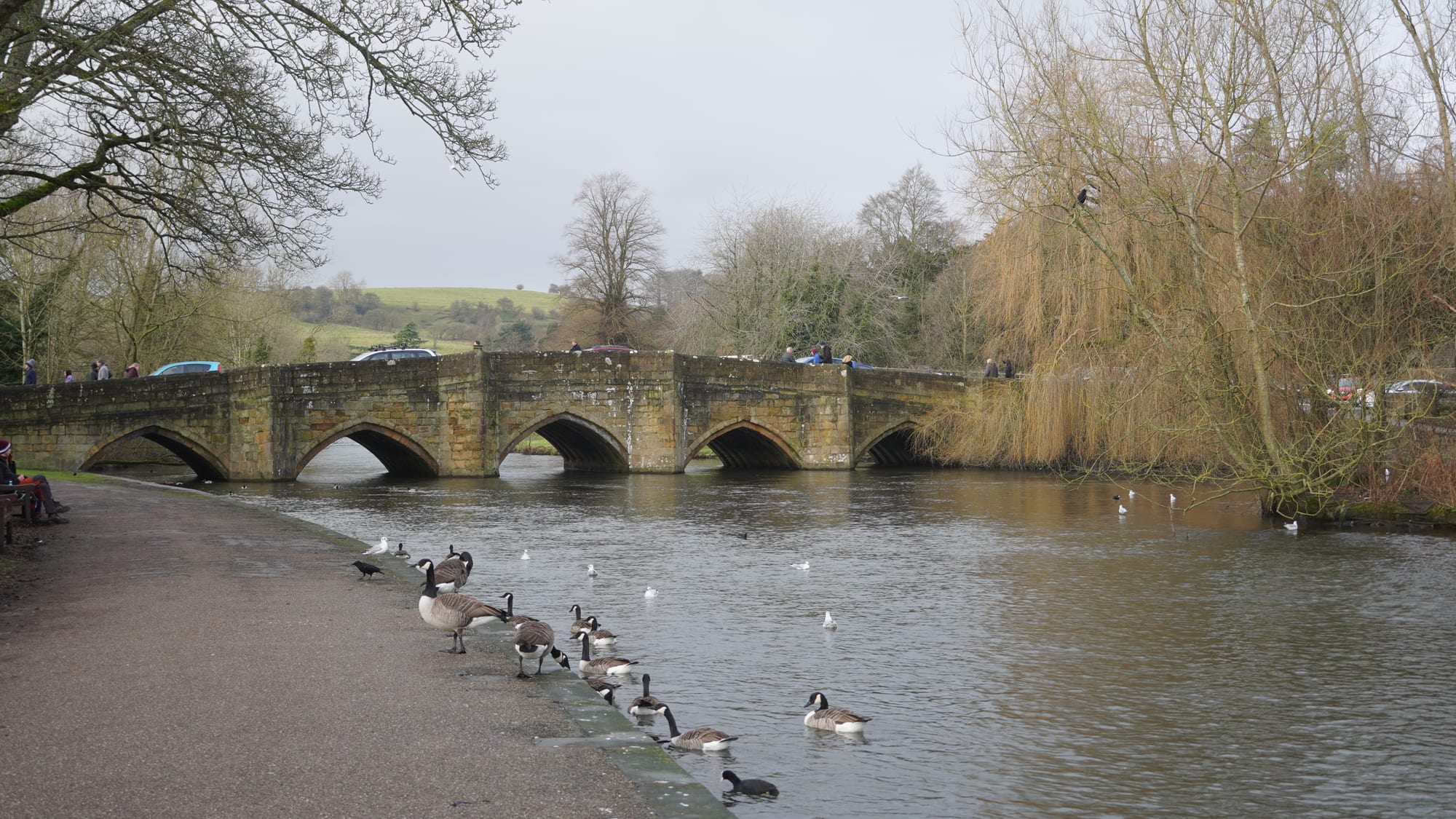
A five-arched medieval stone bridge over a wide, calm river with geese on the riverside path and green hills behind

East Midlands, United Kingdom

Bakewell

The medieval bridge over the River Wye at Bakewell. (Kmtextor / Wikimedia Commons · CC BY-SA 4.0)

A small stone market town on the River Wye in Derbyshire, the largest settlement and only town inside the Peak District National Park. Founded in Anglo-Saxon times and a market town since 1254, it is known for its medieval bridge, its Saxon crosses and the Bakewell pudding, and is the base for Chatsworth House, Haddon Hall and the Monsal Trail.

Neighbourhoods

  • Rutland Square and the town centre
    • First-time visitors
    • Shops and cafés
    • Close to public transport

    The centre of town, lined with handsome Georgian buildings, where the buses stop and the pudding shops, cafés and pubs cluster. There is no bypass, so it is busy with traffic.

    Open in Maps
  • The riverside and the bridge
    • Walks
    • Families

    Riverbanks along the Wye beside the 13th-century bridge, a popular riverside walk, with the agricultural centre and its markets on the far bank.

    Open in Maps
  • Church Hill and the old town
    • Historic district
    • Quiet and residential

    The streets climbing west of the centre to All Saints' Church and its Saxon crosses, past the Tudor Old House Museum and some of the town's 183 listed buildings.

    Open in Maps

Things to do

In the town

  • All Saints' Churchlandmark

    A Grade I listed church founded in 920, largely rebuilt in the 1840s, with two 9th-century crosses in the churchyard.

    Open in Maps
  • Bakewell Bridgelandmark

    A Grade I listed five-arched stone bridge over the Wye from the 13th century, widened in the 19th century.

    Open in Maps
  • Old House Museummuseum

    A 16th-century house from the time of Henry VIII, later turned into mill workers' cottages, now a small local museum.

    Open in Maps
  • Holme Bridgelandmark

    A Grade I listed bridge of 1664 across the Wye on the north-eastern outskirts of town.

    Open in Maps

Country houses

  • Chatsworth Houselandmark

    The seat of the Dukes of Devonshire, rebuilt from 1687, set in gardens and parkland on the River Derwent a few miles from town.

    Open in Maps
  • Haddon Halllandmark

    A medieval manor house on the Wye just outside town, added to between the 13th and 17th centuries, latterly in the Tudor style, and restored from the 1920s.

    Open in Maps

Trails and the dales

  • Monsal Trailtrail

    A path for walking, cycling and riding along the former Midland Railway line through the Wye valley, passing the old Bakewell station.

    Open in Maps
  • Headstone Viaductviewpoint

    The viaduct that carried the old railway across the deep dale of the Wye, now part of the Monsal Trail.

    Open in Maps
  • Magpie Mineattraction

    The ruins of a lead mine worked from the 17th century and rebuilt in its present form from 1840, in the hills outside the town.

    Open in Maps
  • Peak Railattraction

    A preserved railway running heritage trains on part of the old line between Rowsley South and Matlock.

    Open in Maps

Seasonal events

  • Well dressingJune

    Images made of flower petals pressed into clay are set up at several places in the town, a traditional Peak District custom.

  • Bakewell Carnivallate June to early July

    A carnival week ending in a procession through the town at the beginning of July.

  • Bakewell Arts FestivalAugust

    A music and theatre festival begun in 1997.

  • Peak Literary Festivallate May and late October

    A literary festival held twice a year, in spring and autumn.

Eat and drink

Long-standing places and food districts in Bakewell. Hours, ratings and directions come from your maps app, always current.

Bakewell classics

  • The Old Original Bakewell Pudding Shopcafe

    A shop and café on The Square selling its own Bakewell pudding; three shops in town claim to sell the original recipe.

    Open in Maps
  • The Bakewell Tart Shop and Coffee Housecafe

    A shop on Matlock Street, just south of The Square, selling Bakewell tarts.

    Open in Maps
  • Bloomers of Bakewellcafe

    A shop selling its own version of the Bakewell pudding.

    Open in Maps

Markets

  • Bakewell Monday marketmarket

    The town's traditional weekly market day, with a stall market and the cattle market at the purpose-built agricultural centre across the river.

    Open in Maps

Experience Bakewell

History

Bakewell's name means the spring or stream of a woman called Badeca; it was recorded as Badecanwelle in 949. The town was probably founded in Anglo-Saxon times, in the kingdom of Mercia, and All Saints' Church was founded in 920, with Saxon crosses that are older still. The Domesday Book of 1086 records land held here by Edward the Confessor, a church with two priests and a mill. A motte-and-bailey castle was raised in the 12th century, of which only earthworks remain, and in 1254 the town was granted a market, the start of its life as a trading centre. The five-arched bridge over the Wye dates from the 13th century.

In 1697 a chalybeate spring was found and a bath house built, and in the 18th century there was an attempt to turn Bakewell into a spa like Buxton. Richard Arkwright built Lumford Mill in 1777, and much of the town was rebuilt in the 19th century. The railway arrived in 1862, against the protests of John Ruskin, who complained that every fool in Buxton could now be at Bakewell in half an hour; the Duke of Rutland insisted that the station be kept out of sight of Haddon Hall.

The line between Matlock and Buxton closed in 1968, and its track bed became the Monsal Trail. Today it is the only town inside the Peak District National Park, and the park authority has its offices here. The town drew national attention when Stephen Downing, convicted in 1974 of a murder in the town cemetery, had his conviction overturned in 2002 after 27 years in prison, thought to be the longest miscarriage of justice in British legal history.

Culture & Customs

Bakewell's year follows the Peak District calendar. Well dressing comes in June, when pictures made of flower petals pressed into clay appear around the town. Carnival week follows, ending in a procession at the beginning of July, and August brings the Bakewell Arts Festival of music and theatre, begun in 1997. The Peak Literary Festival meets twice a year, from the last Friday in May and the last Friday in October.

The town has a long agricultural tradition. The Bakewell Show, founded in 1819 and known as the Little Royal, was until 2017 one of the largest covered agricultural shows in the UK, attracting about 65,000 visitors, before it was suspended. Monday market day, with its cattle market across the river, remains the busiest day of the week.

Literature and television have added to the town's fame. In Jane Austen's Pride and Prejudice, Elizabeth Bennet names Bakewell as the town from which she travelled to Pemberley, and Chatsworth, a few miles away, has been referenced in books and used as a setting for films and television. The Great British Bake Off pitched its tent in a Bakewell car park for its puddings week in its first series. Local sport is played at a recreation park east of the centre, and the town has rugby union and football clubs.

Daily Life

About 3,500 people lived in Bakewell at the 2021 census, a notable fall since 2011, and the population was 98 per cent White. It is the largest settlement in the Peak District National Park and the centre for a ring of villages including Ashford-in-the-Water, Baslow, Over Haddon and Youlgreave.

Tourism draws both domestic and foreign visitors, alongside the National Park Authority, whose offices at Aldern House on Baslow Road make it a major employer. Newholme Hospital, a 19th-century cottage hospital opposite, was sold to a developer in 2024, with a new health centre beside it. Lady Manners School, founded in 1636 by Grace, Lady Manners of Haddon Hall, is the secondary school, and the Brew School at Rutland Mill, opened in 2014, is the UK's largest dedicated brewing and distilling school.

The town's independent character is defended keenly: a Costa Coffee branch caused protests from local businesses when it opened and closed after almost ten years, in spring 2023. The A6 runs through the town, which has no bypass, so the centre is busy with traffic. There are long-standing efforts to reopen the railway through the Wye valley, and the county council protects the old track bed from development.

Food

The Bakewell pudding is the town's own dish: a flaky pastry base with a layer of sieved jam, topped with a filling of egg and almond paste. The popular story is that it began by accident in 1820, when the landlady of a local inn left instructions for a jam tart with an egg and almond paste in the pastry, and the cook spread the egg and almond on top of the jam instead; when baked, the egg and almond paste set like an egg custard, and the result was popular enough to stay on the menu. Three shops in town claim to sell the original recipe.

The Bakewell tart is a different thing: a shortcrust pastry shell filled with layers of jam and frangipane, topped with flaked almonds. Commercial versions, often iced, have spread the name across Britain, among them Mr Kipling's Cherry Bakewells. Shops in the town sell traditional puddings, plain and iced tarts and moist variations side by side.

Beyond the puddings, there is the Monday market and a monthly farmers' market at the agricultural centre across the river, and the town's cafés, pubs and tea rooms serve walkers and visitors from the national park. The Brew School at Rutland Mill trains brewers and distillers. The surrounding villages have their own pubs.

Planning tools

Budget

Bakewell draws many visitors, and cottages and inns fill up at summer weekends. Chatsworth and Haddon Hall charge for entry. The riverside, the town's streets and the Monsal Trail cost nothing, and buses link the town with Chatsworth.

Daily Budget Midrange
USD 160–290 (inn or B&B, restaurant dinners, country-house entry, a hire car)
Daily Budget Shoestring
USD 70–110 (hostel or budget room nearby, café and pub meals, buses)

Visit on weekdays outside the school holidays, when rooms are cheaper and the roads and car parks quieter.

Best Time to Visit

May to September for walking and cycling, the country-house gardens and the summer calendar of well dressing, carnival and the arts festival. Monday is market day and the busiest day in town. Winter is cold and quiet, and some attractions keep shorter hours or open only in season.

Suggested Number of Days

The town itself takes a day at most. Allow three or four days to include the country houses, the trails and the dales around it, and more for serious walking in the national park.

First Visit
1–2 days
With Surroundings
3–4 days

Transportation

The town is compact and walkable, and there is no bus station — buses stop around the square. Routes link Bakewell with Buxton, Chesterfield, Derby, Macclesfield, Matlock and Sheffield, and some pass Chatsworth. A car helps for the dales and smaller villages, though roads and car parks are crowded at summer weekends.

Cycle or walk the Monsal Trail rather than driving between the dales, and take the bus to Chatsworth to avoid parking.

Airport & Station Connections

Bakewell lost its railway station in 1968. The nearest station is Matlock, about 6 miles away, with trains to Derby and Nottingham, and Sheffield has more trains and better onward transport — the bus from Sheffield takes about an hour. The A6 runs through the town, linking it with Buxton, Matlock and Derby.

Walkability

Very walkable: the square, the bridge, the riverside, the church and the shops are a few minutes apart, though the streets climb steeply to the church. The Monsal Trail and riverside paths lead straight out into the countryside.

Safety

The UK is generally safe, with the main risks being pickpocketing and phone theft in crowded parts of London and other cities, occasional late-night antisocial behaviour, and drink-related trouble around nightlife. Bakewell is a quiet market town; the main risks for visitors are in the hills around it, with sudden changes in weather, fog and steep drops, and narrow, busy roads.

Carry a map, layers and waterproofs on the moors, and keep to paths near crags and quarry edges. Check current official travel advice before travelling.

Climate

Most of the Peak District lies over 300 m above sea level, which brings relatively high rainfall, though temperatures average about the same as the rest of England and Wales. The higher Dark Peak gets more rain than the White Peak around the town.

Summer
mild — in nearby Sheffield, July is the warmest month, with an average maximum of 21.4°C
Winter
cold — in nearby Sheffield, January and February average minimums are about 2.2°C

Local Customs

Bakewell is a working market town as well as a visitor centre, and Monday market day draws farmers and shoppers from the surrounding villages. Well dressing, the Peak District custom of decorating wells with petal pictures, is a high point of the year. Walkers are expected to follow the Countryside Code, leaving gates as they find them and keeping dogs under close control.

Leave gates and property as found, and keep dogs under close control near livestock.

Common Payment Methods

The currency is the pound sterling. Most pubs now take contactless cards, though a few are still cash only, and some merchants no longer accept cash.