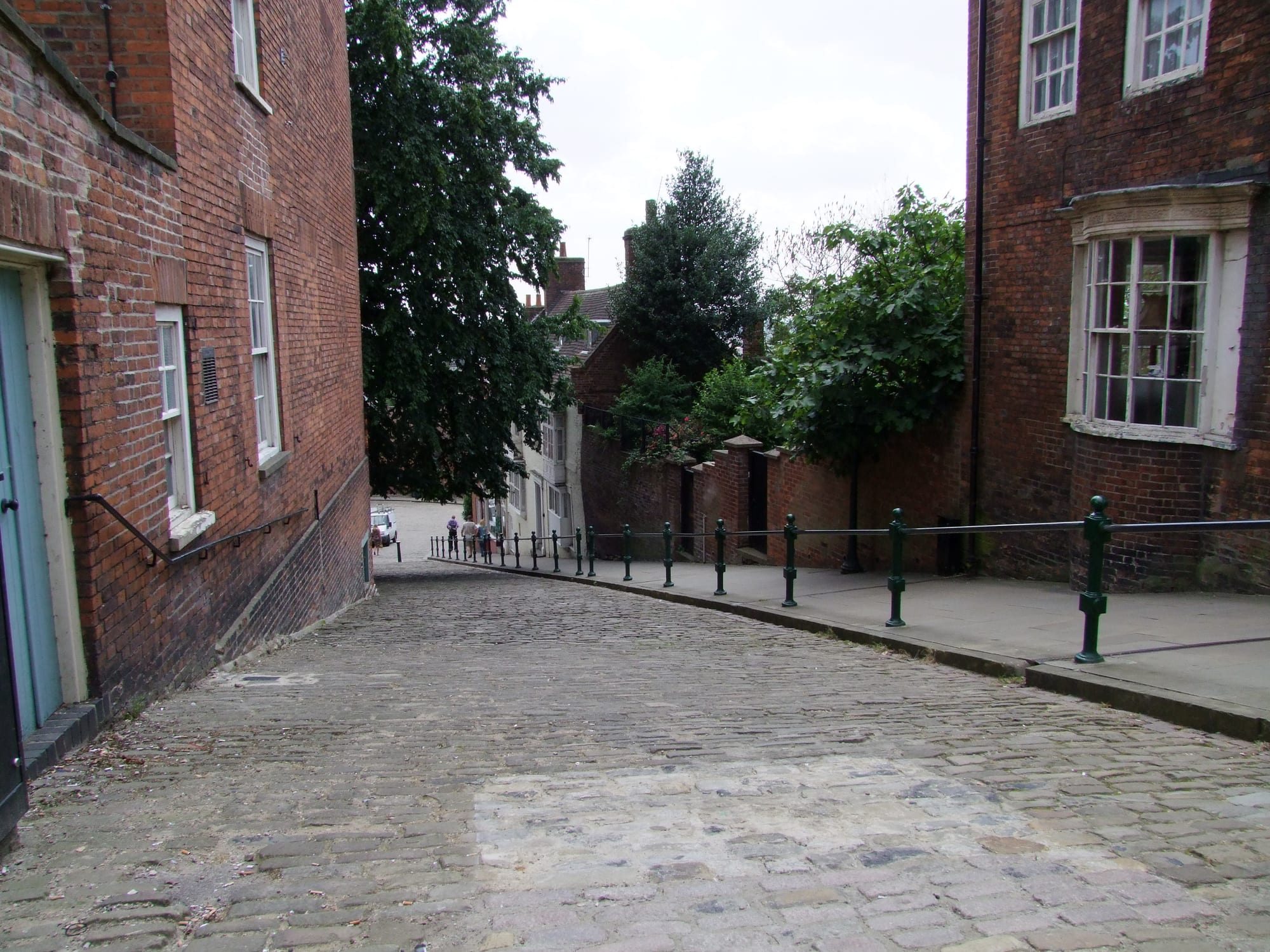
A steep cobbled street running downhill between old red-brick houses, with iron railings and trees under a pale sky

East Midlands, United Kingdom

Lincoln

Steep Hill, the cobbled street that links uphill and downhill Lincoln. (Yarah / Wikimedia Commons · CC BY-SA 3.0)

The county town of Lincolnshire, on a limestone hill above the River Witham and Brayford Pool. A Roman colony, a Viking-age mint town and a medieval wool city, it is crowned by a Norman castle and a Gothic cathedral that was once the tallest building in the world. Two universities have brought new life to the waterfront and the downhill centre.

Neighbourhoods

  • Uphill and the Cathedral Quarter
    • First-time visitors
    • Historic district

    The historic hilltop quarter known locally as the Bail, where the cathedral, the castle and the medieval Bishop's Palace stand close together. Bailgate runs north from the crossroads between them, with shops, cafés and pubs, to the Roman Newport Arch.

    Open in Maps
  • Steep Hill
    • Independent shops
    • Historic buildings

    The narrow, cobbled street that drops from the cathedral quarter to the lower town, lined with small shops and tea rooms and with two of the city's 12th-century stone houses, the Jew's House and the House of Aaron.

    Open in Maps
  • Downhill and the High Street
    • Shopping
    • Close to public transport

    The everyday city centre below the hill, from the Stonebow gateway down the High Street past High Bridge, whose timber-framed shops stand over the Witham, to the railway and bus stations.

    Open in Maps
  • Brayford Waterfront
    • Nightlife
    • Students
    • Waterside

    The natural pool the Romans used as a port, now a marina ringed by the University of Lincoln's campus, bars, restaurants, a cinema and the Engine Shed music venue.

    Open in Maps

Things to do

Cathedral, castle and the hilltop

  • Lincoln Cathedrallandmark

    The Gothic cathedral whose central spire made it the tallest building in the world for over 200 years, known for its rose windows, Wren library and the small carved Lincoln Imp.

    Open in Maps
  • Lincoln Castlelandmark

    The castle William I ordered built in 1068 on the old Roman hilltop, with a walk along its walls, a Victorian prison and one of only four surviving originals of the 1215 Magna Carta.

    Open in Maps
  • Medieval Bishop's Palacelandmark

    The ruined 12th-century palace of the bishops of Lincoln, among the most important buildings in England when it was built, on the slope just south of the cathedral.

    Open in Maps
  • Newport Archlandmark

    A Roman gateway of the city's north wall that still spans a road at the top of Bailgate.

    Open in Maps
  • Jew's Houselandmark

    A 12th-century stone house on Steep Hill, a survival of Lincoln's medieval Jewish community, one of the five main ones in England.

    Open in Maps

The lower town and the water

  • High Bridgelandmark

    The medieval bridge carrying the High Street over the Witham, the oldest bridge in the United Kingdom with buildings still standing on it — a row of timber-framed shops of about 1550.

    Open in Maps
  • Brayford Poolpark

    The marina where the Foss Dyke reaches the city, a pool the Romans used as a port, now with houseboats, swans, bars and the university around it.

    Open in Maps
  • Museum of Lincolnshire Lifemuseum

    The county's agricultural, industrial and social history since 1750, housed in a Victorian militia barracks.

    Open in Maps
  • International Bomber Command Centremuseum

    A memorial and interpretation centre on Canwick Hill, overlooking the city, telling the stories of Bomber Command crews and of civilians affected by the bombing on both sides.

    Open in Maps
  • Sincil Bankattraction

    The home ground of Lincoln City, 'the Imps', on the southern edge of the city.

    Open in Maps

Short trips from the city

  • Doddington Halllandmark

    An Elizabethan country house with gardens in a village west of the city.

    Open in Maps
  • Fossdyke Navigationtrail

    A canal running from Brayford Pool to the Trent at Torksey, possibly the oldest canal in England still in use, with a footpath and cycleway along it from the city to Saxilby.

    Open in Maps
  • Water Rail Waytrail

    A long-distance walking and cycling path that follows the Witham from Lincoln towards Boston.

    Open in Maps

Seasonal events

  • Lincoln Festival of Historysummer

    The city dressed as it was in different periods of its past, with re-enactments and historical markets.

  • Weekend at the AsylumAugust Bank Holiday weekend

    A large steampunk festival held in uphill Lincoln.

  • Lincolnshire Showsummer

    The county's biggest agricultural show, with livestock and horse competitions, a food festival and live music.

  • Christmas marketsDecember

    A Christmas market in and around the cathedral, and a medieval-style market in downhill Lincoln at St Mary le Wigford and St Mary's Guildhall.

Eat and drink

Long-standing places and food districts in Lincoln. Hours, ratings and directions come from your maps app, always current.

Lincoln classics

  • Lincolnshire butchers and delisneighborhood

    The place to find Lincolnshire sausages, haslet and other local pork products, alongside sausage rolls and sandwiches.

    Open in Maps
  • Bailgateneighborhood

    Pubs, cafés and restaurants in old buildings along the street between the castle and the Newport Arch.

    Open in Maps
  • Steep Hillneighborhood

    Tea rooms and small cafés in the old houses on the climb between the lower town and the cathedral.

    Open in Maps

Food districts

  • Brayford Wharfneighborhood

    Bars and chain and independent restaurants around the waterfront, busy with students in term time.

    Open in Maps
  • Lincoln High Streetneighborhood

    Fish and chip shops, cafés and international restaurants along the downhill shopping street.

    Open in Maps

Experience Lincoln

History

An Iron Age settlement of Britons stood beside Brayford Pool, the natural lake on the River Witham whose name, lindon, "the pool", lies behind the city's own. The Romans conquered the area in 48 CE and built a legionary fortress on the hilltop at the northern end of the Fosse Way. When the army moved on it became a colony of veterans, Lindum Colonia, which spread down the hillside to the waterside. After the Viking raids the town revived as a trading place, and by the end of the 10th century its mint rivalled York's.

In 1068 William I ordered a castle on the old Roman site, and the cathedral rose facing it; its central spire, once complete, made it the tallest building in the world for over 200 years. In 1141 the Battle of Lincoln was fought here during the Anarchy. By 1150 the city was among the wealthiest in England, exporting cloth and wool to Flanders, and it had one of the country's five main Jewish communities, which suffered riots in 1190 and an infamous blood libel in 1255 before the expulsion of 1290. When the cathedral's great spire collapsed in 1549 and was not replaced, it marked a long decline.

The reopening of the Foss Dyke canal in 1745 and the railways of the 1840s brought a second boom, when engineering firms such as Ruston's, Clayton's and William Foster's made the city an industrial centre. Foster's designed and built the world's first tanks here during the First World War. Heavy industry shrank after the war, though turbine making continues under Siemens. The University of Lincoln's Brayford campus, opened in 1996, transformed the waterfront.

Culture & Customs

The cathedral dominates the city's skyline and its cultural life: it is a working church, and the university's graduations take place inside, and the small carved Lincoln Imp inside it has become the city's mascot. Lincoln Castle's walls, Victorian prison and copy of Magna Carta — with Hugh of Wells, Bishop of Lincoln, among its signatories in 1215 — make the hilltop a lesson in English history. Its bishops included St Hugh, the cathedral's builder, and the 13th-century scholar Robert Grosseteste.

Lincoln's oldest identity is divided between uphill and downhill. The split goes back to the Norman Conquest, when church and army took the hilltop, and uphill long remained the better-off part of town; Steep Hill is the street that joins them. Modern culture centres on the waterfront, where the Engine Shed hosts concerts, and on a calendar of themed events: a history festival, the August steampunk weekend in uphill Lincoln and two Christmas markets. The traditional Christmas market around the castle ran from 1982 to 2022.

Football means Lincoln City, the Imps, who won League One in 2025–26 with 103 points. The University of Lincoln and Lincoln Bishop University, which began as a church teacher-training college in 1862, have given the city a younger feel than its medieval streets suggest.

Daily Life

About 104,000 people lived in the City of Lincoln district at the 2021 census, and the wider urban area, including North Hykeham and Waddington, had about 128,000. The travel-to-work area reaches about 300,000, drawing in a large rural hinterland. Among residents born abroad, Poland, Romania and Lithuania are the most common countries of birth.

The economy rests on public services, the two universities, tourism and what remains of engineering. Siemens still makes industrial turbines at the old Ruston works, while empty factory buildings have become multi-use units, with gyms, university space and a radio station. In the 2021–22 academic year almost 19,000 university students studied in the city, and their presence has filled the Brayford area with flats, bars and restaurants.

The city's division between uphill and downhill still shapes daily life: the hilltop holds the historic quarter, while the High Street, the stations and most shops are below. A southern bypass, the North Hykeham relief road, was due to start construction in 2025 as the final section of a ring road around the city.

Food

Lincolnshire's farming country gives the city its local food, above all pork. The Lincolnshire sausage is a pork sausage dominated by the herb sage, unlike the more peppery Cumberland. Haslet is a pork meatloaf made from minced pork, stale white bread, sage, salt and black pepper, sliced thin and eaten cold with pickles and salad or in sandwiches; it is sold mainly by butchers and on markets. Stuffed chine, salt pork filled with herbs, usually parsley, is another traditional county dish.

The county also produces Lincolnshire Poacher, a hard cheese made from unpasteurised cow's milk at a farm in Alford and matured for between 14 and 24 months; its rind looks like granite. Butchers and delis in the city sell local meats, sausage rolls and sandwiches, and some restaurants put Lincolnshire sausages on their menus.

Eating out divides along the hill. Bailgate and Steep Hill have pubs, tea rooms and small restaurants in old buildings; the Brayford waterfront has bars and restaurants busy with students; and the downhill High Street has fish and chip shops, cafés and restaurants serving food from Korea to the Mediterranean. Lincoln College runs a training restaurant where advanced catering and hospitality students cook.

Planning tools

Budget

Lincoln is good value by English standards, with reasonable hotel and restaurant prices. Rooms fill up and cost more during the steampunk festival and the Christmas markets, and on university graduation weekends. The castle and cathedral charge entry, while walking the streets of the hilltop and the waterfront costs nothing.

Daily Budget Midrange
USD 150–270 (mid-range hotel, restaurant dinners, castle and cathedral entry)
Daily Budget Shoestring
USD 65–105 (budget hotel or guest house, pub and café meals, buses)

Book early for festival weekends and December, and allow time for the castle's walls, prison and Magna Carta.

Best Time to Visit

Late spring to early autumn for walking the hilltop and the waterside paths, with the history festival, the county show and the August steampunk weekend. December brings the Christmas markets and a festive cathedral. Winters are cold and grey, but the city is quiet and compact enough for a short visit in any season.

Suggested Number of Days

Most first visits take one to two days, as the historic centre is compact. Allow about three to include the countryside and canal paths around the city at an easy pace.

First Visit
1–2 days
With Surroundings
3 days

Transportation

The city centre is compact and walkable, apart from the climb of Steep Hill. A circular Walk and Ride bus links the lower High Street with the castle and cathedral quarter, and regional buses run from across Lincolnshire. Driving in the centre is best avoided: the uphill road layout is confusing even for locals.

Use the Walk and Ride bus for the climb if Steep Hill is too much, and leave a car outside the centre.

Airport & Station Connections

Lincoln station sits at the meeting point of lines from Newark, Gainsborough, Grimsby and Sleaford, and direct trains run to London King's Cross, Nottingham, Sheffield and Leicester. Humberside Airport, 29 miles north, has flights to Amsterdam; East Midlands Airport, 43 miles away, is the main international airport for the county. Regional buses come in from across Lincolnshire.

Walkability

Very walkable, but hilly. The hilltop quarter, Steep Hill, the High Street and Brayford Pool lie close together, joined by the steep street that gives the city its character. Paths along the Witham and the Fossdyke lead out of town for longer walks.

Safety

The UK is generally safe, with the main risks being pickpocketing and phone theft in crowded parts of London and other cities, occasional late-night antisocial behaviour, and drink-related trouble around nightlife. Lincoln has the usual urban petty crime and some weekend nightlife trouble in the centre, and the main hazard for visitors is the gradient of Steep Hill, slippery when wet or icy.

Wear sturdy shoes for the cobbles of Steep Hill, especially in wet or icy weather. Check current official travel advice before travelling.

Climate

Warm summers and cold, grey winters. The city's temperature records since 1948 run from −15.6°C in February 1956 to 40.3°C on 19 July 2022.

Summer
warm — the city's record high, set on 19 July 2022, is 40.3°C
Winter
cold and grey, with frost — the lowest recent reading was −10.4°C in December 2010

Local Customs

Lincoln has an old divide between uphill and downhill, dating from the Norman Conquest, when the religious and military elite took the hilltop; uphill was long the more affluent. The Lincoln Imp, carved in the cathedral, is a symbol of the city, and the football club is nicknamed the Imps. The cathedral is a working church as well as a sight.

Keep voices down and follow guidance on photography during services in the cathedral; the alcohol purchase age is 18.

Common Payment Methods

The currency is the pound sterling. Most pubs now take contactless cards, though a few are still cash only, and some merchants no longer accept cash; the railway station has a cash machine.