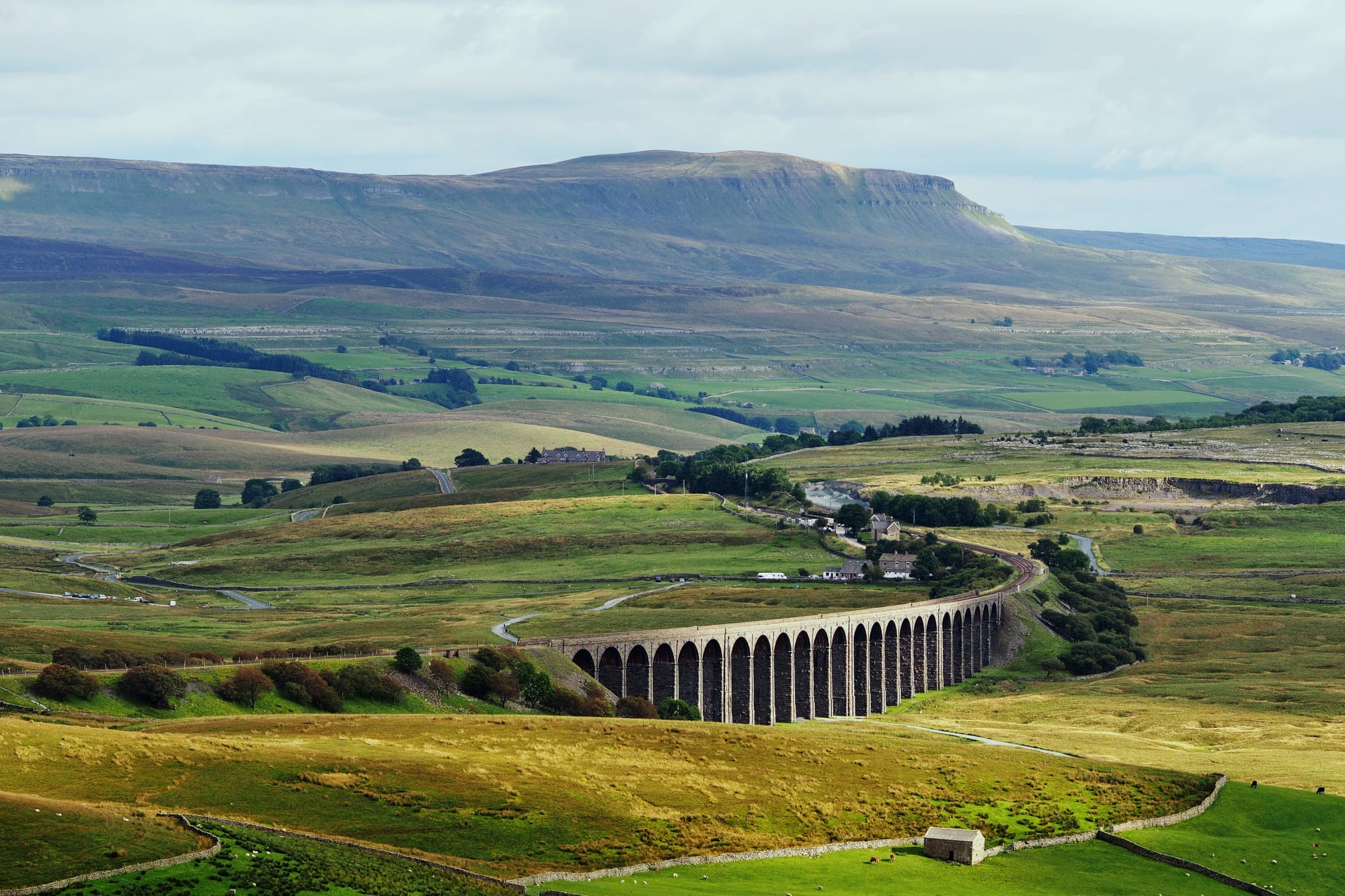
A long stone railway viaduct of many arches crossing green moorland, with the flat-topped hill of Pen-y-ghent behind

United Kingdom

Yorkshire & the Humber

The Ribblehead Viaduct on the Settle–Carlisle line in the Yorkshire Dales, with Pen-y-ghent in the distance. (Kreuzschnabel / Wikimedia Commons · CC BY-SA 3.0)

England's largest historic county and the Humber estuary lands to its south-east, running from the Pennines to the North Sea — the Roman and Viking city of York, the textile and steel cities of Leeds, Bradford and Sheffield, the port of Hull, and two national parks of limestone dales and heather moorland.

Explore Yorkshire & the Humber

History

The region was home to the Brigantes, Britain's largest Celtic tribe, until the Romans founded Eboracum at York in AD 71 as a legionary fortress. In 306 Constantine was proclaimed emperor there. After Rome, the area became part of the Anglo-Saxon kingdom of Northumbria, and the Synod of Whitby in 664 settled how the English church would date Easter. Vikings took York in 866 and made it the capital of a kingdom they called Jórvík.

After 1066, William the Conqueror put down northern revolts in the brutal Harrying of the North, but the region later filled with Cistercian abbeys such as Fountains and Rievaulx, grown rich on wool. The Wars of the Roses left the battle of Towton in 1461, and in 1536 the Pilgrimage of Grace rose in the county against Henry VIII's closure of the monasteries.

Industry transformed the West Riding. Leeds, Bradford and Halifax became wool and textile centres, and Titus Salt built the model mill village of Saltaire, now a UNESCO World Heritage Site. Sheffield became the world's steel and cutlery city, where stainless steel was developed in 1913. South Yorkshire's coalfield was at the heart of the 1984–85 miners' strike, and its pits closed soon after. Hull, a major fishing and trading port, was the birthplace of William Wilberforce, and James Cook learned his seamanship in Whitby. Since the 1980s Leeds has grown into a financial and legal centre.

Culture & Customs

Yorkshire has one of the strongest regional identities in England. Locals call it "God's own county", celebrate Yorkshire Day on 1 August, and are known for bluntness, thrift and dry humour. The dialect survives in words such as "owt" (anything) and "nowt" (nothing), and each part of the county has its own accent.

Sport is part of the identity. Sheffield FC, founded in 1857, is recognised as the world's oldest football club, and rugby league began in 1895 at a meeting in Huddersfield. Yorkshire County Cricket Club plays at Headingley in Leeds, and Doncaster's St Leger, first run in 1776, is the oldest of the classic horse races. Brass bands, such as the Black Dyke Band from Queensbury, grew out of the mill towns.

The Brontë sisters wrote at Haworth, and Bram Stoker set part of Dracula in Whitby, which now hosts a Goth Weekend. Bradford has a large community of Pakistani heritage, and the Leeds West Indian Carnival has run each August since 1967. Sheffield's music, from the Human League and Pulp to the Arctic Monkeys, has a proud history, and Hull was the UK City of Culture in 2017.

Daily Life

About 5.5 million people live in Yorkshire and the Humber. Leeds has about 800,000 people, Sheffield about 560,000, Bradford about 550,000 and Hull about 270,000. York has about 200,000, while Huddersfield, Wakefield, Doncaster, Grimsby and Scunthorpe are other large towns and Harrogate is a wealthy spa town of about 75,000.

Leeds is the region's business centre, with banking, law, media and a large student population, and Sheffield and Bradford are rebuilding around universities and services. Advanced manufacturing near Sheffield, steelworks at Scunthorpe, chemicals and renewable energy on the Humber, and food processing at Grimsby remain important. North Yorkshire and the East Riding are farming and tourism country.

Many West Yorkshire towns still show the effects of lost industry, and gaps in income and health between the prosperous north of the county and the former coalfields are a live issue. Improving transport between the northern cities, including a mass-transit system for Leeds, is a long-running debate.

Food

Yorkshire pudding, a puffy batter baked in hot fat, was traditionally eaten as a starter with gravy before the meat. Wensleydale cheese, a crumbly white cheese, is made at Hawes in the Dales, and is often eaten with fruit cake. The Rhubarb Triangle between Wakefield, Morley and Rothwell grows forced rhubarb in dark sheds, and Yorkshire forced rhubarb has protected status.

Sweet treats include parkin, a sticky ginger cake made with oatmeal and treacle and eaten around Bonfire Night, Yorkshire curd tart, and the fat rascal, a rich fruit scone made famous by Bettys tea rooms in Harrogate and York. York was a chocolate city, home to Rowntree's and Terry's, and Pontefract has long made liquorice sweets. Sheffield has Henderson's Relish, a spicy, vinegar-based sauce, and Hull has its patties, fried rounds of mashed potato and sage.

The coast is known for fish and chips, especially in Whitby. Bradford is well known for curry. Beer matters: Masham has Theakston and Black Sheep, and Tadcaster the Samuel Smith and John Smith breweries, while Timothy Taylor brews in Keighley.

Attractions & Natural Wonders

York has its Minster, the medieval walls, the Shambles, Clifford's Tower, the Jorvik Viking Centre and the National Railway Museum, and Castle Howard lies north of the city. To the west, Harrogate offers the Royal Pump Room and Valley Gardens, with Fountains Abbey and Studley Royal near Ripon.

The Yorkshire Dales National Park has Malham Cove and Gordale Scar, the Three Peaks of Whernside, Ingleborough and Pen-y-ghent, the Ribblehead Viaduct, Aysgarth Falls in Wensleydale, the market town of Hawes and the valley of Swaledale.

The North York Moors National Park has heather moorland, Rievaulx Abbey near Helmsley, and the North Yorkshire Moors Railway. On the coast, Whitby has its ruined abbey and 199 steps, with Robin Hood's Bay and Scarborough nearby, and Bempton Cliffs and Flamborough Head hold large seabird colonies.

Leeds has the Royal Armouries, Kirkstall Abbey and its Victorian arcades, and Bradford the Science and Media Museum, with Saltaire and the Brontë Parsonage at Haworth nearby; the Yorkshire Sculpture Park lies near Wakefield. Sheffield has Kelham Island Museum and the Winter Garden. Hull offers The Deep aquarium, its old town and the Humber Bridge, with Beverley Minster to the north.

Cities in Yorkshire & the Humber

Planning basics

Budget

Yorkshire is noticeably cheaper than the South of England. Leeds, Sheffield, Bradford and Hull have good-value hotels and restaurants, and pub food across the county is generous. York and Harrogate are the pricier exceptions, especially at weekends and during races and festivals, and cottages in the Dales and on the coast book up in summer.

Daily Budget Midrange
USD 160–290 (mid-range hotel or Dales inn, restaurant dinners, abbey and museum entry, a hire car)
Daily Budget Shoestring
USD 65–110 (hostel or budget hotel, pub and cafe meals, trains and buses)

Stay in Leeds or a market town rather than central York at weekends, and use the free National Railway Museum and the city walls to cut costs.

Safety

Yorkshire is generally safe. The cities have normal urban petty crime and busy weekend nightlife in Leeds and Sheffield. The main natural hazards are hill fog and fast-changing weather on the Three Peaks and high moors, slippery limestone at Malham, and incoming tides at Robin Hood's Bay and under the coastal cliffs.

Check the weather before hill walks, and check tide times before walking on the beaches below the coastal cliffs. Check current official travel advice before travelling.

Climate

The Pennines in the west catch rain and snow, and the high Dales and moors are cool and exposed. The Vale of York and the east are drier and more sheltered, while the coast from Whitby to the Humber faces the North Sea, which brings cold winds and sea fog known locally as fret.

Summer
mild to warm, 18–23°C in the lowlands, cooler on the moors and coast
Winter
cold and damp, 0–7°C, with snow on the Pennines and moors

Transportation

The East Coast Main Line from London King's Cross reaches York and Leeds in about two hours, and trains link Leeds, Sheffield, York and Hull across the region. Leeds Bradford Airport serves the west. The scenic Settle–Carlisle line crosses the Dales over the Ribblehead Viaduct, and the Esk Valley line and the heritage North Yorkshire Moors Railway reach Whitby. Buses in the Dales and moors are infrequent, so a car helps there.

Travel by train between the cities, and hire a car in York or Leeds for the Dales and moors.

Best Time to Visit

May to September suits walking in the Dales and on the North York Moors, with August turning the moors purple with heather. The Great Yorkshire Show in Harrogate is held in July, the Whitby Goth Weekend in spring and autumn, and seabirds at Bempton Cliffs peak from May to July. York suits any season, with a large Christmas market in December.