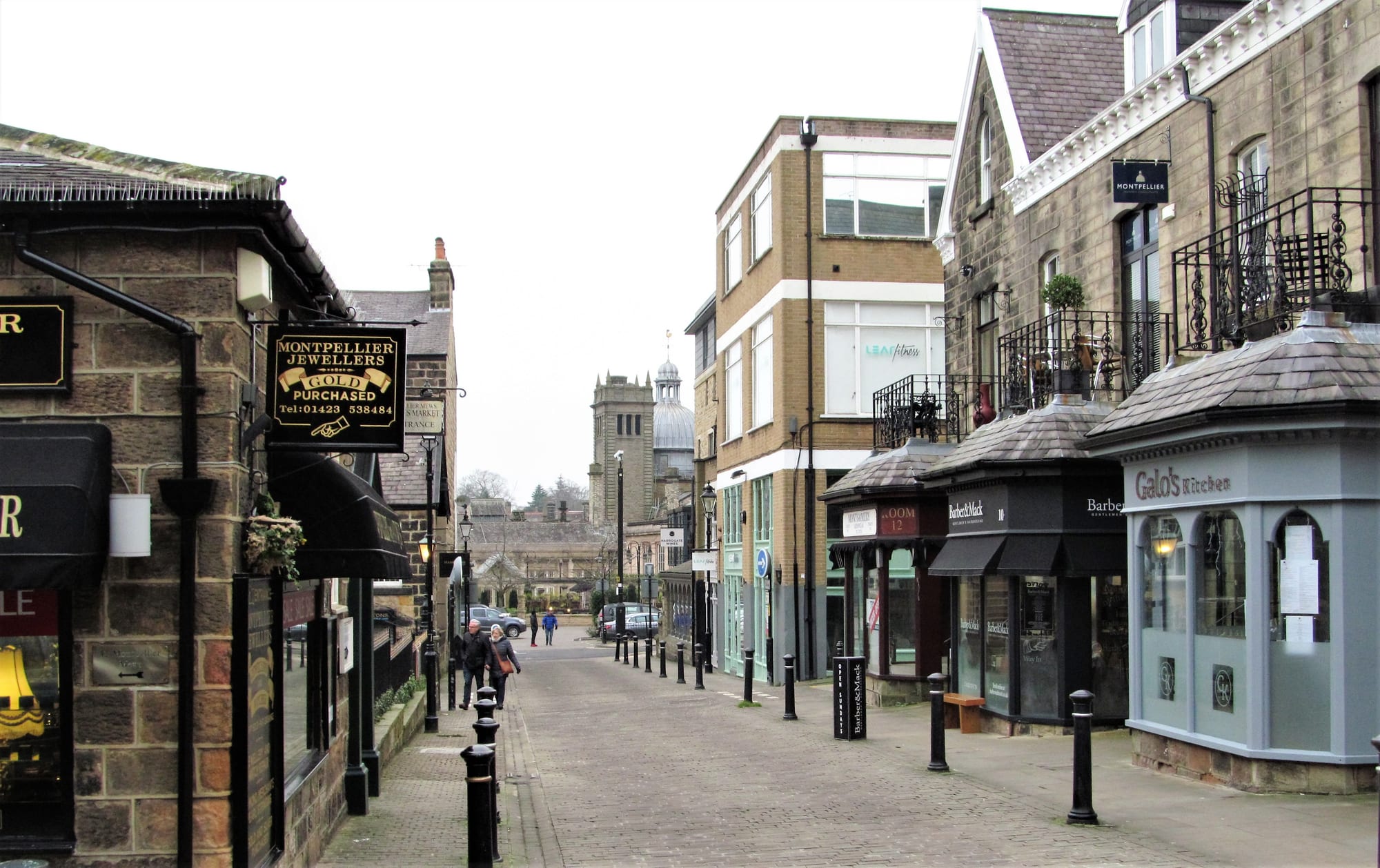
A paved shopping street of stone buildings with small shopfronts, bollards and a domed tower at the far end

Yorkshire & the Humber, United Kingdom

Harrogate

A street in the Montpellier Quarter of central Harrogate. (Gordon Hatton / Wikimedia Commons · CC BY-SA 2.0)

A North Yorkshire spa town that grew from two small settlements after mineral springs were found in the 16th century, becoming known as 'The English Spa'. Its Victorian pump room, Turkish baths and gardens, the 200-acre Stray and Bettys tea rooms recall the spa years; today it is a prosperous conference, shopping and commuter town.

Neighbourhoods

  • Montpellier Quarter and Low Harrogate
    • First-time visitors
    • Shopping
    • Spa heritage

    The old spa quarter on the slope below Parliament Street, with boutique and designer shops, cafés and the original Bettys. The Royal Pump Room, Mercer Art Gallery and the entrance to Valley Gardens are a short walk downhill.

    Open in Maps
  • Town centre
    • Close to public transport
    • Shopping
    • Theatre

    The pedestrianised Cambridge Street and Oxford Street are the main high streets, with Harrogate Theatre on Oxford Street, the railway and bus stations nearby and the Royal Hall and Turkish Baths around Crescent Gardens.

    Open in Maps
  • High Harrogate
    • Historic district
    • Quiet and residential

    One of the two original settlements, where the first spring, the Tewit Well, was found in 1571; its site is marked by a dome on the Stray.

    Open in Maps
  • Duchy and the west side
    • Quiet and residential
    • Gardens

    The residential Duchy estate borders the town centre to the north, and the western side of town runs out past the Valley Gardens towards RHS Harlow Carr.

    Open in Maps

Things to do

Spa heritage

  • Royal Pump Room Museummuseum

    The 1842 stone rotunda built over the Old Sulphur Well, said to be Europe's strongest sulphur well, now the town museum telling the story of the spa.

    Open in Maps
  • Turkish Bathsattraction

    The Victorian Turkish baths inside the Royal Baths, opened by the town in 1897 as a hydrotherapy centre and still in use.

    Open in Maps
  • Royal Halllandmark

    A Grade II listed theatre and concert hall on Crescent Gardens designed by Frank Matcham.

    Open in Maps
  • Mercer Art Gallerymuseum

    The town gallery in the Old Town Hall, with a collection of over 2,000 mainly 19th- to 21st-century works and changing exhibitions.

    Open in Maps

Parks and gardens

  • Valley Gardenspark

    A 17-acre park laid out in 1887 for Queen Victoria's golden jubilee, reaching south to Bogs Field, with England's largest cluster of mineral springs, a play park and tennis courts.

    Open in Maps
  • The Straypark

    Some 200 acres of open grassland wrapping around three sides of the town centre, kept as a public common since 1770 and fiercely protected.

    Open in Maps
  • RHS Garden Harlow Carrpark

    The Royal Horticultural Society's garden on the western edge of town, opened in 1950 by the Northern Horticultural Society, with a second Bettys tea room.

    Open in Maps

Short trips from the town

  • Knaresboroughattraction

    A market and spa town on the River Nidd 3 miles east, with a Norman castle.

    Open in Maps
  • Ripley Castlelandmark

    A 14th-century country house in the village of Ripley, 3 miles north of the town.

    Open in Maps
  • Fountains Abbey and Studley Royallandmark

    The ruins of Fountains Abbey within Studley Royal Park and its 18th-century landscaped garden, a World Heritage Site owned by the National Trust.

    Open in Maps

Seasonal events

  • Great Yorkshire ShowJuly, from the second Tuesday

    England's largest agricultural show, four days of livestock, food and country life at the Great Yorkshire Showground.

  • Harrogate Flower Showstwice a year

    Two flower shows a year held at the Great Yorkshire Showground.

Eat and drink

Long-standing places and food districts in Harrogate. Hours, ratings and directions come from your maps app, always current.

Harrogate classics

  • Bettys Café Tea Roomscafe

    The first Bettys, opened in 1919 by the Swiss confectioner Frederick Belmont, known for the fat rascal, a plump, fruity scone it introduced in 1983.

    Open in Maps

Food districts

  • Montpellier Quarterneighborhood

    Cafés and restaurants among the boutiques of the old spa quarter.

    Open in Maps
  • Cold Bath Road and West Parkneighborhood

    Restaurants and pubs along West Park, facing the Stray, and up Cold Bath Road beside the Valley Gardens.

    Open in Maps

Experience Harrogate

History

In the Middle Ages Harrogate was little more than a place on the boundary of the township of Bilton with Harrogate, within the Royal Forest of Knaresborough. Its fortunes changed in 1571, when William Slingsby found that the water of the Tewit Well in High Harrogate resembled that of the springs at Spa in present-day Belgium. Edmund Deane's book Spadacrene Anglica, or the English Spa Fountain, publicised the waters in 1626, and further iron-rich chalybeate and sulphur springs were found in High and Low Harrogate in the 17th and 18th centuries. The two settlements grew together into the town known as "The English Spa".

When the Royal Forest of Knaresborough was enclosed under an act of 1770, 200 acres of land including the known springs were reserved as a public common, the Stray, which remains open space today, and development spread around it. Wealthy visitors seeking cures brought money to the town: the Georgian Theatre opened in 1788, the Royal Pump Room in 1842, and the council's Royal Baths, a hydrotherapy centre, in 1897. Samson Fox, mayor three years running in the 1890s, lit Parliament Street with water-gas, the first street in the world to be lit that way.

Like spa towns across Europe, Harrogate lost popularity after the First World War, and the Royal Baths wound down after losing a National Health Service contract in 1969. The town reinvented itself through conferences, exhibitions and the Great Yorkshire Showground, and as a prosperous home for commuters to Leeds and York. In 2025 it gained a new town council, which in November that year was licensed to use the borough's arms of 1884.

Culture & Customs

Harrogate's culture still grows from its spa years. The Royal Hall, a theatre designed by Frank Matcham, and the Royal Pump Room museum stand by Crescent Gardens, the Victorian Turkish baths in the Royal Baths are still in use, and Harrogate Theatre opened as the Grand Opera House in January 1900. Taking afternoon tea at Bettys, founded in the town in 1919, is a ritual for visitors and residents alike.

The town is a festival centre. Harrogate International Festivals, one of the North of England's leading arts organisations, runs the Theakston Old Peculier Crime Writing Festival and its Crime Novel of the Year award, along with literature and music festivals. The Great Yorkshire Show, the largest agricultural show in England, fills the showground every July, and the twice-yearly Harrogate Flower Shows suit a town of parks and gardens, from the Valley Gardens and the Stray to RHS Harlow Carr.

Local life has a reputation for comfort and calm: from 2013 to 2015 surveys by a property website named Harrogate the happiest place to live in the United Kingdom. Harrogate Town play league football, with a long rivalry with Harrogate Railway Athletic, and cricket is played in the local leagues.

Daily Life

Harrogate had about 73,600 people at the 2011 census, and the built-up area taking in Knaresborough about 89,000. It is one of the most prosperous towns in the North, with expensive terraced houses lining the Stray and wealthy districts such as Wheatlands to the south.

The economy rests on conferences and exhibitions at the Harrogate Convention Centre and the Great Yorkshire Showground, on tourism, shopping and services, and on locally based firms: Bettys and Taylors, which blends Yorkshire Tea, launched in 1977, and the bottlers of Harrogate Spring Water. The Army Foundation College and RAF Menwith Hill lie to the west. Many residents commute to Leeds and York on the half-hourly trains.

The town centre is busy with shoppers on Cambridge Street and Oxford Street, and Parliament Street and the Montpellier Quarter have the designer shops. Residents live in districts such as Starbeck to the east, Woodlands to the south-east, Wheatlands, Pannal and Hornbeam Park, several with their own station or frequent buses. The Stray is jealously guarded: if any part is taken for road widening it must be replaced elsewhere.

Food

Bettys is Harrogate's best-known food institution. The Swiss confectioner Frederick Belmont opened the first Bettys Café Tea Room here in 1919, and the company, which bought the tea and coffee merchants Taylors of Harrogate in 1962, now runs tea rooms across Yorkshire, including one at RHS Harlow Carr, as well as a cookery school. Its fat rascal, a plump, fruity scone introduced in 1983, became its best-known bakery product, and Taylors' Yorkshire Tea, launched in 1977, is one of the country's best-known brews.

The waters themselves were once the town's most famous drink. Harrogate spa water contains iron, sulphur and common salt, and visitors in the 17th and 18th centuries drank the chalybeate, or iron-rich, waters as a health treatment; the sulphur water was later served in the Royal Pump Room. Harrogate Spring Water, bottled in the town, is sold internationally today.

For eating out, the Montpellier Quarter has cafés and restaurants among its boutiques, and West Park and Cold Bath Road, facing the Stray and the Valley Gardens, have restaurants and pubs. The Great Yorkshire Show each July is a showcase for the county's farm produce.

Planning tools

Budget

Harrogate is one of the pricier towns in Yorkshire, with upmarket shops, restaurants and hotels, many built for spa visitors and now filled by conference trade. Rooms are hardest to find during the Great Yorkshire Show and big conferences. The Stray, the Valley Gardens and the walks to Knaresborough cost nothing.

Daily Budget Midrange
USD 170–300 (mid-range hotel, restaurant dinners, a Turkish baths session, garden or abbey entry)
Daily Budget Shoestring
USD 70–120 (budget guest house, café and pub meals, buses and trains)

Staying in York or Leeds and visiting by train is often cheaper; the trains are half-hourly.

Best Time to Visit

Late spring to early autumn shows the gardens at their best, with the Great Yorkshire Show in July. The Turkish baths, museums and tea rooms suit any season, and winter is quiet outside the conference calendar.

Suggested Number of Days

One or two days suit the town. Allow three or four to add the nearby market towns, abbeys and the edge of the Dales, which lie within an easy drive or bus ride.

First Visit
1–2 days
With Surroundings
3–4 days

Transportation

The centre is walkable. Four stations on the Harrogate Line — Harrogate, Hornbeam Park, Pannal and Starbeck — have half-hourly trains to Leeds and York. Buses leave from the town-centre bus station, with frequent route 1 services to Knaresborough via Starbeck and others to Leeds, to Bradford via Leeds Bradford Airport, and to Otley, Pateley Bridge and Boroughbridge.

Use the train or bus 1 for Knaresborough; a car helps for the abbeys and the Dales.

Airport & Station Connections

Leeds Bradford Airport is 10 miles south-west, linked by the A2 Flyer bus. Trains reach Harrogate from Leeds in about 35 minutes and from York in about 40 minutes via Knaresborough. By road the A61 runs to Leeds and Ripon and the A59 to York and Skipton, with the A1(M) to the east.

Walkability

Very walkable: the station, shops, Montpellier Quarter, Pump Room and Valley Gardens are all within about fifteen minutes of each other, and paths cross the Stray. The town centre slopes down towards the Valley Gardens; RHS Harlow Carr is a longer walk through the gardens and woods.

Safety

The UK is generally safe, with the main risks being pickpocketing and phone theft in crowded parts of London and other cities, occasional late-night antisocial behaviour, and drink-related trouble around nightlife. Harrogate is a prosperous, quiet town; ordinary care at night in the town-centre bars is enough.

Watch belongings in the busy shopping streets and at large events at the showground. Check current official travel advice before travelling.

Climate

A temperate climate, with an average annual temperature of about 10°C and frosts in winter.

Summer
mild — July and August average highs of about 21°C
Winter
cold — January nights average slightly below 1°C, with frost and occasional snow

Local Customs

Harrogate has a reputation for gentility, built in its spa years, and was voted the happiest place to live in Britain in property-website polls from 2013 to 2015. Afternoon tea is an institution. The Stray is protected land: any part lost to road works must be replaced elsewhere.

Follow the rules and session times of the Turkish baths, and keep to the paths and lawns of the protected Stray.

Common Payment Methods

The currency is the pound sterling. Cards and contactless are widely accepted in shops, cafés and restaurants.