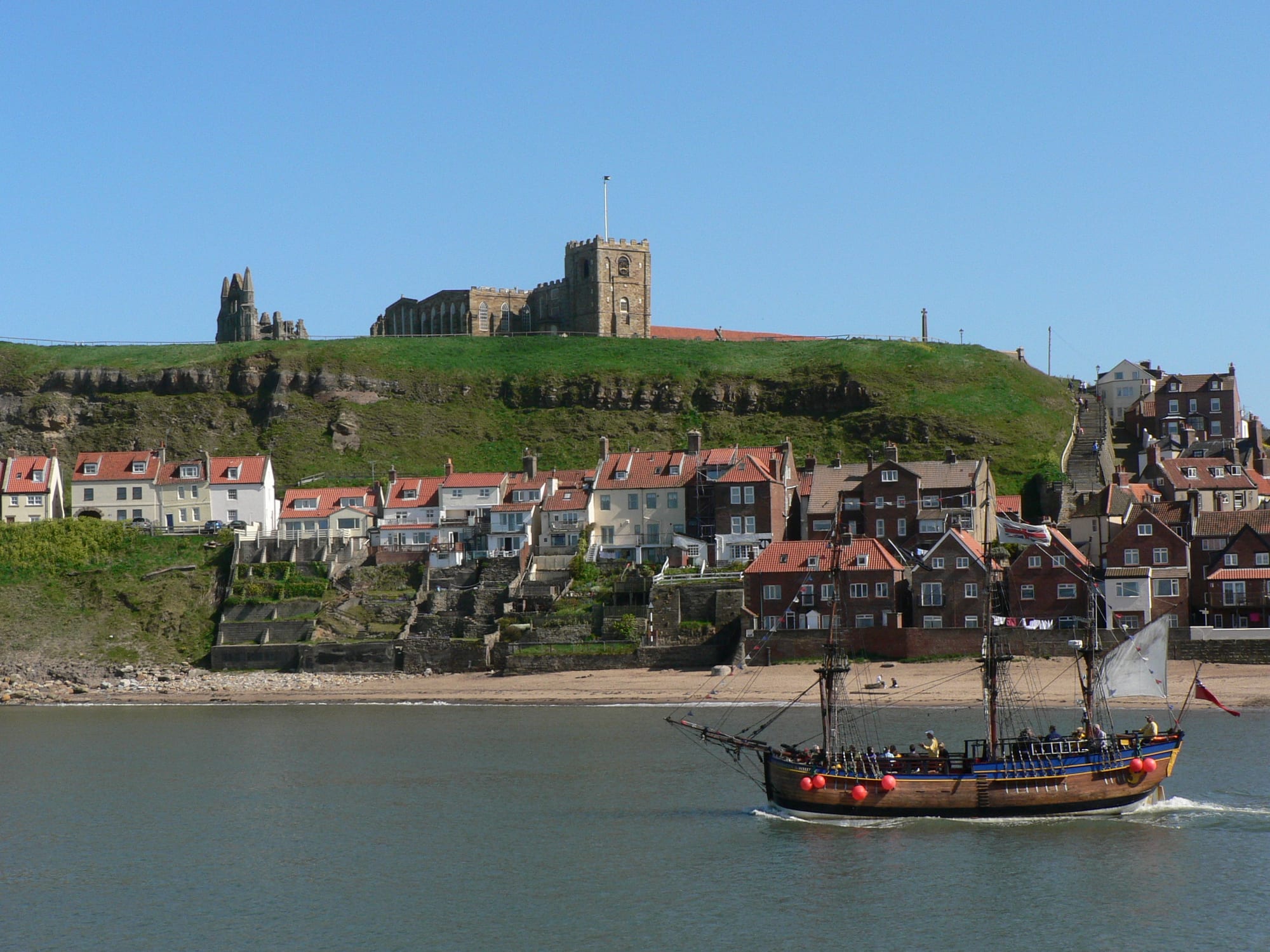
A wooden three-masted sailing ship in Whitby harbour below red-roofed houses, St Mary's church and the abbey ruins on the green cliff

Yorkshire & the Humber, United Kingdom

Whitby

Whitby harbour, with St Mary's Church and the ruins of Whitby Abbey on the East Cliff above. (Alistair Young / Wikimedia Commons · CC BY 2.0)

A North Yorkshire seaside town and fishing port in a deep valley at the mouth of the River Esk, where the North York Moors meet the sea. Its ruined abbey on the East Cliff stands on the site of a 7th-century monastery; whaling, coal shipping and jet made it rich, Captain Cook learned his seamanship here, and Bram Stoker set part of Dracula in the town.

Neighbourhoods

  • East side and Church Street
    • Historic district
    • First-time visitors
    • Shopping

    The old town on the east bank below the cliff, where Church Street and Henrietta Street run between cottages, pubs, cafés and shops. The 199 steps climb from the head of Church Street to St Mary's Church and the abbey.

    Open in Maps
  • West side and the harbour
    • Fish and chips
    • Close to public transport
    • Pubs

    Across the swing bridge, the west bank holds the railway and bus stations, the quays of the lower harbour and a strip of fish-and-chip shops and pubs along the waterfront.

    Open in Maps
  • West Cliff
    • Sea views
    • Beaches
    • Walking

    The cliff above the harbour mouth on the west side, with the statue of Captain Cook and the whale bone arch looking across to the abbey, and paths down to the sands.

    Open in Maps
  • Sandsend and Upgang
    • Beaches
    • Quiet
    • Walking

    The sand and shingle beach runs west from the harbour for a couple of miles past Upgang to the village of Sandsend, where the cliffs begin again.

    Open in Maps

Things to do

Landmarks of the town

  • Whitby Abbeylandmark

    The ruins of the Benedictine abbey church on the East Cliff, on the site of the 7th-century monastery where the Synod of Whitby met in 664, cared for by English Heritage, with a museum in 17th-century Cholmley House.

    Open in Maps
  • St Mary's Church and the 199 stepslandmark

    The parish church on the East Cliff beside the abbey, reached from the head of Church Street by the 199 steps of the Church Stairs, with views over the harbour rooftops.

    Open in Maps
  • Whitby Swing Bridgelandmark

    The bridge that divides the upper and lower harbours and joins the two halves of the town.

    Open in Maps
  • Captain Cook statue and whale bone archviewpoint

    On the West Cliff, the statue of James Cook, who served his apprenticeship in the town, and an arch of whale bones recalling the whaling fleet, both looking across to the abbey.

    Open in Maps

Museums

  • Captain Cook Memorial Museummuseum

    Walker's House on Grape Lane, home of Captain John Walker, to whom Cook was apprenticed in 1746 and where he lodged.

    Open in Maps
  • Whitby Museummuseum

    The town museum in Pannett Park, with collections of local archaeology, social history and jet, and a 'Hand of Glory' on display.

    Open in Maps
  • Whitby Lifeboat Museummuseum

    The old lifeboat house of 1895, used until 1957, displaying the Robert and Ellen Robson lifeboat built in 1919.

    Open in Maps

Beaches and the coast

  • Whitby beach to Sandsendbeach

    A couple of miles of sand and shingle west of the river; at high tide the beach is covered.

    Open in Maps
  • Cleveland Waytrail

    The national trail follows the clifftops through Whitby, north towards Runswick Bay and Staithes and south towards Robin Hood's Bay and Scarborough.

    Open in Maps

Short trips from the town

  • Robin Hood's Bayattraction

    A village 6 miles south in the North York Moors National Park, on the Cleveland Way and at the end of Wainwright's Coast to Coast walk.

    Open in Maps
  • North Yorkshire Moors Railwayattraction

    A heritage railway first opened in 1836 as the Whitby and Pickering Railway, running steam trains across the national park, with some continuing to Whitby.

    Open in Maps

Seasonal events

  • Whitby Goth Weekendlate April and around Halloween

    A twice-yearly alternative music festival held since 1993, with live bands and trade stalls, that fills the town with people in Gothic dress.

  • Whitby RegattaAugust

    Three days of events each year, highlighted by rowing races between local clubs.

  • Bram Stoker Film FestivalOctober

    A festival of horror and Gothic film held in the town since 2008.

Eat and drink

Long-standing places and food districts in Whitby. Hours, ratings and directions come from your maps app, always current.

Whitby classics

  • Fish and chips on the harbourneighborhood

    Whitby's supply of fresh fish has filled the town with chip shops, along the west side of the harbour above all.

    Open in Maps
  • The Magpie Caférestaurant

    One of the town's many fish and chip shops, which Rick Stein has described as the best fish and chip shop in Britain.

    Open in Maps
  • Fortune's kipper smokehouserestaurant

    A smokery past the foot of the abbey steps on Henrietta Street, where Whitby's speciality, kippers, are smoked.

    Open in Maps

Pubs and cafés

  • Church Streetneighborhood

    Old pubs and cafés along the east side's main street, including one at the foot of the abbey steps.

    Open in Maps

Experience Whitby

History

Whitby's story begins on the East Cliff, where a double monastery for men and women was founded in the 7th century under the abbess Hilda. It became a royal nunnery of the kingdom of Deira and a centre of learning, where the cowherd Cædmon became the first known English poet, and in 664 the Synod of Whitby settled the date of Easter in Northumbria in favour of the Roman reckoning. After the Norman Conquest William de Percy refounded the abbey as a Benedictine house in 1078. Henry VIII's commissioners closed it in 1539, and by 1540 the town had only about 200 people.

The sea made Whitby's fortune. Its ships carried coal and its yards built them: James Cook learned his trade on colliers sailing from the port, and the Endeavour, which he took to Australia and New Zealand, was built here in 1764 as the coal ship Earl of Pembroke. The first whaling ship left for Greenland in 1753, and by 1795 Whitby was a major whaling port, though by 1831 only one whaler remained. Alum was mined along the coast, and in Victorian times jet, the black fossil from the cliffs and moors, was carved here into fashionable jewellery.

Visitors had come since Georgian times, and the railway, which arrived in 1839, turned the town into a popular resort; Bram Stoker set part of Dracula here. In December 1914, during the First World War, the town was shelled from the sea. The jet trade declined at the end of the 19th century, the coastal railway lines closed in 1958 and 1965, and fishing and tourism became the mainstays. Today both cliffs are being eroded quite rapidly.

Culture & Customs

Few small towns have such a literary reputation. Cædmon's hymn, composed at the abbey, is among the earliest English poetry, and Bram Stoker discovered the name Dracula in the town's old public library before setting the count's arrival in England here, drawing on local folklore such as the beaching of the Russian ship Dmitry. Since 1993 the twice-yearly Whitby Goth Weekend has drawn people in Gothic and Victorian dress, and since 2008 the Bram Stoker Film Festival has been held each October. The television drama Heartbeat often set its stories in the town.

Music and the sea shape the calendar. Whitby Folk Week has run for more than four decades, and the three-day regatta each August brings rowing races to the harbour. The town has had a lifeboat since 1802, and its volunteer crews operate an inshore boat and a Shannon-class all-weather lifeboat launched in 2023.

Local folklore is rich. Legend says St Hilda turned the area's snakes to stone, explaining the ammonite fossils found on the shore, and three of these "snakestones" appear in the town's coat of arms; one genus of ammonite is named Hildoceras in her honour. The statue of William Scoresby Sr, the whaler who designed the crow's nest, stands by the inner harbour, and Cook's statue looks out from the West Cliff.

Daily Life

Whitby parish had about 13,200 people at the 2011 census, with a mean age of about 42. Its population swells with visitors in summer and at festival weekends.

The economy rests on fishing, tourism and some manufacturing. Fresh fish still comes into the harbour, and from May to August small open boats are licensed to net salmon off the harbour entrance. Eight shops still sell jet jewellery, mostly to tourists, and the marina pontoons in the upper harbour serve pleasure boats. Many jobs are seasonal, and the town is busiest on fine summer weekends, when roads and car parks fill.

Residents live on both banks of the Esk. A high-level bridge built in 1980 carries through traffic over the Esk Valley, away from the swing bridge. Public transport is limited: a few trains a day run up the Esk Valley to Middlesbrough, and buses link the town with Scarborough, York and Middlesbrough. The erosion of the East Cliff is a continuing local worry.

Food

Fish is Whitby's food. The steady supply of fresh fish has filled the town with chip shops, especially along the west side of the harbour, and the Magpie Café has been described by Rick Stein as the best fish and chip shop in Britain. The commercial catch is no longer herring but cod, haddock and other fish caught within 12 miles of the coast.

Kippers are the town's speciality: split, salted and smoked herring, a reminder of the herring fleets that sailed from Whitby from the Middle Ages. Fortune's smokehouse, past the foot of the abbey steps on Henrietta Street, still smokes them. Salmon, netted off the harbour mouth from May to August, is a seasonal catch.

The east side's Church Street holds old pubs, cafés and tea rooms, one at the foot of the abbey steps, and the west side has pubs on the streets just back from the river. Real ale and pub food are the usual evening options.

Planning tools

Budget

Whitby is a busy resort in summer, when guest houses and cottages fill and prices rise, especially at weekends and during the Goth Weekends and regatta. Fish and chips and pub meals keep food costs down. The beaches, the clifftop paths and the views from both cliffs cost nothing.

Daily Budget Midrange
USD 160–270 (guest house or B&B, restaurant dinners, abbey and museum entry, a steam railway trip)
Daily Budget Shoestring
USD 65–110 (hostel bed or budget B&B, fish and chips and pub meals, buses)

Day-trippers by car should use the park-and-ride on Guisborough Road; town-centre parking is very hard in summer.

Best Time to Visit

Late spring to early autumn brings the warmest weather, the beaches and the steam trains, but fine summer weekends are crowded. The Goth Weekends in late April and around Halloween are the town's best-known events, and the regatta takes over the harbour in August. Winter is quiet and often windy, and sea frets are most common in spring and early summer.

Suggested Number of Days

One or two days are enough for the town, its cliffs and its beach. Allow three or four to add the coast path, nearby villages and the moors, especially without a car, as buses and trains along the coast are not frequent.

First Visit
1–2 days
With Surroundings
3–4 days

Transportation

The town is walkable, though both sides climb steeply from the harbour. Buses follow the main road a mile or so inland and reach Sandsend and Robin Hood's Bay; the Arriva X93/X94 runs every 30 minutes along the coast to Scarborough in about an hour, and the X4 north to Middlesbrough. The abbey can be reached by road via Green Lane instead of the steps.

In summer all roads into town are congested; use the park-and-ride or arrive by bus or train.

Airport & Station Connections

Whitby station is the end of the Esk Valley line from Middlesbrough, which has a handful of trains a day, and some North Yorkshire Moors Railway heritage trains run through from Pickering. Buses are often quicker: the coast route from Scarborough, and Coastliner services to and from York and Malton across the moors. York is 47 miles away.

Walkability

The centre is compact: the swing bridge links the two sides, and the harbour, Church Street and the West Cliff are a few minutes apart. The 199 steps to the abbey and the climbs to both cliffs are steep, and cobbled lanes can be slippery in the wet.

Safety

The UK is generally safe, with the main risks being pickpocketing and phone theft in crowded parts of London and other cities, occasional late-night antisocial behaviour, and drink-related trouble around nightlife. In Whitby the natural hazards matter most: the incoming tide covers the beach and can cut off walkers below the cliffs, and the East Cliff is eroding.

Check tide times before walking on the beaches below the cliffs, and keep back from cliff edges. Check current official travel advice before travelling.

Climate

A cool coastal climate facing the North Sea, which brings cold winds and the sea fog known locally as fret. Summers are mild rather than warm.

Summer
mild — in nearby Scarborough, July and August average highs of about 19°C, falling to about 12°C at night
Winter
chilly and windy — in nearby Scarborough, January averages highs of about 7°C and lows of about 2°C

Local Customs

Whitby welcomes the Goths who fill its streets twice a year, and black clothing and Victorian dress draw little comment. Jet jewellery, made from the black fossil found in the local cliffs, is the traditional souvenir.

Dogs are not allowed on the busiest ends of the beach from May to September. Ask before photographing people in costume during the Goth Weekends.

Common Payment Methods

The currency is the pound sterling. Cards are widely accepted in shops, cafés and pubs, and a little cash helps for small purchases and market stalls.