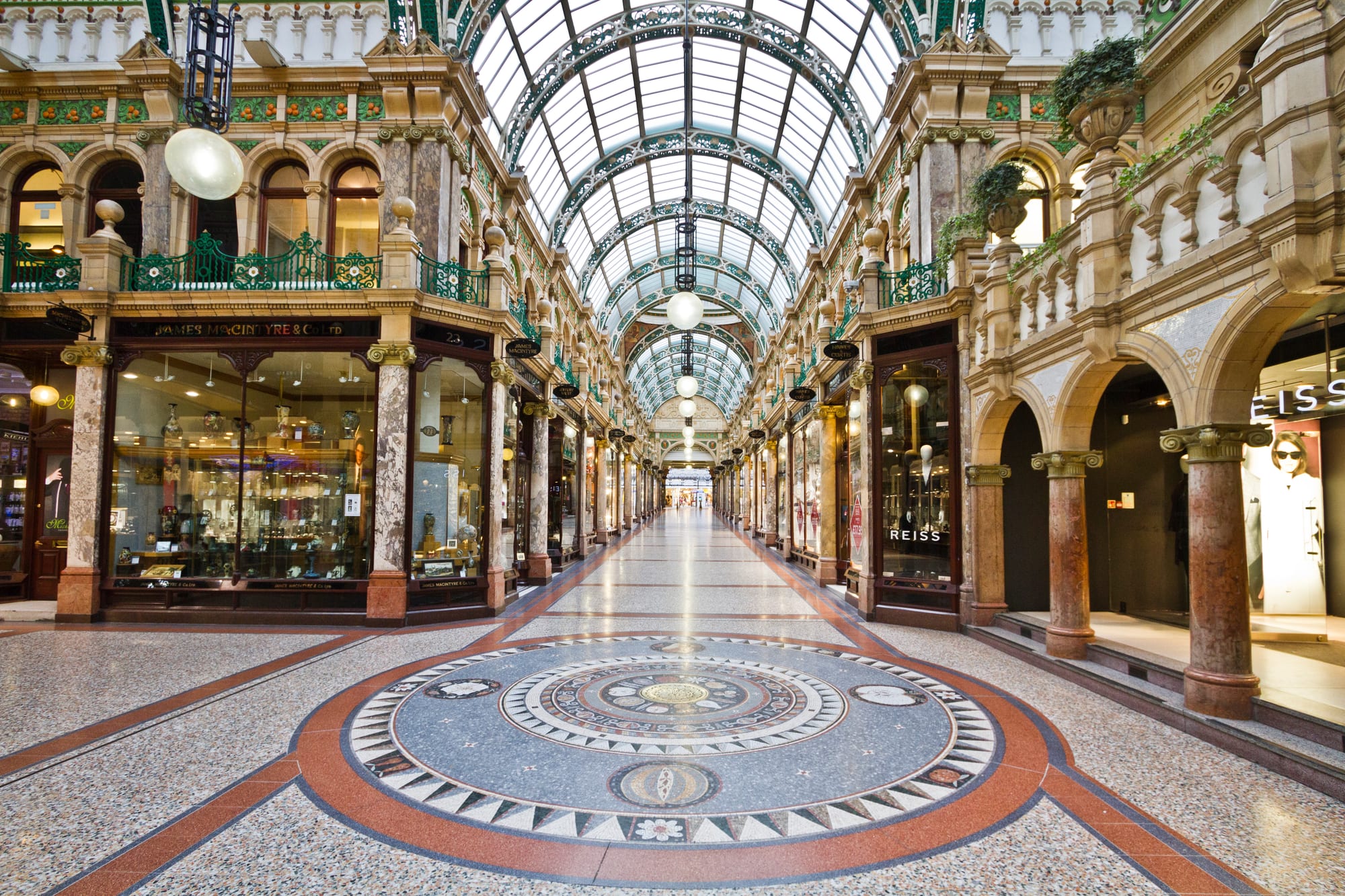
A Victorian shopping arcade with a glass roof on iron arches, carved shopfronts and a mosaic floor

Yorkshire & the Humber, United Kingdom

Leeds

County Arcade in the Victoria Quarter, off Briggate in central Leeds. (Michael D Beckwith / Wikimedia Commons · CC BY 4.0)

The largest settlement in Yorkshire, on the River Aire in the eastern foothills of the Pennines — a medieval market town that grew rich on wool and flax and became a Victorian mill and engineering city. Today it is a financial, legal and shopping centre with five universities, glass-roofed Victorian arcades, a vast covered market and the national collection of arms and armour.

Neighbourhoods

  • City centre and the arcades
    • First-time visitors
    • Shopping
    • Close to public transport

    The compact core between the railway station and the Headrow, centred on pedestrianised Briggate. Glass-roofed Victorian arcades, narrow medieval yards, Kirkgate Market, the Town Hall and the art gallery are all within a short walk, and most of the city's hotels are here.

    Open in Maps
  • The Calls and the Exchange Quarter
    • Nightlife
    • Riverside
    • Best for food

    The old riverside warehouse district below the Corn Exchange, turned into flats, restaurants and bars from the 1980s. Call Lane is the main bar street, busy at night and quiet by day, and footbridges cross the Aire to Brewery Wharf.

    Open in Maps
  • Leeds Dock
    • Museums
    • Waterfront

    A former canal dock east of the centre, rebuilt with flats and offices around the water. The Royal Armouries Museum stands here, by the River Aire.

    Open in Maps
  • Headingley and Hyde Park
    • Students and nightlife
    • Sport
    • Local life

    North-west of the centre, the heart of the city's student population, with terraced streets, pubs and cafés along Otley Road. Headingley Stadium holds Yorkshire cricket and the Leeds Rhinos rugby league team, and the Hyde Park picture house and park lie nearer town.

    Open in Maps
  • Chapeltown and Chapel Allerton
    • Local life
    • Cafés and bars
    • Quiet and residential

    Neighbouring districts to the north. Chapel Allerton is a former village with its own cluster of bars, cafés and restaurants and a large Caribbean community; Chapeltown, next to it, is the home of the West Indian Carnival each August.

    Open in Maps
  • Kirkstall
    • History
    • Riverside walks

    A district on the River Aire north-west of the centre, built around the ruins of Kirkstall Abbey and its park. The abbey's gatehouse holds a museum, and the canal towpath runs close by.

    Open in Maps

Things to do

Famous landmarks

  • Victoria Quarterlandmark

    Two restored arcades of 1898–1904 and a covered former street off Briggate, roofed with a large expanse of modern stained glass and filled with upmarket shops.

    Open in Maps
  • Leeds Town Halllandmark

    Cuthbert Brodrick's civic hall on the Headrow, completed in 1858 as a symbol of the city's Victorian wealth, with a tall clock tower and a concert hall inside.

    Open in Maps
  • Leeds Corn Exchangelandmark

    Brodrick's oval, domed trading hall of 1864, built for the grain trade and converted to shops in the late 1980s.

    Open in Maps
  • Leeds Minsterlandmark

    The Gothic Revival parish church on the site of the oldest church in the city, recorded as early as the 7th century, with a choir that sings choral services each week.

    Open in Maps
  • Temple Workslandmark

    The Egyptian-style flax mill built for John Marshall in Holbeck, one of the city's most unusual reminders of its industrial past.

    Open in Maps

Museums and galleries

  • Royal Armouries Museummuseum

    The national collection of arms and armour, which opened at Leeds Dock in 1996 when this part of the collection moved from the Tower of London.

    Open in Maps
  • Leeds Art Gallerymuseum

    Opened in 1888 beside the Town Hall, with a collection of 20th-century British art designated as of national importance.

    Open in Maps
  • Henry Moore Institutemuseum

    Next door to the art gallery, a centre for the study and display of sculpture from around the world.

    Open in Maps
  • Leeds City Museummuseum

    The city's own museum in a Brodrick building on Millennium Square, covering local history, natural history and world cultures.

    Open in Maps
  • Leeds Industrial Museum at Armley Millsmuseum

    A former woollen mill on the Aire holding textile machinery, railway equipment and heavy engineering from the city's working past.

    Open in Maps
  • Thackray Museum of Medicinemuseum

    A museum of the history of medicine beside St James's University Hospital, opened in 1997.

    Open in Maps

Abbeys, parks and historic houses

  • Kirkstall Abbeylandmark

    The ruins of a Cistercian monastery founded around 1152 and closed under Henry VIII, set in a public park on the north bank of the Aire.

    Open in Maps
  • Abbey House Museummuseum

    In the abbey's former gatehouse, with walk-through Victorian streets and displays on the story of the community.

    Open in Maps
  • Roundhay Parkpark

    More than 700 acres of parkland, lakes, woodland and gardens on the north-east edge of the city, also used for big outdoor concerts.

    Open in Maps
  • Temple Newsamlandmark

    A Tudor-Jacobean house in grounds landscaped by Capability Brown, one of the city's museum sites.

    Open in Maps

Markets

  • Kirkgate Marketmarket

    The largest covered market in Europe, a Grade I listed complex on Vicar Lane with about 800 stalls, where Marks & Spencer began as a penny bazaar in 1884.

    Open in Maps

Music, sport and nights out

  • Leeds Grand Theatreattraction

    The Victorian theatre that is home to Opera North, the only national opera company based outside London.

    Open in Maps
  • City Varietiesattraction

    A music hall on Swan Street, off Briggate, where Charlie Chaplin once performed.

    Open in Maps
  • Elland Roadattraction

    The home ground of Leeds United, founded in 1919, in Beeston south-west of the centre.

    Open in Maps
  • Headingley Stadiumattraction

    The joint home of Yorkshire County Cricket Club and the Leeds Rhinos rugby league team.

    Open in Maps

Short trips from the city

  • Harewood Houselandmark

    A country house built in 1759–71 by John Carr and Robert Adam for Edwin Lascelles, whose fortune came from West Indian plantations, in a Capability Brown landscape.

    Open in Maps
  • Saltaireattraction

    Titus Salt's model mill village near Bradford, a UNESCO World Heritage Site.

    Open in Maps

Seasonal events

  • Leeds West Indian CarnivalAugust bank holiday weekend

    One of the longest-running West Indian carnivals in Europe, held in Chapeltown and Harehills since 1967.

  • Leeds Festivallate August

    A big rock and indie music festival held each year at Bramham Park outside the city.

Eat and drink

Long-standing places and food districts in Leeds. Hours, ratings and directions come from your maps app, always current.

Leeds classics

  • Kirkgate Market food stallsmarket

    Butchers, fishmongers, greengrocers and street-food stalls under the market's Victorian and Edwardian halls.

    Open in Maps
  • Yorkshire puddingrestaurant

    Batter baked in hot fat, served with gravy and a Sunday roast in pubs across the city.

    Open in Maps

Food districts and bars

  • Call Laneneighborhood

    The city's best-known bar street, running from the Corn Exchange towards the river, busy in the evenings.

    Open in Maps
  • Briggate's yardsneighborhood

    Narrow medieval yards running off Briggate, several of them home to old pubs and bars.

    Open in Maps
  • Chapel Allertonneighborhood

    A suburban village of bars, cafés and restaurants north of the centre.

    Open in Maps

Experience Leeds

History

The name Leeds goes back to Loidis, the forested district Bede described in the 8th century, once part of the Brittonic kingdom of Elmet. The town was a small manorial borough in the 13th century and a market town by the 16th, its medieval streets laid out around Briggate, Kirkgate and The Calls. Its inhabitants petitioned Charles I for a charter of incorporation, granted in 1626. Before the Industrial Revolution Leeds became the centre that coordinated the West Riding's woollen cloth trade, and white broadcloth was traded at its White Cloth Hall.

Waterways opened the town to the world: the Aire and Calder Navigation of 1699 and the Leeds and Liverpool Canal, completed in 1816. From around 1790 mills went up for woollen finishing and flax, among them John Marshall's, whose Egyptian-style Temple Works still stands in Holbeck. Iron foundries, engineering and printing followed, the Corn Exchange opened in 1864, and in 1884 Michael Marks opened a penny bazaar in Kirkgate Market that grew into Marks & Spencer. Louis Le Prince filmed the Roundhay Garden Scene and Leeds Bridge in 1888, the first known moving pictures in the world. Electric trams spread the suburbs to Headingley, Potternewton and Roundhay, and Queen Victoria granted city status in 1893.

The 20th century absorbed surrounding villages and the city overtook York in size, while the old heavy industries declined. Since the 1980s Leeds has rebuilt itself on finance, law, retail and its universities: the riverside warehouses of The Calls became flats and bars, the Royal Armouries arrived in 1996 and Trinity Leeds opened in 2013. The city council is marking the four hundredth anniversary of the Royal Charter in 2026.

Culture & Customs

Leeds sees itself as the cultural and commercial capital of West Yorkshire. Opera North, the only national opera company based outside London, performs at the Grand Theatre; Northern Ballet and Phoenix Dance Theatre, formed in Harehills in 1981, are based here; and the Leeds Playhouse has two auditoriums. The art gallery and the Henry Moore Institute make the city a centre for sculpture, and Henry Moore and Damien Hirst both studied at its art college.

Sport is followed with passion. Leeds United, formed in 1919, play at Elland Road, where statues honour the manager Don Revie and the captain Billy Bremner of the club's great years. Headingley is the home of Yorkshire cricket and of the Leeds Rhinos rugby league team.

The city's communities shape its calendar. Chapel Allerton and Chapeltown have a large Caribbean community, and the Leeds West Indian Carnival, held since 1967, is one of the longest-running in Europe. The Leeds Festival fills Bramham Park with rock and indie bands each August, and big pop concerts have been held in Roundhay Park. Students give Headingley and Hyde Park a young, late-night character.

Daily Life

About 536,000 people lived in Leeds itself at the 2021 census, and about 812,000 in the wider City of Leeds district, the second most populous local authority in the United Kingdom. The city is part of the West Yorkshire Built-up Area, the fourth-largest in the country.

The economy is the most diverse of the UK's main employment centres. First Direct and Yorkshire Bank have their headquarters here, the major banks run large offices, and law, retail, health and the five universities employ many more. The fourth-largest student population in the country keeps the nightlife busy, and Briggate, the arcades and the shopping centres draw shoppers from across the North.

Most people live in suburbs of terraced streets and semi-detached houses reached by bus, from Headingley and Kirkstall to Harehills, Beeston and Roundhay, with new flats in the centre and around Leeds Dock. Transport is a long-running issue: a Supertram scheme was cancelled in 2005, a new tram system was announced in 2023, and in 2024 the combined authority announced that buses would move into public ownership.

Food

Leeds eats as Yorkshire does. The Yorkshire pudding, a batter baked in hot fat, appears with the Sunday roast in pubs across the city. Early forced rhubarb comes from the Rhubarb Triangle, which reaches into the south of the district around Rothwell.

Kirkgate Market is the place to see the city's food: butchers, fishmongers, greengrocers and stalls selling food from the many communities that have settled in Leeds, under Victorian and Edwardian roofs. Chapeltown and Harehills, with large Caribbean and South Asian communities, add to the choice, and the student districts are full of cheap places to eat.

Drinking has its own geography. The narrow yards off Briggate hide some of the oldest pubs in the centre, Call Lane and The Calls are lined with bars, and the riverside around Brewery Wharf has more. Yorkshire's breweries supply many of the pubs, and the art deco headquarters of the old Tetley brewery still stands as a reminder of the city's brewing past.

Planning tools

Budget

Leeds is good value by British standards, cheaper than London or York for rooms and food. The Royal Armouries is free, and the city centre is walkable. Hotel prices rise on big match days, cricket Tests and the August festival and carnival weekend.

Daily Budget Midrange
USD 150–260 (city-centre hotel, restaurant dinners, a show or match, local trains)
Daily Budget Shoestring
USD 65–110 (hostel or budget hotel, market and pub meals, buses and walking)

Eat at Kirkgate Market at lunchtime and use the free Royal Armouries; book rooms early for festival and big match weekends.

Best Time to Visit

May to September brings the longest days, outdoor concerts in the parks, the cricket season at Headingley and the August carnival and festival. The city suits any season, though, since most sights are indoors; winter brings football, theatre, the Christmas lights and lower hotel prices.

Suggested Number of Days

Two days cover the centre and one or two of the outer sights. Three or four allow for country houses nearby and a trip into the Dales or to York, both easy by train. Match days and festival weekends call for extra time.

First Visit
2 days
With Surroundings
3–4 days

Transportation

Leeds has no tram or underground; buses are the main public transport, with frequent services on the main routes, and local trains reach some suburbs such as Headingley. A tram system for the city and wider region was announced in 2023. Leeds City Bikes, an electric bicycle rental scheme, opened in September 2023, and the Leeds and Liverpool Canal towpath is a walking and cycling route.

Walk within the centre and use buses or local trains for Headingley, Kirkstall and Roundhay.

Airport & Station Connections

Leeds railway station, in the city centre, is the second-busiest in Northern England, with direct trains to London King's Cross every half hour and frequent services to York, Manchester and the rest of the North. Leeds Bradford Airport is at Yeadon, about 8 miles north-west of the city centre, linked by Flyer buses.

Walkability

The city centre is compact: the station, Briggate, the arcades, the market, the Town Hall and the riverside are all within a few minutes of one another, and much of the shopping district is pedestrianised. Kirkstall, Headingley and Roundhay are a bus ride away, and the canal and riverside paths are the pleasant routes out on foot.

Safety

The UK is generally safe, with the main risks being pickpocketing and phone theft in crowded parts of London and other cities, occasional late-night antisocial behaviour, and drink-related trouble around nightlife. In Leeds the busy weekend nightlife of Call Lane and the student districts brings crowds and drink-related trouble late at night, and phone theft is the most common risk in the city centre.

Keep phones and bags secure in crowds and on late-night streets, and use licensed taxis after a night out. Check current official travel advice before travelling.

Climate

A mild, damp climate typical of northern England, influenced by the Pennines to the west. July and August are the warmest months and January and February the coldest; temperatures above 30°C or below −10°C are uncommon.

Summer
mild — July and August average about 15°C across day and night
Winter
cold and damp — January and February average about 3°C

Local Customs

Yorkshire people take pride in plain speaking and dry humour, and Leeds is no exception. Queuing is expected, at bars as well as bus stops, and pub rounds are bought in turn. Sport divides loyalties sharply: Leeds United at Elland Road, and the Rhinos and Yorkshire cricket at Headingley. The student population gives Headingley and Hyde Park a young, late-night feel.

Order and pay at the bar in pubs; carry identification if young-looking, since the legal age to buy alcohol is 18.

Common Payment Methods

The currency is the pound sterling. Cards and contactless payment are widely used, and cash machines are easy to find. A little cash is useful for some market stalls.