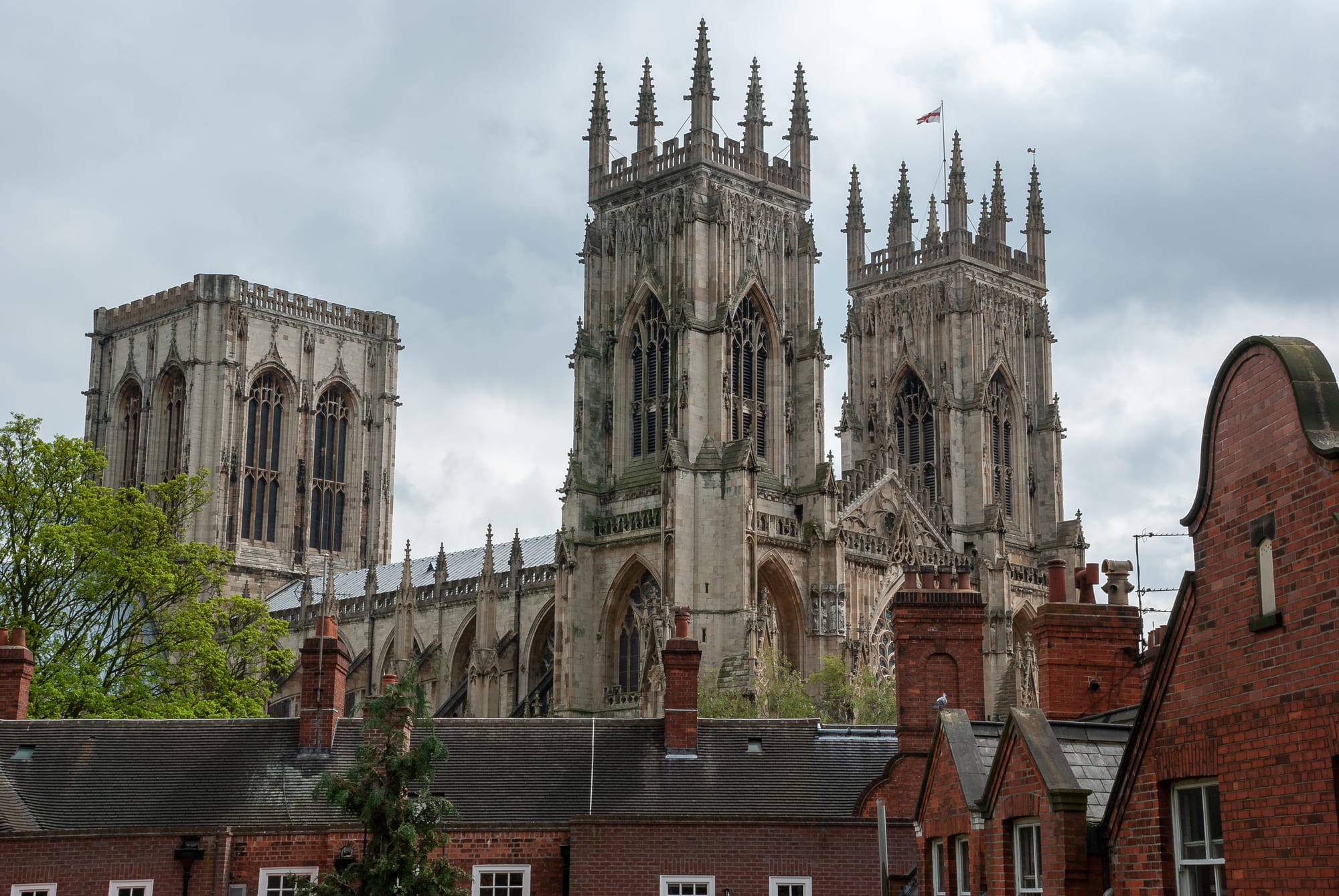
The three pale stone Gothic towers of York Minster rising above red-brick houses and slate roofs under a grey sky

Yorkshire & the Humber, United Kingdom

York

York Minster seen from the city walls near Bootham Bar. (Chris Gorringe / Wikimedia Commons · CC BY-SA 2.0)

A cathedral city where the rivers Ouse and Foss meet, founded by the Romans as Eboracum in AD 71 and later the Viking capital Jórvík. Its medieval walls, the great Gothic minster and lanes such as the Shambles survive largely intact; railways and chocolate made its 19th-century fortune, and tourism, universities and services drive it today.

Neighbourhoods

  • The walled centre
    • First-time visitors
    • Historic district
    • Shopping

    The medieval core inside the walls between the minster and the castle, a tangle of narrow streets such as the Shambles, Stonegate, Petergate and Goodramgate. Many streets are car-free during business hours, and most sights, tea rooms and pubs are within a few minutes' walk.

    Open in Maps
  • Micklegate
    • Nightlife
    • Restaurants
    • Close to the station

    The street running from the Ouse up to Micklegate Bar, on the station side of the river. Its mostly Georgian buildings hold restaurants, traditional pubs and bars.

    Open in Maps
  • Fossgate and Walmgate
    • Best for food
    • Independent shops
    • Pubs

    Two connected streets running south-east from the centre to Walmgate Bar, lined with independent restaurants, cafés, a craft brewery bar and homeware shops, close to the Merchant Adventurers' Hall and the National Centre for Early Music.

    Open in Maps
  • Bootham and Gillygate
    • Quiet and residential
    • Cafés
    • Close to the minster

    Just outside Bootham Bar to the north, a district of terraces, small shops and cafés, with York St John University and the art gallery and Museum Gardens close by.

    Open in Maps
  • South Bank and the Knavesmire
    • Quiet and residential
    • Racing
    • Local life

    Streets south of the walls around Bishopthorpe Road, beside the Knavesmire, the open common where York Racecourse holds its meetings. Rowntree Park and the river paths are near.

    Open in Maps

Things to do

Famous landmarks

  • York Minsterlandmark

    The seat of the Archbishop of York, built mostly between 1220 and 1472, which keeps most of its medieval stained glass, including the east window, the largest expanse of medieval stained glass in the world.

    Open in Maps
  • York city wallstrail

    A walk of around 2 miles on the medieval walls, punctuated by four main gateways, or bars; the stretch from Bootham Bar to Monk Bar gives the best views of the minster.

    Open in Maps
  • The Shambleslandmark

    A narrow medieval street of overhanging timber-framed buildings, once the butchers' street, now lined with shops and tea rooms.

    Open in Maps
  • Clifford's Tower and York Castlelandmark

    The ruined 13th-century stone keep of the Norman castle on its mound, where 150 of the city's Jews died in the earlier timber keep in 1190, beside the later prison buildings of the castle complex.

    Open in Maps
  • Merchant Adventurers' Halllandmark

    A medieval guildhall on Fossgate, built mostly between 1357 and 1361, whose Great Hall is timber-framed.

    Open in Maps
  • Micklegate Barlandmark

    Long the main southern entrance to the city, first recorded in the 12th century and reusing stone from a Roman gate, now holding a small museum.

    Open in Maps

Museums

  • National Railway Museummuseum

    Home of the national collection of historic railway vehicles, including Mallard and a Japanese bullet train; its Station Hall reopened in 2025 after a refurbishment.

    Open in Maps
  • Jorvik Viking Centremuseum

    Opened in 1984 on the site of Viking-age excavations at Coppergate, where 'time capsule' carriages carry visitors through scenes of the 10th-century town.

    Open in Maps
  • York Castle Museummuseum

    A social history museum in the former prison buildings of York Castle.

    Open in Maps
  • Yorkshire Museum and Museum Gardensmuseum

    The county museum of archaeology and natural history, set in gardens holding the ruins of St Mary's Abbey.

    Open in Maps
  • York Art Gallerymuseum

    The city's art gallery on Exhibition Square, with paintings from the 14th century to the present.

    Open in Maps
  • Barley Hallmuseum

    A reconstructed medieval town house owned by the York Archaeological Trust.

    Open in Maps

Rivers, parks and racing

  • York Racecourseattraction

    Racing on the Knavesmire since 1731, with the four-day Ebor Festival in August.

    Open in Maps
  • Rowntree Parkpark

    A riverside park by the Ouse south of the city centre.

    Open in Maps

Short trips from the city

  • Castle Howardattraction

    A country house 15 miles north of York, home of the Carlisle branch of the Howard family for more than 300 years and the setting of Brideshead Revisited on screen.

    Open in Maps

Seasonal events

  • Jorvik Viking FestivalFebruary

    A city-wide celebration of all things Norse in the second week of February, organised by the Jorvik Viking Centre.

  • York Mystery Playssummer, at intervals of several years

    Performances of the medieval cycle of plays once staged by the city's guilds, one of four virtually complete surviving English cycles.

  • Ebor FestivalAugust

    Four days of racing on the Knavesmire, including the Ebor Handicap, run since 1843.

  • York Beer and Cider FestivalSeptember

    Yorkshire's largest beer festival, held on the Knavesmire by the local branch of CAMRA.

  • St Nicholas Fairthe run-up to Christmas

    York's Christmas market of stalls and wooden chalets on Parliament Street and St Sampson's Square, selling gifts, crafts and seasonal food.

Eat and drink

Long-standing places and food districts in York. Hours, ratings and directions come from your maps app, always current.

York classics

  • Bettys Café Tea Roomscafe

    The York branch of the Harrogate tea-room company in St Helen's Square, whose basement bar was a haunt of wartime airmen; the mirror they signed is still on display.

    Open in Maps
  • Shambles Marketmarket

    The city's outdoor market between the Shambles and Parliament Street, with produce and food stalls.

    Open in Maps

Food streets

  • Fossgate and Walmgateneighborhood

    York's best-known run of independent restaurants and cafés, from tapas to modern British cooking, with traditional pubs between.

    Open in Maps
  • Micklegateneighborhood

    Restaurants and pubs along the old main road into the city from the south-west.

    Open in Maps

Pubs

  • Historic pubs inside the wallsneighborhood

    Old inns such as the Golden Fleece and Ye Olde Starre Inne, whose sign has spanned Stonegate since 1733, in a city where a 2016 count found 328 real ales in over 200 pubs.

    Open in Maps

Experience York

History

The Romans founded Eboracum in AD 71 as a legionary fortress on high ground between the Ouse and the Foss, and it became the capital of the province of Britannia Inferior. Its headquarters lies beneath the minster, and in 306 Constantine the Great was proclaimed emperor by the troops here. Under the Anglo-Saxons, as Eoforwic, it was a royal and church centre: a wooden church was built for the baptism of King Edwin of Northumbria in 627. Vikings took the city in 866 and renamed it Jórvík, and it became a busy trading town with a mint and workshops around Coppergate, with a population second only to London.

The people of York rebelled two years after the Norman Conquest, and William the Conqueror built castles to hold the city; in 1190, 150 of its Jews died in the timber keep during a massacre. Around 1080 Archbishop Thomas began the cathedral that became the present minster, finished in 1472. The city prospered as the centre of the northern church and as a wool-trading town, and its walls and gateways took their present form. Parliament besieged the city in 1644, during the Civil War.

The railway promoter George Hudson brought the railway in 1839, and York became a major railway centre and the headquarters of the North Eastern Railway. Rowntree's, founded in 1862, and Terry's made it a chocolate city, and by 1900 railways and confectionery were its two great industries. German bombing in the Baedeker Blitz gutted several historic buildings. As the old industries declined, tourism grew: the National Railway Museum opened in 1975 and the Jorvik Viking Centre in 1984. Terry's factory closed in 2005, and floods in 2000 and 2015 tested the city's river defences.

Culture & Customs

York's identity rests on its long history and its church. The minster is the mother church of the northern province and the seat of the Archbishop of York, and the medieval guilds' cycle of mystery plays, one of four virtually complete in England, is still revived at intervals in the streets, the minster and the Museum Gardens. The National Centre for Early Music, in the former church of St Margaret on Walmgate, hosts the York Early Music Festival, and the Theatre Royal, the Grand Opera House and the Joseph Rowntree Theatre provide drama.

Racing has been a part of city life since the racecourse opened on the Knavesmire in 1731; the Ebor Festival each August includes a handicap first run in 1843. The Jorvik Viking Festival celebrates the city's Norse past each February, and the St Nicholas Fair and other Christmas events fill the streets in the run-up to Christmas. York also has a strong pub culture: a 2016 count by local real-ale campaigners found 328 different real ales on sale in more than 200 pubs.

Civic tradition runs deep. York has had a Lord Mayor since 1370, one of only five in the UK with the title "The Right Honourable", and the city keeps a ceremonial Sheriff. The universities of York and York St John bring a large student population, and in 2016 York became a sister city of Nanjing in China.

Daily Life

About 203,000 people lived in the City of York council area at the 2021 census, which includes surrounding villages and the town of Haxby; the built-up area of the city itself had about 142,000. The population is overwhelmingly White British, and Christianity remains the largest religion, reported by about 44 per cent of residents in 2021.

The economy of chocolate and railways that sustained York into the 1950s has largely gone. The railway carriage works, which employed thousands, closed in the 1990s, and Terry's chocolate factory, maker of the Chocolate Orange, shut in 2005. Nestlé still makes KitKat and Yorkie bars at the former Rowntree's works, but tourism, the universities, insurance, BT and other services now provide most jobs. Visitors crowd the walled centre year-round.

Residents live mostly in the suburbs and villages beyond the walls, from Acomb and Holgate in the west to Heworth, Fulford and Heslington, home to the university, in the east and south. Much land around the city is too flood-prone to build on, and the ings, or flood meadows, along the Ouse are often under water in winter. Traffic is restricted in the centre, and park-and-ride sites and cycling routes along the river carry many people into town.

Food

York ham is the city's best-known food: a mild-flavoured, dry-cured ham with delicate pink colouring, described as saltier but milder than other European dry-cured hams. Folklore has it that the oak construction of the minster provided the sawdust for smoking it. The Shambles Market, between the Shambles and Parliament Street, has food and produce stalls.

Chocolate is part of the city's story. Rowntree's and Terry's employed thousands, the KitKat and Yorkie are still made here by Nestlé, and York's Chocolate Story, a visitor attraction that opened in 2012, tells the history. A chocolate festival is held in spring and a food and drink festival each September in Parliament Street and the market squares.

Tea and beer complete the picture. Bettys Café Tea Rooms in St Helen's Square, the York branch of the Harrogate company founded by the Swiss confectioner Frederick Belmont, is an institution, and its basement bar was a favourite of wartime airmen. Old inns such as the Golden Fleece and Ye Olde Starre Inne serve real ale, and every September the Knavesmire hosts Yorkshire's largest beer festival. Fossgate, Walmgate and Micklegate hold many of the city's independent restaurants.

Planning tools

Budget

York is one of the pricier places to stay in the North, especially at weekends, on race days and in the run-up to Christmas, when taxis also charge higher rates. Food ranges from market stalls and pubs to the independent restaurants of Fossgate and Micklegate. Walking the city walls costs nothing.

Daily Budget Midrange
USD 180–300 (central hotel or guest house, restaurant dinners, minster and museum entry)
Daily Budget Shoestring
USD 70–120 (hostel bed, market and pub meals, walking and buses)

Leave a car at a park-and-ride site on the ring road rather than driving into the walled centre, and note that the park-and-ride cannot be used overnight.

Best Time to Visit

York suits any season. May to July bring the most sunshine and the outdoor events, August the Ebor races, and September the food and beer festivals. The Viking Festival in February and the St Nicholas Fair before Christmas fill the cooler months, when the city is busiest at weekends.

Suggested Number of Days

Two or three days cover the walled city and its main museums at an easy pace. Allow four or five to add the country houses, abbeys, moors and coast within reach, for which a car or careful use of buses helps.

First Visit
2–3 days
With Surroundings
4–5 days

Transportation

The centre is best on foot: many streets inside the walls are car-free during business hours. Buses run to the suburbs, some take contactless cards, and Coastliner routes reach Malton, Pickering, Scarborough and Whitby. Park-and-ride sites by the ring road serve drivers. The river paths along the Ouse are good cycle routes, and bikes can be hired.

Taxis charge higher rates at Christmas, New Year, on bank holidays and to or from the Knavesmire on race days.

Airport & Station Connections

York station, just outside the western walls, is a principal stop on the East Coast Main Line, with direct trains from London King's Cross in about two hours, Edinburgh, Newcastle, Leeds and Manchester, including Manchester Airport. The nearest international airport is Leeds Bradford, about 30 miles away, which has no railway station and is reached by bus or road; Manchester Airport has direct trains.

Walkability

Excellent. The walled centre is compact and largely flat, and the station to the minster is a short walk across the Ouse. The full circuit of the walls is around 2 miles. Cobbles, crowds in the Shambles at busy times and narrow pavements are the main obstacles.

Safety

The UK is generally safe, with the main risks being pickpocketing and phone theft in crowded parts of London and other cities, occasional late-night antisocial behaviour, and drink-related trouble around nightlife. In York, crowds in the Shambles and around the minster draw pickpockets. The Ouse floods regularly; in 2000 and 2015 floods reached homes.

Keep bags closed in crowded streets, and keep away from the riverside paths when the Ouse is high. Check current official travel advice before travelling.

Climate

Being lowland and inland, York is warmer in summer than the Yorkshire coast but prone to frost, fog and cold winds in winter, spring and very early summer. May to July are the sunniest months, averaging about six hours of sunshine a day.

Summer
mild to warm — temperatures often reach 27°C or more on hot days, and nearby Linton-on-Ouse has recorded 34.8°C
Winter
cold, with frost and fog — snow can fall from December to as late as April but quickly melts; nearby Linton-on-Ouse has recorded −17.3°C

Local Customs

Yorkshire people are known for plain speaking and pride in their county. York is a working cathedral city: the minster holds daily services, and visitors are asked to respect them. Pub culture is strong, with real ale at its heart, and tea rooms are an institution. The city keeps a Lord Mayor, an office held since 1370.

Keep quiet during services in the minster and churches, and stand aside to let others pass in the narrow streets and on the walls.

Common Payment Methods

The currency is the pound sterling. Cards and contactless are widely accepted in shops, pubs and restaurants, and on some buses; a little cash helps at market stalls.