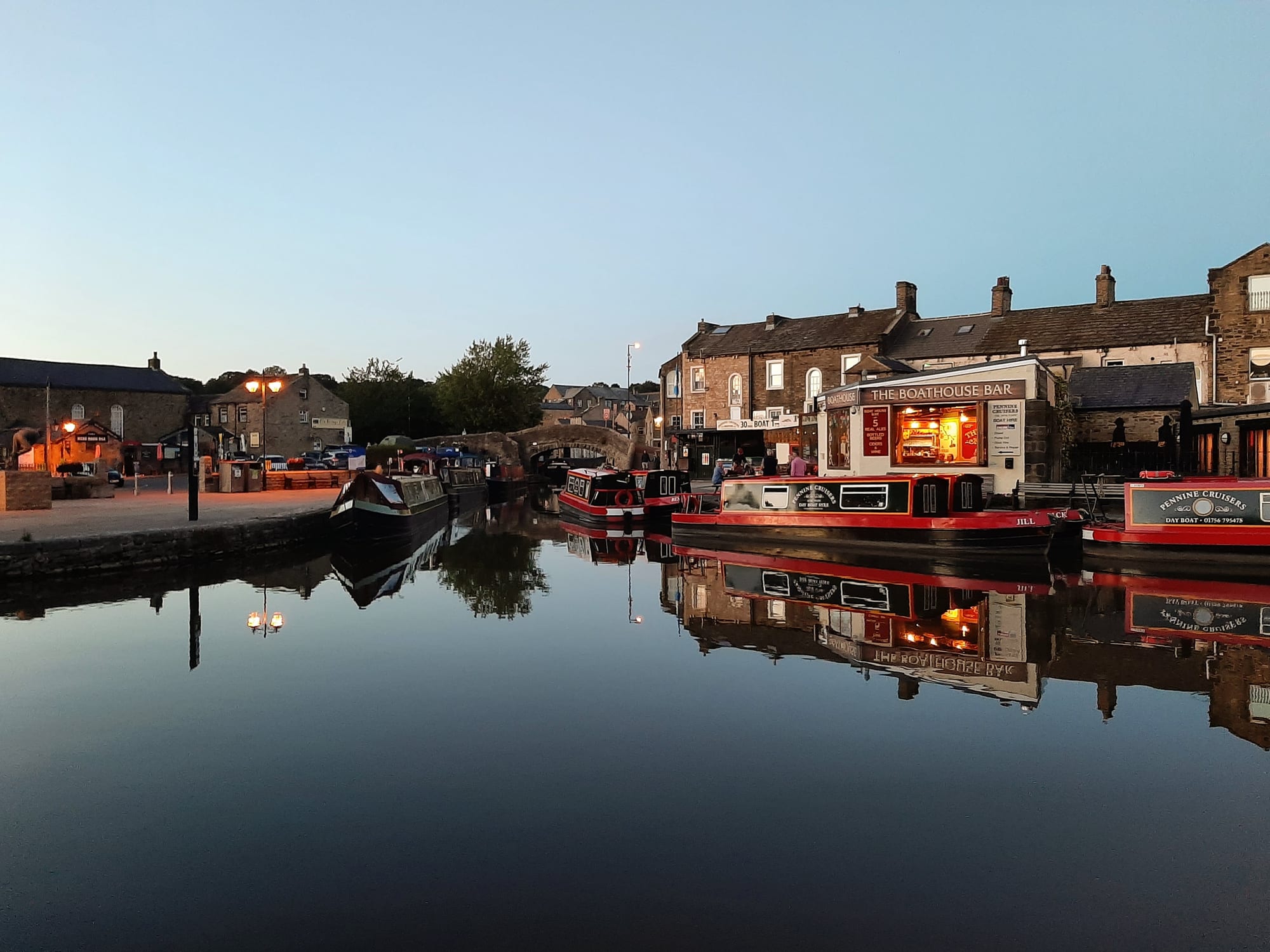
Narrowboats moored in a still canal basin at dusk, reflected in the water beside stone buildings and a footbridge

Yorkshire & the Humber, United Kingdom

Skipton

The canal basin on the Leeds and Liverpool Canal in Skipton at dusk. (Jansch Wiki / Wikimedia Commons · CC BY-SA 4.0)

A market town of about 15,000 people on the River Aire and the Leeds and Liverpool Canal, on the southern edge of the Yorkshire Dales. Its name means 'sheep town'; a Norman castle, one of the best preserved in England, guards the top of a wide high street that still holds a market four days a week.

Neighbourhoods

  • High Street and the castle
    • First-time visitors
    • Historic district
    • Markets

    The broad high street climbs to Holy Trinity Church and the gatehouse of Skipton Castle. Market stalls line it on Mondays, Wednesdays, Fridays and Saturdays, and the Town Hall holds the Craven Museum & Gallery.

    Open in Maps
  • Canal basin
    • Waterside walks
    • Boat trips
    • Cafés and pubs

    Close to the high street, where narrowboats tie up on the Leeds and Liverpool Canal. Boat trips leave from the basin, and the short Springs Branch runs north into the ravine below the castle.

    Open in Maps
  • Aireville and the west side
    • Quiet and residential
    • Parks

    Residential streets around Aireville Park, which holds the free weekly parkrun and the end of the town gala's procession each June.

    Open in Maps

Things to do

In the town

  • Skipton Castlelandmark

    Begun in 1090 as a wooden motte-and-bailey and later rebuilt in stone, it is one of the most complete and best preserved medieval castles in England, and open to the public.

    Open in Maps
  • Holy Trinity Churchlandmark

    The medieval parish church on the High Street, near the castle, with a present building dating from about 1300.

    Open in Maps
  • Craven Museum & Gallerymuseum

    The town museum in the Town Hall, shortlisted for the Art Fund Museum of the Year award in 2024.

    Open in Maps
  • Skipton canal basinattraction

    A stop on the 127-mile canal across the Pennines, with boat trips and towpath walks.

    Open in Maps

Short trips into the Dales

  • Bolton Abbeylandmark

    An estate on the River Wharfe east of the town, with the ruins of Bolton Priory and riverside walks.

    Open in Maps
  • Embsay and Bolton Abbey Steam Railwayattraction

    A heritage steam railway running from Embsay, just outside Skipton, to a station near Bolton Abbey.

    Open in Maps
  • Malham Coveviewpoint

    A curved limestone cliff with a pavement of limestone blocks on top, one of the best-known sights of the Yorkshire Dales.

    Open in Maps
  • Grassingtonattraction

    A stone-built village in Wharfedale with a cobbled square, a base for walks in the upper dale.

    Open in Maps

Seasonal events

  • Skipton Sheep Dayfirst Sunday in July

    A heritage day on the high street celebrating the town's association with sheep, with a petting zoo, educational shows and food and drink stalls.

  • Skipton Galasecond Saturday in June

    A procession of decorated floats, a marching band and classic cars through the town centre, ending in Aireville Park with live music, stalls and fireworks.

  • Skipton Christmas marketDecember

    The high street closes to traffic and more than 50 extra stallholders join the regular market traders.

Eat and drink

Long-standing places and food districts in Skipton. Hours, ratings and directions come from your maps app, always current.

Skipton classics

  • Skipton marketmarket

    The street market on the high street, held on Mondays, Wednesdays, Fridays and Saturdays, a survivor of the medieval market that made the town.

    Open in Maps
  • Wensleydale cheesemarket

    The crumbly white cheese of the Dales, often eaten with fruit cake.

    Open in Maps

Pubs and cafés

  • Pubs and tea rooms on the high streetneighborhood

    Old coaching inns, pubs and tea rooms along the high street and the lanes leading off it.

    Open in Maps
  • Canal basin cafésneighborhood

    Places to eat and drink beside the moored narrowboats at the basin.

    Open in Maps

Experience Skipton

History

Skipton means "sheep town", from the Old English sceap and tun, and it was recorded in the Domesday Book of 1086. In 1090 the Norman baron Robert de Romille built a wooden motte-and-bailey castle here, and in the 12th century William le Gros strengthened it with a stone keep against raids from Scotland. The castle raised Skipton from a poor dependent village to a burgh run by a reeve, and its protection drew families to settle around it in times of war.

In 1310 Edward II granted the castle to Robert Clifford, and it remained the Clifford family's principal seat until 1676; the High Corn Mill on Eller Beck, one of the oldest mills in North Yorkshire, dates to 1310. In the Civil War the castle held out against Cromwell's forces for three years, and was afterwards repaired rather than demolished. The town grew into a prosperous market for sheep and woollen goods.

In the 19th century Skipton became a small mill town, linked to the big cities by the Leeds and Liverpool Canal and its Springs Branch, built to carry limestone from quarries near the castle. The market from its early years still survives, though sheep are now sold at the auction mart on the edge of town. From 1974 to 2023 Skipton was the seat of Craven District Council, abolished when North Yorkshire Council took over.

Culture & Customs

Skipton calls itself the Gateway to the Dales, and much of its life revolves around visitors heading into the hills, especially on market days. The town celebrates its origins at Skipton Sheep Day on the first Sunday in July, a heritage event on the high street with a petting zoo, shows and food stalls, and the June gala ends its procession in Aireville Park with live music, stalls and fireworks. At Christmas the high street closes to traffic for a market that brings in more than 50 extra stallholders.

The Town Hall stages music, theatre, comedy, markets and fairs and houses the Craven Museum & Gallery, shortlisted for the Art Fund Museum of the Year award in 2024. Skipton Little Theatre on Clifford Street seats about 70 and is run by a not-for-profit group, and Drystone Radio and My Skipton Radio broadcast locally. A free parkrun is held every week in Aireville Park.

The town has repeatedly been named one of the best and happiest places to live in the country, in Rightmove's Happy at Home Index in 2020 and 2023 and by The Sunday Times in 2024, and local pride reflects it.

Daily Life

About 15,000 people lived in Skipton at the 2021 census. It is the nearest and largest town to a large part of the Dales, so shops, services and the market serve a wide farming hinterland, and tourism brings crowds on Mondays, Wednesdays, Fridays and Saturdays, the market days.

It is also a commuter town: direct trains run to Leeds, Bradford and London. Livestock auctions continue at the mart on the western edge of town, keeping farming visible in daily life. One of the larger employers is the Skipton Building Society, founded in the town, with its subsidiary companies. The bypass that opened in 1981 and 1982 greatly reduced journey times to the Dales. In December 2022 Craven Arts reopened the former parish church school on Otley Street as an arts venue.

Daily rhythm follows the market and the seasons: quiet weekday mornings, market-day crowds and summer weekends when walkers and day-trippers arrive by train from Leeds and Bradford. Since 2023 the town has been governed by North Yorkshire Council, and the parliamentary seat is held by Sir Julian Smith.

Food

Skipton's food is that of the Dales and of Yorkshire. Wensleydale cheese, a supple, crumbly cheese first made commercially at Hawes, further up the Dales, is often eaten with fruit cake. The Yorkshire pudding, a batter baked in hot fat, comes with the Sunday roast in the town's pubs.

The market on the high street sells local produce alongside general goods, and the pubs and tea rooms of the high street and the canal basin feed the walkers and day-trippers who pass through on their way into the hills. The surrounding Craven countryside is grazing land for sheep and cattle — in the 19th century it produced the Craven Heifer, a famously vast cow.

Sweet things follow the county's traditions: parkin, a ginger cake made with oatmeal and treacle and eaten around Bonfire Night, and Yorkshire curd tart. Beer is part of the Dales' identity, with Theakston and Black Sheep brewing at Masham and Timothy Taylor at Keighley, down the Aire valley.

Planning tools

Budget

Skipton is cheaper than York or Harrogate but busy on market days and summer weekends, when Dales visitors fill its rooms and car parks. Many of the best things around it — the canal towpath, the Dales walks, the market — cost nothing.

Daily Budget Midrange
USD 150–270 (mid-range guesthouse or inn, restaurant dinners, castle entry, a hire car or boat trip)
Daily Budget Shoestring
USD 65–110 (budget guesthouse or hostel nearby, pub and café meals, trains and buses)

Stay midweek for lower prices, and use the train from Leeds or Bradford rather than driving in on a market day.

Best Time to Visit

May to September suits Dales walking and canal trips, with Sheep Day in early July. Spring and autumn are quieter, and in December the high street hosts a Christmas market. Winter is cold and damp, and buses into the Dales are less frequent.

Suggested Number of Days

The town itself fills a day. As the gateway to the Dales it rewards a longer stay of three or four days, with the time depending on how much walking is planned and whether there is a car for the outlying valleys.

First Visit
1 day
With Surroundings
3–4 days

Transportation

The town is best explored on foot. Skipton bus station on Keighley Road, rebuilt in 2009, is the hub for local and Dales buses, and the Dales Bus 580 runs to Settle via Gargrave. The A65 to the Lake District and the A59 to York meet near the town. A car helps for Bolton Abbey and the upper dales.

Use the train along the Aire valley and a car or the Dales buses for the outlying valleys.

Airport & Station Connections

Skipton is 27 miles north-west of Leeds. The electrified Airedale Line runs regular trains to Keighley, Bradford Forster Square and Leeds, and a daily direct service goes to London King's Cross. Some trains continue north through the Dales towards Lancaster and Carlisle.

Walkability

Compact and easy on foot: the station, the canal basin, the high street, the church and the castle are all a few minutes apart, and the towpath makes a level walk out of town. The streets around the castle are sloping, and market days crowd the pavements.

Safety

The UK is generally safe, with the main risks being pickpocketing and phone theft in crowded parts of London and other cities, occasional late-night antisocial behaviour, and drink-related trouble around nightlife. Skipton is a quiet market town; the main hazards are in the hills around it, where fog and fast-changing weather catch walkers out.

Check the forecast and carry proper clothing before walking in the Dales, and take care on canal edges. Check current official travel advice before travelling.

Climate

A cool, damp climate on the edge of the Pennines. In nearby Leeds, July and August are the warmest months and January and February the coldest.

Summer
mild — in nearby Leeds, July and August average about 15°C across day and night
Winter
cold and damp — in nearby Leeds, January and February average about 3°C

Local Customs

A farming and market town with a strong attachment to its sheep-trading past, still marked by the livestock auction mart on the western edge of town and by Sheep Day each July. Yorkshire plain speaking and pub rounds are the norm, and walkers in boots are a common sight in pubs and cafés.

Close gates and keep dogs on leads near livestock on Dales walks; order and pay at the bar in pubs.

Common Payment Methods

The currency is the pound sterling. Cards and contactless payment are widely accepted in shops, pubs and cafés, and the town has cash machines; a little cash is useful for market stalls and village shops in the Dales.