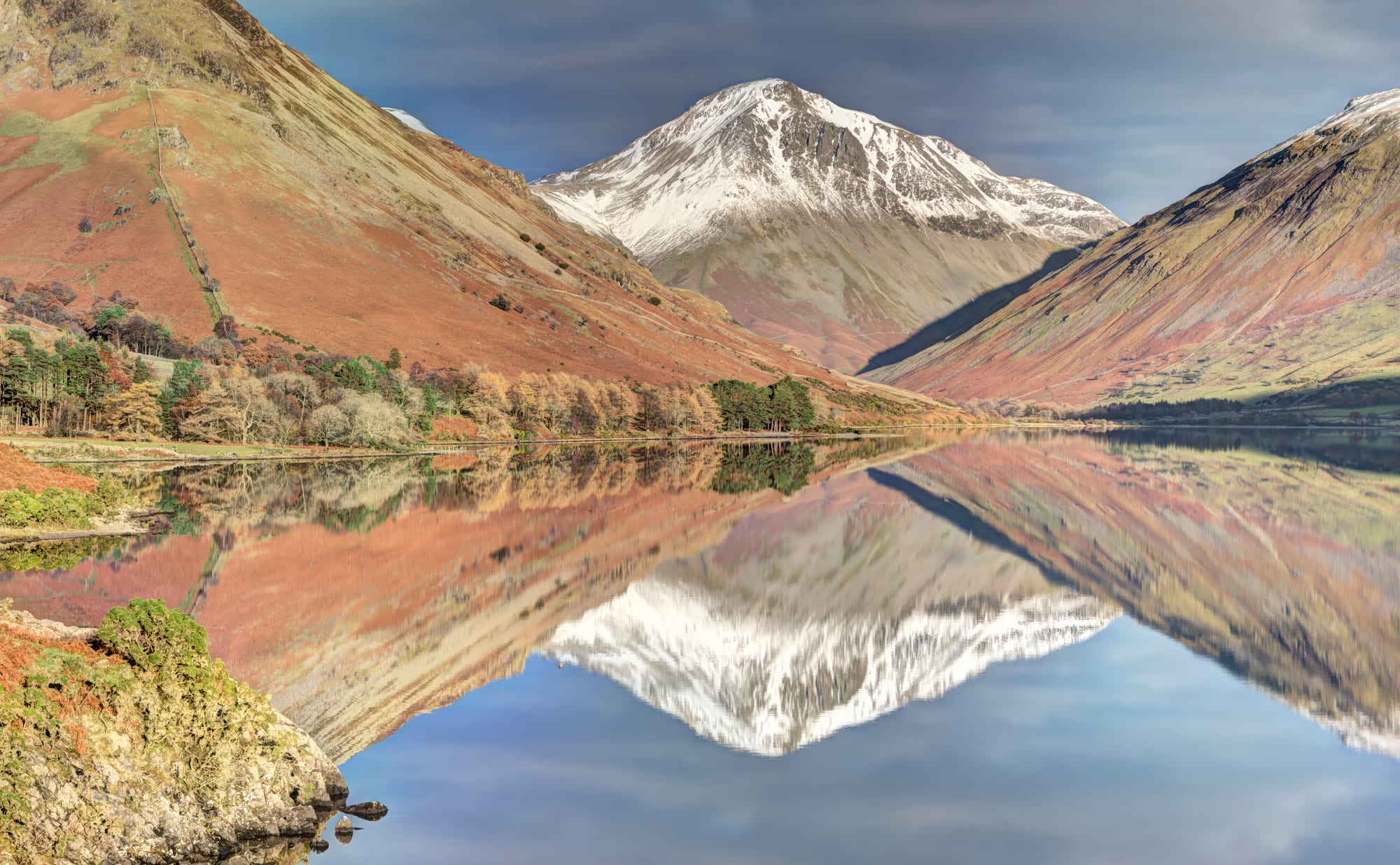
A snow-capped pyramid-shaped mountain between bracken-covered slopes, mirrored in the still water of a lake

United Kingdom

North West England

Great Gable reflected in Wastwater, at the head of Wasdale in the western Lake District. (John260660 / Wikimedia Commons · CC BY-SA 4.0)

The north-western quarter of England between the Pennines and the Irish Sea, from Cheshire's farmland through the great cities of Manchester and Liverpool and the Lancashire coast to the mountains and lakes of Cumbria — the cradle of the cotton industry and the railway age, and home of England's highest peaks.

Explore North West England

History

The Romans built a legionary fortress at Deva, today's Chester, and a fort at Mamucium, from which Manchester takes its name; Hadrian's Wall ended on the Solway coast in Cumbria. After Rome, Cumbria belonged for a time to Brittonic kingdoms before Anglian and then Norse settlers arrived, leaving Norse words such as fell, beck and tarn across the Lake District. Carlisle and the Cumbrian borders were fought over with Scotland for centuries, raided by the Border reivers until the 17th century.

Lancashire gave its name to the house of Lancaster in the Wars of the Roses, and in 1612 the Pendle witches were tried and hanged at Lancaster. The region's great change came with industry. The Bridgewater Canal opened in 1761 to carry coal into Manchester, which became "Cottonopolis", the world's first industrial city, surrounded by mill towns such as Oldham, Bolton and Blackburn. The Liverpool and Manchester Railway of 1830 was the first inter-city railway worked by steam locomotives. Liverpool grew into one of the world's great ports, enriched by the slave trade and later by emigrant ships and the Irish arrivals of the famine years.

The region was also a centre of radical politics, from the Peterloo Massacre of 1819 to the Co-operative movement founded in Rochdale in 1844 and the suffragettes of Emmeline Pankhurst. In the 20th century Manchester built the first stored- program computer in 1948, and the Blitz hit Liverpool hard in 1941. The decline of the docks and mills brought hard times from the 1960s, followed by regeneration after the 1996 IRA bombing in Manchester and Liverpool's year as European Capital of Culture in 2008.

Culture & Customs

Manchester and Liverpool have two of England's strongest urban identities, and a friendly rivalry between them. Liverpool's Scouse accent and wit reflect its Irish and Welsh heritage and its port history, and the city has a long-established Chinese community. Manchester is proud of its independence and its role as the capital of the North, with a lively gay village around Canal Street.

Music defines both cities. Liverpool gave the world the Beatles and the Merseybeat sound of the 1960s, while Manchester produced Joy Division, New Order, the Smiths, the Stone Roses and Oasis, and the Haçienda club was the heart of the "Madchester" years. Football is almost a religion: Manchester United and Manchester City, Liverpool and Everton are four of England's best-known clubs, and rugby league is strong in Wigan, St Helens and Warrington.

Cumbria has its own traditions: Cumberland and Westmorland wrestling, fell running and the Grasmere Sports each summer, and the gurning contest at Egremont's Crab Fair. The Lake District's poets, led by William Wordsworth, who was born in Cockermouth, and the children's writer Beatrix Potter shaped how the English see landscape. The old rivalry between Lancashire and Yorkshire lives on in cricket and banter.

Daily Life

About 7.5 million people live in North West England. Greater Manchester has about 2.9 million, with around 570,000 in the city of Manchester itself, and Liverpool has about 490,000. Preston, Blackpool, Bolton, Warrington and Stockport are large towns, Chester has about 90,000 people and Lancaster about 50,000, while Cumbria's largest place is Carlisle.

Manchester is the North's biggest business centre, with finance, media at MediaCityUK in Salford, universities and technology. Liverpool relies on its port, universities, health and tourism. Cheshire is among the wealthiest parts of the North, and the region still makes chemicals, cars and aircraft parts. Cumbria has nuclear work at Sellafield, submarine building at Barrow-in-Furness, hill farming and tourism.

Daily life in the cities is busy, with trams, buses and packed commuter trains, while the Lake District's towns fill with visitors in summer. Current issues include the gap between the booming city centres and poorer former mill towns, housing costs in the Lakes driven up by second homes, and the long wait for better rail links across the Pennines.

Food

The North West has a strong tradition of hearty dishes. Lancashire hotpot is a slow-baked stew of lamb and onions topped with sliced potatoes, and Scouse, a meat and vegetable stew from the sailors' lobscouse, gave Liverpudlians their nickname. Bury is famous for black pudding, and Lancashire and Cheshire both make crumbly cheeses named after their counties. Morecambe Bay potted shrimps, small brown shrimps set in spiced butter, are a local delicacy.

Cumbria has the long, coiled Cumberland sausage, which has protected status, Herdwick lamb from the fell sheep, Kendal mint cake, a sugary peppermint bar carried by climbers, and Grasmere gingerbread, a chewy, spicy biscuit-cake sold in the village since the 19th century. Cartmel is known for its sticky toffee pudding.

Sweet baking includes Eccles cakes, flaky pastry rounds filled with currants, and the Manchester tart of jam, custard and coconut in a pastry case. Vimto, the fruit cordial, was invented in Manchester in 1908. Beer is brewed by old family firms such as Robinsons in Stockport and Thwaites in Lancashire, and Liverpool and Manchester have strong curry and Chinese food scenes.

Attractions & Natural Wonders

The Lake District National Park, a UNESCO World Heritage Site, holds Windermere, England's largest natural lake, with Bowness and Ambleside on its shores, and Scafell Pike, England's highest mountain. Grasmere has Wordsworth's Dove Cottage, Keswick sits on Derwentwater beneath Catbells, with Borrowdale and Buttermere beyond, and Wastwater lies below Great Gable. Ullswater has lake steamers, Coniston has Ruskin's house of Brantwood, and Beatrix Potter's Hill Top is in Near Sawrey. Castlerigg stone circle stands above Keswick.

Manchester offers the Science and Industry Museum, the John Rylands Library, Manchester Art Gallery, the Northern Quarter and Old Trafford, with the Lowry and IWM North at Salford Quays. Liverpool has the Royal Albert Dock, with the Merseyside Maritime Museum, the International Slavery Museum and the Beatles Story, the Three Graces on the Pier Head, the Cavern Club and two cathedrals, with Port Sunlight village across the Mersey.

Chester has its walls, the Rows, a Roman amphitheatre and its cathedral, with Chester Zoo nearby and the Jodrell Bank Observatory elsewhere in Cheshire. Blackpool has its Tower, piers, Pleasure Beach and Illuminations, and Lancaster its castle, priory and the Ashton Memorial, overlooking Morecambe Bay.

Cities in North West England

Planning basics

Budget

The North West is cheaper than southern England. Manchester and Liverpool have plenty of mid-range hotels and good-value food, and Blackpool is one of the cheapest places to stay in the country outside peak weekends. The Lake District is the expensive corner, with high prices for cottages, inns and parking in summer and school holidays.

Daily Budget Midrange
USD 160–310 (mid-range hotel or Lakes inn, restaurant dinners, museum and attraction entry, a lake cruise)
Daily Budget Shoestring
USD 65–110 (hostel, cafe and pub meals, local trains, buses and trams)

Most of Manchester's and Liverpool's big museums are free; in the Lakes, stay in Keswick or Ambleside midweek to avoid peak prices.

Safety

The region is generally safe. Manchester and Liverpool have the usual big city problems of phone theft, pickpocketing and rowdy nightlife at weekends. In the Lake District, fell-walkers face fog, sudden storms and steep ground, and Morecambe Bay has fast tides and quicksand that make crossing it without an official guide dangerous.

Carry proper clothing, a map and a forecast on the fells, and never walk out onto Morecambe Bay's sands except on a guided crossing. Check current official travel advice before travelling.

Climate

The region faces the Atlantic and is wetter than the east of England. The Lake District is the wettest part of England, with Seathwaite in Borrowdale often cited as the wettest inhabited place in the country, and its fells get snow and gales in winter. Manchester's rainy reputation is only partly deserved, and the coast is milder and breezier.

Summer
mild, 17–22°C, with changeable weather and regular rain
Winter
cool and wet, 2–8°C, with snow and ice on the Lake District fells

Transportation

The West Coast Main Line from London Euston reaches Manchester and Liverpool directly and continues to Lancaster, Oxenholme for the Lakes, Penrith and Carlisle. Manchester Airport is one of the UK's busiest, with a smaller airport at Liverpool. Manchester has the Metrolink trams, Liverpool the Merseyrail network and the Mersey Ferries, and Blackpool a seafront tram. In the Lake District, buses and lake steamers link the main villages, but the western valleys need a car.

Take the train to Windermere or Penrith and use buses and boats in the Lakes, where parking is scarce in summer and mountain passes such as Hardknott are steep and narrow.

Best Time to Visit

May to September is best for the Lake District, with long days for fell-walking, though July and August are crowded; spring and autumn bring fewer visitors and good colours. Blackpool's Illuminations run from late summer until after the New Year holidays. Manchester and Liverpool suit any season, with football and concerts in winter and Christmas markets in December.