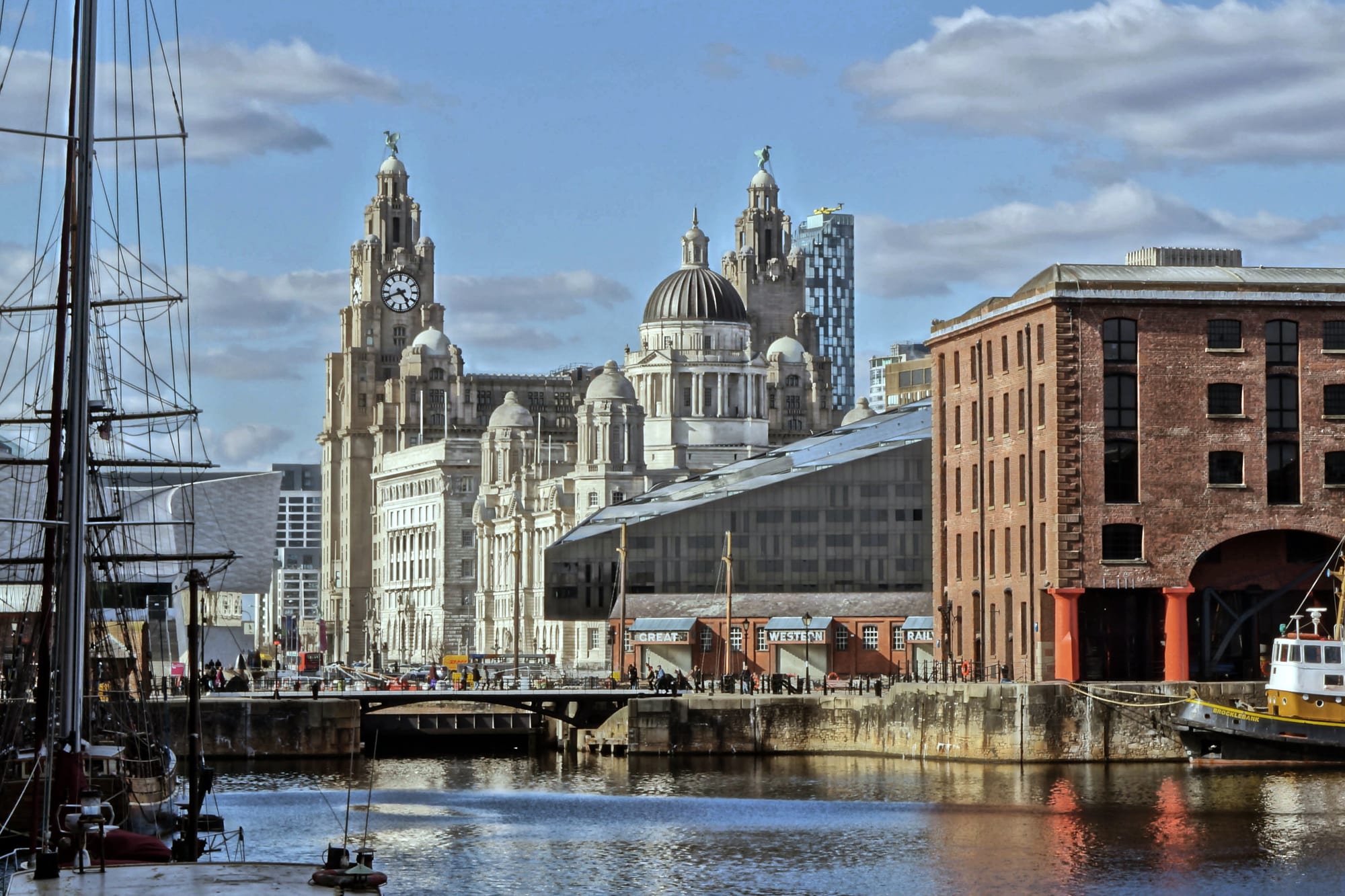
Red-brick warehouses beside a dock basin, with the clock towers of the Royal Liver Building and a domed building behind

North West England, United Kingdom

Liverpool

The Royal Albert Dock with the Pier Head buildings beyond, on the Liverpool waterfront. (Beverley Goodwin / Wikimedia Commons · CC BY 2.0)

A port city on the east bank of the Mersey estuary, founded as a borough in 1207 and grown rich on Atlantic trade, including the slave trade, and on emigrant shipping. Decline in the 20th century gave way to revival after its year as European Capital of Culture in 2008; today it is known for its waterfront, its museums, the Beatles and two great football clubs.

Neighbourhoods

  • The waterfront and Royal Albert Dock
    • First-time visitors
    • Museums
    • Waterfront

    The Pier Head with its three great early 20th-century buildings, the Mersey Ferries terminal and the restored warehouses of the Royal Albert Dock, now filled with museums, restaurants and bars. A riverside walk links it all.

    Open in Maps
  • City centre and the Commercial District
    • Shopping
    • Architecture
    • Close to public transport

    The grand shipping and banking buildings around Castle Street and Dale Street, the shopping streets of Church Street and Lord Street, and the civic buildings around Lime Street station and St George's Hall.

    Open in Maps
  • RopeWalks and Bold Street
    • Nightlife
    • Best for food
    • Independent shops

    A grid of former rope-making streets and warehouses between the centre and the Anglican cathedral. Bold Street is lined with cafés and independent restaurants, and Seel Street and Concert Square are busy with bars and clubs at night.

    Open in Maps
  • Chinatown
    • Best for food
    • Local life

    Home to the oldest Chinese community in Europe, whose first residents arrived as seamen in the 19th century. Its ornamental gateway on Nelson Street is the largest multiple-span arch of its kind outside China.

    Open in Maps
  • Baltic Triangle
    • Creative district
    • Bars and street food

    A former warehouse district south of the centre, now known for creative and digital businesses, studios, music venues and food halls.

    Open in Maps
  • Georgian Quarter and Hope Street
    • Historic district
    • Quiet and residential
    • Arts and theatre

    Terraces of Georgian houses on the hill around Hope Street, the road that runs between the two cathedrals, with the Philharmonic Hall and the Everyman Theatre on or near it.

    Open in Maps

Things to do

Famous landmarks

  • Royal Liver Buildinglandmark

    One of the three Pier Head buildings, with the two Liver birds on its clock towers watching over the city and the river.

    Open in Maps
  • Liverpool Cathedrallandmark

    Giles Gilbert Scott's Anglican cathedral, built between 1904 and 1978, the longest cathedral in the world, with the highest and heaviest ringing peal of bells in the world.

    Open in Maps
  • Liverpool Metropolitan Cathedrallandmark

    The Roman Catholic cathedral at the northern end of Hope Street, built to Frederick Gibberd's circular design and nicknamed 'Paddy's Wigwam' for its shape.

    Open in Maps
  • St George's Halllandmark

    A vast neoclassical hall of concerts and law courts opposite Lime Street station.

    Open in Maps

Museums

  • Merseyside Maritime Museummuseum

    The story of the port and its ships in a warehouse on the Royal Albert Dock.

    Open in Maps
  • International Slavery Museummuseum

    A museum of the transatlantic slave trade in which Liverpool was the most heavily involved port in Europe, and of its legacies.

    Open in Maps
  • Museum of Liverpoolmuseum

    The city's own history museum in a modern building at the Pier Head.

    Open in Maps
  • The Beatles Storymuseum

    A museum of the band and its history on the Royal Albert Dock.

    Open in Maps
  • Walker Art Gallerymuseum

    A neoclassical gallery on William Brown Street housing one of the largest art collections in England outside London.

    Open in Maps
  • World Museummuseum

    Natural history, archaeology and world cultures beside the Walker Art Gallery.

    Open in Maps

Beatles and music

  • The Cavern Clubattraction

    The Mathew Street club that opened in 1957 as a jazz venue and became closely associated with Merseybeat; closed in 1973 and filled in, it reopened in 1984.

    Open in Maps
  • Mendipsattraction

    The suburban house in Woolton where John Lennon lived with his aunt Mimi, now preserved by the National Trust.

    Open in Maps
  • 20 Forthlin Roadattraction

    The terraced house in Allerton where Paul McCartney grew up and the Beatles wrote some of their early songs.

    Open in Maps

Parks and football

  • Sefton Parkpark

    A large Victorian park in the south of the city, with a glass palm house of 1896 and a lake.

    Open in Maps
  • Anfieldattraction

    The home of Liverpool FC since 1892, in the north of the city.

    Open in Maps
  • Hill Dickinson Stadiumattraction

    Everton's new ground at Bramley-Moore Dock on the northern waterfront, replacing Goodison Park.

    Open in Maps

Short trips from the city

  • Mersey Ferriestransit hub

    The ferries across the river from the Pier Head to the Wirral, with river cruises and a view back to the waterfront.

    Open in Maps
  • Port Sunlightattraction

    The model village built by the Lever brothers for their soap-factory workers across the Mersey on the Wirral, with the Lady Lever Art Gallery.

    Open in Maps
  • Another Placeattraction

    Antony Gormley's 100 cast-iron figures facing the sea along the beach at Crosby, north of the city.

    Open in Maps
  • Speke Halllandmark

    A Tudor timber-framed manor house near the airport in the south of the city.

    Open in Maps

Seasonal events

  • Grand NationalApril

    A handicap steeplechase first run in 1839, held at Aintree Racecourse near Liverpool, with horses jumping 30 fences over two laps.

  • International Beatle WeekAugust

    Gigs by bands from around the world at multiple venues, with the annual Beatles Convention, screenings and events on the band and its home city.

  • Liverpool Biennialsummer, usually every two years

    A festival of contemporary art held in galleries and public spaces across the city.

Eat and drink

Long-standing places and food districts in Liverpool. Hours, ratings and directions come from your maps app, always current.

Liverpool classics

  • Scouserestaurant

    The meat and vegetable stew brought to the port by sailors, which gave Liverpudlians their nickname.

    Open in Maps

Food districts

  • Bold Streetneighborhood

    The city's best-known food street, with cafés and restaurants from around the world.

    Open in Maps
  • Chinatownneighborhood

    Chinese restaurants and supermarkets around Nelson Street in the oldest Chinese community in Europe.

    Open in Maps
  • Baltic Triangle food hallsneighborhood

    Street-food halls, bars and breweries in converted warehouses south of the centre.

    Open in Maps

Experience Liverpool

History

Liverpool's name comes from the Old English lifer, thick or muddy water, and pōl, a pool or creek; it is first recorded around 1190 as Liuerpul. King John's letters patent of 1207 founded the borough, but it remained small for centuries, with perhaps 600 people in the mid-16th century. In 1699, the year its first recorded slave ship, the Liverpool Merchant, sailed for Africa, it was made a parish.

The 18th century made it rich. Liverpool became the European port most heavily involved in the Atlantic slave trade, and profits from slaving and tobacco built the town, even as local men such as William Rathbone, William Roscoe and Edward Rushton led the abolitionist movement. In the 19th century the port handled the cotton that fed Lancashire's mills, and during the Great Famine of the 1840s up to two million Irish people passed through within a decade, many staying and many sailing on to America. Docks, grand commercial buildings and the Pier Head's three great buildings followed.

The 20th century was harder. Between the wars about 140,000 people were moved from the inner city to new estates, and the Blitz was second only to London's. Containerisation made the old docks obsolete, and the population of the city proper roughly halved between the 1930s and 2001. In the 1960s the Merseybeat sound and the Beatles made it famous worldwide. Revival came with regeneration and the European Capital of Culture year in 2008. Parts of the city were a UNESCO World Heritage Site from 2004 until July 2021, when the status was revoked over developments including Everton's new stadium at Bramley-Moore Dock.

Culture & Customs

Music is Liverpool's calling card. The Beatles emerged from the Merseybeat scene of the 1960s, playing the Cavern Club on Mathew Street, and Guinness World Records recognises Liverpool as the "World Capital City of Pop". The city is also home to the UK's oldest surviving classical orchestra, the Royal Liverpool Philharmonic, and its oldest repertory theatre, the Liverpool Playhouse.

Football divides the city. Liverpool FC play at Anfield, and Everton, who spent well over a century at Goodison Park across Stanley Park, now play at the Hill Dickinson Stadium on the northern docks. The Grand National at Aintree each April is one of Britain's great sporting days.

Identity is strong and distinct. Residents are formally Liverpudlians but more often called Scousers, after the stew made popular by sailors, and the Scouse accent began to diverge from the Lancashire accent in the late 19th century. As many as three-quarters of the population are estimated to have some Irish ancestry, and the city has the oldest Chinese community in Europe.

Daily Life

Liverpool had an estimated population of about 509,000 in 2024, within a wider Liverpool City Region of more than 1.5 million. After decades of decline the city's population has risen steadily since 2001, and it is younger than that of England as a whole.

The port remains central to the economy: Liverpool is the UK's largest port for transatlantic trade, and the Liverpool2 container terminal, completed in 2022, can take the world's largest container ships. Tourism and culture have become major industries, alongside the universities, health, science around the Knowledge Quarter and a pharmaceutical cluster at Speke, and creative and digital firms in the Baltic Triangle.

Most people live in terraced streets and suburban estates spreading north, east and south from the centre. Local politics has been turbulent: a highly critical government inspection in 2021 led to commissioners being sent in to oversee parts of the city council, and in April 2024 a national ranking placed it 317th of 318 local authorities. All five of the city's MPs were Labour after the 2024 general election.

Food

Scouse is the city's dish: a stew of diced meat, usually beef or lamb, gently simmered with potatoes, carrots and onions. The word comes from lobscouse, a dish of meat and ship's biscuit eaten by Northern European sailors, and the stew is so closely tied to Liverpool that it gave its people their name. It is often served with pickled red cabbage or beetroot and crusty bread. As a thrift dish it was made with whatever vegetables and cheap cuts were to hand, and a meatless version, blind scouse, fed those who could not afford meat.

The port brought the world's food with it. Chinatown, home to the oldest Chinese community in Europe, has Chinese restaurants and supermarkets around Nelson Street and its great gateway. Bold Street is the best-known food street, with cafés and restaurants from many countries, and the Baltic Triangle's converted warehouses hold street-food halls, bars and breweries.

Pubs are part of the city's life, from the ornate Victorian pubs of the centre to the small ones around Hope Street where students and musicians have drunk for generations, and the Albert Dock has restaurants and bars facing the water.

Planning tools

Budget

Liverpool is good value for a big British city, cheaper than London or Manchester for rooms. Most of the major museums are free. Prices rise sharply for Liverpool and Everton home matches, the Grand National and big concerts, when rooms sell out.

Daily Budget Midrange
USD 160–290 (city-centre hotel, restaurant dinners, a stadium tour or attraction entry, a ferry trip)
Daily Budget Shoestring
USD 65–110 (hostel, café and pub meals, Merseyrail and buses)

Use the free museums on the waterfront and William Brown Street, and book rooms well ahead for match and Grand National weekends.

Best Time to Visit

May to September brings the longest days, the best weather for the waterfront and the ferries, and festivals including International Beatle Week in August. The city suits any season, though: the museums are indoors and the football season runs from August to May. Winters are cool, with rain spread through the year.

Suggested Number of Days

Most first visits take two or three days; around four allow time for the Wirral and the coast north of the city as well. A match, a concert or a big race weekend adds to the number.

First Visit
2–3 days
With Surroundings
4 days

Transportation

Merseyrail's electric trains run underground beneath the centre and out to the suburbs, the Wirral and the coast, and buses cover the rest of the city. The Mersey Ferries cross the river from the Pier Head, and road tunnels run under the Mersey to the Wirral.

Walk the centre and waterfront, and use Merseyrail for the coast at Crosby and the Wirral.

Airport & Station Connections

Liverpool Lime Street, the world's oldest still-operating main line station, has direct trains from London Euston and across the North. Liverpool John Lennon Airport is on the Mersey estuary about 7.5 miles south-east of the city centre; Manchester Airport, with more long-haul flights, is reached by train.

Walkability

The centre is compact and easy on foot: Lime Street, the shopping streets, the Albert Dock and the Pier Head are within a short walk of one another, and Hope Street and the two cathedrals are a short climb uphill. The riverside promenade makes a long, level walk, though it can be windy.

Safety

The UK is generally safe, with the main risks being pickpocketing and phone theft in crowded parts of London and other cities, occasional late-night antisocial behaviour, and drink-related trouble around nightlife. In Liverpool these risks concentrate in the busy city-centre nightlife streets at weekends and in match-day crowds.

Keep phones secure in crowds and bars, and use licensed taxis late at night. Check current official travel advice before travelling.

Climate

A temperate maritime climate with relatively mild summers, cool winters and rain spread fairly evenly through the year. Extremes are rare: since records began in 1867 temperatures in the city have ranged from −17.6°C to 34.5°C.

Summer
mild — daytime highs average around 20°C and overnight lows around 14°C
Winter
cool — snow is fairly common though heavy snow is rare; the lowest reading on record is −17.6°C, in December 2010

Local Customs

Liverpudlians are called Scousers, after the stew, and the Scouse accent and humour are a strong part of the city's identity. Football loyalties run deep — Liverpool is red, Everton blue — and families are often split between the two. The city has one of the strongest Irish heritages in the United Kingdom.

Order and pay at the bar in pubs, and be careful about football colours on derby days.

Common Payment Methods

The currency is the pound sterling. Cards and contactless payment are widely used, and cash machines are easy to find.