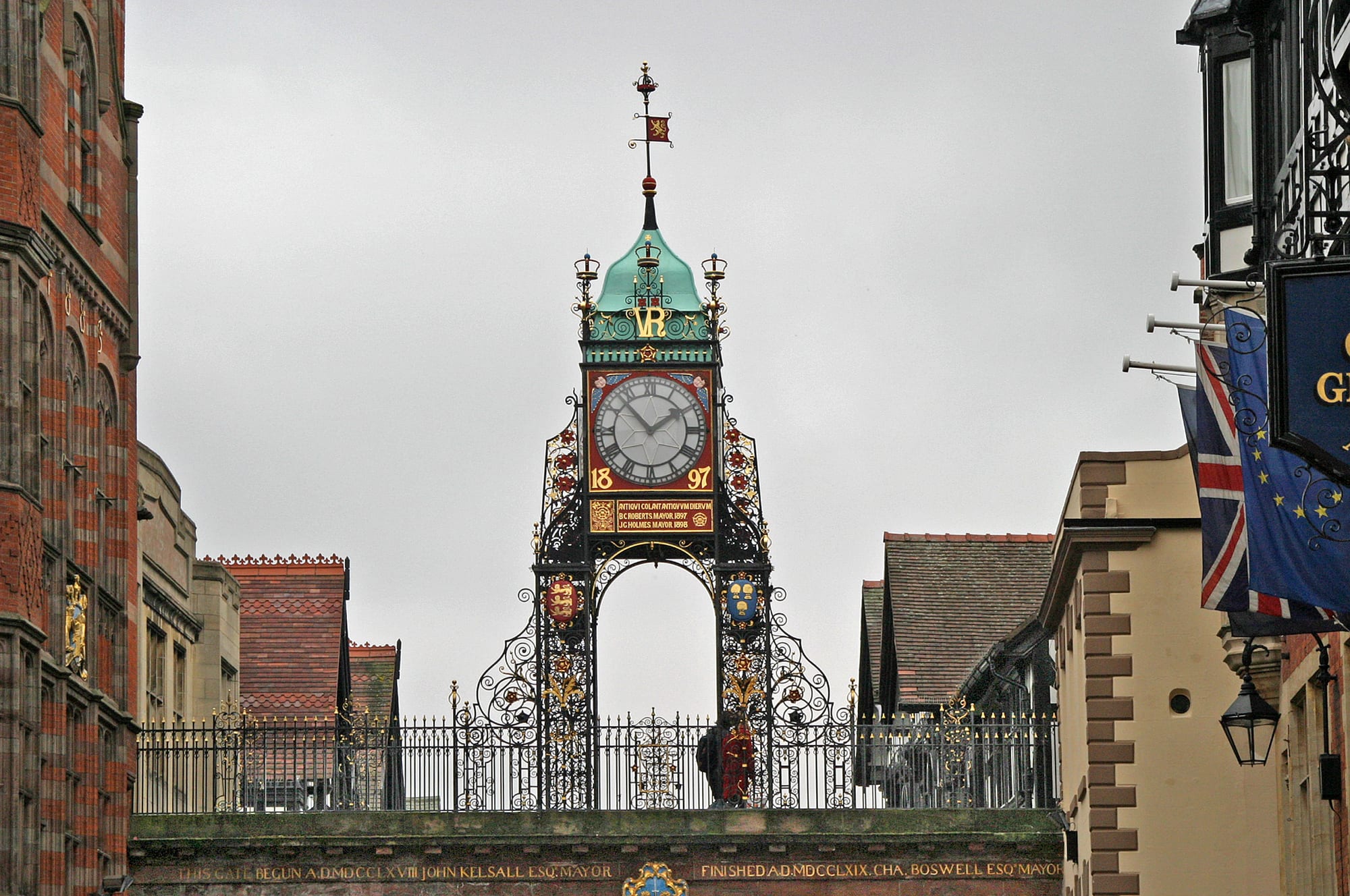
An ornate iron clock tower with a green copper cap standing on a stone arch above a street, between brick buildings

North West England, United Kingdom

Chester

The Eastgate Clock of 1897 on the city walls above Eastgate Street in Chester. (W. Bulach / Wikimedia Commons · CC BY-SA 4.0)

The county town of Cheshire, on the River Dee beside the Welsh border, founded by the Romans as the legionary fortress of Deva. Its almost complete city walls, the two-level medieval shopping galleries called the Rows and a cathedral that grew from a Benedictine abbey draw day-trippers, while the modern city lives on shops, finance, a university and the races.

Neighbourhoods

  • The walled city
    • First-time visitors
    • Historic district
    • Shopping

    The centre inside the walls, where Eastgate, Northgate, Watergate and Bridge Street still follow the lines of the Roman fortress. The Rows, the cathedral, the town hall and most pubs and restaurants are here, and the footpath along the top of the walls loops right round it.

    Open in Maps
  • Handbridge
    • Quiet and residential
    • Riverside walks

    The district on the south bank of the Dee, reached across the medieval Old Dee Bridge. Edgar's Field, said to be where King Edgar held court in 973, is here, and the riverside paths give views back to the walls and the Groves.

    Open in Maps
  • Hoole
    • Close to public transport
    • Local life

    A Victorian suburb just beyond the railway station, whose railways supplied much of the city's workforce, absorbed into Chester in 1954. Its Victorian terraces have local shopping streets of their own, a short walk from the centre.

    Open in Maps
  • Upton and the zoo
    • Families
    • Quiet and residential

    A residential area on the northern edge of the city and home of Chester Zoo. Bache station, on the line to Liverpool, is the quickest way in by train from the centre.

    Open in Maps

Things to do

Famous landmarks

  • Chester city wallslandmark

    Some of the best-preserved city walls in Britain, almost complete, with a walkway along the top that crosses the old gates and passes towers such as King Charles' Tower.

    Open in Maps
  • Eastgate Clocklandmark

    An ornate iron clock of 1897 on the arch of the Eastgate, said to be the most photographed clock in England after Big Ben.

    Open in Maps
  • Chester Rowslandmark

    Covered walkways at first-floor level along the four main streets, with a second line of shops above the street ones and stone undercrofts beneath — a medieval arrangement found nowhere else in Britain.

    Open in Maps
  • Chester Cathedrallandmark

    The former abbey church of St Werburgh, seat of a bishop since 1541, with every style of English medieval architecture from Norman to Perpendicular and its monastic buildings beside it.

    Open in Maps
  • St John the Baptist's Churchlandmark

    A church said to have been founded in 689, outside the walls on a cliff above the Dee, which served for a time as Chester's first cathedral.

    Open in Maps
  • Chester Town Halllandmark

    The Victorian town hall, opened in 1869 by the Prince of Wales after its predecessor burnt down in 1862.

    Open in Maps

Roman Chester and museums

  • Chester Roman Amphitheatrelandmark

    The largest Roman amphitheatre so far uncovered in Britain, just outside the walls, rediscovered in 1929; the northern half is exposed and cared for by English Heritage.

    Open in Maps
  • Grosvenor Museummuseum

    The city's main museum, with a collection of Roman tombstones from Deva and an art gallery, in a Victorian building.

    Open in Maps
  • Dewa Roman Experiencemuseum

    A museum of Roman Chester on Pierpoint Lane, off Bridge Street.

    Open in Maps
  • Chester Castlelandmark

    The castle begun on William the Conqueror's orders to control the town and the Welsh border, now mostly a set of later buildings that include the Cheshire Military Museum.

    Open in Maps

The river and parks

  • The Grovespark

    The riverside promenade below the walls where boats leave for trips along the Dee and rowing boats can be hired in the warmer months.

    Open in Maps
  • Grosvenor Parkpark

    The city's main park, given to the city by the 2nd Marquess of Westminster and opened in 1867, with a miniature railway and a summer open-air theatre.

    Open in Maps
  • Old Dee Bridgelandmark

    A medieval stone bridge, largely rebuilt in 1387, linking the walled city with Handbridge.

    Open in Maps
  • Chester Racecourseattraction

    The Roodee, between the walls and the river, recognised by Guinness World Records as the oldest racecourse still in operation; the walls walk passes above it.

    Open in Maps

Theatre and nights out

  • Storyhouseattraction

    The arts centre that opened in 2017 in the remodelled 1936 Odeon cinema, combining a theatre, a cinema and the city library.

    Open in Maps

Short trips from the city

  • Chester Zooattraction

    One of the UK's largest zoos, with more than 11,000 animals, at Upton on the northern edge of the city.

    Open in Maps
  • Cheshire Oaks Designer Outletattraction

    The largest outlet centre in the United Kingdom, at Ellesmere Port about 5 miles from the city.

    Open in Maps
  • National Waterways Museummuseum

    A museum of Britain's inland waterways at Ellesmere Port, in the surviving buildings of the inland port where the Shropshire Union Canal meets the Manchester Ship Canal.

    Open in Maps

Seasonal events

  • Chester Races May FestivalMay

    The racecourse's best-known meeting, introduced in 1766, when crowds fill the Roodee and the city's bars.

  • Chester Midsummer Watch Paradearound midsummer, June

    A costumed procession through the streets that dates back to the late 15th century and was revived in 1995.

  • Chester Mystery Playssummer, every five years

    A medieval cycle of Bible plays, banned under Elizabeth I and revived in 1951 for the Festival of Britain, now staged in the city every five years.

Eat and drink

Long-standing places and food districts in Chester. Hours, ratings and directions come from your maps app, always current.

Historic pubs

  • The Bear and Billetrestaurant

    A pub in a Grade I listed timber-framed house of the 17th century on Lower Bridge Street, described as the finest of its kind in Chester.

    Open in Maps
  • The Falconrestaurant

    A Grade I listed pub at the corner of Lower Bridge Street and Grosvenor Road, once part of the Rows, on a street of historic pubs.

    Open in Maps

Food streets

  • The Rowsneighborhood

    Restaurants and cafés among the shops at both levels of the galleries along Eastgate, Watergate, Northgate and Bridge Street.

    Open in Maps
  • Lower Bridge Streetneighborhood

    The street running down from the Cross towards the Old Dee Bridge, lined with old timber-framed buildings and traditional pubs.

    Open in Maps

Experience Chester

History

Chester began around AD 75 as Deva Victrix, a fortress built by the Roman Second Legion Adiutrix and later the base of the Twentieth Legion, Valeria Victrix, on the River Dee. Its name came from the river or the goddess of the Dee. Deva was one of the main army camps of Roman Britain and grew into a large civilian settlement; its four main streets, Eastgate, Northgate, Watergate and Bridge Street, still follow the Roman plan, and its amphitheatre, built in the 1st century, is the largest yet found in Britain.

After the Romans left, Æthelfrith of Northumbria defeated a Welsh army at the Battle of Chester in 616. In 689 King Æthelred of Mercia founded a minster church, now St John's, and around 907 Æthelflæd, Lady of the Mercians, built a fortified burh whose defenders fought off a Viking siege. King Edgar held court here in 973. Chester was one of the last English cities to fall to the Normans; William the Conqueror ordered a castle built to control the town and the Welsh border, and in 1071 Hugh d'Avranches became Earl of Chester. The abbey of St Werburgh became the cathedral in 1541. In the Civil War the city sided with Charles I and was subdued by Parliament's forces.

The Industrial Revolution brought canals, railways and new roads, with workers housed in Newtown and Hoole. Much of the black-and-white architecture of the centre is Victorian, part of the Black-and-white Revival, many buildings designed by John Douglas for the Grosvenor family, the Dukes of Westminster. Suburbs such as Blacon grew in the 1950s, and the University of Chester gained full university status in 2005.

Culture & Customs

Chester's identity rests on its history. The walls, the Rows and the timber-framed fronts are what most visitors come for, and the city keeps old traditions alive. The Chester Mystery Plays, a cycle of Bible plays dating back at least to the early 15th century and banned under Elizabeth I, were revived for the Festival of Britain in 1951 and are staged every five years. The Midsummer Watch Parade, a costumed procession first recorded in the late 15th century, was revived in 1995.

Horse racing on the Roodee goes back to the 16th century — 1539 is the year usually cited — and the course is recognised by Guinness World Records as the oldest still in operation; the May Festival dates from 1766. Race days are big social occasions, and the bars of the centre fill before and after.

Culture also has newer homes. Storyhouse, opened in 2017 in the remodelled 1936 Odeon cinema, combines a theatre, a cinema and the library; Grosvenor Park Open Air Theatre, founded in 2010, plays every summer; and the Chester Philharmonic Orchestra was founded in 1884. The city sits on the border with Wales — its urban area includes Saltney in Flintshire — and the Welsh have long called it Caer. Local tradition holds that only someone born inside the walls is a true Cestrian.

Daily Life

About 93,000 people lived in Chester's built-up area at the 2021 census, making it the largest settlement in the borough of Cheshire West and Chester; the wider city, including rural areas, had about 139,000. Most residents live outside the walls, in suburbs such as Hoole, Handbridge, Boughton, Upton, Blacon and Lache.

Tourism, retail, public administration and financial services carry the economy. Bank of America, NFU Mutual, Lloyds Bank, Virgin Money, Quilter and M&S Bank all have offices in the city, and the University of Chester and the Countess of Chester Hospital are large employers. Just across the Welsh border at Broughton, Airbus employs around 6,000 people making the wings for its aircraft, and many of them live in and around Chester.

The centre is busy with shoppers every day, using the Rows, an indoor market and two shopping centres, the Grosvenor and the Forum. The long Northgate redevelopment, begun in 2007, has reshaped the north of the centre with a cinema and a new bus interchange. Weekend life follows the racing calendar in summer, and the riverside at the Groves fills on warm evenings.

Food

Chester's food scene is built around its streets rather than a single dish. Restaurants and cafés sit among the shops at both the street and Row levels of the Rows, above the medieval stone undercrofts. The Rows are believed to include the oldest shop front in England, and eating in them is part of a visit.

The county gives its name to Cheshire cheese, a dense, crumbly cheese made in Cheshire and the neighbouring counties of Shropshire, Staffordshire, Denbighshire and Flintshire, and it turns up on cheeseboards and in sandwiches across the city.

Pubs are the other strength. Chester has plenty of historic, traditional English pubs, several in Grade I listed buildings. On Lower Bridge Street the Bear and Billet occupies what has been described as the finest 17th-century timber-framed town house in Chester, and the Falcon, at the junction with Grosvenor Road, was the first building to have its section of the Rows enclosed, in the 17th century. Race days and summer weekends bring crowds to the riverside bars by the Groves and to the pubs inside the walls.

Planning tools

Budget

Chester is a popular day-trip city, and prices for rooms rise on race days and summer weekends, when demand from visitors is highest. Walking the walls, the Rows and the cathedral precincts costs nothing, and the compact centre means little is spent on transport.

Daily Budget Midrange
USD 160–300 (mid-range hotel, restaurant dinners, museum or zoo entry, a river cruise)
Daily Budget Shoestring
USD 65–110 (hostel or budget room, pub meals and bakeries, walking and local buses)

Check the racecourse calendar before booking: race days fill rooms and city-centre bars.

Best Time to Visit

Late spring to early autumn is best, with the races from May, river boats on the Dee and outdoor theatre in Grosvenor Park in summer. The city's sights are mostly outdoors or under cover in the Rows, so it also works as a winter trip, when it is quieter.

Suggested Number of Days

The walled centre is small, and a day or an overnight stay is enough for a first look. Adding the zoo or the Welsh border countryside stretches a visit to about three days, and more if Chester is used as a base for Liverpool or North Wales.

First Visit
1–2 days
With Surroundings
3 days

Transportation

The city centre is small and nearly everything inside the walls is within walking distance. Buses from the city's bus interchange, opened in 2017, serve the suburbs such as Blacon and Saltney and towns including Mold, Wrexham and Liverpool. Bache station, on the line to Liverpool, is the quickest way to the zoo, and boats run along the Dee from the Groves.

Walk rather than drive in the centre; the walls path is the easiest way to move round the old city.

Airport & Station Connections

Chester railway station, east of the walls, has Merseyrail trains to Liverpool every 15 minutes, taking about 45 minutes, and trains every 30 minutes to Manchester Piccadilly and Manchester Airport, taking just over an hour; lines also run along the North Wales coast to Holyhead, for Dublin ferries, and towards Birmingham and Cardiff. National Express coaches from London take about six hours.

Walkability

Very good. The walls make a circuit of the centre, the four main streets meet at the Cross, and the Rows give covered walking in the rain. The river, the racecourse, the amphitheatre and Grosvenor Park are all at the edge of the walls, and Hoole and Handbridge are a short walk beyond.

Safety

The UK is generally safe, with the main risks being pickpocketing and phone theft in crowded parts of London and other cities, occasional late-night antisocial behaviour, and drink-related trouble around nightlife. Chester is a small, busy city whose centre is crowded with shoppers by day; race days bring large crowds and full bars, and the riverside paths need care near the water.

Keep valuables secure in the crowds on race days and around the Rows. Check current official travel advice before travelling.

Climate

An oceanic climate, sheltered by the Welsh mountains and the Pennines, so that temperatures are like those further inland despite the nearby Irish Sea. The Welsh mountains also cast a rain shadow: annual rainfall at the nearest weather station, Hawarden, is barely over 700 mm.

Summer
mild to warm — the warmest day of an average year reaches about 29°C, and about 12 days a year pass 25°C
Winter
cool and damp, with occasional hard frosts — the lowest temperature on record is −18.2°C, in January 1982

Local Customs

The UK does not have a strong culture of tipping; about 10–15 per cent is customary in restaurants for good service but is not expected. By local tradition a true Cestrian is someone born inside the city's walls. Chester sits right on the Welsh border, and the Welsh name for the city is Caer.

City-centre bars fill before and after race meetings, and the cathedral is a working church, so visits pause for services.

Common Payment Methods

The currency is the pound sterling. Shops widely accept foreign credit and debit cards, contactless cards and phone payments are recommended, and cash machines are very widely available, so there is no need to carry large amounts of cash.