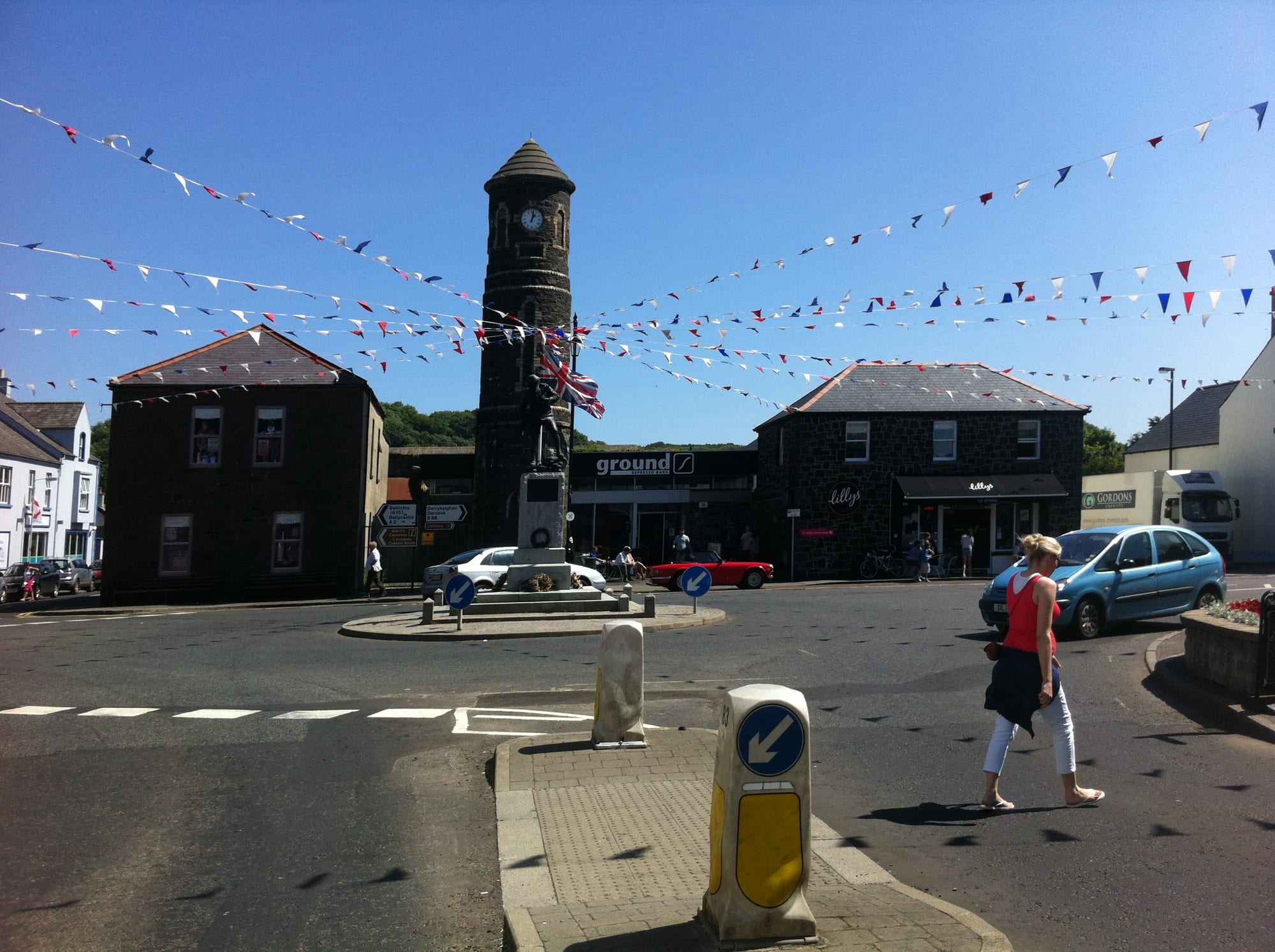
A dark stone clock tower and war memorial on a roundabout in Bushmills, with bunting strung across the square under a blue sky

Northern Ireland, United Kingdom

Bushmills

The clock tower in the Market Square at the centre of Bushmills. (Darrin Antrobus / Wikimedia Commons · CC BY-SA 2.0)

A village of about 1,200 people on the north coast of County Antrim, named after the River Bush and a 17th-century watermill. It is known for the Old Bushmills Distillery, whose label recalls a distilling licence of 1608, and lies about two miles from the Giant's Causeway, so in summer its Main Street fills with visitors.

Neighbourhoods

  • Main Street and the Market Square
    • First-time visitors
    • Cafés and pubs
    • Close to public transport

    The village centre, laid out around a Market Square built in the 1840s, whose clock tower, loosely modelled on an Irish round tower, was added in 1874. Cafés, a bar, a fish-and-chip shop, and the visitor information centre line Main Street, and the distillery is a short walk away.

    Open in Maps
  • Portballintrae
    • Seaside
    • Quiet and residential
    • Walks

    A small village with a cove and a breezy promenade just north of Bushmills. A few whitewashed fishermen's cottages survive among newer houses and second homes, and the coast path leads east from here towards the Causeway.

    Open in Maps
  • The Causeway coast
    • Coastal scenery
    • Walks

    The headlands and bays north-east of the village, around the Giant's Causeway, reached by road, by the summer heritage railway or on foot along the coast path.

    Open in Maps

Things to do

In the village

  • Old Bushmills Distilleryattraction

    An Irish whiskey distillery founded as a company in 1784 and rebuilt after a fire in 1885, drawing its water from Saint Columb's Rill; tours and tastings draw around 120,000 visitors a year.

    Open in Maps
  • Giant's Causeway and Bushmills Railwayattraction

    A narrow-gauge heritage railway two miles long, running in summer between the village and the Giant's Causeway, partly on the course of an earlier line that closed in 1949.

    Open in Maps

The Causeway Coast

  • Giant's Causewayattraction

    Tens of thousands of interlocking basalt columns stepping into the sea, a UNESCO World Heritage Site that attracts over two million visitors a year.

    Open in Maps
  • Dunluce Castlelandmark

    The ruins of a medieval castle on a basalt outcrop between Portballintrae and Portrush, beside the coast walk from Portrush to the Causeway.

    Open in Maps
  • Portballintraeneighborhood

    The small seaside village and cove just north of Bushmills, with a promenade and a golf club nearby.

    Open in Maps
  • Carrick-a-Rede Rope Bridgeattraction

    A rope bridge strung to a small rocky island off Ballintoy, along the coast to the east and served by the same coastal bus.

    Open in Maps

Short trips from the village

  • Portrushneighborhood

    A seaside resort on a peninsula to the west, with a branch railway to Coleraine and the starting point of the coastal walk to the Causeway.

    Open in Maps
  • The Dark Hedgesattraction

    A tunnel of beech trees along the Bregagh Road inland, between Armoy and Stranocum.

    Open in Maps
  • Ballycastleneighborhood

    A small harbour town 11 miles to the east, at the far end of the coastal bus route, with ferries to Rathlin Island.

    Open in Maps

Eat and drink

Long-standing places and food districts in Bushmills. Hours, ratings and directions come from your maps app, always current.

Bushmills classics

  • Old Bushmills Distilleryrestaurant

    The village's distillery, whose tastings include the Bushmills Original and Black Bush blends and its single malts.

    Open in Maps
  • Bush House Barrestaurant

    A bar on Main Street in the centre of the village.

    Open in Maps

Cafés and food on Main Street

  • Main Street cafésneighborhood

    A short run of cafés, a bistro at the Courthouse and a fish-and-chip shop along Main Street, busiest in the summer season.

    Open in Maps

Experience Bushmills

History

The village takes its name from the River Bush and from a large watermill built on it in the early 17th century; its Irish name is Muileann na Buaise. In 1608 a royal licence to distil whiskey in the area was granted to a local landowner, the date the distillery still prints on its label. Bushmills Presbyterian Church on Main Street dates from 1646, and the parish church of St John the Baptist from 1821.

Whiskey shaped the place. A stream called Saint Columb's Rill, rising in the boggy hills to the south-east and flowing into the Bush, once supplied five distilleries that burned peat from the bogs; the company behind the present Old Bushmills Distillery was formed in 1784, and after periods of closure the distillery has worked more or less continuously since it was rebuilt following a fire in 1885. The Market Square was laid out in the 1840s and its clock tower added in 1874.

The railway age came and went. The Giant's Causeway Tramway, hailed at its opening as the first long electric tramway in the world, reached Bushmills from Portrush in 1883 and the Causeway in 1887, and ran until the end of the 1949 season; the village station closed the same year. After the Second World War the village was the site of one of five transmitter stations of the Consol long-range navigation system. Today Bushmills is part of the Causeway Coast and Glens district, and a narrow-gauge heritage railway once again runs from the village to the Causeway in summer.

Culture & Customs

Bushmills is a quiet, close-knit village whose identity is bound up with its distillery and with the coast. The distillery celebrated 400 years of distilling in the area in 2008 by releasing a whiskey called "1608", and its name has carried the village around the world; Bushmills is twinned with Louisville, Kentucky, in the heart of American whiskey country.

The community is strongly unionist in background. In the 2021 census about 89 per cent of residents came from a Protestant or other Christian background and under 3 per cent from a Catholic one; three-quarters identified as British and about a third as Northern Irish, with people able to choose more than one identity. Church life remains important, with Presbyterian, Free Presbyterian, Church of Ireland and Catholic churches and a gospel hall in or around the village.

Around Bushmills, the coast itself is the cultural landscape. The basalt that crops out in columns at the Causeway also gives Saint Columb's Rill its mineral water, and the Iron Age earthworks at Lissanduff, known locally as the cups and saucers, show how long people have lived here. Golf is played at Bushfoot, just east of Portballintrae, and at the famous links of nearby Portrush.

Daily Life

The 2021 census counted 1,247 people in Bushmills, slightly fewer than ten years before. Children go to schools such as Dunluce School and Bushmills Primary School, and Coleraine, nine miles away, is the nearest large town, on the railway between Belfast and Derry.

The economy turns on whiskey and tourism. The distillery draws around 120,000 visitors a year, and the Giant's Causeway two miles to the north draws over two million, many of whom pass through the village. In summer Main Street's cafés, bar, shops and hostel are busy, and a park-and-ride car park on Main Street feeds the shuttle bus to the Causeway. Second homes have spread around Portballintrae on the coast nearby.

Out of season the village returns to a quieter rhythm of farming country, church, school and the pub, with buses along the coast road to Coleraine, Portrush and Ballycastle. Distillery production pauses each July for maintenance, though tours continue.

Food

Whiskey is the village's product. The Old Bushmills Distillery makes the Bushmills Original and Black Bush blends and single malts aged 10, 12, 16 and 21 years, using water drawn not from the River Bush itself but from its tributary, Saint Columb's Rill. To mark 400 years of distilling in the area it released a one-off whiskey called "1608", made with crystal malt. Tastings are part of the distillery tour, which runs all year.

Eating in Bushmills is simple and seasonal. Main Street has a handful of cafés, a bistro at the Courthouse, a bar and a fish-and-chip shop serving fish and chips and similar fast food. The Ulster fry, which topped a poll of Ulster's favourite dish, is the province's take on the full breakfast — bacon, sausages and eggs with soda farls and potato bread, the farls being made from soda bread.

Coleraine and Portrush, a short drive away, are larger places with more choice for those staying longer.

Planning tools

Budget

Bushmills is a small, tourist-facing village, and prices rise in summer when visitors come for the distillery and the Causeway. Rooms are few and fill early in the season. The distillery tour and the Causeway are the main paid costs; the coast path, the beaches and Portballintrae cost nothing.

Daily Budget Midrange
USD 160–270 (B&B or small hotel, pub and bistro meals, distillery tour, a hire car for the coast)
Daily Budget Shoestring
USD 65–110 (hostel bed, café lunches and chip suppers, Ulsterbus coastal buses)

Book rooms well ahead for the summer season and for big golf events at nearby Portrush.

Best Time to Visit

March to October, when the visitor information centre, the Causeway shuttle bus and the heritage railway's summer service are running and the coast walks are at their best. July and August are the busiest months. Winter is quiet, and the distillery runs tours all year.

Suggested Number of Days

One or two days cover the village itself and the coast immediately around it. Three or four make sense as a base for the wider Causeway Coast; without a car, the bus timetables add time.

First Visit
1–2 days
With Surroundings
3–4 days

Transportation

Ulsterbus 402 runs along the coast from Coleraine through Portrush, Dunluce, Portballintrae and Bushmills to the Giant's Causeway, Ballintoy and Ballycastle, and bus 172 runs more directly from Coleraine. From March to October a shuttle bus links the village car park with the Causeway, and the heritage railway runs in summer. A car makes the wider coast and the inland sights much easier.

The coast between Portrush and the Causeway is also within cycling range, or a long walk on the coast path.

Airport & Station Connections

Bushmills is about 60 miles from Belfast, 9 miles from Coleraine and 11 miles from Ballycastle. Trains between Belfast and Derry stop at Coleraine, where a branch line runs to Portrush; buses connect from either to Bushmills. By car from Belfast the inland route runs by the M2 and A26 via Ballymoney, and the slower coast road runs through the Glens of Antrim. Day tours from Belfast also come here.

Walkability

The village centre is small and easily walked, with the distillery a short walk from the Market Square. The Causeway is about two miles away along the road or the railway, and the coast path from Portrush past Dunluce Castle to the Causeway runs for about seven miles.

Safety

The UK is generally safe, with the main risks being pickpocketing and phone theft in crowded parts of London and other cities, occasional late-night antisocial behaviour, and drink-related trouble around nightlife. Northern Ireland has a lower crime rate than the rest of the UK; the hazards here are mostly outdoors, on cliffs, slippery basalt and the currents of the north coast.

Keep to marked paths on the cliffs, take care on wet rock at the Causeway, and check the weather before coastal walks. Check current official travel advice before travelling.

Climate

In nearby Coleraine the climate is maritime, with cool summers and relatively mild winters. The north coast is breezy and exposed to Atlantic weather, and showers are frequent in every season.

Summer
mild — in Belfast average daytime highs are about 17.5°C in July
Winter
cool — in Belfast average daytime highs are about 6.5°C in January

Local Customs

Bushmills is a small village where most residents come from a Protestant community background. Visitors are welcome, but as elsewhere in Northern Ireland it is wise to listen rather than offer opinions on politics or identity. Pubs and cafés are informal.

Respect private land and farm gates on coastal and inland walks, and keep dogs on leads near livestock.

Common Payment Methods

The currency is the pound sterling, and Visa and Mastercard debit and credit cards are accepted. Northern Irish banks print their own notes, which are often not accepted in Great Britain, so swap them for Bank of England notes before leaving.