History · Sri Lanka
Why was a palace built on top of Sri Lanka's Sigiriya rock?
Sri Lanka's chronicle says a fifth-century king who had killed his father moved his capital onto a 180-metre rock to wait for his brother's revenge.
By Globeway Editorial · 13 October 2026
The short answer
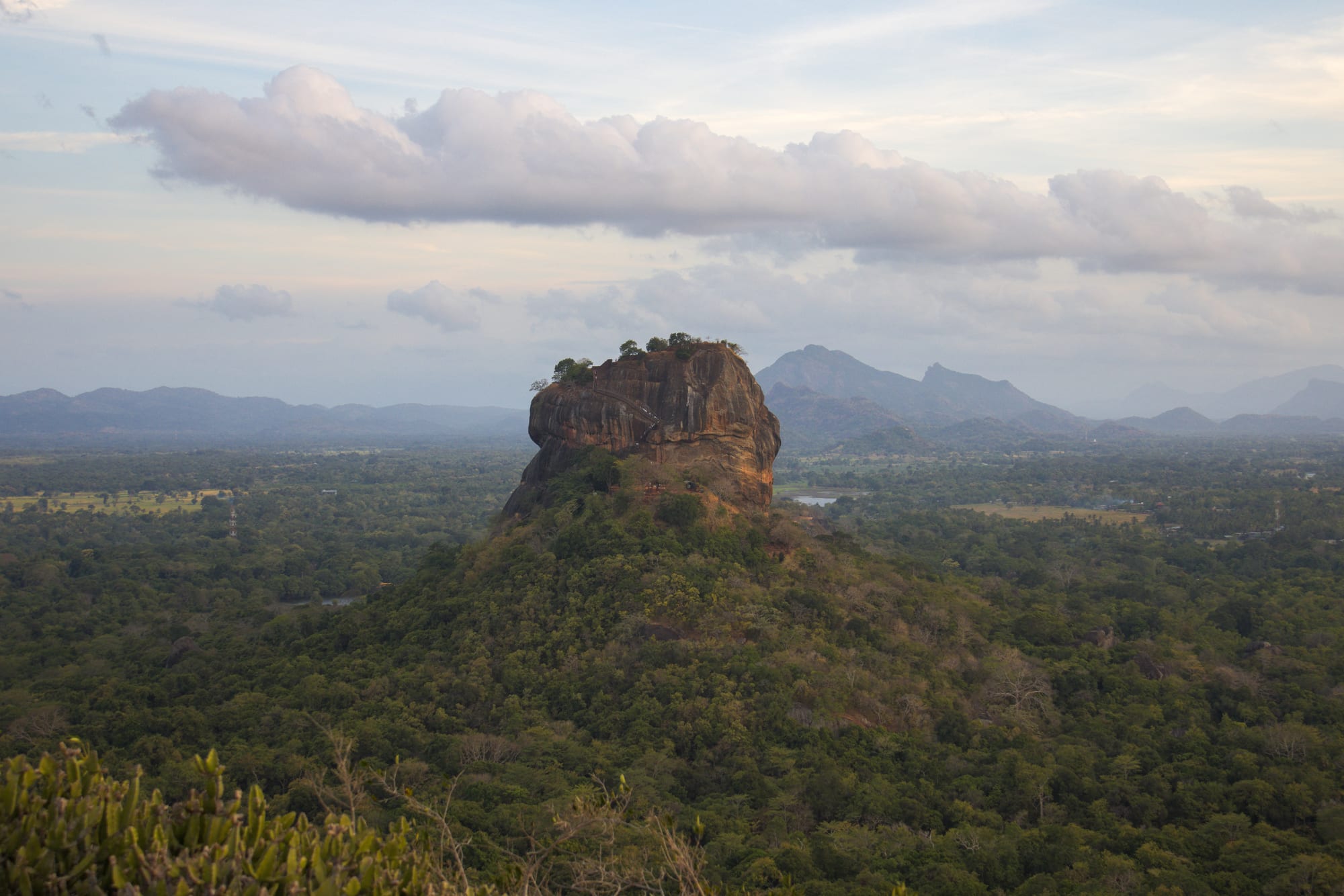
According to Sri Lanka's ancient royal chronicle, the palace on Sigiriya was built out of fear. In the late fifth century a prince named Kashyapa seized the throne from his father, King Dhatusena, and had him killed. The rightful heir, Kashyapa's half-brother Moggallana, fled to South India and swore to return. Expecting an attack, Kashyapa abandoned the old capital of Anuradhapura and moved his court onto the summit of Sigiriya, a sheer granite rock about 180 metres (590 feet) high with a clear view across the plains in every direction.
But Sigiriya was never just a bunker. Kashyapa ringed the rock with moats, ramparts and some of the oldest landscaped gardens in the world, painted its cliff face, and built a gateway in the shape of a giant lion. Some historians also read the site differently, as a pleasure palace, a project begun by his father, or a religious complex with no military purpose at all. The chronicle's story of a guilty king waiting for revenge is the best known answer, but not the only one.
A rock made for a fortress
Sigiriya is an inselberg, an isolated hill of hard rock left standing when the land around it wore away. It is the solidified plug of magma from an ancient volcano, and it rises abruptly from the low plains that run out from Sri Lanka's central mountains. Pidurangala Rock, about 1 kilometre to the north, has a similar origin.
People had used the area long before any king. A rock shelter at Aligala, just east of the main rock, shows occupation around 3000 BCE, and from the 3rd century BCE Buddhist monks lived in caves under the boulders on the surrounding slopes. Inscriptions carved by the cave mouths record the shelters being donated to the monastic order. What changed in the fifth century was the scale: the rock became the seat of a kingdom.
A son, a father and a stolen throne
The main account comes from the Cūḷavaṃsa, or "Lesser Chronicle", a history of Sri Lanka's monarchs written in the Pali language and compiled over many years by Buddhist monks. Dhatusena had two sons. Moggallana, born to the royal consort, was the heir; Kashyapa, the elder, was the son of a non-royal wife.
The trouble began with Migara, the king's nephew and the commander of his army, who was married to Dhatusena's daughter. After Migara mistreated her, the king had Migara's mother burned alive. Seeking revenge, Migara encouraged Kashyapa to overthrow his father in a palace coup. Dhatusena was imprisoned, and Migara persuaded Kashyapa that the old king had hidden great treasures. When Kashyapa demanded them, Dhatusena led him to the Kala Wewa, a vast irrigation reservoir he had built, and said that this water was the only treasure he had. Enraged, Kashyapa had his father walled up alive. The crime earned him the name Pithru Ghathaka Kashyapa, Kashyapa the Patricide.
Disgraced among both the public and the Buddhist monks, and expecting Moggallana to return with an army, Kashyapa moved his capital and residence to the more secure summit of Sigiriya. Most of the palaces, defences and gardens on and around the rock date from his reign, which the chronicle places between 477 and 495 CE.
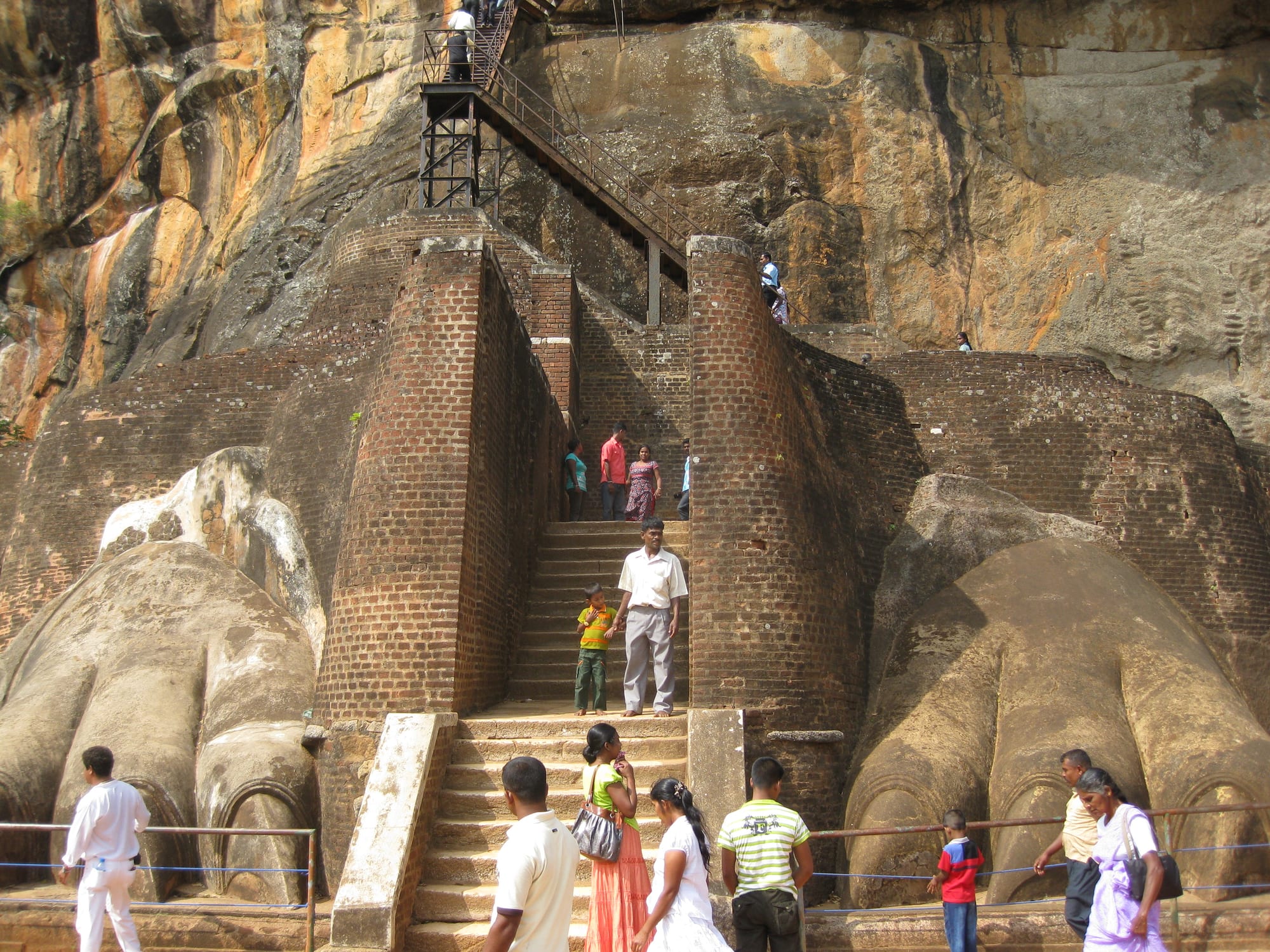
Visitors once climbed through the body of a colossal lion to reach the summit. A sculpted head stood above these paws but collapsed long ago.
A palace, a fortress and a garden city
The complex was built in three levels. On the flat summit stood the upper palace, with cisterns cut into the rock to store water. On a terrace partway up was the Lion Gate, the enormous lion through which the final stairway passed and which gave the site its name: Sinhagiri, the Lion Rock. Lower palaces clung to the slopes, and moats, walls and gardens spread for a few hundred metres around the base.
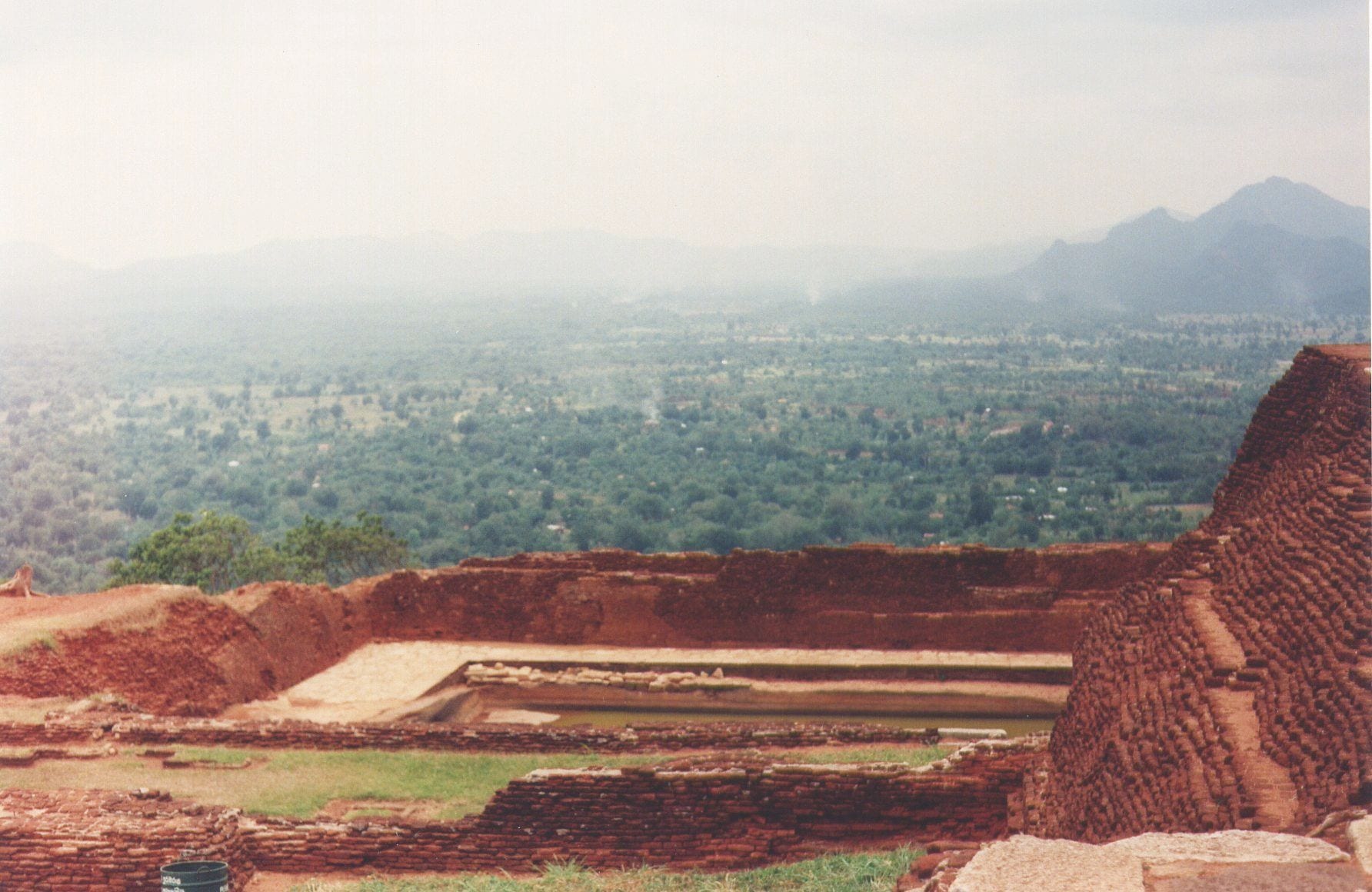
From the top, any army crossing the surrounding plain would have been visible long before it arrived.
The defensive logic is plain to see. The rock offered an unhindered view in all directions, and large ramparts and moats surrounded the city below. Boulders on the lower slopes, according to tradition, were ready to be pushed down on attackers.
Yet Kashyapa built for splendour too. West of the rock, his water gardens were laid out symmetrically, with pools, islands for summer palaces and fountains of circular limestone plates fed by underground conduits; some still work in the rainy season. The western face of the rock was covered with paintings across an area about 140 metres long and 40 metres high. Graffiti refer to 500 ladies in them, though most have been lost. Beside the path ran the Mirror Wall, coated in plaster so highly polished that, it is said, the king could see his reflection as he walked.
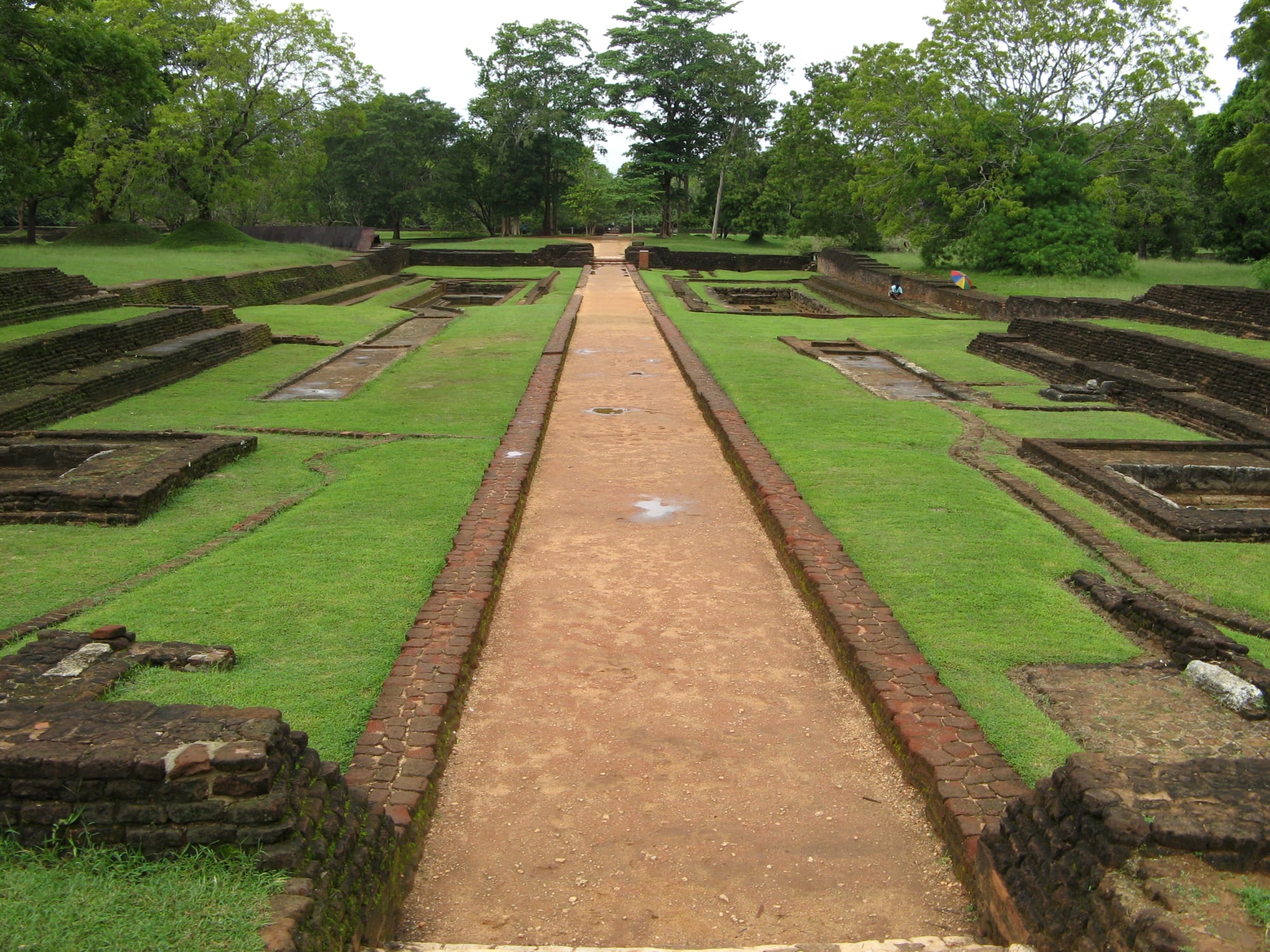
The pools and fountains were fed by gravity through underground conduits linked to the moats and to an artificial lake south of the rock.
The brother returns
In 495 Moggallana came back with an army raised in South India, and the armies met on the plains around Sigiriya. According to the chronicle, Kashyapa turned his war elephant to gain a better position, but his troops took the move for a retreat and deserted him. Rather than be captured, he killed himself with his own blade.
Moggallana moved the capital back to Anuradhapura and turned Sigiriya into a Buddhist monastery complex. It served as a monastery until the 13th or 14th century, then fell silent, apart from a brief spell as an outpost of the Kingdom of Kandy in the 16th and 17th centuries.
Other ways of reading the rock
The chronicle's story is vivid, but it is not the only explanation. Some accounts make Dhatusena the original builder, with Kashyapa finishing the work in his father's honour. Others cast Kashyapa as a pleasure-loving king and Sigiriya as his pleasure palace. Even his death is told in different ways, including poisoning by a concubine. Still other interpretations treat the whole site as the work of a Buddhist community, with no military purpose, and suggest it may have played a part in the rivalry between the Mahayana and Theravada traditions of Buddhism on the island.
- c. 3000 BCE
People shelter at Aligala, beside the rock.
- 3rd century BCE
Buddhist monks begin living in caves on the surrounding slopes.
- 477 CE
Kashyapa seizes the throne, by the chronicle's dating.
- 495 CE
Moggallana defeats Kashyapa; Sigiriya becomes a monastery.
- 1831
A British officer, Major Jonathan Forbes, comes across the overgrown summit.
- 1890s
Archaeological work begins, led most extensively by H. C. P. Bell.
- 1982
Sri Lanka's Cultural Triangle Project begins excavating the whole city.
Today Sigiriya is a UNESCO World Heritage Site and is regarded as one of the most important examples of urban planning from the first millennium, its geometric gardens deliberately interlocked with the natural shapes of rock and boulder. Visitors still follow Kashyapa's route: through the water gardens, up the terraces, past the surviving paintings and the Mirror Wall, and between the lion's paws to the ruins on the summit.