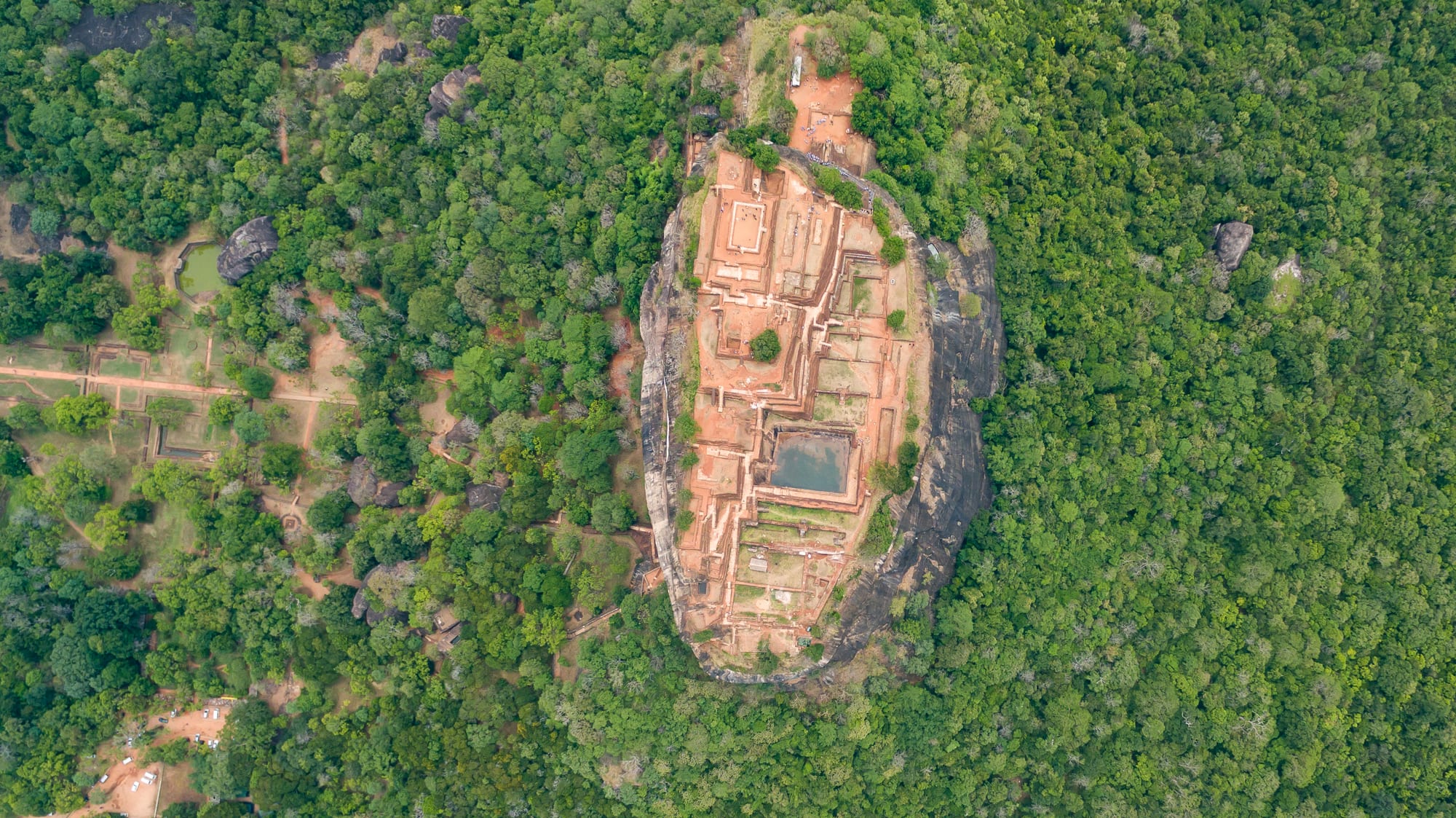
Aerial view straight down on the flat summit of Sigiriya rock, its brick palace foundations and a rock-cut pool ringed by dense green forest

The Cultural Triangle, Sri Lanka

Sigiriya

The palace ruins on the summit of Sigiriya rock, seen from the air. (dronepicr / Wikimedia Commons · CC BY 2.0)

A village in the dry plains of north-central Sri Lanka, gathered around a granite rock that rises some 180 metres above the scrub. On its summit stand the remains of a royal citadel built in the fifth century by King Kashyapa, reached past water gardens, painted rock maidens and a stairway between two giant brick lion's paws.

Neighbourhoods

  • Sigiriya village
    • First-time visitors
    • Close to the rock
    • Budget stays

    A scatter of guesthouses, small restaurants and shops along the lanes south and west of the rock, between the site entrance and the village tank. Almost everything is within walking or cycling distance of the gates, and buffalo, monkeys and the occasional elephant share the roads.

    Open in Maps
  • The Pidurangala side
    • Quiet and residential
    • Sunrise walks

    The road running north past the rock towards Pidurangala, with smaller guesthouses, paddy fields and forest. It is quieter than the village and closest to the path up the neighbouring rock, which gives the classic view of Sigiriya itself.

    Open in Maps
  • Kimbissa and the Dambulla road
    • Hotels with pools
    • Drivers and day trips

    The junction area south-west of the village, on the main road between Dambulla and Habarana, where the larger hotels, tour operators and jeep outfits are based. It is convenient for trips out to the parks and the ancient cities, but a drive from the rock.

    Open in Maps
  • Kandalama
    • Resorts
    • Lake views
    • Birdwatching

    The forested reservoir a short drive south-west, with a handful of large hotels set above the water and roads through scrub jungle. It is a place to stay rather than a settlement, and is known for birds and for occasional elephants on the tracks.

    Open in Maps

Things to do

Rocks and ruins nearby

  • Pidurangalaviewpoint

    A rock and ancient forest monastery immediately north of Sigiriya, climbed by a steep path past a reclining Buddha to a boulder-strewn top that looks straight across at the citadel.

    Open in Maps
  • Ritigalatrail

    A forested mountain ridge and strict nature reserve north of the village, with the stone paths, terraces and double-platform ruins of an ancient ascetic monastery on its lower slopes.

    Open in Maps
  • Nalanda Gedigelandmark

    A small stone shrine of about the 8th to 10th centuries south of Dambulla, unusual for combining South Indian temple architecture with Buddhist use, and dismantled and rebuilt away from its original site.

    Open in Maps

Wildlife and water

  • Minneriya National Parkpark

    A park around an ancient reservoir east of the village, known for the numbers of elephants that graze the drying grass of its shore in the dry season.

    Open in Maps
  • Kaudulla National Parkpark

    A second reservoir park north of Minneriya, on the same elephant circuit and often quieter, with water birds, deer and jungle fowl.

    Open in Maps
  • Kandalama Reservoirpark

    An irrigation tank in forest south-west of the village, good for birdwatching from its bunds and a landmark of the drive towards Dambulla.

    Open in Maps

Short trips

  • Dambulla cave templelandmark

    Five caves in a rock outcrop about seventeen kilometres away, filled with Buddha images and painted ceilings, and a UNESCO World Heritage Site.

    Open in Maps
  • Polonnaruwalandmark

    The medieval capital east of Sigiriya, a compact and cyclable spread of palace ruins, the Vatadage and the rock-cut Buddhas of the Gal Vihara beside a huge reservoir.

    Open in Maps
  • Avukana Buddha statuelandmark

    A standing Buddha almost twelve metres high, more than fourteen with its pedestal, carved from a granite face beside the Kala Wewa reservoir west of the village.

    Open in Maps
  • Habaranatransit hub

    The road junction north of Sigiriya where the roads to Trincomalee, Polonnaruwa and Anuradhapura meet, with a station on the Batticaloa railway line, and the base for many park safaris.

    Open in Maps

Seasonal events

  • VesakMay

    The full-moon festival of the Buddha's birth, enlightenment and death, when lanterns are hung in the village and free food is served at roadside stalls.

  • PosonJune

    The full moon marking the arrival of Buddhism in Sri Lanka, when pilgrims travel across the north-central plains, above all to Mihintale and Anuradhapura.

  • Sinhala and Tamil New Yearmid-April

    The national new year at the end of the harvest, marked with milk rice, oil-cake sweets, village games and family visits.

  • The elephant gatheringdry season, about May to September

    As the reservoirs shrink, large numbers of elephants move onto the grass of the Minneriya and Kaudulla tank beds, and jeep traffic to the parks peaks.

Eat and drink

Long-standing places and food districts in Sigiriya. Hours, ratings and directions come from your maps app, always current.

Village kitchens

  • Rice and curry in Sigiriya villagerestaurant

    Guesthouses and small family kitchens serve the dry-zone version of rice and curry, often a dozen small dishes of pumpkin, jackfruit, dhal, beans, gotu kola and a freshwater fish or chicken curry, cooked on firewood.

    Open in Maps
  • Roadside curd and treacle stallsmarket

    Clay pots of buffalo curd, eaten with kithul palm treacle, are sold at stalls along the roads around the village, a dry-zone speciality and the standard local sweet.

    Open in Maps

Markets and food streets

  • Dambulla Dedicated Economic Centremarket

    The national wholesale vegetable market at Dambulla, a short drive south, where produce from the hill country and the dry zone is traded through the night.

    Open in Maps
  • Sigiriya village shopsneighborhood

    A handful of bakeries and boutiques near the site road sell short eats, rolls and fish buns, king coconuts for drinking, and wood-apple or beli drinks.

    Open in Maps

Experience Sigiriya

History

The rock was a refuge and a monastery long before it was a palace: caves at its base carry Brahmi inscriptions from the last centuries BC recording gifts to Buddhist monks. Its famous period was brief. According to the chronicles, Kashyapa seized the throne at Anuradhapura in AD 477 after his father Dhatusena was walled up alive, and his brother Moggallana, the rightful heir, fled to India. Kashyapa moved his capital to this rock in the plains and built a royal city on and around it, the whole complex laid out on a symmetrical plan with moats, ramparts, water gardens fed by gravity, boulder and terraced gardens, and a palace on the summit.

The approach was staged for effect. A mirror wall of polished plaster ran along a gallery beneath the overhang where painted figures of women, the frescoes, were laid out across the rock face; higher up, a stairway rose through the mouth of a vast brick lion, of which only the paws survive and from which the name Sinhagiri, lion rock, derives. Kashyapa ruled for some eighteen years before Moggallana returned with an army; the king was defeated near the rock and died in 495, and the capital returned to Anuradhapura.

The site then became a monastery again for several centuries before being abandoned to the forest. Villagers and travellers knew of it, but it was the British in the 19th century who cleared and surveyed it, and archaeologists have worked there ever since. The mirror wall carries graffiti left by visitors between about the 8th and 10th centuries, verses that form one of the earliest bodies of Sinhala writing. Sigiriya was inscribed as a UNESCO World Heritage Site in 1982, and the village beside it has grown on the visitors that followed.

Culture & Customs

Sigiriya is a dry-zone farming village that happens to sit beside one of Asia's great archaeological sites, and the two sides of it run in parallel. Around the rock, life follows the pattern of the tank villages of the north-central plains: a Buddhist temple, a reservoir whose water is shared by custom as much as by regulation, paddy in two seasons and chena plots cleared in the rains. The village calendar turns on poya days and the harvest, and dansal, roadside stalls giving away food and drink, appear at the major full moons.

The site brings a second culture of guides, drivers, jeep owners, guesthouse families and craft sellers, and the language of the village has adapted to it. Guiding at the rock is a trade passed down locally, and the painted maidens, the mirror-wall verses and the story of Kashyapa are retold in versions that differ in their sympathies — the parricide king as tyrant, or as a builder driven by guilt.

Behaviour at the site matters. It is a heritage monument, but the caves and the nearby Pidurangala are active Buddhist places, so shoulders and knees are covered, shoes come off at shrines, and photographs posed with the back turned to a Buddha image are treated as a serious insult. Writing on the mirror wall has been banned to protect the ancient verses. Elephants are part of village life rather than a spectacle, and farmers keep watch over crops at night against them.

Daily Life

Only a few thousand people live in the village and the settlements immediately around it, in a district of scattered hamlets between tanks and forest. Farming remains the base of the economy — paddy under the irrigation tanks, chena plots of chilli, maize and vegetables, and cattle and buffalo whose milk becomes curd — but tourism now provides much of the cash income. Guesthouse families, cooks, drivers, bicycle hire, guides, jeep crews and craft stalls all depend on visitors to the rock, and that dependence was felt sharply when arrivals collapsed after the 2019 attacks, the pandemic and the economic crisis of 2022; numbers have recovered since.

The day begins before dawn. The first visitors go up the rock in the cool, farmers are in the fields early, and by midday the heat pushes everyone into the shade. Evening brings the second working period, and after dark the roads empty, partly out of habit and partly because of elephants.

Human–elephant conflict is the district's hardest problem: herds raid crops and damage houses, farmers keep night watches from platforms in the fields, and people and elephants are killed each year across the north-central plains. Water is the other constant issue, with the tanks rising and falling through the year, and the region also carries a high burden of chronic kidney disease among farming families, a long-standing public-health concern in the dry zone.

Food

Dry-zone cooking is the village's everyday food, and it is more varied than its reputation. A rice and curry here can run to a dozen small dishes: dhal, pumpkin in coconut milk, jackfruit curry, snake gourd, long beans, gotu kola mallung shredded with coconut, papadam, and a fiery pol sambol of scraped coconut, chilli and lime. Freshwater fish from the tanks, dried fish and chicken are the usual proteins, and cooking over firewood in clay pots is still common in village kitchens.

Older dry-zone staples appear alongside rice. Kurakkan, finger millet, is made into flatbread and porridge; green gram and cowpea come from the chena plots; and the fruit of the wood-apple is pulped into a thick, sour-sweet drink sold at roadside stalls along with king coconut and beli. The area's best-known sweet is buffalo curd set in shallow clay pots and poured over with kithul treacle, sold from stands all along the Dambulla road.

Visitors also meet the cooking-demonstration circuit, a village industry in its own right: guesthouses run lessons in grinding spices, scraping coconut and building a curry, often with vegetables picked from the garden. Hotels serve the same dishes in buffet form, while the shops near the site sell short eats, fish buns and strong sweet tea — the same snacks found in any Sri Lankan town.

Planning tools

Budget

Beds in Sigiriya range from simple village guesthouses to jungle lodges and resorts by the reservoir, and prices rise sharply at the top end. The larger cost for most visitors is entry: the ticket for the rock is priced in US dollars for foreigners, and a jeep with driver for the elephant parks is charged on top of the park fee. Food and bicycles are cheap.

Daily Budget Midrange
USD 75–180 plus site tickets (hotel with pool, a car and driver, jeep safaris)
Daily Budget Shoestring
USD 25–40 before site tickets (guesthouse, rice and curry, buses, a bicycle)

Budget separately for entrance fees, which are the main expense here, and share a jeep to the parks to cut the cost.

Best Time to Visit

January to April is dry and clearer, the easiest time for the climb, though April turns very hot. The elephant gathering on the reservoir shores peaks in the dry months from about May to September, when the plains are hot, dusty and windy. October to January is the rainy season, with heavy showers that can make the rock's steps slippery and close the summit route during storms.

Suggested Number of Days

One full day is enough for the village and the site itself, and two nights allow an unhurried start. Three or four make sense for anyone using Sigiriya as a base for the wider plains. Heat is the limiting factor, and it shortens what can comfortably be done in a day.

First Visit
1–2 days
With Surroundings
3–4 days

Transportation

The village is small and flat, and bicycles are the usual way to get about; guesthouses lend or rent them. Tuk-tuks cover the short distances to Pidurangala and the site gates. Buses run from the village to Dambulla and Habarana, where connections reach the rest of the country, but most visitors travelling further use a hired car and driver, which is also how jeep safaris to the parks are arranged.

Cycle or walk in the early morning rather than the middle of the day, and avoid rural roads after dark, when elephants move between the forest and the tanks.

Airport & Station Connections

Sigiriya lies off the main road between Dambulla and Habarana, about seventeen kilometres from Dambulla and about ten from Habarana, with buses from both. From Colombo it is roughly four to five hours by road, and from Kandy around three. The nearest railway stations are at Habarana and Polonnaruwa on the Batticaloa line; the nearest international airport is near Colombo.

Walkability

The village itself is easily walked, and the site is entered on foot through the gardens, but the distances inside it are longer than they look and the climb to the summit is a long series of steep staircases, some of them metal walkways bolted to the rock face. Shade is scarce once the sun is up, and the surfaces are hot. Paths to Pidurangala involve a rough boulder scramble near the top.

Safety

Crime is rare, and the real hazards are heat, height and wildlife. Dehydration and sunstroke are common on the exposed climb, the stairways are narrow with steep drops, and the upper route is sometimes closed. Wild elephants use the roads and tank bunds at dusk and after dark, and monkeys snatch food and bags.

Carry water and sun protection, start the climb early, follow site staff instructions on the rock, and stay off rural roads after dark. Check current official travel advice before travelling.

Climate

This is the dry zone: hot all year, with strong sun and little shade. The main rains come with the northeast monsoon from October to January, while the mid-year southwest monsoon passes over as dry, gusty wind that shrinks the reservoirs and draws the elephants onto their shores.

Summer
May–September: hot, dry and windy, commonly 30–35°C by day, with dust and haze on the plains
Winter
October–January: the rainy season, with heavy afternoon showers, humid days around 28–32°C and cooler nights; February to April is dry and very hot

Local Customs

This is a conservative rural district and a place of Buddhist pilgrimage as well as a tourist site. Shoulders and knees should be covered at temples, footwear and hats removed, and visitors should not turn their backs on a Buddha image to be photographed or pose beside statues, which is treated as a serious offence in Sri Lanka. Tattoos of the Buddha can cause trouble. Poya days, at each full moon, are public holidays when alcohol is not sold.

Dress modestly for temples and carry a light scarf, never posing with one's back to a Buddha image, and ask before photographing villagers or their homes.

Common Payment Methods

The currency is the Sri Lankan rupee. Hotels and the site ticket office take cards, and foreigners' entry tickets are priced in US dollars but payable in rupees. Guesthouses, tuk-tuks, jeeps, bicycles and village shops expect cash. There are ATMs in Dambulla and Habarana rather than in the village itself, so it is worth arriving with rupees in hand.