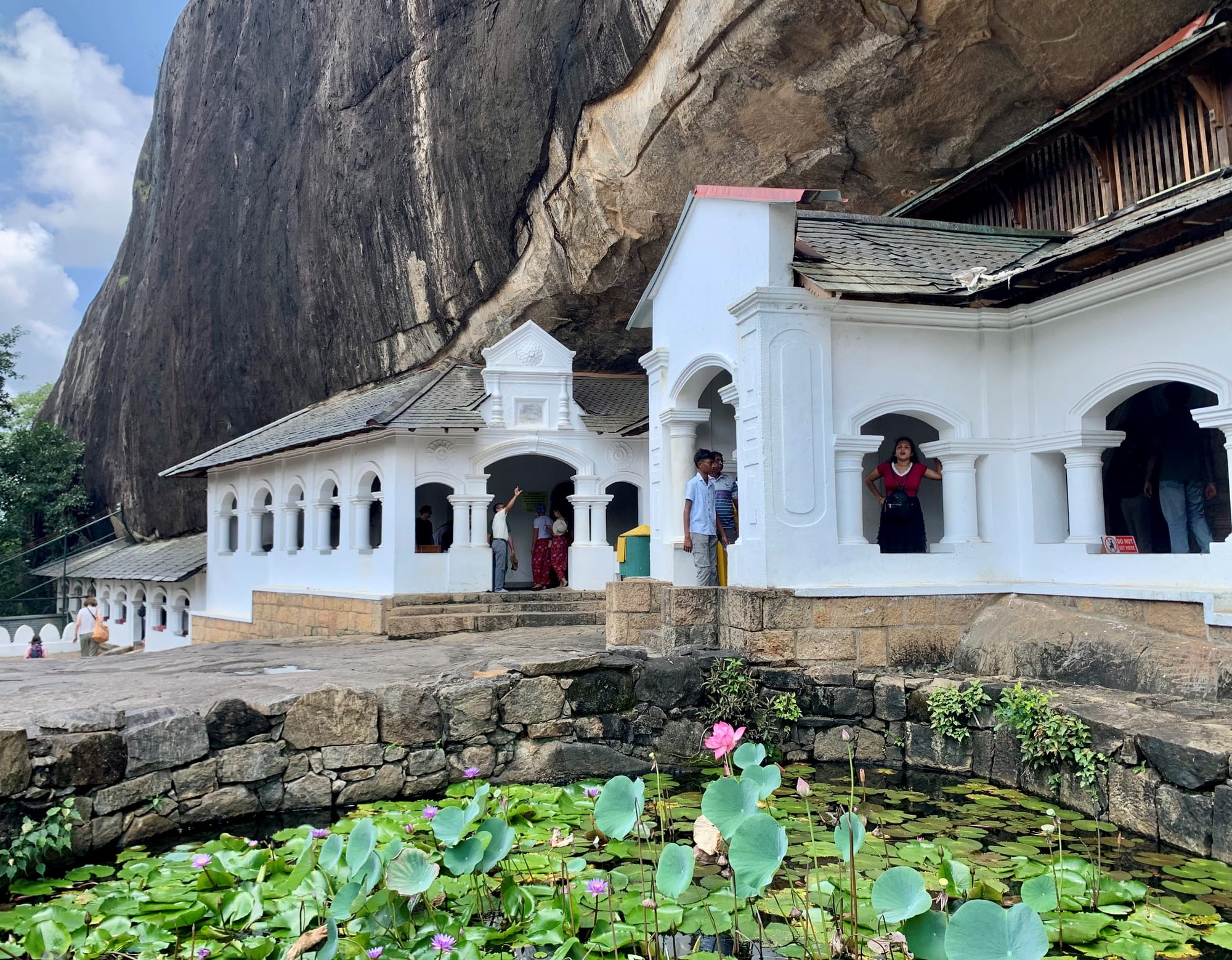
White colonnaded temple buildings built under a huge overhanging granite rock face, above a pond of lotus leaves and pink flowers

The Cultural Triangle, Sri Lanka

Dambulla

The whitewashed frontage of the cave temple beneath the rock at Dambulla. (Dudva / Wikimedia Commons · CC0)

A town in the dry plains of north-central Sri Lanka, built at the junction where the roads from Colombo, Kandy, Anuradhapura and Trincomalee meet. Above it a granite outcrop holds five caves lined with Buddha images and painted ceilings, a place of worship for more than two thousand years and a UNESCO World Heritage Site.

Neighbourhoods

  • The town centre and the junction
    • First-time visitors
    • Close to transport
    • Everyday shopping

    The crossroads where the Kandy, Colombo, Trincomalee and Anuradhapura roads meet, lined with shops, banks, eating houses and the bus stand. It is noisy and practical rather than pretty, and it is where buses to every corner of the country can be caught.

    Open in Maps
  • Below the rock
    • Temple visitors
    • Budget stays

    The southern edge of town, where the Golden Temple buildings and the stairway up to the caves stand beside the Kandy road. Guesthouses, craft stalls and small restaurants gather here, within walking distance of the climb.

    Open in Maps
  • The Economic Centre area
    • Markets
    • Local life

    North of the centre, around the huge wholesale vegetable market that supplies much of Sri Lanka. Lorries, traders and porters work through the night, and the surrounding streets hold tea kiosks, hardware shops and cheap lodgings used by drivers.

    Open in Maps
  • Kandalama
    • Resorts
    • Lake views
    • Quiet and residential

    A forested reservoir a few kilometres east of town, with large hotels set above the water and roads through scrub jungle. It is a base for birdwatching and for trips to Sigiriya, and is quiet at night apart from the wildlife.

    Open in Maps

Things to do

Temples and ancient sites

  • Dambulla cave templelandmark

    Five caves under a rock overhang above the town, holding more than 150 Buddha images and painted ceilings and walls, in use since the first century BC and inscribed by UNESCO in 1991.

    Open in Maps
  • Ibbankatuwa Megalithic Tombsattraction

    A prehistoric burial ground of stone cist and urn graves about five kilometres south-west of the town on the Kurunegala road, radiocarbon-dated to about 700–450 BC and one of several ancient burial sites found in Sri Lanka.

    Open in Maps

Sport and green space

  • Rangiri Dambulla International Stadiumattraction

    A cricket ground built in 2001 on the edge of town, which has hosted one-day internationals and Twenty20 matches and is known for being put up in a matter of months.

    Open in Maps
  • Kandalama Reservoirpark

    An irrigation tank in dry forest east of the town, its bunds good for birdwatching and its shores used by elephants in the dry months.

    Open in Maps

Short trips

  • Sigiriyalandmark

    The fifth-century rock citadel of King Kashyapa about seventeen kilometres north-east, with water gardens, frescoes and the lion's paws at the foot of the summit stairway.

    Open in Maps
  • Pidurangala Rockviewpoint

    An ancient forest monastery and rock beside Sigiriya, climbed for the view across to the citadel.

    Open in Maps
  • Nalanda Gedigelandmark

    A small stone shrine of about the 8th to 10th centuries south of the town, notable for its South Indian architecture and for having been dismantled and rebuilt away from its original site.

    Open in Maps
  • Aluvihare Rock Templelandmark

    A cave monastery near Matale to the south, traditionally the place where the Pali Buddhist canon was first written down on palm leaves in the first century BC.

    Open in Maps
  • Minneriya National Parkpark

    A reservoir park east of the town where elephants gather in numbers on the drying grass of the tank bed in the dry season.

    Open in Maps

Seasonal events

  • VesakMay

    The full moon of the Buddha's birth, enlightenment and death, when lanterns line the roads, the cave temple fills with pilgrims and free food is handed out at dansal.

  • PosonJune

    The full moon marking the arrival of Buddhism in Sri Lanka, a major pilgrimage occasion across the north-central plains.

  • Sinhala and Tamil New Yearmid-April

    The national new year at the close of the harvest, with milk rice, oil-cake sweets, village games and a near-complete pause in trade.

Eat and drink

Long-standing places and food districts in Dambulla. Hours, ratings and directions come from your maps app, always current.

Dambulla classics

  • Rice and curry in the town centrerestaurant

    Eating houses around the junction serve dry-zone rice and curry at midday — dhal, pumpkin, jackfruit, beans, gotu kola mallung and a fish or chicken curry, with pol sambol and papadam.

    Open in Maps
  • Buffalo curd and treacle stallsmarket

    Clay pots of set buffalo curd, poured over with kithul palm treacle, are sold at roadside stands on the highways out of town, the standard sweet of this part of the island.

    Open in Maps

Markets and food streets

  • Dambulla Dedicated Economic Centremarket

    The country's main wholesale vegetable market, where produce from the hill country and the dry zone is traded in bulk through the night and lorries queue along the road.

    Open in Maps
  • The junction food stallsneighborhood

    Bakeries and kiosks around the bus stand sell short eats, fish buns, rolls and vadai with strong sweet tea, feeding drivers and passengers at all hours.

    Open in Maps

Experience Dambulla

History

Dambulla's history begins with its rock. The caves under the overhang were occupied by Buddhist monks in the last centuries BC, and inscriptions at the site record early donations. Tradition holds that King Valagamba, driven out of Anuradhapura by South Indian invaders in the first century BC, sheltered here for years and, on regaining his throne, had the caves converted into a temple. Later kings added to them: images were carved and installed, the caves were plastered and painted, and in the twelfth century Nissanka Malla of Polonnaruwa is said to have had many of the statues gilded, giving the place its name of the Golden Rock Temple.

The painting and sculpture seen now belong largely to the Kandyan period of the eighteenth century, when the temple was restored under Kandyan kings and covered with murals of the Buddha's life and of Sri Lankan history, laid over earlier work. The site was inscribed as a UNESCO World Heritage Site in 1991, and a large golden Buddha and a museum were later built at the foot of the rock.

The modern town below grew for a much plainer reason: it stands where the main roads from Colombo, Kandy, Anuradhapura, Polonnaruwa and Trincomalee cross. Irrigation and resettlement schemes in the twentieth century brought farmers into the surrounding dry zone, and the government's wholesale market, the Dedicated Economic Centre, made Dambulla the clearing house for much of the country's vegetable trade. A cricket stadium followed in 2001, built on the edge of town in a matter of months.

Culture & Customs

Two quite different lives share the same address. Dambulla is a place of pilgrimage, where white-clad families climb the rock with lotus flowers and oil for the lamps, monks tend the caves, and the great full-moon days fill the terrace; and it is a hard-working market town whose rhythms are set by lorries, produce prices and bus timetables. Visitors usually see only the first, since most arrive, climb the rock and leave for Sigiriya the same day.

The surrounding countryside keeps the customs of the dry-zone village: the temple and the tank at the centre of life, water shared under old rules of cultivation, and dansal set up at the roadside during Vesak and Poson to hand out rice, drinks and sweets free to travellers. The perahera season brings drummers and dancers through the streets, and the Kandyan tradition of drumming and dance is strong here, since this is the northern edge of the old Kandyan kingdom.

The town is predominantly Sinhalese and Buddhist, with Muslim traders long established in the market trade and a smaller Tamil population. Manners are conservative: modest dress, shoes removed at temples and in homes, and a reserve with strangers that gives way quickly to hospitality. The temple's rules on dress and behaviour are enforced, and pictures taken with a Buddha image behind a smiling visitor are a reliable way to cause serious offence.

Daily Life

Tens of thousands of people live in the town and the surrounding divisional area, the second largest urban centre in Matale District after Matale itself, spread between the built-up junction and farming villages around the tanks. The economy rests on three things: agriculture, the wholesale market and the traffic. Farmers grow paddy under the irrigation schemes and, on higher ground and chena plots, chilli, onions, maize and vegetables; the Economic Centre buys, sorts and redistributes produce from across the country, working hardest between midnight and dawn; and the junction supports garages, hardware stores, lodgings and eating houses for drivers.

Tourism is the fourth pillar and the most visible to outsiders — guesthouses, guides, craft stalls, drivers and the hotels out at Kandalama — but it employs far fewer people than the vegetable trade. Government offices, schools and a base hospital account for much of the remaining work.

Days start before dawn and slow at midday when the heat becomes hard to work in, picking up again in the late afternoon. The town's persistent problems are those of the dry zone: water that is plentiful in some years and scarce in others, elephants raiding crops and damaging houses as farms push into forest, and a chronic kidney disease of uncertain cause that has long affected farming families across the north-central plains. Traffic through the junction, and the lorry parks around the market, add noise and dust that residents complain about regularly.

Food

The everyday meal is rice and curry in its dry-zone form: rice with dhal, a pumpkin or jackfruit curry, long beans or snake gourd, a mallung of shredded greens and coconut, papadam, and pol sambol, the pounded mixture of scraped coconut, chilli, lime and onion that accompanies nearly everything. Freshwater fish from the tanks, dried fish and chicken are the common proteins. Older grains have not disappeared: kurakkan, finger millet, is eaten as flatbread or as a thick porridge, and green gram and cowpeas from the chena plots appear boiled with coconut at breakfast.

Because the town is a market and a crossroads, its street food is that of the bus stand: short eats in glass cases — fish buns, cutlets, rolls, vadai — along with kottu, roti chopped on a hot plate with vegetables, egg and meat to a loud, rhythmic clatter, and hoppers and string hoppers in the evening. Tea is strong, milky and heavily sweetened.

Two local products stand out. Buffalo curd, set in shallow clay pots and eaten with kithul treacle or jaggery, is sold from stalls along every road out of town. And because the Dedicated Economic Centre gathers the produce of the entire country, Dambulla's own kitchens have unusually good access to hill-country vegetables as well as dry-zone ones — leeks and carrots from Nuwara Eliya alongside local jackfruit, drumstick and wood-apple, which is pulped into a sour-sweet drink sold at the roadside.

Planning tools

Budget

Dambulla is a working town rather than a resort, and beds are cheaper here than at Sigiriya or in the Kandalama hotels, with plain guesthouses near the junction and mid-range places on the roads out. Food in town is inexpensive. The costs that matter are the entry fee for the cave temple, priced for foreigners, and the hire of a car, tuk-tuk or jeep to reach the sites and parks around it.

Daily Budget Midrange
USD 75–180 plus site tickets (hotel with pool, a car and driver, jeep safaris)
Daily Budget Shoestring
USD 25–40 before site tickets (guesthouse, rice and curry, buses, a bicycle)

Stay in Dambulla and travel out to the sites if the budget is tight, since rooms here cost less than at Sigiriya, and carry cash for entry fees.

Best Time to Visit

February to April and the dry mid-year months are the most reliable, with little rain, though April and May are very hot on the plains. The elephant gathering at the reservoir parks peaks in the dry season from about May to September. October to January brings the northeast monsoon, when heavy showers can flood roads and make the temple stairway slippery.

Suggested Number of Days

A single day covers the town and its cave temple. Two or three nights make sense for anyone using Dambulla as a base for the wider plains, which is its main role. Heat limits how much can be done between late morning and mid-afternoon.

First Visit
1 day
With Surroundings
3 days

Transportation

Dambulla is a road junction first and foremost, with frequent buses to Colombo, Kandy, Anuradhapura, Polonnaruwa, Trincomalee and Sigiriya from the central stand, and it is the easiest place in the region to change buses. Tuk-tuks handle short trips in and around town. There is no railway station; the nearest lines run through Habarana and Polonnaruwa. Most visitors seeing several sites hire a car and driver.

Agree tuk-tuk fares before setting out, and keep off rural roads after dark, when elephants cross between forest and tanks.

Airport & Station Connections

The town sits on the main Colombo–Trincomalee road, about four hours from Colombo and two to three from Kandy by bus or car, with Sigiriya seventeen kilometres away and Anuradhapura and Polonnaruwa each within a couple of hours. Habarana, about twenty-five kilometres north, is the nearest railway station. The nearest international airport is near Colombo, and a domestic airstrip operates near Sigiriya.

Walkability

The centre is compact and can be walked, but it is built around a busy highway junction with heavy lorry traffic, narrow pavements and little shade, so walking is practical rather than pleasant. The cave temple involves a climb of several hundred steps up the rock, barefoot for the last stretch inside the terrace, and the stone gets very hot by the middle of the day.

Safety

Crime is low and mostly limited to overcharging and touts around the temple. The genuine risks are heat and dehydration on the climb, monkeys that snatch food and bags on the temple stairway, heavy traffic at the junction, and wild elephants on rural roads at dusk and after dark. Hot stone burns bare feet on the temple terrace in the afternoon.

Carry water and sun protection, take socks for the barefoot sections at the temple, keep food out of sight near the monkeys, and avoid rural roads after dark. Check current official travel advice before travelling.

Climate

A dry-zone climate: hot all year with strong sun. Most rain falls in the northeast monsoon between October and January, while from May to September the southwest monsoon crosses as dry, gusty wind and the reservoirs drop.

Summer
May–September: hot, dry and windy, commonly 30–35°C by day, with dust and haze
Winter
October–January: the rainy season, with heavy showers, days around 28–32°C and cooler nights; February to April dry and very hot

Local Customs

The cave temple is an active monastery as well as a monument. Shoulders and knees must be covered to enter, footwear and hats are removed at the terrace, and posing with one's back to a Buddha image, or climbing on statues, is treated as a serious offence in Sri Lanka. Poya days, at each full moon, are public holidays when alcohol is not sold and the temple is at its busiest.

Carry a scarf or sarong for the temple, remove shoes and hats at the entrance to the terrace, and ask before photographing monks or worshippers.

Common Payment Methods

The currency is the Sri Lankan rupee. Hotels, larger restaurants and the temple ticket office take cards, but buses, tuk-tuks, market traders, guesthouses and small eating houses deal in cash. Bank branches and ATMs are clustered around the junction, and they are the most reliable in the area, so it is worth drawing money here before heading out to Sigiriya or the parks.