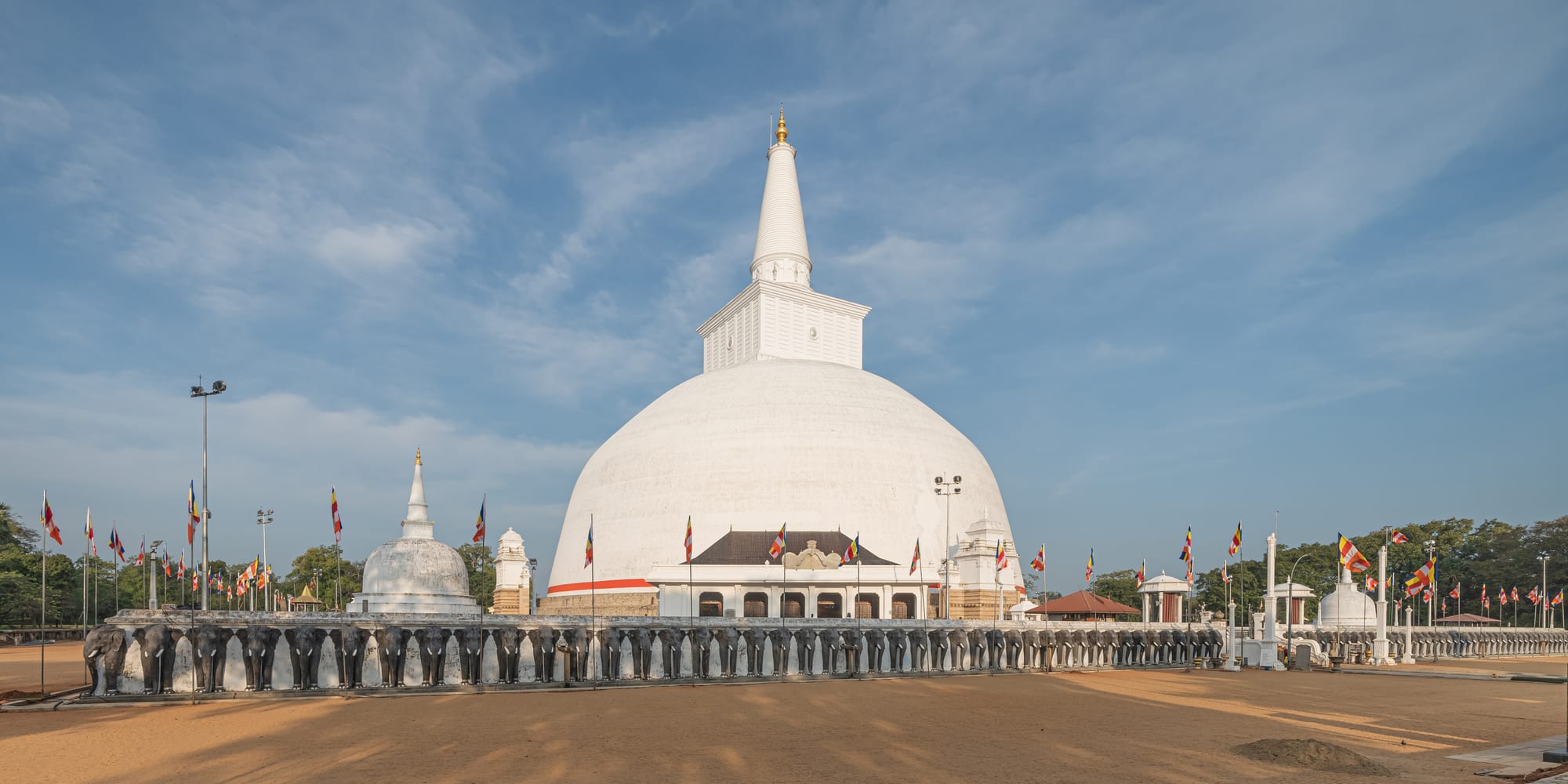
A large whitewashed dome-shaped stupa with a pointed spire, ringed by a wall of carved stone elephants and rows of Buddhist flags

The Cultural Triangle, Sri Lanka

Anuradhapura

The Ruwanwelisaya stupa and its wall of elephant sculptures in the sacred city of Anuradhapura. (A.Savin / Wikimedia Commons · FAL)

The first capital of Sri Lanka, in the dry plains of the north-central province, and the seat of Sinhalese kings for more than a thousand years. Its sacred city spreads over several square kilometres of brick stupas, monastery ruins and reservoirs around the Sri Maha Bodhi, a fig tree grown from a cutting of the tree under which the Buddha gained enlightenment.

Neighbourhoods

  • The new town
    • First-time visitors
    • Close to transport
    • Everyday shopping

    The modern centre east of the ruins, laid out in the twentieth century when the old city was cleared for archaeology. Shops, banks, the market, the bus stands and the railway station are here, along with most cheap and mid-range accommodation.

    Open in Maps
  • The sacred city
    • Historic district
    • Pilgrims
    • Cycling

    A wide belt of parkland, tanks and ruins west of the new town, holding the great stupas, the Bodhi tree and the monastery sites. There is no housing inside it, and it is crossed by quiet roads best covered by bicycle or tuk-tuk.

    Open in Maps
  • Around Nuwara Wewa
    • Lake views
    • Quiet and residential
    • Sunset walks

    The shore of one of the city's great ancient reservoirs, on the eastern side of town. Hotels and guesthouses line parts of the bund, which fills in the evening with families, joggers and food carts.

    Open in Maps
  • Mihintale road
    • Quiet and residential
    • Pilgrim stays

    The eastern approach towards the hill of Mihintale, about twelve kilometres away, with scattered guesthouses, paddy land and village temples. It is a practical base for an early start at the stairway.

    Open in Maps

Things to do

The great stupas

  • Ruwanwelisayalandmark

    The white dome raised by King Dutugemunu in the second century BC, ringed by a wall of sculpted elephants and among the most venerated shrines in the country.

    Open in Maps
  • Jetavanaramayalandmark

    A colossal stupa of bare red brick built in the third century AD, once among the tallest structures in the ancient world and one of the largest brick monuments anywhere.

    Open in Maps
  • Abhayagiri Dagabalandmark

    The stupa and monastery complex north of the centre, founded in the first century BC, which became a great centre of Buddhist learning visited by Chinese pilgrims.

    Open in Maps
  • Thuparamayalandmark

    Traditionally the earliest stupa in Sri Lanka, built in the third century BC to enshrine a relic of the Buddha, surrounded by slender stone pillars.

    Open in Maps
  • Mirisavetiyalandmark

    A restored white stupa near the Tissa Wewa reservoir, built by Dutugemunu and standing in open ground away from the crowds.

    Open in Maps
  • Lankaramalandmark

    A small stupa on a circular platform ringed by rows of stone columns, built by King Valagamba in the first century BC.

    Open in Maps

Temples and monastery ruins

  • Jaya Sri Maha Bodhilandmark

    A sacred fig grown from a cutting of the Bodhi tree at Bodh Gaya, brought in the third century BC and the oldest living planted tree in the world with a documented planting date.

    Open in Maps
  • Isurumuniyalandmark

    A rock temple beside the Tissa Wewa, known for its carvings, including the relief usually called the Isurumuniya Lovers.

    Open in Maps
  • Samadhi Statuelandmark

    A seated Buddha in meditation carved from dolomite marble and dated to about the fourth to sixth century, set among trees in the Abhayagiri area.

    Open in Maps
  • Kuttam Pokunalandmark

    The twin bathing ponds of the Abhayagiri monastery, faced in cut granite with steps, filters and a carved water spout, an example of ancient hydraulic engineering.

    Open in Maps

Reservoirs and green space

  • Tissa Wewapark

    A tank built in the third century BC to supply the royal city, its bund lined with old trees and its western shore beside the Isurumuniya temple.

    Open in Maps

Short trips

  • Mihintalelandmark

    The hill east of the city where the monk Mahinda is said to have met King Devanampiya Tissa and brought Buddhism to the island, climbed by a long granite stairway to stupas and a summit rock.

    Open in Maps
  • Avukana Buddha statuelandmark

    A standing Buddha almost twelve metres high, more than fourteen with its pedestal, carved from a granite face beside the Kala Wewa reservoir south-east of the city.

    Open in Maps
  • Wilpattu National Parkpark

    One of the country's oldest and largest national parks, west of the city, a forest dotted with natural lakes and known for leopards and sloth bears.

    Open in Maps
  • Ritigalatrail

    A forested mountain and strict nature reserve south-east of the city, with the stone paths and platforms of an ancient ascetic monastery on its lower slopes.

    Open in Maps
  • Anuradhapura railway stationtransit hub

    The station in the new town on the northern line, with trains south to Colombo and north towards Jaffna.

    Open in Maps

Seasonal events

  • PosonJune

    The full moon marking the arrival of Buddhism in Sri Lanka and the city's greatest festival, when enormous crowds of white-clad pilgrims fill Anuradhapura and Mihintale and free food is given out along the roads.

  • VesakMay

    The full moon of the Buddha's birth, enlightenment and death, marked with lanterns, illuminated panels and processions around the stupas.

  • Sinhala and Tamil New Yearmid-April

    The national new year at the close of the harvest, with milk rice, oil-cake sweets and village games, and a pause in almost all business.

  • Poya daysevery full moon

    Each full moon is a public holiday and a day of observance, when the sacred city is busiest, white clothing is worn and alcohol is not sold.

Eat and drink

Long-standing places and food districts in Anuradhapura. Hours, ratings and directions come from your maps app, always current.

Anuradhapura classics

  • Rice and curry in the new townrestaurant

    Eating houses near the market and the bus stands serve the dry-zone spread at midday — dhal, pumpkin, jackfruit, beans, gotu kola mallung, papadam and pol sambol, with fish, chicken or an egg curry.

    Open in Maps
  • Buffalo curd and treacle stallsmarket

    Set buffalo curd in shallow clay pots, eaten with kithul palm treacle, is sold at roadside stands around the city and is the region's standard sweet.

    Open in Maps

Markets and food streets

  • Anuradhapura marketmarket

    The produce market in the new town, busiest early in the morning, piled with dry-zone vegetables, bananas, wood-apple, dried fish and spices.

    Open in Maps
  • The bus stand food stallsneighborhood

    Bakeries and kiosks around the bus stands sell short eats, fish buns, cutlets, vadai and kottu chopped to order, with strong sweet tea at any hour.

    Open in Maps
  • Vegetarian pilgrim kitchensrestaurant

    Simple places near the sacred city cook without meat for pilgrims, serving rice and vegetable curries, string hoppers and milk rice, especially busy on poya days.

    Open in Maps

Experience Anuradhapura

History

Tradition names the city after Anuradha, a minister of the legendary founder Vijaya, and dates its establishment as a capital to the fourth century BC; archaeology shows a substantial settlement here well before the historical record begins. Its decisive moment came in the third century BC, when the monk Mahinda, sent by the Mauryan emperor Ashoka, met King Devanampiya Tissa on the hill of Mihintale and converted him. A cutting of the Bodhi tree at Bodh Gaya was brought by the nun Sanghamitta and planted in the royal park, where it still grows, and the city became the centre of Theravada Buddhism.

Over the following centuries it grew into one of the largest cities in Asia, supported by a system of reservoirs and canals of remarkable sophistication. Dutugemunu, who defeated the South Indian ruler Elara in the second century BC, raised the Ruwanwelisaya; later kings built the vast monasteries of the Mahavihara, Abhayagiri and Jetavana, whose brick stupa was among the tallest buildings on earth when it was completed. Monks from China and elsewhere came to study, and the city's tanks — Basawakkulama, Tissa Wewa, Nuwara Wewa — fed a dense farming population.

Repeated invasions from South India wore the kingdom down, and in 993 the Chola empire sacked Anuradhapura and moved the capital to Polonnaruwa. The old city was abandoned to the forest for the best part of nine centuries. British surveyors and antiquarians rediscovered its monuments in the nineteenth century, excavation and restoration followed, and in the twentieth century the modern town was deliberately moved eastwards so that the sacred area could be cleared. During the civil war the city, close to the front lines, suffered attacks including one at the Sri Maha Bodhi in 1985. It was inscribed as a UNESCO World Heritage Site in 1982.

Culture & Customs

Anuradhapura is first of all a pilgrimage city, and its daily culture is shaped by that. Families arrive by bus and lorry dressed in white, carrying lotus flowers, oil for the lamps and bundles of food; they walk barefoot between the stupas, pour water at the Bodhi tree, and tie strips of cloth to its railings. Monks are everywhere, and the sound of chanting carries across the parkland in the early morning and evening. On poya days, and above all at Poson in June, the crowds are enormous and the city's roads are lined with dansal, stalls where volunteers hand out rice, drinks and sweets free to anyone passing.

The city is also a symbol in Sinhalese national memory, the place where the island's Buddhist identity was founded and where Dutugemunu's victory is retold as a national story. That significance made it a target during the civil war and still gives its monuments a political weight beyond the religious one. The region as a whole is predominantly Sinhalese and Buddhist, with Muslim traders in the town and a Tamil minority.

Conduct at the monuments is taken seriously and enforced. Shoulders and knees are covered, shoes and hats come off at the sacred enclosures, and visitors who pose with their backs to Buddha images or climb on statues can expect anger and, in some cases, police involvement. Away from the ruins, manners are those of the rural dry zone: quiet, hospitable and conservative.

Daily Life

The modern town holds several tens of thousands of people, with many times that number across the district. It works as the administrative and commercial centre of the North Central Province, with government offices, a teaching hospital, schools and a university campus, and it serves as the market town for a wide farming hinterland. Paddy grown under the ancient and modern irrigation systems is the mainstay, along with chena plots of chilli, maize and vegetables, and freshwater fisheries in the tanks.

Pilgrimage and tourism form the other half of the economy: guesthouses, restaurants, bicycle hire, tuk-tuk drivers, flower and lamp sellers at the shrines, and the trade that surges at every full moon. Unlike many Sri Lankan destinations, Anuradhapura's visitor flow is mostly domestic, which made it steadier than the coast through the collapse in foreign arrivals after 2019 and the economic crisis of 2022.

Life runs early and late around the heat of the day, with the Nuwara Wewa bund filling with walkers, cyclists and food carts in the cool of the evening. The district's difficulties are those of the dry zone: variable rainfall and dependence on the tanks, human–elephant conflict on the farming frontier, and a chronic kidney disease of uncertain cause that has long affected farming families across the north-central plains. The city also carries the memory of the war years, when it stood on the route north.

Food

Dry-zone cooking is the city's everyday food. Rice and curry here means rice with dhal, pumpkin or ash plantain in coconut milk, jackfruit, long beans or snake gourd, a mallung of gotu kola or other leaves shredded with coconut, papadam, and pol sambol pounded from scraped coconut, chilli, lime and onion. Freshwater fish from the tanks, dried fish and chicken are the common proteins, and village kitchens still cook over firewood in clay pots.

Older dry-zone staples hold their place. Kurakkan, finger millet, is made into dark flatbread and porridge; green gram and cowpeas boiled with coconut are a common breakfast; and ambul thiyal, fish soured with dried goraka, appears on menus alongside dishes from the coast. Because the city fills with pilgrims, vegetarian cooking is unusually easy to find, and milk rice, kiribath, cut into diamonds and eaten with lunu miris, marks poya days and family occasions.

Street and snack food comes from the bus stands and bakeries: short eats in glass cases, kottu chopped noisily on a hot plate, hoppers and string hoppers in the evening, and vadai sold from baskets. Buffalo curd with kithul treacle is the sweet of the region, sold in clay pots along the roads, and the drinks are king coconut, wood-apple pulped with jaggery, beli fruit, and the strong sweet milk tea that punctuates the day.

Planning tools

Budget

Anuradhapura is inexpensive by Sri Lankan standards, with guesthouses in the new town, a few hotels along the Nuwara Wewa bund and little at the top end. Food and bicycle hire cost very little. The significant expense is the sacred city ticket, priced in US dollars for foreign visitors and covering the main monuments, with separate charges at some sites and at the national parks.

Daily Budget Midrange
USD 75–180 plus site tickets (hotel with pool, a car and driver, jeep safaris)
Daily Budget Shoestring
USD 25–40 before site tickets (guesthouse, rice and curry, buses, a bicycle for the ruins)

Hire a bicycle rather than a tuk-tuk for the ruins, which are flat and spread out, and keep the sacred city ticket to hand, as it is checked at several monuments.

Best Time to Visit

February to September is generally dry, with the mid-year months hot, windy and dusty; April and May bring the highest temperatures. October to January is the rainy season, when showers are heavy but the parkland is green. Poson, at the June full moon, is the most extraordinary time to be here and also the most crowded, with accommodation scarce.

Suggested Number of Days

Most visits run to one or two days for the main monuments, and three for anyone adding the hill to the east or the national park to the west. Heat is the real constraint, and cycling the site takes longer than the distances suggest.

First Visit
1–2 days
With Surroundings
3 days

Transportation

The new town and the sacred city are several kilometres apart, and the ruins themselves are spread over a wide area, so bicycles, tuk-tuks or a car are needed. Bicycle hire is easy and popular, since the ground is flat and the site roads are quiet. Buses run from the new town to Mihintale, Dambulla, Colombo, Jaffna and Trincomalee, and trains use the northern line to Colombo and Jaffna.

Start early, carry water on the bicycle, and remember that shoes must be removed at several monuments, so footwear that is easy to take off helps.

Airport & Station Connections

Anuradhapura lies on the main northern road and rail routes, about four to five hours from Colombo by road and a similar time by train, with Dambulla around an hour and a half away and Jaffna some four hours to the north. Buses arrive from Kandy, Trincomalee and Puttalam as well. The nearest international airport is near Colombo.

Walkability

The new town is walkable, but the sacred city is not: its monuments stand up to two or three kilometres apart across open parkland with little shade, and the surfaces around the stupas must be crossed barefoot, which is painful on hot stone and sand by the middle of the day. Most visitors cycle between sites and walk within them.

Safety

The city is safe, with little crime beyond occasional overcharging and touts at the monuments. The practical risks are heat and dehydration, burnt feet on hot stone, monkeys that snatch food and bags, snakes in long grass at the quieter ruins, and elephants on rural roads at dusk and after dark.

Visit early or late, carry water and socks for the barefoot areas, keep food out of sight where monkeys gather, and avoid rural roads after dark. Check current official travel advice before travelling.

Climate

A dry-zone climate: hot all year, with strong sun and little cloud for much of it. Most rain falls with the northeast monsoon between October and January; from May to September the southwest monsoon arrives as dry, gusty wind and the reservoirs fall.

Summer
May–September: hot, dry and windy, commonly 30–35°C by day, with dust and haze
Winter
October–January: the rainy season, with heavy showers, days around 28–32°C and cooler nights; February to April dry and very hot

Local Customs

The sacred city is a place of worship before it is a monument, and standards are strictly applied. White or modest clothing covering shoulders and knees is expected, footwear and hats come off at the stupas and the Bodhi tree, and photographs posed with the back turned to a Buddha image, or taken while touching a statue, cause serious offence and can lead to arrest. Tattoos of the Buddha have caused travellers difficulty in Sri Lanka.

Wear or carry something white and modest for the sacred city, remove shoes and hats at each monument, and follow the lead of pilgrims in how to behave around the Bodhi tree.

Common Payment Methods

The currency is the Sri Lankan rupee. Hotels, larger restaurants and the ticket office take cards, but guesthouses, tuk-tuks, bicycle hire, the market and small eating houses work in cash. Banks and ATMs are concentrated in the new town rather than near the ruins, so it is worth drawing money before setting out for the day.