History · Lebanon
How did the Romans move the giant stones of Baalbek into place?
Roman engineers dragged three 800-tonne blocks downhill from a nearby quarry with ropes and capstans; the even bigger stones never left the quarry at all.
By Globeway Editorial · 13 October 2026
The short answer
The giant stones that were actually used at Baalbek, the three blocks known as the Trilithon, weigh about 800 tonnes each. Roman builders cut them in a quarry less than a kilometre from the temple and slightly higher up the hill, so the stones never had to be lifted, only dragged. A long-standing explanation, set out by the French scholar Jean-Pierre Adam in 1977, is that teams moved them on rollers with capstans (upright winches turned by men pushing on bars) and pulley blocks, perhaps along temporary earth embankments, and then manoeuvred them into place in the temple's foundation wall. Exactly how it was done is still not known for certain.
The question needs one correction. The largest stones at Baalbek were never moved: three even bigger blocks, of roughly 1,000 to 1,500 tonnes, still lie in the quarry where the Romans left them. And the Trilithon is not the heaviest stone ever moved. That record is usually given to the Thunder Stone, a granite boulder of about 1,500 tonnes that was hauled to Saint Petersburg between 1768 and 1770 to become the pedestal of the Bronze Horseman statue. The Trilithon still ranks among the largest monoliths (single blocks of stone) ever moved in the ancient world.
A temple built to astonish
Baalbek sits at about 1,145 metres in Lebanon's Beqaa Valley. The Romans called it Heliopolis, and around 16 BC it became a Roman colony. The huge quarry beside the town probably encouraged the decision to build an enormous temple complex there, on the remote eastern edge of the empire. Work on the Temple of Jupiter most likely began soon after the colony was founded, and a graffito on one of the topmost column drums shows it was largely complete by AD 60.
The temple stood on a raised podium whose walls were built of about 24 monoliths, those in the lowest level weighing around 300 tonnes each. On the west side, a second course holds the three famous blocks. Each is more than 19 metres long, about 4.3 metres high and 3.6 metres deep, and they average about 800 tonnes apiece. Above that platform rose 54 Corinthian columns 19.9 metres high, the tallest of any classical temple.
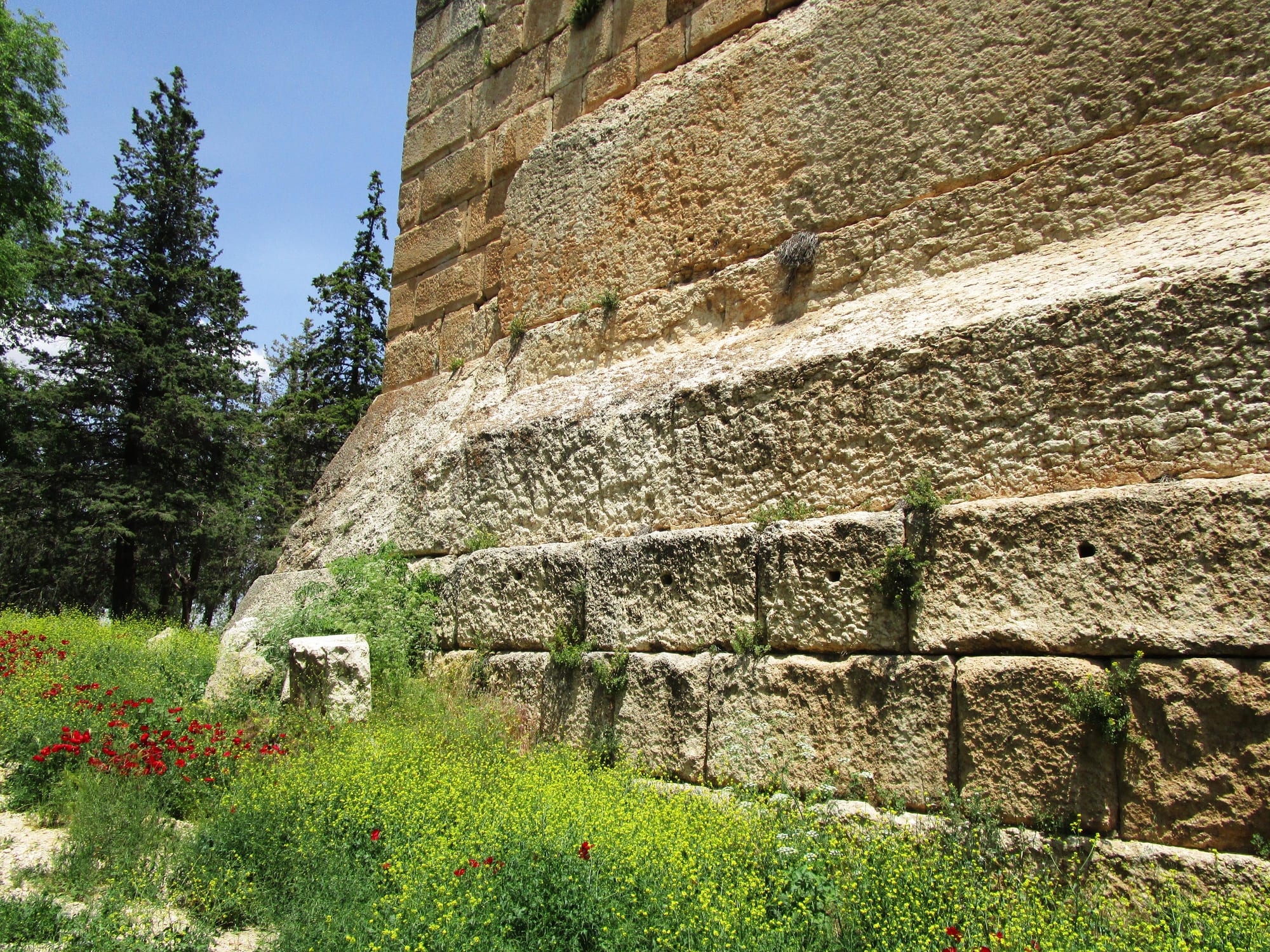
The Trilithon blocks are not at ground level. They rest on a course of blocks that are themselves around 350 tonnes each, so the builders had to slide each giant onto a platform already several metres up, then push it hard against its neighbour with great precision.
Downhill all the way
The key to the puzzle is geography. The quarry lies slightly higher than the temple complex, so moving the stones was a matter of controlled dragging, not lifting. One well-known reconstruction has the blocks rolled the short distance from the quarry and drawn into their final position by capstans and pulley blocks. A capstan multiplies human strength: many men walking round a vertical drum can wind in a rope with far more force than they could ever pull by hand, and many capstans can be anchored in a row and worked together.
Other suggestions fill in the details. The stones may have been rolled along temporary earthen banks built up from the quarry to the height of the wall. Some researchers have proposed several cranes working in combination, or raising one side of a block at a time and packing supports underneath, then doing the same on the other side. None of these ideas has been proved, and archaeological work at the site has been hampered by unrest in the region.
What Roman cranes could and could not do
Cranes were the Romans' standard tool for heavy building, but they had clear limits. Lifted blocks carry holes for a lewis, an iron fitting wedged into the stone so a crane rope could grip it, and each hole points to one rope worked by its own capstan. On the architrave blocks of the Temple of Jupiter itself, dividing a block's weight by its number of lewis holes gives about 7.5 tonnes per lifting point. No single crane could have touched an 800-tonne block.
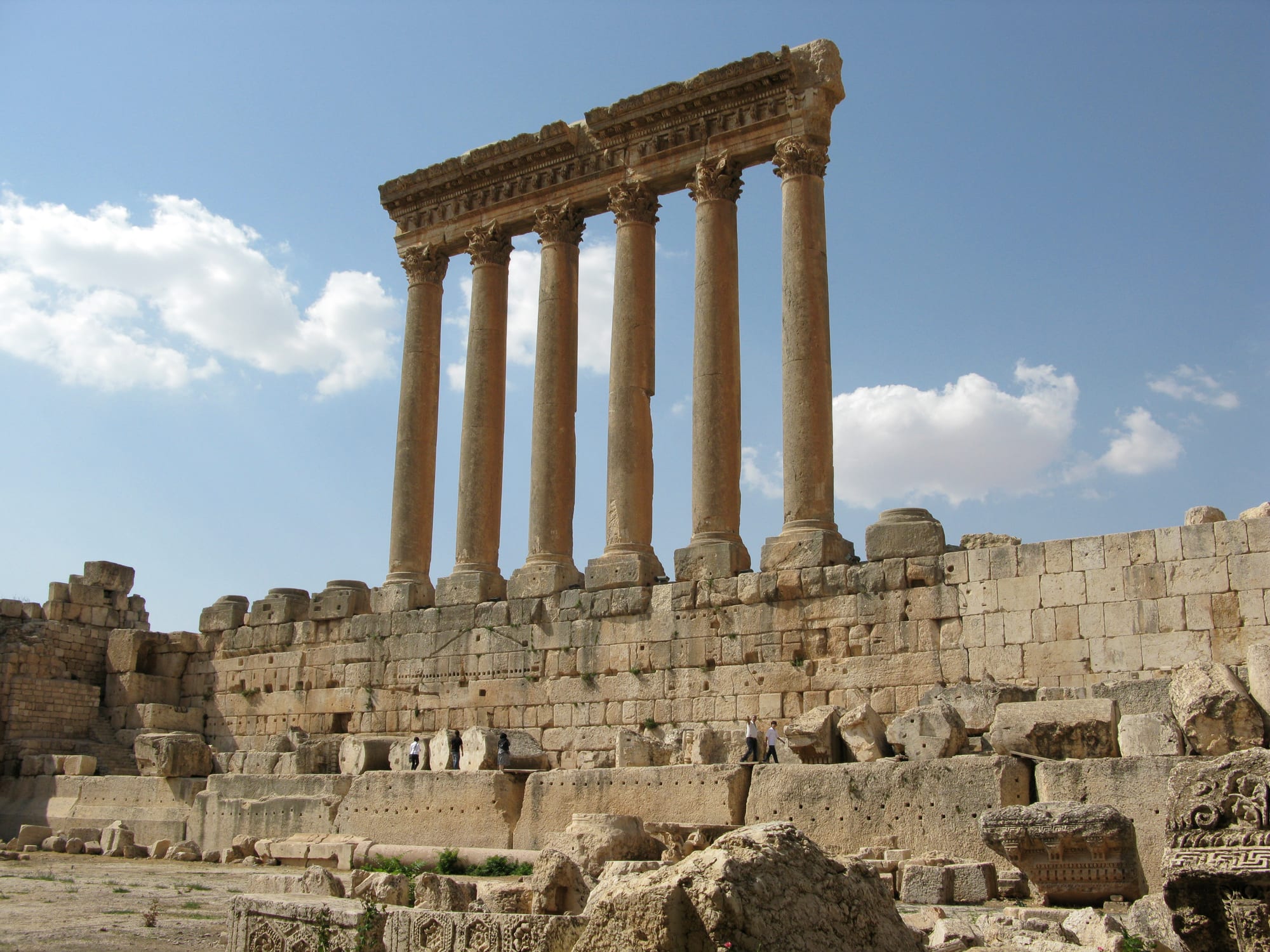
The stones on top of these columns show that Roman engineers could also lift remarkable weights when they had to. The entablature blocks weigh up to 60 tonnes, and one corner block more than 100, all raised about 19 metres above the ground.
That is why the Trilithon was dragged rather than hoisted. For the heaviest lifts at Baalbek, historians of Roman engineering think builders set up a four-masted lifting tower, with the block raised vertically in the middle by capstans placed on the ground around it.
The giants left behind
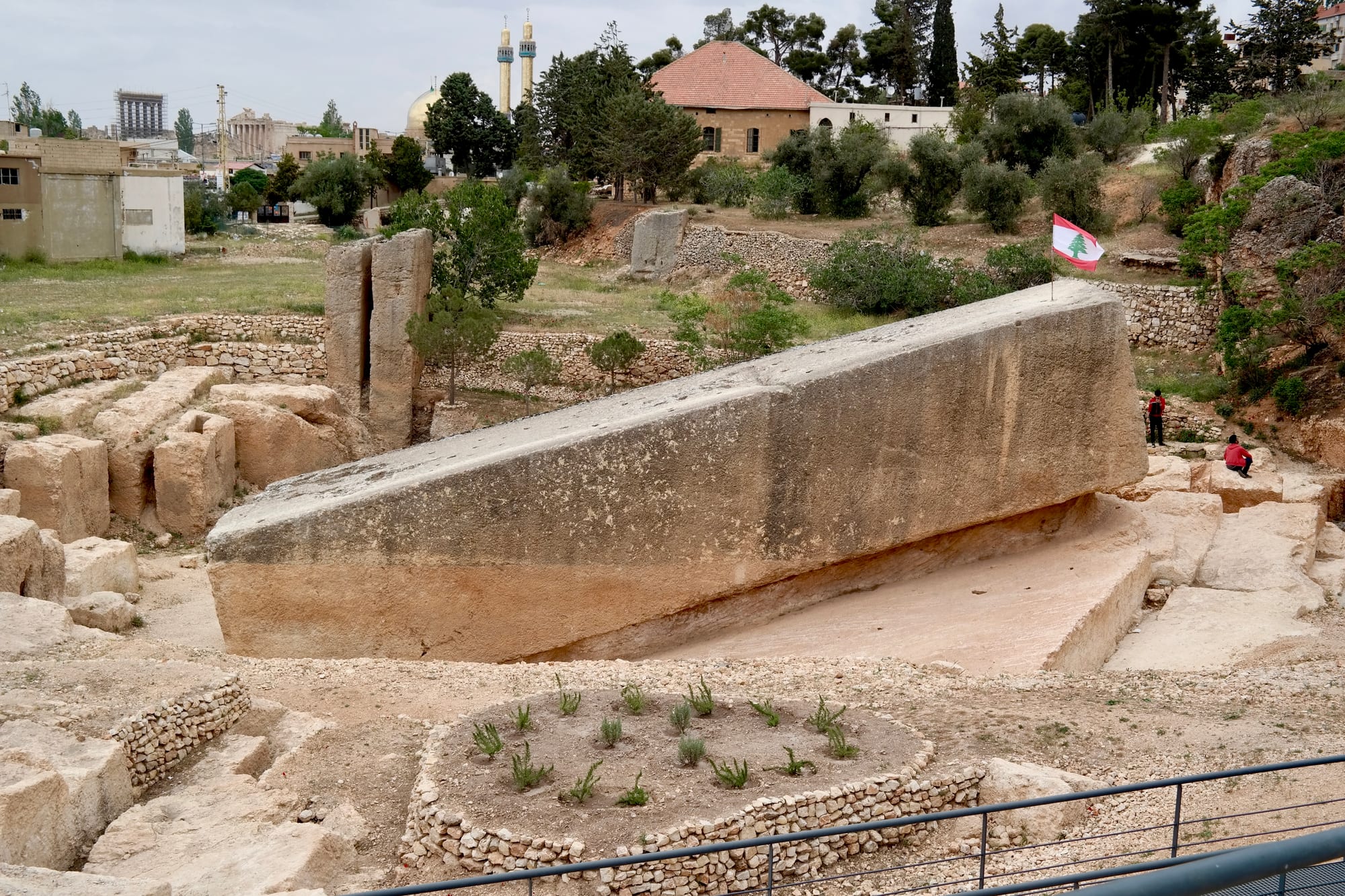
In the same quarry lie three blocks that dwarf the Trilithon. The Stone of the Pregnant Woman, more than 20 metres long, was measured by a team from the Austrian city of Linz in 1996 at about 1,000 tonnes. Its underside was never cut free and is still joined to the bedrock, and a study in 2015 found cracks and a defect on one face. A second block, the Stone of the South, was rediscovered in the 1990s and is estimated at 1,242 tonnes. A third, the Forgotten Stone, was found in 2014 by archaeologists of the German Archaeological Institute and is estimated at around 1,500 tonnes.
They rank among the largest stones ever quarried. All three are thought to have been meant for the temple, perhaps as an addition to the Trilithon, but they were abandoned for reasons nobody knows. Local stories explain the Pregnant Woman's name in several ways: one tells of a pregnant woman who promised to reveal how to move the stone if the townspeople fed her until she gave birth; others link it to pregnant jinn set to work on it, or to a belief that touching the stone brings fertility.
The stone that took the record
The Thunder Stone shows what it took to beat Baalbek. Found at Lakhta, 6 kilometres inland from the Gulf of Finland, in 1768, it was dragged overland on a sledge that ran on bronze balls along a short track that had to be taken up and relaid again and again. It took 400 men nine months, with no animals or machines; the larger capstan alone needed 32 men to turn it. A barge built specially for the stone then carried it to Saint Petersburg, where it arrived in 1770. It weighed about 1,500 tonnes when found and was carved down along the way. Baalbek's builders had managed a comparable feat more than 1,700 years earlier, three times over, using rope and muscle.
Seeing the stones today
The temple complex, inscribed as a UNESCO World Heritage Site in 1984, still shows the Trilithon in the podium's western wall, and the quarry known as Hajar al-Hibla, with the Stone of the Pregnant Woman lying at its steep angle, is a short distance from the ruins. Visits have been badly disrupted by conflict: Israeli strikes hit the Baalbek area in 2024, when UNESCO granted the site enhanced protection, and fighting between Israel and Hezbollah resumed in March 2026, with most governments advising against travel to Lebanon.