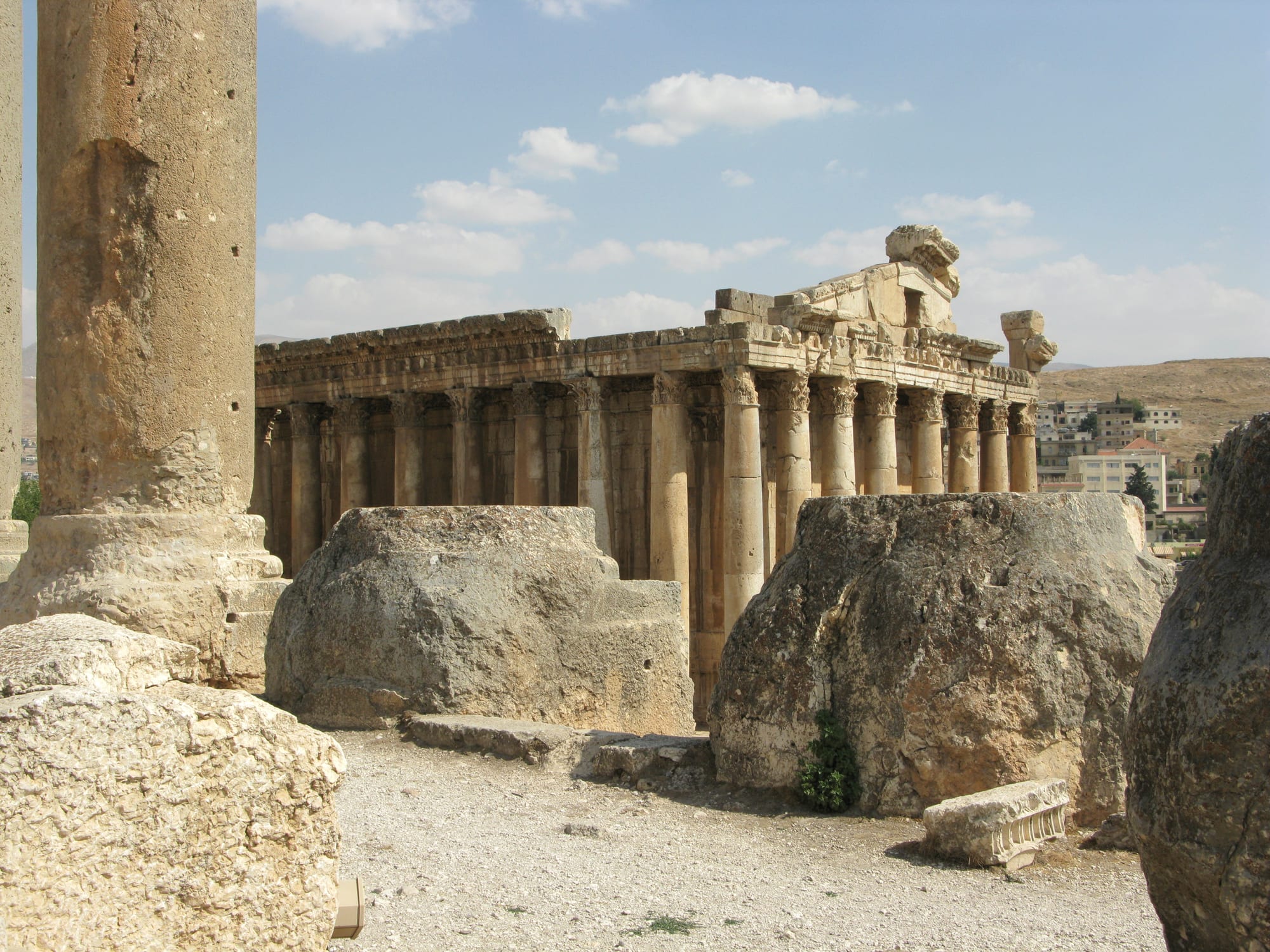
A large, remarkably intact Roman temple with rows of tall fluted columns and a richly carved doorway, mountains behind

Lebanon

The Temple of Bacchus at Baalbek in the Bekaa Valley, one of the largest and best-preserved Roman temples anywhere. (Vyacheslav Argenberg / Wikimedia Commons · CC BY 4.0)

A small, mountainous Mediterranean country of remarkable religious diversity and cultural energy — once the "Paris of the Middle East," now enduring economic collapse, a shattered political order, and, since March 2026, renewed war with Israel and an Israeli occupation of part of its south.

Explore Lebanon

History

The Lebanese coast was the homeland of the Phoenicians, whose city-states — Tyre, Sidon, and Byblos, one of the oldest continuously inhabited towns in the world — spread an alphabet and trade across the Mediterranean. Rome later made the region prosper, raising the colossal temples of Baalbek. The mountains became a refuge for minority communities, above all the Maronite Christians and the Druze.

After the sectarian bloodshed of 1860, an autonomous Ottoman "Mount Lebanon" was created. France then carved out "Greater Lebanon" after the First World War, adding the Muslim-majority coast and the Bekaa to the Christian mountain heartland, and ruled it under a mandate until independence in 1943. A power-sharing "National Pact" fixed the top offices by sect — a Maronite Christian president, a Sunni prime minister, a Shia speaker — a system still in place and widely blamed for paralysis.

Beirut was a banking and cultural hub until the civil war of 1975–1990, a devastating multi-sided conflict marked by Israeli invasions and a long Syrian military occupation that ended only in 2005. The Shia party and militia Hezbollah, armed and backed by Iran, emerged as one of the country's most powerful forces. Since 2019 Lebanon has suffered one of the worst economic collapses in modern history, compounded by the catastrophic 2020 Beirut port explosion, and by renewed war with Israel — fighting that followed the Gaza war, an Israeli invasion in 2024, and then, after Israel and the United States attacked Iran in February 2026, a new war from 2 March 2026. Israel struck targets across the country, invaded the south on 16 March and has occupied part of it since; a US-brokered ceasefire agreed in April has been extended again and again without ending the fighting. The Lebanese government has prohibited Hezbollah's military and security activities and adopted an army plan to disarm the militias, and in June 2026 it signed a US-mediated framework agreement with Israel that ties a gradual Israeli withdrawal to Hezbollah's disarmament; Hezbollah has rejected both.

  • Lebanon: The Mosaic State — Phoenician city-states and a mountain refuge for religious minorities — a French-made country with power split by sect, a 15-year civil war, Syrian and Israeli intervention, and a modern economic collapse

Culture & Customs

Lebanon is one of the most religiously diverse countries in the Middle East, with eighteen officially recognised sects — Maronite and other Christians, Sunni and Shia Muslims, Druze, and others — living side by side, sometimes uneasily, in villages and city quarters that often retain a single-community character. Sect shapes politics, marriage, and much of social life.

There is a famous, self-aware Lebanese resilience and appetite for life — Beirut's restaurants and nightclubs, the mountain village and its summer festivals, the music of Fairuz and the Rahbani brothers, and a strong publishing and arts scene. The diaspora is central: there are far more people of Lebanese descent abroad — in Brazil, the United States, West Africa, the Gulf, and Australia — than in Lebanon itself, and their money and visits are woven into family life.

Hospitality is generous and food-centred, family ties are close, and identity is attached as much to the ancestral village as to the state. The collapse of the past few years has driven a new wave of emigration, especially of the young and skilled.

  • Lebanon: Many Faiths at One Table — Eighteen recognised religious communities, a greeting that may run to three kisses, and a code of honour and hospitality that insists no guest ever leaves hungry

Daily Life

Greater Beirut holds a large share of the country's people, in a dense city of rebuilt-then-blast-scarred downtown, seaside corniche, and hillside neighbourhoods. Tripoli in the north, Sidon and Tyre in the south, and Zahlé in the Bekaa are the other main centres, and the Mount Lebanon range is a landscape of terraced villages, monasteries, and summer resorts.

The economic collapse dominates daily life: the currency's crash wiped out savings, banks froze deposits, poverty has soared, and the state can barely provide electricity — most homes and businesses run on private diesel generators on a schedule. Joseph Aoun, the army commander, was elected president in January 2025 after a two-year vacancy, but institutions remain weak and clientelist.

Daily life continues with remarkable stubbornness — the café, the mountain drive, the long lunch, the family gathering — against a background of power cuts, price rises, mass displacement from the south, and war.

  • Lebanon: Life Between the Blackouts — Eighteen recognised religious sects sharing one small country, a family network that reaches deep into the diaspora, and an ordinary day now organised as much around the private generator as around the clock

Food

Lebanese cuisine is one of the most celebrated in the world, and its heart is mezze: a long parade of small dishes — hummus, moutabbal, tabbouleh (herb-heavy, with only a little bulgur), fattoush, warak enab (stuffed vine leaves), kibbeh, makanek sausages, muhammara, and fresh bread — meant to be grazed over hours.

Grilled meats (shish taouk, kafta, lamb) and manakish — flatbread with za'atar, cheese, or spiced meat, eaten for breakfast — are everyday staples. Kibbeh nayyeh (raw finely minced lamb or beef with bulgur and spices, a dish traditionally served to honour guests) appears at weddings and celebrations, and knafeh — warm cheese pastry soaked in sugar syrup — is the sweet.

Arak, the aniseed spirit that clouds when water is added, is the traditional drink with mezze and is regarded as the national drink, and the Bekaa Valley produces respected wines — Ksara, founded in 1857, Musar and Kefraya — from vineyards worked through decades of instability.

  • Lebanon: Food and the National Dish — Minced lamb pounded with bulgur wheat, eaten raw, fried or baked, a dish so central to Lebanese cooking that it is counted among the country's national dishes

Attractions & Natural Wonders

Byblos (Jbeil), north of Beirut, has a compact old town, a Crusader castle, and layers of ruin going back to the Bronze Age, around a pretty fishing harbour. Beirut itself, in calmer times, offers the corniche and the Pigeon Rocks at Raouché, the National Museum, the Sursock Museum, and the nightlife of Gemmayzeh and Mar Mikhael. Jeita Grotto, in the hills nearby, is a spectacular two-level limestone cavern.

The Qadisha Valley, a deep gorge dotted with cliff-hanging monasteries, and the ancient cedar groves above it — the tree on the national flag — form a UNESCO World Heritage landscape. Baalbek, in the Bekaa, holds the immense Roman temples of Jupiter and Bacchus, inscribed by UNESCO in 1984, though the Bekaa has been struck repeatedly in the current war.

In the south, Sidon has a Crusader sea castle and Tyre a UNESCO-listed archaeological site with Roman remains including a hippodrome, and Beiteddine and Deir el-Qamar in the Chouf have Ottoman-era palaces and a cedar reserve. Almost all of the south and the Bekaa are unsafe to visit at present, and even the coast and the mountains should be approached only with current advice and a driver who knows the situation. Part of the south has been under Israeli occupation since March 2026.

  • Lebanon: Nine Attractions and Natural Wonders — Some of the largest Roman temples ever built, a Mediterranean capital that keeps rebuilding itself, a cave river deep underground, and a valley of monasteries below the last wild stands of the cedar of Lebanon

Planning basics

Budget

Lebanon's economy has collapsed, and pricing is chaotic. The local currency lost almost all its value; the economy has effectively "dollarised," and visitors should bring US dollars in cash. Guesthouses and local restaurants can be cheap; Beirut hotels, imported goods, and generator-backed electricity add up. Cards work unevenly.

Source
Traveller reports, 2023–2024 — the situation is volatile; verify before travelling.
Daily Budget Midrange
USD 100–200 (Beirut hotel, restaurants, a hired car and driver)
Daily Budget Shoestring
USD 40–70 (guesthouse, local food, shared 'service' taxis)

Bring more US dollars in cash than you expect to need; ATMs are unreliable and 'fresh dollar' cash is what everyone wants.

Source: Traveller reports, 2023–2024 — the situation is volatile; verify before travelling.

Visa Requirements

Citizens of eligible countries, including most Western ones, are granted a visa on arrival for a stay of up to one month, extendable by two further months. The conditions include a return or onward ticket, an address and a telephone number in Lebanon, and a passport valid for at least three months with two blank pages. Entry is refused to anyone whose passport carries an Israeli stamp, visa or seal.

Typical Validity
1 month on arrival, extendable by 2 months

Confirm the current on-arrival rules for your nationality, and check whether Beirut airport is operating normally.

Safety

This is the decisive planning fact for Lebanon. Even before 2023, southern Lebanon, the Bekaa Valley, the Syrian border, and the Palestinian refugee camps carried "do not travel" warnings, with risks of unrest, unexploded munitions, kidnapping in some areas, and the ever-present chance of escalation. Fighting between Israel and Hezbollah resumed on 2 March 2026, after Israel and the United States began their war with Iran, and Israel carried out airstrikes across much of Lebanon, including Beirut. On 16 March 2026 Israel began a ground invasion, and it has occupied part of southern Lebanon — several hundred square kilometres — since; its government has said its forces will stay. More than a million people, over a sixth of the population, have been displaced. A US-brokered ceasefire agreed on 16 April 2026 has been extended repeatedly, but strikes, drone attacks and ground fighting in the south have continued through the year. In June 2026 Lebanon and Israel signed a US-mediated framework agreement that ties a gradual Israeli withdrawal to the disarmament of Hezbollah, which Hezbollah has rejected. The Lebanese government prohibited Hezbollah's military and security activities in March 2026. Most governments advise against all or all-but-essential travel to Lebanon.

Source
US Department of State, UK FCDO, and other advisories — check for the latest wording.

Worldlore covers Lebanon so it can be understood — its ancient cities, its cuisine, its resilience — not to encourage travel now. Anyone considering a visit must read the current advisories in full and stay far from the south, the Bekaa, and the border.

Source: US Department of State, UK FCDO, and other advisories — check for the latest wording.

Climate

Mediterranean on the coast — hot, dry summers and mild, wet winters — and alpine in the mountains, which get heavy snow and have a ski season. The Bekaa Valley behind the mountains is drier and more continental.

Coast
hot humid summers (28–33°C), mild rainy winters
Mountains
cool summers; heavy winter snow, ski resorts December–March

Transportation

Beirut–Rafic Hariri International Airport is the only civilian airport and the sole practical way in (the only open land border is with Syria). There is no passenger rail. Getting around means shared "service" taxis and minibuses, private taxis, and — the usual choice for visitors — a hired car with driver. Since March 2026 movement has been far harder: Israeli strikes destroyed the main bridges over the Litani River, cutting the south off from the rest of the country, and air travel across the region has been disrupted by the wider war.

A driver who knows the current checkpoints and no-go areas is strongly advised, especially outside Beirut and Mount Lebanon.

Best Time to Visit

In calmer periods, spring (April–June) and autumn (September–November) are ideal on the coast and in the mountains. Winter is for skiing. None of that applies at present: the war that resumed in March 2026, the occupation of part of the south and the strikes that have continued through 2026 override any seasonal calculation. Read the safety section first.

Currency

The Lebanese pound (LBP, or lira) has lost the vast majority of its value. Transactions are largely in US dollars, and there is a distinction between "fresh" dollars (cash brought in) and trapped bank dollars. Bring plenty of small US bills.

Symbol
ل.ل / $
Cash To Bring
US dollars, in cash, in a range of small denominations
Currency Code
LBP — Lebanese pound; US dollars in wide use

Language

Arabic is the official language, spoken in a distinctive Lebanese dialect heavily seasoned with French and English. French is widely used in education, business, and signage; English is increasingly common, especially among the young; and Armenian is spoken in that community. Educated Lebanese often switch between all three in a sentence.

Also Widely Used
French, English
Official Language
Modern Standard Arabic; Lebanese Arabic is the spoken form