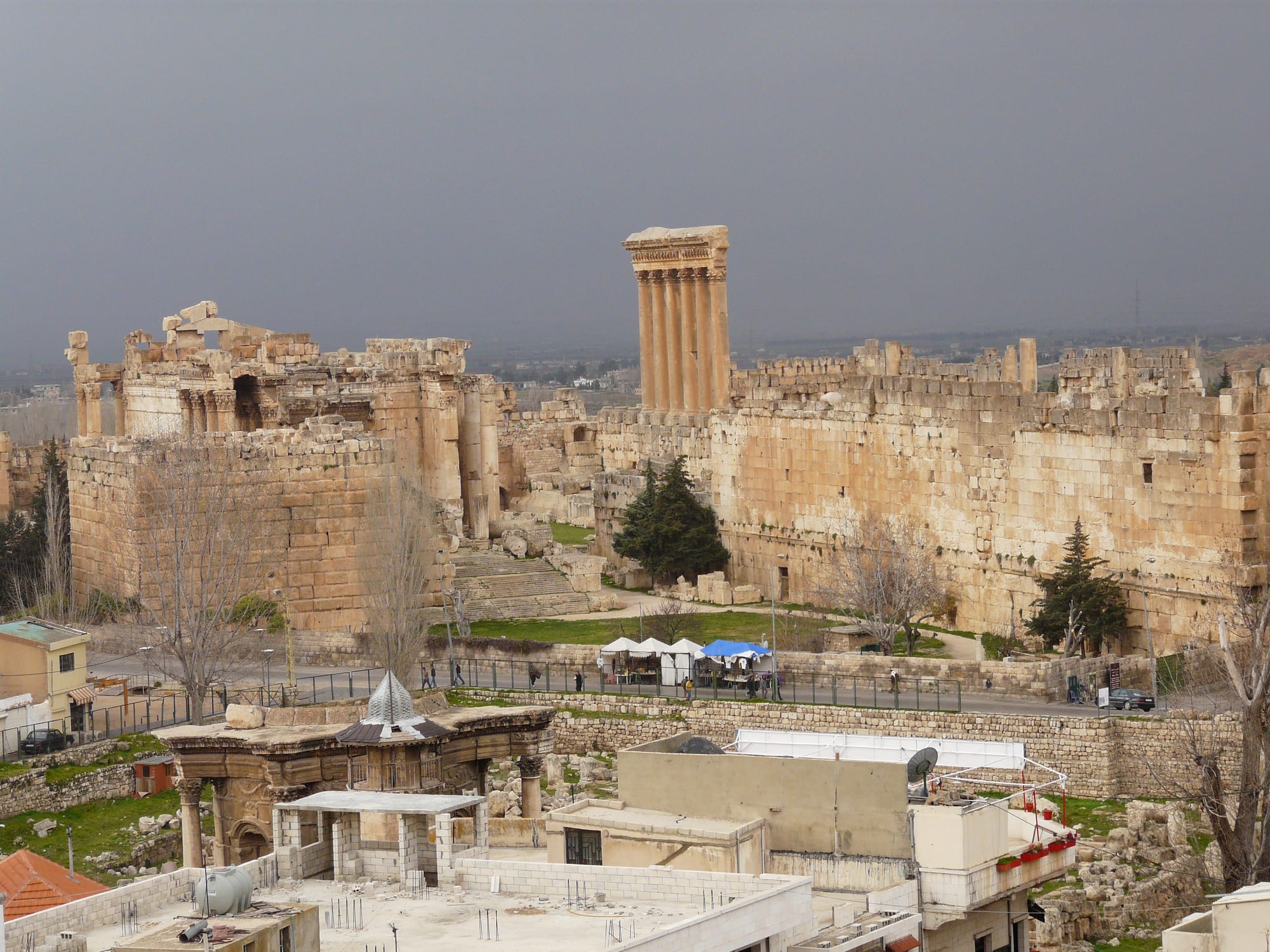
The massive stone walls of the Baalbek sanctuary with six tall Corinthian columns standing above them, modern houses in the foreground

Lebanon

Baalbek

The Roman sanctuary at Baalbek, with the surviving columns of the Temple of Jupiter, seen above the modern town. (Ywpark2003 / Wikimedia Commons · CC0)

A town in Lebanon's Bekaa Valley, between the Lebanon and Anti-Lebanon mountains, built beside one of the largest Roman sanctuaries ever constructed. Known to the Greeks and Romans as Heliopolis, it holds the temples of Jupiter and Bacchus and was inscribed by UNESCO in 1984. This page is written to explain the city, not to encourage travel.

Neighbourhoods

  • The sanctuary and the streets around it
    • First-time visitors
    • Historic district

    The centre of the town sits directly against the walls of the Roman sanctuary, with hotels, cafés and souvenir stalls on the streets below the acropolis. Almost everything a visitor comes for is within a few minutes' walk of the entrance.

    Open in Maps
  • The old quarter and the quarries
    • Historic district
    • Quiet and residential

    South-west of the temples, older stone houses and lanes run towards the Roman quarry where the largest cut blocks still lie in the ground. The area is residential and unhurried, with mosques, small shops and gardens.

    Open in Maps
  • The modern town
    • Local life
    • Close to public transport

    Spreading east and north along the road through the Bekaa, this is where the markets, garages, schools and minibus stands are. It is an ordinary working valley town rather than a tourist one.

    Open in Maps
  • The valley edge
    • Quiet and residential
    • Views

    Beyond the built-up area the Bekaa opens into orchards, vineyards and irrigated fields, with the snow-capped Anti-Lebanon range along the horizon towards the Syrian border.

    Open in Maps

Things to do

The Roman sanctuary

  • Temple of Jupiterlandmark

    The largest temple of the Roman world after the Temple of Venus and Roma in Rome, of which six colossal Corinthian columns still stand on a vast raised podium.

    Open in Maps
  • Temple of Bacchuslandmark

    A second-century temple, among the best preserved anywhere in the Roman world, its walls, colonnade and richly carved doorway largely intact.

    Open in Maps
  • Temple of Venuslandmark

    A small circular temple with a scalloped entablature outside the main enclosure, later used as a church.

    Open in Maps
  • The trilithon and the Stone of the Pregnant Womanlandmark

    Three limestone blocks of about 800 tonnes each set in the sanctuary's western wall, with even larger cut blocks still lying in the quarry nearby.

    Open in Maps
  • Great Court and Hexagonal Courtattraction

    The monumental approach to the sanctuary — propylaea, a six-sided forecourt and a great altar court — through which the temples were entered.

    Open in Maps

The town

  • Qubbat Durislandmark

    A small domed shrine built in 1243, in the Ayyubid period, in the village of Duris on the edge of the town, one of several surviving Islamic monuments.

    Open in Maps

Short trips from the town

  • Hermelattraction

    A town at the northern end of the Bekaa, on the Orontes river and near the ancient pyramid-shaped monument known as Kamouh el Hermel.

    Open in Maps
  • Anjarattraction

    An eighth-century Umayyad walled city in the southern Bekaa, laid out on a Roman grid, inscribed by UNESCO in 1984.

    Open in Maps
  • Zahléattraction

    The main town of the Bekaa, about 35 kilometres south-west, known for its riverside restaurants and as a centre of the valley's wine trade.

    Open in Maps
  • Ksaraattraction

    A winery founded in 1857 by Jesuit priests near Zahlé, with Roman-era caves used as cellars.

    Open in Maps

Seasonal events

  • Baalbeck International Festivalsummer

    A festival of music and theatre staged among the temples in July and August since the mid-1950s, and a fixture of Lebanese cultural life.

  • Ashurashifting with the lunar calendar

    Commemorations by the town's Shia majority, with processions, black banners and public gatherings.

  • Harvest in the Bekaalate summer and autumn

    Grapes, apples, cherries and vegetables come in from the valley's farms, and roadside stalls sell the surplus.

Eat and drink

Long-standing places and food districts in Baalbek. Hours, ratings and directions come from your maps app, always current.

Baalbek classics

  • Sfiha Baalbakiehrestaurant

    The town's best-known dish, small open pies of minced lamb with tomato and pine nuts baked on thin dough, sold by bakeries and eaten by the dozen.

    Open in Maps
  • Bekaa mezze and grillsrestaurant

    Hummus, tabbouleh, fattoush, raw kibbeh and grilled lamb, with the valley's vegetables and dairy, are the standard meal in the Bekaa.

    Open in Maps

Markets and bakeries

  • The town marketmarket

    Stalls and shops selling the valley's produce, dried fruit, nuts, pulses and mouneh preserves put up for winter.

    Open in Maps
  • Village bakeriescafe

    Ovens turning out manakish with za'atar or cheese and flatbread through the morning, the ordinary Lebanese breakfast.

    Open in Maps

Experience Baalbek

History

The mound at Baalbek was settled from the Bronze Age, and the name joins Baal, the Semitic storm god, to the region — a sanctuary long before Rome arrived. The Greeks called the place Heliopolis, city of the sun, after the conquests of Alexander, and under Roman rule, from the time of Augustus onwards, it became the site of one of the greatest building projects of the empire. Work continued for more than two centuries, producing the Temple of Jupiter Heliopolitanus on a platform of colossal stone, the Temple of Bacchus, the round Temple of Venus and the courts that led to them.

The engineering is what still draws attention. Three blocks in the western retaining wall, the trilithon, weigh in the region of 800 tonnes each, and in the quarry a short distance away lie larger blocks that were cut but never moved, including the one known as the Stone of the Pregnant Woman. How they were shifted and placed remains a matter of study, and has attracted a long fringe of speculation.

Christianity, then Islam, remade the site: a basilica was built in the great court under Theodosius, and the Umayyads raised a mosque from Roman columns. The sanctuary was fortified as a citadel in the medieval centuries, damaged repeatedly by earthquakes, and excavated by German and later French and Lebanese archaeologists from 1898. UNESCO inscribed it in 1984. The modern town became a stronghold of Hezbollah after the party's founding in the 1980s, and the Bekaa has been struck repeatedly in the fighting since 2024.

Culture & Customs

Baalbek is a Shia Muslim town with a Sunni and Christian minority, and its public life reflects that: Ashura is marked with processions and gatherings, mosques and husseiniyas anchor the neighbourhoods, and religious and political banners are part of the streetscape. It is also a tribal place, where large extended families from the surrounding villages carry weight in local affairs.

Against this stands the Baalbeck International Festival, held among the temples since the mid-1950s, which has put Lebanese and international performers on a stage between the columns and made the ruins a symbol of the country as a whole. The Temple of Bacchus has appeared on Lebanese banknotes and stamps, and school trips from across the country have come here for generations.

Manners are those of the Lebanese interior: emphatic hospitality, coffee or tea offered at once and difficult to decline, formal greetings, and a slower, more conservative register than Beirut. Visitors are still a novelty in a town whose tourism has come and gone with the security situation, and are usually met with curiosity and courtesy. Agriculture, the seasons and the state of the roads are the ordinary subjects of conversation; politics is not one for outsiders to open.

Daily Life

Baalbek has roughly 80,000 residents and serves a wide district of farming villages that use its markets, schools and hospital. Most people live in concrete-built quarters spreading out from the old centre, and the ruins sit directly against the houses rather than apart from them.

The valley economy is agricultural — potatoes, wheat, vegetables, vineyards and orchards on irrigated land, with dairy and sheep from the drier ground towards the Anti-Lebanon. Tourism, once a significant employer, has been intermittent for decades. The region has long been among the poorest in Lebanon, with weak state presence and high emigration, and the collapse of the currency after 2019 cut incomes further; the state supplies only a few hours of electricity a day, so private generators fill the gap where households can afford them.

The rhythm is agricultural and early: markets in the morning, a long midday pause in summer heat, and evenings in family houses. Winters are cold at this altitude and life moves indoors. Since 2024 strikes on the Bekaa have displaced families from the town and its villages, and the war has shaped every plan made here.

Food

Baalbek's own dish is sfiha baalbakieh, small open-topped pies of finely chopped lamb mixed with tomato, onion, pine nuts and pomegranate molasses, spread thin on rounds of dough and baked quickly; they are ordered by the tray and eaten hot, and bakeries in the town are known for them across Lebanon. Lahm bi ajin, a similar meat flatbread, is the everyday version.

Otherwise the table is that of the Bekaa, the country's larder. Mezze begins with hummus, moutabbal, tabbouleh, fattoush and labneh, and the valley's kibbeh nayyeh — raw lamb pounded with bulgur and spices — has a particular reputation. Grilled lamb and shish taouk follow, with the region's vegetables and its dairy: shanklish rolled in za'atar, ambaris salted in clay jars, and thick yoghurt.

Mouneh, the preserving that fills a house for winter, matters here more than on the coast: kishk of dried yoghurt and bulgur ground to powder, pickled turnips and cucumbers, dried figs and apricots, grape molasses, and olive oil pressed in the autumn. The Bekaa is also Lebanon's vineyard, supplying wineries near Zahlé and Kefraya and the arak stills of the villages, while in the town itself tea and cardamom coffee are what is drunk.

Planning tools

Budget

Baalbek is inexpensive by Lebanese standards — a valley town with simple hotels and guesthouses, cheap local food and a modest entrance fee for the site. The main cost for most visitors is the car and driver used to reach it. Since the currency's collapse the economy has effectively dollarised, and US dollars in cash are what is wanted.

Daily Budget Midrange
USD 100–200 (Beirut hotel, restaurants, a hired car and driver)
Daily Budget Shoestring
USD 40–70 (guesthouse, local food, shared 'service' taxis)

Bring US dollars in small denominations; cards are rarely useful here and ATMs are unreliable.

Best Time to Visit

In calmer periods spring, from April to June, and autumn, from September to November, suit the valley best, when the fields are green or the harvest is in and the light on the temples is low. The Bekaa is hot and dusty in high summer and cold with snow on the flanking ranges in winter. The war that resumed in March 2026 overrides any seasonal calculation.

Suggested Number of Days

The sanctuary itself takes two or three hours, and most visits to the town are day trips. Two days allows the wider Bekaa, its wineries and its other ancient sites, though conditions in the valley govern whether any of that is possible.

First Visit
half a day
With Surroundings
2 days

Transportation

There is no rail. Minibuses and shared 'service' taxis run between Baalbek, Zahlé, Beirut and other Bekaa towns, and local taxis work within the town, but the usual arrangement for visitors is a hired car with a driver from Beirut. The site and the town centre are covered on foot.

A driver who knows the current checkpoints and which roads are in use is essential in the Bekaa; agree the route and the waiting time in advance.

Airport & Station Connections

Baalbek lies about 70 kilometres north-east of Beirut, reached over the Mount Lebanon range through the Dahr El Baidar pass and then north up the Bekaa, usually two hours or more by road. Beirut–Rafic Hariri International Airport is the only civilian airport and the sole practical way into the country. Israeli strikes destroyed the main bridges over the Litani River, and air travel across the region has been disrupted by the wider war.

Walkability

The sanctuary and the streets immediately around it are walked easily, and the ruins themselves take an hour or two on foot over uneven stone, steps and loose ground. The rest of the town is strung along roads with poor pavements and fast traffic, and the valley beyond needs a vehicle.

Safety

Baalbek and the Bekaa Valley carried 'do not travel' warnings from most governments well before the current war, because of unrest, weapons, the nearness of the Syrian border and the risk of kidnapping. Fighting between Israel and Hezbollah resumed on 2 March 2026, after Israel and the United States began their war with Iran, and Israel carried out airstrikes across much of Lebanon; the Bekaa, including the area around Baalbek, has been struck repeatedly during the conflict. On 16 March 2026 Israel began a ground invasion and has occupied part of southern Lebanon since. A US-brokered ceasefire agreed on 16 April 2026 has been extended repeatedly, but strikes, drone attacks and ground fighting in the south have continued through the year. Most governments advise against all or all-but-essential travel to Lebanon, and against any travel to the Bekaa.

Globeway covers Lebanon so it can be understood — its ancient cities, its cuisine, its resilience — not to encourage travel now. Anyone considering a visit must read the current advisories in full and stay far from the south, the Bekaa, and the border. Check current official travel advice before travelling.

Climate

The Bekaa is a high valley between two mountain ranges, which keep much of the coast's rain off it, so the climate is drier and more continental than Beirut's: hot days and cool nights in summer, cold winters with frost and occasional snow, and rain concentrated between November and March.

Summer
hot and dry by day, about 30–34°C, with cool nights
Winter
cold, about 4–11°C by day, with frost, rain and occasional snow, and heavy snow on the ranges either side

Local Customs

Baalbek is a conservative, mainly Shia Muslim town, and dress should be modest for both men and women — covered shoulders and knees, and a headscarf carried for mosques and shrines. Alcohol is far less visible than on the coast. Hospitality is pressed on visitors and tea or coffee is hard to refuse. Political banners and portraits are a normal part of the street; they are not a subject for comment or photography.

Ask before photographing people, and do not photograph checkpoints, soldiers, armed men, political posters or damaged buildings; leave politics to locals to raise.

Common Payment Methods

The Lebanese pound is the nominal currency, but US dollars in cash are used for most transactions after its collapse in value. Cards are of little use in the town and ATMs are unreliable or empty, so money should be brought in cash in small denominations from Beirut.