Culture & Customs · Bolivia
Why do people live on floating islands in Lake Titicaca?
The Uru people began building movable islands of reed to stay safe from hostile neighbours; today tradition and tourism keep them afloat.
By Globeway Editorial · 13 October 2026
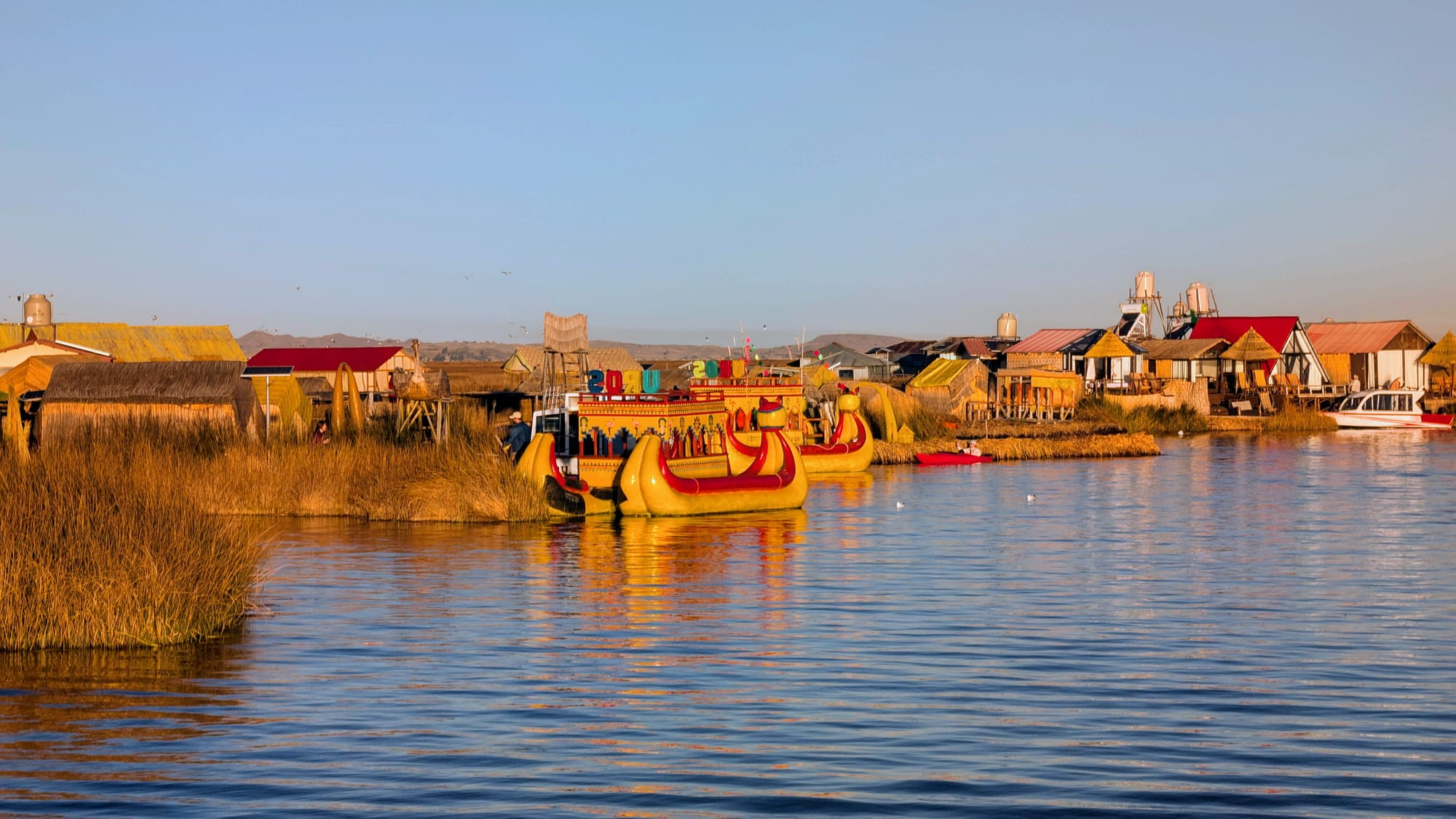
The short answer
The people who live on the floating islands of Lake Titicaca are the Uru, also called the Uros. According to their own tradition, their ancestors came to the lake long before the Spanish conquest, were pushed around by more powerful neighbours and could not win land of their own. So they made land. They built islands from bundles of totora, a thick, buoyant reed that grows in the shallows, and because the islands floated, they could be moved into deep water or to another part of the lake whenever danger came.
Defence was the original reason; habit, identity and money are the reasons now. The Uru regard themselves as people of the lake, and the islands remain the heart of that identity. For the families who still live on them, mostly on the Peruvian side of the lake near the city of Puno, the islands are also a living: visitors arriving by boat from Puno have become their main source of income, alongside fishing and hunting birds.
A people without land
The Uru are an Indigenous people of Peru and Bolivia, living in three main groups: the Uru-Chipaya, Uru-Murato and Uru-Iruito. Legend says they came from the Amazon, and that once on the Altiplano, the high plateau around the lake, they were oppressed by the people already there. They called themselves Lupihaques, "sons of the Sun", and considered themselves the owners of the lake and its water. One old saying held that they had black blood, because they did not feel the cold.
Ownership of the lake did not protect them. When the Inca Empire conquered the region, the Uru had to pay taxes to it and were often enslaved. They traded and married with their Aymara neighbours on the shore and, around 500 years ago, gave up their own language for Aymara. The Uru language itself is now extinct or nearly so: in 2004 only two people still spoke it. Conflict with the Aymara over land began in 1722 and ended only in the 1970s, when the Aymara took permanent control of the lands the Uru had held.
Against that history, an island that could float away made sense. Many of the islands still have a watchtower.
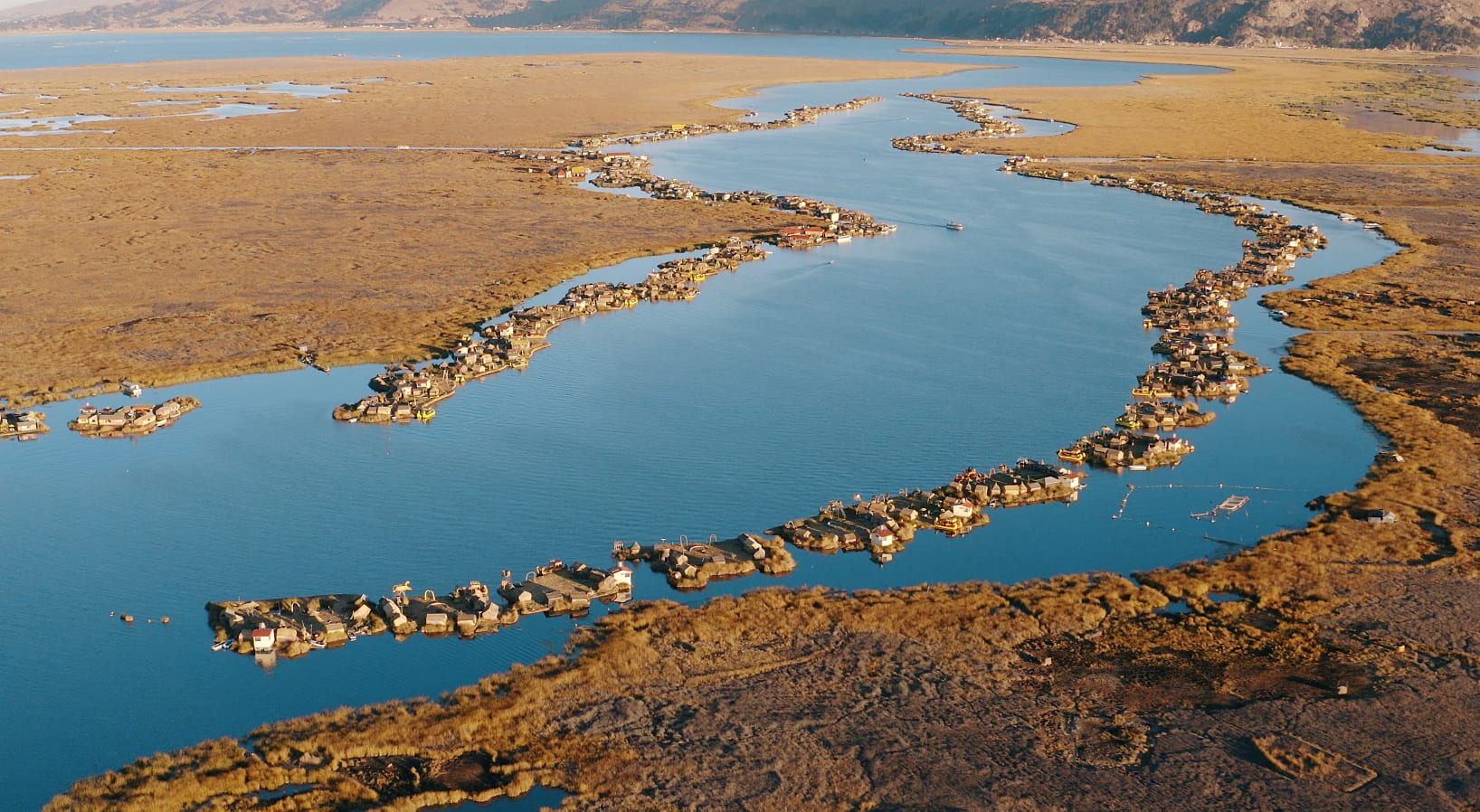
Most of the islands now cluster in the Bay of Puno, on the western side of Lake Titicaca.
How to build an island out of reeds
An island begins below the waterline. Totora plants grow a dense mat of interwoven roots, which the Uru call khili, between one and two metres thick and light enough to float. Islanders cut it into blocks of about 4 by 10 metres, once with eucalyptus wedges and now with metal saws 1.5 metres long made for the job. The blocks are tied together with rope and anchored to eucalyptus poles driven into the lake bed, so the island floats but does not drift.
On top go layer after layer of cut, dried reeds. The lowest layers rot quickly, so fresh reeds are added to the surface every two weeks to three months, more often in the rainy season. The houses, mostly reed as well, sit on an extra metre of dry reeds, which islanders say guards against rheumatism. Cooking is done on pottery stoves set on flat stones so that the island does not catch fire, and tiny separate islands nearby serve as outhouses.
Even with constant care, an island lasts about 25 years. After that, water seeps through the reeds, and the families build a new island and let the old one sink. The larger islands house about ten families; the smaller ones, only about 30 metres across, house two or three.
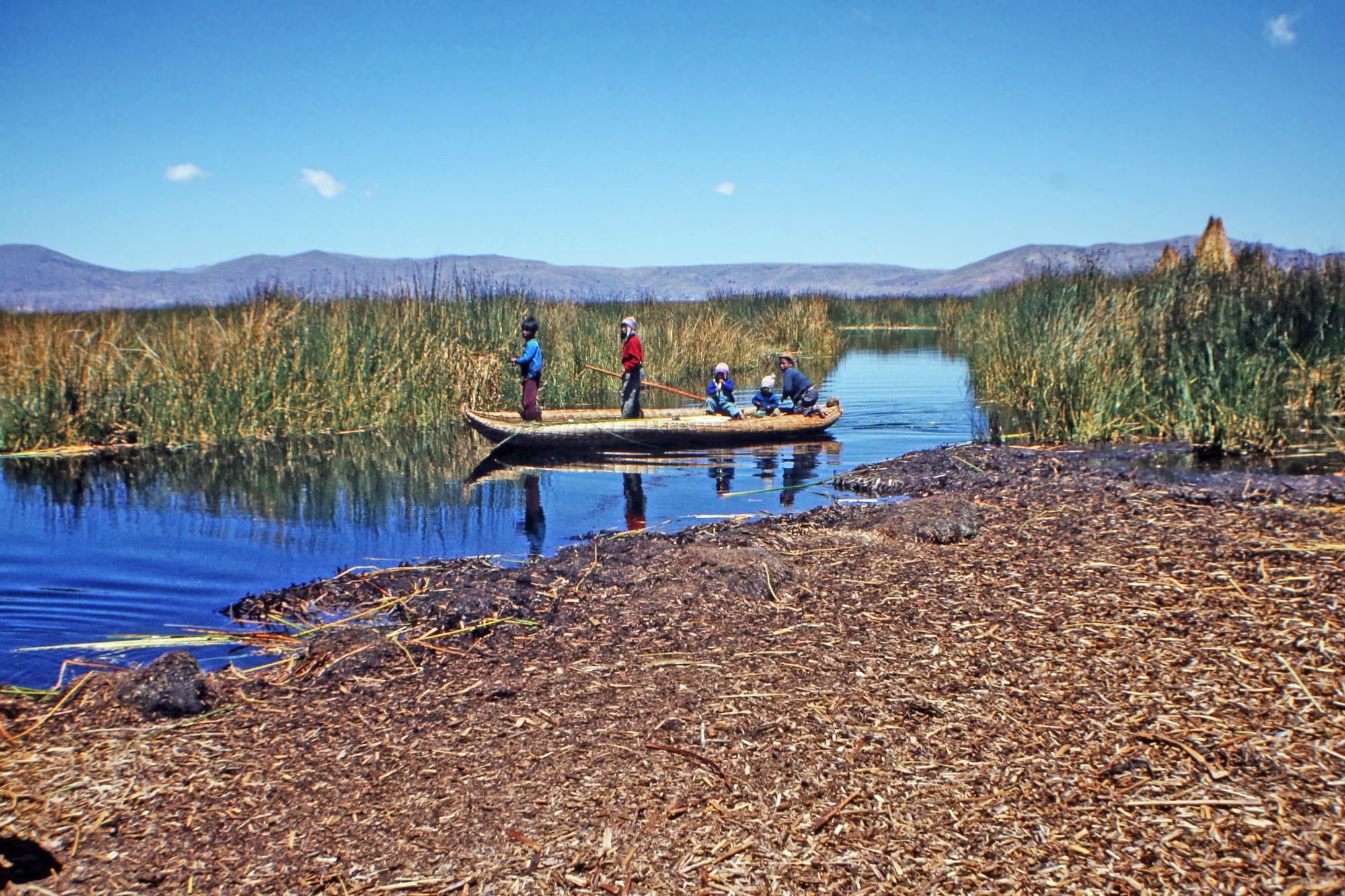
The same reed builds the ground, the houses and the boats, called balsas.
A plant that is also food and medicine
Totora is not only a building material. When a reed is pulled up, the white base, called chullo, is often eaten, and islanders value it as a source of iodine against goitre, a swelling of the thyroid gland. They wrap reeds around aching parts of the body, lay split reed on the forehead to cool down on hot days, use it against hangovers and brew a tea from its flowers. The reed plays the part in Uru life that the coca leaf plays for other Andean peoples.
The rest of the diet comes from the lake and the air. Islanders fish for native ispi and carachi as well as catfish, and for trout, introduced to the lake in 1940. They hunt gulls, ducks and flamingos, keep ibis for eggs and meat, and keep cats to deal with rats. What the lake cannot give, such as quinoa, they get by bartering reeds on the mainland in Puno.
Floating islands in the modern world
Island life has changed a great deal. Most islands once lay near the middle of the lake, about 14 kilometres from shore, but after a major storm wrecked them in 1986 many Uru rebuilt closer to Puno. Most boats now have motors, nearly all islands share solar panels for television and lights, and the main island has an Uru-run FM radio station. Young children go to school on the islands; older ones go to the mainland. Many islands have a shower building with a hot water boiler, and waste is collected in septic tanks taken ashore to be emptied.
Counts of the islanders vary widely. One estimate put about 1,200 Uru on an archipelago of 60 islands in 2011; others describe about 120 islands, but only a few hundred people actually living on them, with most of the roughly 2,000 people of Uru descent counted in 1997 having moved to the mainland. Even those who live on the water bury their dead ashore, in special cemeteries.
Tourism is now the main source of money. Visitors come by boat from Puno, the islanders sell crafts and carry guests in reed boats, and some islands offer simple lodging and meals. The idea has spread across the border: in March 2007 the Uru-Iruito, who live on the Bolivian side of the lake and along the Desaguadero River, began building four floating islands in Bolivian waters as part of a tourism plan run from La Paz, the first named Pachakamak.
Seeing the islands today
The best-known islands lie in the Bay of Puno, at about 3,810 metres above sea level, within Peru's Titicaca National Reserve. Lake Titicaca, the largest lake in South America, is often called the highest navigable lake in the world. The altitude means intense sun by day and, in the winter months, cold nights, while summer is the rainy season. Every step on an island is a step on a raft of reeds that its owners must keep renewing by hand.