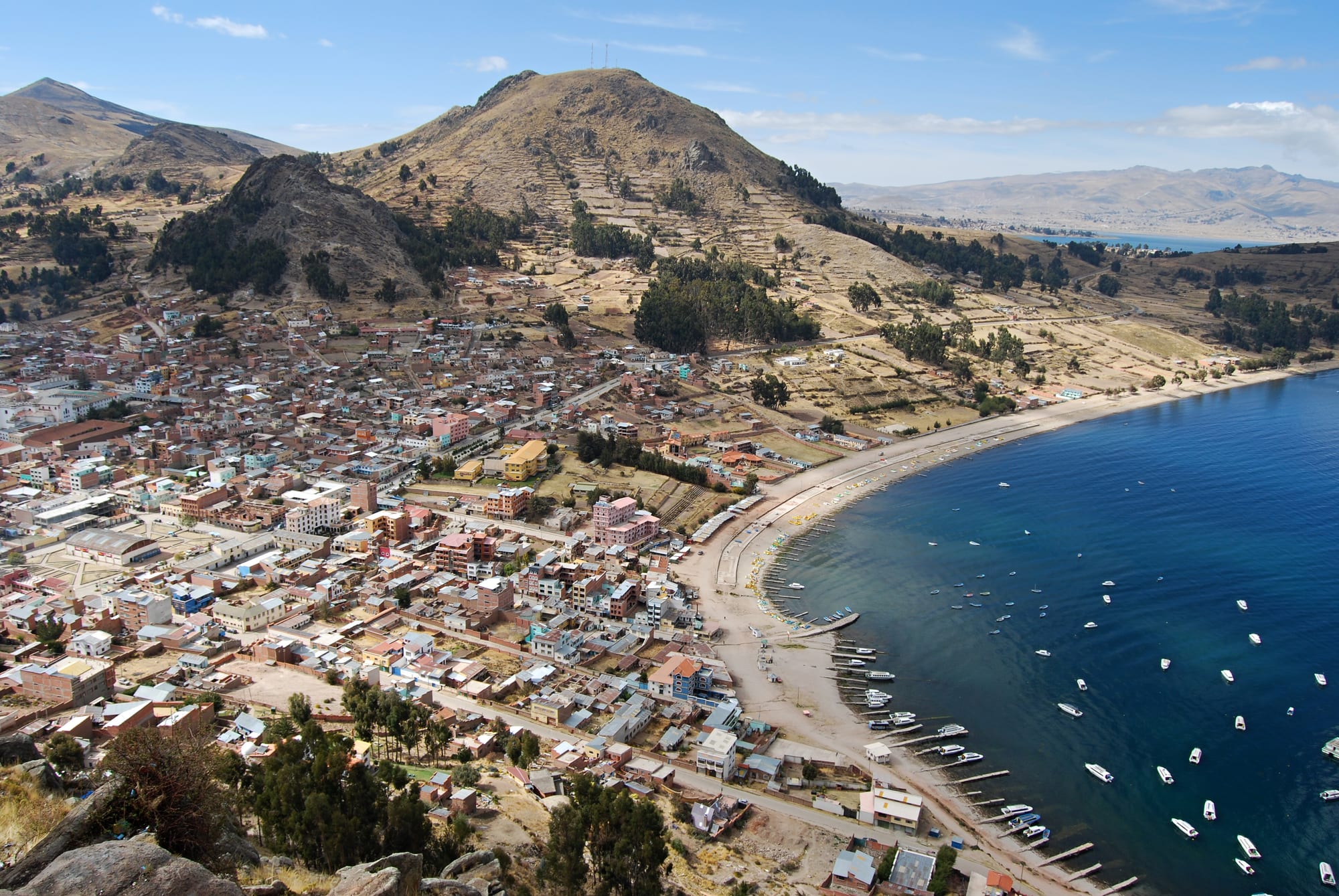
The town of Copacabana spread beside a curving beach and a blue bay of Lake Titicaca dotted with moored boats, below brown hills

La Paz, Uyuni & the Altiplano, Bolivia

Copacabana

Copacabana and its bay on Lake Titicaca, seen from the summit of Cerro Calvario. (Pavel Špindler / Wikimedia Commons · CC BY 3.0)

The main Bolivian town on the shore of Lake Titicaca, set at about 3,800 metres between the hills of Calvario and Niño Calvario on a peninsula reaching towards Peru. An Inca outpost on the way to the sacred Isla del Sol, it grew into Bolivia's foremost pilgrimage town around a 17th-century shrine to the Virgin of Copacabana, and is now also the port for boats to the islands.

Neighbourhoods

  • The basilica and Avenida 6 de Agosto
    • First-time visitors
    • Historic district
    • Pilgrimage

    The upper town around Plaza 2 de Febrero and the white basilica, where pilgrims, candle sellers and souvenir stalls fill the square. Avenida 6 de Agosto runs from here down to the lake, lined with restaurants, cafés, agencies and small hotels; the street a block north has a more local feel, with street markets and grocery shops.

    Open in Maps
  • The lakefront
    • Views
    • Best for food
    • Boats to the islands

    The long beach and promenade along the bay, where the boats for Isla del Sol leave from the jetties and a row of stalls grills lake trout. Hotels and restaurants with lake views line the shore, and the north end leads to the path up Cerro Calvario.

    Open in Maps
  • Isla del Sol villages
    • Quiet
    • Walking
    • Inca ruins

    Yumani and Challapampa, the largest villages on the roadless island a boat ride away, have simple guesthouses for those who want to stay overnight among the terraces and ruins, with no cars and long views over the lake.

    Open in Maps

Things to do

Famous landmarks

  • Basilica of Our Lady of Copacabanalandmark

    The white, Moorish-style 17th-century shrine of the Virgin of Copacabana, patroness of Bolivia, whose statue was made in the 1580s by the Indigenous sculptor Francisco Tito Yupanqui; it was raised to a minor basilica in 1940.

    Open in Maps
  • Cerro Calvarioviewpoint

    The hill over the north end of the beach, climbed in about half an hour by a path lined with the Stations of the Cross; pilgrims make offerings at the top, and the view takes in the town, the bay and the lake.

    Open in Maps
  • Pachat'aqaattraction

    A pre-Inca astronomical observatory of two parallel stone blocks on Mount Kesanani, about 600 metres south of town, known to the Spanish as the 'Inca Gallows'.

    Open in Maps

Lake Titicaca and the islands

  • Copacabana beachbeach

    The town's lakefront, too cold for most swimmers but busy with boats, trout stalls and people watching the sunset over the lake.

    Open in Maps
  • Isla del Solattraction

    The rocky, roadless island where Inca religion placed the birth of the sun god, reached by boat from Copacabana, with more than 80 ruins, mostly Inca, terraced hillsides and footpaths between its villages.

    Open in Maps
  • Isla de la Lunaattraction

    A smaller island east of Isla del Sol where Inca legend placed the rising of the moon, with ruins of an Inca temple of chosen women and, from the 1930s, a prison for political detainees.

    Open in Maps

Seasonal events

  • Feast of the Virgin of Candelaria2 February

    The Virgin's main feast day in the Church calendar, celebrated with Masses, processions and Indigenous dances that the clergy were never able to suppress entirely.

  • August festival of the VirginEarly August

    The second great feast, around 5–6 August, which brings thousands of pilgrims from Bolivia and southern Peru, with dance troupes, brass bands and processions.

  • Holy WeekMarch or April

    Easter brings large crowds to Cerro Calvario, as pilgrims climb the Stations of the Cross to the summit.

Eat and drink

Long-standing places and food districts in Copacabana. Hours, ratings and directions come from your maps app, always current.

Copacabana classics

  • Trout stalls on the beachrestaurant

    A long row of near-identical stalls on the lakefront serving trucha — Lake Titicaca trout — fried or grilled, with rice, potatoes and salad.

    Open in Maps
  • Restaurants on Avenida 6 de Agostoneighborhood

    The main street down to the lake, where restaurants and cafés serve trout in many versions alongside pizza, soups and dishes for travellers.

    Open in Maps

Food districts and markets

  • Central marketmarket

    The town market, with set lunches, juice and soup stalls, and trout with rice and potatoes from stands nearby in the evening.

    Open in Maps

Experience Copacabana

History

Long before the Spanish, the Copacabana peninsula was a sacred landscape. The Aymara had venerated the islands of the lake from time immemorial, and when the Incas absorbed the region they adopted the shrine and oracle on Isla del Sol, where their religion placed the birth of the sun, and held Copacabana as the key to it, with minor shrines where Inca ceremonies were observed alongside local ones. The stone observatory on the hill of Kesanani, older than the Incas, is a reminder of how long the site has been watched over.

After the Spanish arrived in the 1530s, Dominican friars made Copacabana the centre of their missions around the lake, and in 1589 the shrine was entrusted to the Augustinians. A few years earlier Francisco Tito Yupanqui, an Indigenous sculptor descended from the Inca nobility, had made an image of the Virgin after many failed attempts; it was installed in Copacabana, miracles were attributed to it, and the town became a great pilgrimage centre. The present basilica was built in the 17th century, and the Virgin's fame spread so far that her name was carried to a chapel on a beach in Rio de Janeiro.

During the great Indigenous uprising of 1781 the church was desecrated, though the Virgin's chapel was left untouched, and in 1826 President Antonio José de Sucre expropriated the shrine's jewels and colonial treasures to make Bolivia's first coins. In 1925 the image was crowned by papal decree, in 1940 the shrine became a minor basilica, and the Virgin of Copacabana remains the patroness of Bolivia.

Culture & Customs

Copacabana's life turns on the Virgin. Pilgrims come from across Bolivia and southern Peru to pray before her image in its chapel, light candles and climb Cerro Calvario, where offerings and ch'allas, ritual libations, accompany their requests at the summit. Catholic devotion and Aymara practice sit side by side here as naturally as anywhere in the Andes, and the town is known throughout Bolivia for its religious celebrations, festivals and traditional heritage.

The great feasts are on 2 February, the Candlemas feast of the Virgin of Candelaria, and in early August, when dance troupes, brass bands and thousands of pilgrims fill the square in front of the basilica. Indigenous dances accompany these feasts, and the clergy have never been able to suppress them entirely. Holy Week brings large crowds to Calvario. The Alasitas tradition of miniature offerings, seen at its largest in La Paz, is also part of the Virgin's feast here.

Most people on the peninsula and the islands are Aymara, and Aymara is widely spoken alongside Spanish. On Isla del Sol, where about 800 families live, farming on ancient terraces, fishing and tourism shape island life. Courtesy, a greeting and respect for sacred places are expected everywhere.

Daily Life

About 6,000 people live in the town itself, and the municipality of Copacabana, which reaches south to the Peruvian border and includes Isla del Sol, had about 17,500 at the 2024 census. The town lies between the hills of Calvario and Niño Calvario, on the western end of a peninsula that is cut off from the rest of Bolivia by the Strait of Tiquina and joined by land only to Peru.

Pilgrimage and tourism are the main businesses: hotels, restaurants, boat owners, candle and souvenir sellers and the transport between La Paz and the Peruvian border at Kasani, one of the main entry points into Bolivia for foreign visitors. Around the town, families farm potatoes and other highland crops on terraces and fish the lake, and trout is both a local food and a source of income. Boat owners and barge crews at Tiquina depend on the crossing and have opposed proposals for a bridge, which other residents of the peninsula have long called for.

Days are quiet once the morning boats have left for the islands and the buses for La Paz or Puno have gone, and busier again at sunset, when people gather along the beach. The rhythm changes completely at festival time and at weekends, when pilgrims arrive by the busload. The national shortages of fuel and dollars and blockades on the road to La Paz are felt here too, as the town depends on visitors and supplies arriving by road and ferry.

Food

Trout is Copacabana's speciality, so dominant that practically every restaurant serves it. Trucha — the rainbow trout raised and fished in Lake Titicaca — comes fried or grilled, usually with rice, potatoes and salad, and a long row of stalls on the beach cooks little else. Ispi, a small native fish of the lake, is the older local catch.

Beyond the lake, the cooking is that of the Altiplano. Potatoes in many forms, including chuño, the freeze-dried potato of the high plateau, go into soups and side dishes, quinoa is common, and set lunches of soup and a main course are the everyday meal in the market and small restaurants. On cold mornings, api, the thick purple-corn drink, is drunk with fried buñuelos.

Avenida 6 de Agosto has adapted to travellers, with cafés and pizza places alongside the trout houses, and evening stands near the market serve trout with rice and potatoes to locals and visitors alike. Coca tea is offered everywhere for the altitude, Paceña beer is the usual drink, and on feast days the ch'alla — a ritual offering of drink to Pachamama — accompanies the celebrations.

Planning tools

Budget

Copacabana is one of the cheaper stops in Bolivia: hostels and simple lakeside hotels, trout lunches and short boat rides all cost little. Prices rise during the February and August festivals and at Easter, when rooms fill with pilgrims. A night on Isla del Sol adds island entrance fees, boat tickets and slightly higher prices for anything carried up the hill.

Daily Budget Midrange
USD 60–120 (lakeview hotel, restaurant meals, a private boat or guided island trip)
Daily Budget Shoestring
USD 25–45 (hostel bed, trout and market meals, buses and public boats)

Carry small boliviano notes for island entrance fees and the Tiquina crossing, and some extra cash in case blockades delay the road back to La Paz.

Best Time to Visit

May to October is dry and sunny, with clear views across the lake, though nights are near or below freezing from June to August. The wet season, roughly November to March, brings afternoon storms. The town is at its most crowded and colourful for the Virgin's feasts in February and August and at Easter.

Suggested Number of Days

One or two days covers the town and its hills. Allow two to four days to add the islands of the lake, especially with a night spent on one. Festival dates, the boat schedules and the border crossing to Peru change the number.

First Visit
1–2 days
With Surroundings
2–4 days

Transportation

The town is small and easy to walk. Boats to Isla del Sol and Isla de la Luna leave from the beach jetties, either as scheduled public boats or as private and tour boats; the crossing takes a couple of hours or less, depending on the boat. Shared vans leave for the Peruvian border from Plaza Sucre when full, and pedicabs can be hired at Plaza 2 de Febrero to carry luggage to hotels.

Confirm the return boat time from the islands before leaving, and allow for rougher water and cold winds in the afternoon.

Airport & Station Connections

Buses from La Paz take three to four hours, crossing the Strait of Tiquina by boat while the bus goes over on a barge. From Peru, buses from Puno take about three and a half hours, including the border crossing at Kasani, about 7.5 kilometres south of town. El Alto International Airport, serving La Paz, is the nearest airport with regular flights.

Walkability

Everything in town is within walking distance, from the basilica down Avenida 6 de Agosto to the beach in a few minutes, but the streets slope and the altitude makes uphill walks hard work. Cerro Calvario is a steep half-hour climb. On Isla del Sol there are no motor vehicles or paved roads, and all travel is on foot along stony paths and steps.

Safety

Violent crime against tourists is relatively low, but manage the risks: fake-taxi and fake-police scams and express robberies occur in La Paz, Cochabamba, and on the Uyuni and Copacabana routes, and petty theft is common on overnight buses and in markets. Copacabana itself is calm, but the altitude, the strong sun on the lake and the cold water are real hazards, and roadblocks can close the road to La Paz.

Use sun protection on the lake, walk Cerro Calvario and the island paths in daylight, and keep valuables close on buses and at the border. Check current official travel advice before travelling.

Climate

A cold subtropical highland climate moderated by the lake: days hover around 15°C all year, with little variation between seasons, while nights are cold and often below freezing in the dry season. The sun at this altitude burns quickly.

Summer
wet season, December to February at its peak: days around 15°C, cloudier, with afternoon rain
Winter
dry season, June to August: sunny days around 15°C and nights near or below freezing

Local Customs

Copacabana is first of all a sacred place for Catholic and Aymara pilgrims, and the basilica, the Virgin's chapel and the summit of Cerro Calvario are places of prayer and offering. Aymara is widely spoken around the lake alongside Spanish. A greeting before a question is expected, and island communities may charge visitors small fees to walk their paths.

Dress modestly and keep quiet in the basilica, do not photograph worshippers or offerings without asking, and pay island fees where they are asked.

Common Payment Methods

The currency is the boliviano (Bs). A shortage of US dollars since about 2023 and the end of the boliviano's peg in June 2026 have made exchange rates and cards unpredictable. There are money changers dealing in US dollars and Peruvian soles and a few ATMs, but they cannot be relied on; bring US dollars in good condition and small boliviano notes, especially for the islands.