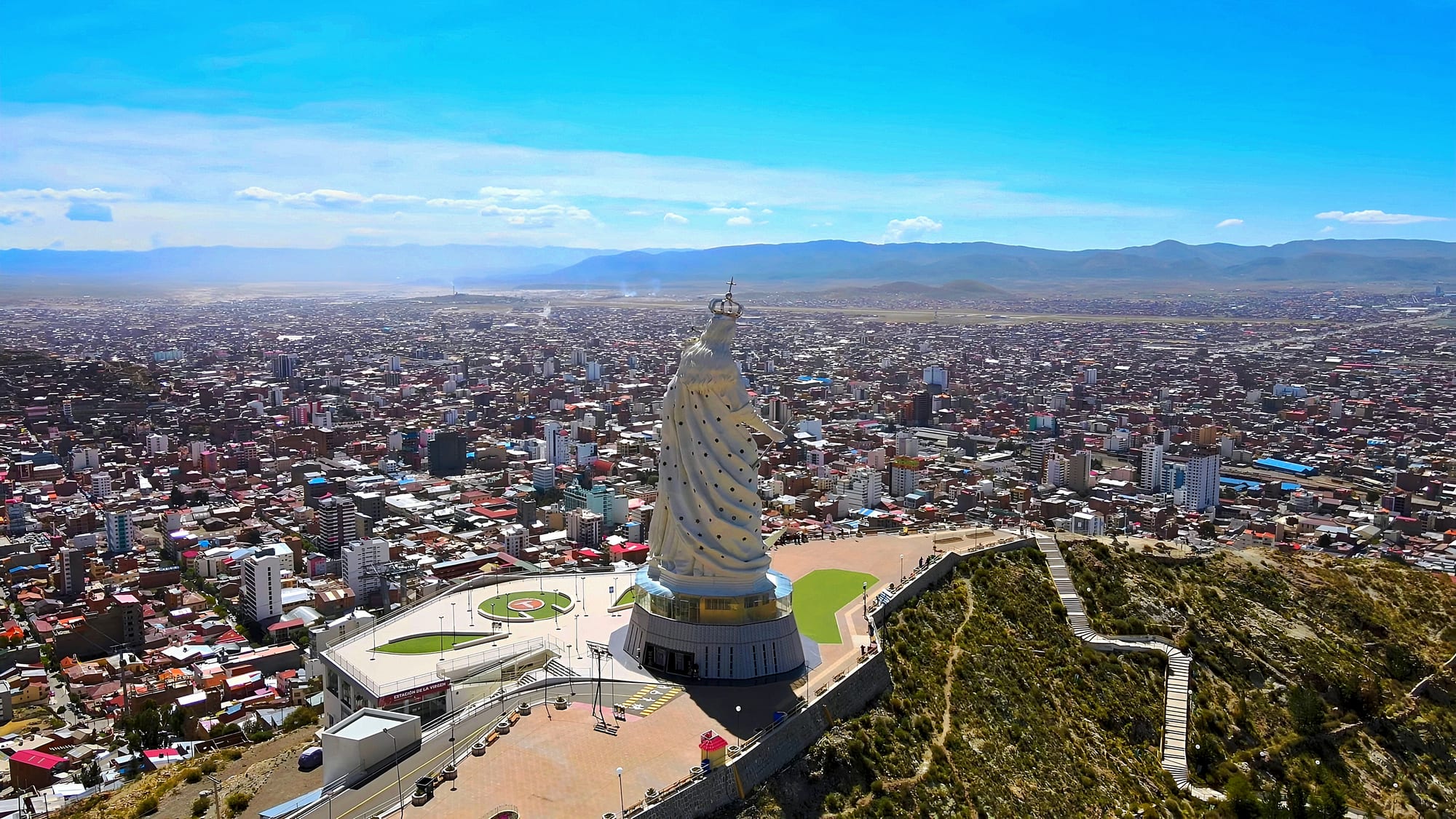
Aerial view of the white Virgen del Socavón statue on its hilltop plaza above the low buildings of Oruro

La Paz, Uyuni & the Altiplano, Bolivia

Oruro

The monument to the Virgen del Socavón on Santa Bárbara hill, with Oruro spread across the plain below. (Parallelepiped09 / Wikimedia Commons · CC BY-SA 4.0)

A mining city on the open Altiplano at about 3,700 metres, halfway between La Paz and Sucre. Founded on silver in 1606 and later enriched by tin, it is best known for its Carnival, a UNESCO-recognised festival of devil dancers and brass bands, and for the railway that runs south from here towards Uyuni and the Argentine border.

Neighbourhoods

  • City centre and Plaza 10 de Febrero
    • First-time visitors
    • Historic district

    The grid of streets around the main square, named after the rebellion of 10 February 1781. The cathedral, the Patiño family house now run as a museum, banks, cafés and most of the city's cheaper hotels are within a few blocks, and the railway station is a short walk away.

    Open in Maps
  • Socavón and Santa Bárbara hill
    • Religious sites
    • Views
    • Carnival

    The west side of the centre, where the sanctuary of the Virgen del Socavón faces the Plaza del Folklore at the end of the Carnival route. A cable car opened in 2018 climbs from the plaza to the giant statue of the Virgin on Santa Bárbara hill, with views over the whole city and the plain.

    Open in Maps
  • Avenida 6 de Agosto and the bus terminal
    • Close to public transport
    • Cheap eats

    A long north–south avenue with a railway track running down its middle, linking the main bus terminal in the north with the centre in the south. Cheap eateries cluster around the terminal, and watching a train roll down the middle of the road is a local spectacle.

    Open in Maps
  • The south side
    • Quiet and residential
    • Museums

    Residential districts stretching towards the shallow waters of Lake Uru Uru, with a museum of ethnography and folklore near the zoo. Walks up the hills around the town give views over the city.

    Open in Maps

Things to do

Famous landmarks

  • Sanctuary of the Virgen del Socavónlandmark

    The minor basilica of the Virgin of the Mine Tunnel, whose image of the Virgin of Candelaria appeared, by tradition, in a hollow of the Pie de Gallo hill in 1789; it is the goal of the Carnival processions.

    Open in Maps
  • Monument to the Virgen del Socavónviewpoint

    A giant white statue of the Virgin of Candelaria on Santa Bárbara hill, reached by cable car from the Plaza del Folklore, with a viewing plaza over the city.

    Open in Maps
  • Plaza 10 de Febrerolandmark

    The main square, named after the 1781 rebellion against Spanish rule and the reference point of the city centre.

    Open in Maps
  • Faro de Conchupatalandmark

    The monument where the present Bolivian flag was first raised, on 7 November 1851.

    Open in Maps

Museums

  • Casa de la Cultura Simón I. Patiñomuseum

    The family home of the tin baron Simón Patiño, lived in until 1912 and now a historical museum.

    Open in Maps
  • Museo Etnográfico Mineromuseum

    A mining museum housed in a mine tunnel, showing how Bolivian miners have worked underground.

    Open in Maps
  • Museo Nacional Antropológico Eduardo López Rivasmuseum

    Tools and displays on the Uru and Chipaya peoples of the Altiplano, together with displays on the Carnival.

    Open in Maps
  • Museo Mineralógicomuseum

    A collection of precious stones, minerals and fossils.

    Open in Maps

Carnival crafts and sport

  • Calle La Paz embroiderersattraction

    The street where embroiderers make the elaborate costumes worn by the Carnival dancers.

    Open in Maps
  • Estadio Jesús Bermúdezattraction

    The city's football and athletics stadium, holding about 33,000 people at more than 3,700 metres, home ground of Club San José.

    Open in Maps

Short trips from the city

  • Uru Uru Lakepark

    A shallow lake on the city's southern edge, formed in 1962 where the Desaguadero River spreads out on its way to Lake Poopó.

    Open in Maps

Seasonal events

  • Carnival of OruroFebruary or early March, the days before Lent

    A UNESCO Masterpiece of the Oral and Intangible Heritage of Humanity since 2001, in which dozens of dance groups parade through the city to the sanctuary of the Virgen del Socavón, led by the Diablada.

Eat and drink

Long-standing places and food districts in Oruro. Hours, ratings and directions come from your maps app, always current.

Oruro classics

  • Charquekanrestaurant

    The dish the city claims as its own, an old recipe of the Uru people built on charque, dried meat.

    Open in Maps
  • Lamb dishesrestaurant

    Brazuelo, costillar, mecheado and tostadita de cordero — Altiplano lamb cooked several ways and served from midday with chuño, potato and salsa criolla.

    Open in Maps
  • Chicharrón de llamarestaurant

    Pieces of llama meat fried in oil, served with chuño or boiled quinoa, potatoes and llajwa chilli sauce.

    Open in Maps

Food districts

  • Around the bus terminalneighborhood

    Simple eateries around the main bus terminal serving set lunches, grilled meat and morning broths to travellers and traders.

    Open in Maps
  • City centreneighborhood

    Restaurants, bakeries and cafés in the streets around the main square, where the city's sit-down meat restaurants are concentrated.

    Open in Maps

Experience Oruro

History

Oruro takes its name from the Uru people, who lived on the plateau and around its lakes long before the Spanish arrived. Around 1605 a priest, Francisco Medrano, and other Spaniards found rich silver deposits in a hill in the Uru country, and on 1 November 1606 a judge of the Audiencia of Charcas founded the Real Villa de San Felipe de Austria at the mining settlement beside the Pie de Gallo hill. By 1678 a census counted almost 76,000 inhabitants, which made it the second-largest city in Upper Peru.

The town has a proud record of rebellion. On 10 February 1781 its people rose against Spanish authority, an uprising remembered in the name of the main square, and in October 1810 it rose again in support of the patriots of Cochabamba. In 1789, by tradition, an image of the Virgin of Candelaria appeared in a hollow of the Pie de Gallo hill — the origin of the cult of the Virgen del Socavón, the Virgin of the Mine Tunnel. In 1851 the present Bolivian flag was raised for the first time at the Faro de Conchupata.

After silver faded, tin brought a second boom. By the 1890s the railway from Antofagasta reached the city, carrying ore to the Pacific, and Simón Patiño, whose family lived in Oruro until 1912, became one of the richest men in the world. The city has followed metal prices up and down ever since. In March 2020 it became the first city in Bolivia to enter quarantine during the coronavirus pandemic.

Culture & Customs

The Carnival of Oruro defines the city. Originally an Indigenous festival, it was transformed into a Christian pilgrimage in honour of the Virgen del Socavón, patroness of miners, and in 2001 UNESCO proclaimed it a Masterpiece of the Oral and Intangible Heritage of Humanity. More than 48 groups of dancers performing 18 different dances parade for hours through the streets to the sanctuary: the Diablada, the Morenada, the Caporales, the Tinku, the Kullawada, the Llamerada and many more, accompanied by bands.

The Diablada is the emblem. Its dancers wear horned devil masks and embroidered costumes, led by the Archangel Michael, and some scholars trace it to the Uru llama llama dance and to the miners' devotion to El Tío, lord of the underground; the first organised Diablada group with set music and choreography appeared in 1904. The costumes are made by the embroiderers of Calle La Paz.

Beyond Carnival, Oruro is a working city with a strong miners' identity, a mix of Quechua, Aymara and mestizo people, and long football traditions: Oruro Royal Club, founded in 1896, is considered the first football club in Bolivia, brought by workers on the Antofagasta railway. The Uru and Chipaya peoples of the department, whose culture is shown in the anthropological museum, are among the oldest communities of the Altiplano.

Daily Life

About 300,000 people lived in the municipality of Oruro at the 2024 census, making it Bolivia's fifth-largest city. It is the capital of Oruro Department and the seat of a Catholic diocese. Mining — tin, tungsten, silver and copper — has always set the city's fortunes, bringing cycles of boom and bust.

Trade has grown in importance. Oruro sits on the main highway between La Paz and the south and on the routes to the Chilean ports of Iquique and Arica, and goods move through it by road and by rail. The Technical University of Oruro, founded in 1892, brings thousands of students, and schools such as the Colegio Alemán, which marked its centenary in 2023, are part of the city's pride.

The days are shaped by the altitude and the cold. Mornings start early and chilly, with broths and hot drinks from stalls; afternoons can be sunny and still until the wind rises. Life slows at night. The national dollar and fuel shortages, rising prices and the blockades that cut the main roads in 2026 weigh heavily on a city that lives by transport and trade.

Food

Oruro's cooking is built on the meat of the high plateau — lamb and llama — together with potatoes, chuño and quinoa. The dish the city claims as its own is charquekan, an ancestral dish of the Uru people built on charque, dried meat. Another favourite is chicharrón de llama, pieces of llama meat fried and served with chuño or phisara, boiled quinoa, potatoes and llajwa, the fresh tomato and chilli sauce found on every Bolivian table.

Orureño lamb is said to owe its flavour to the plants of the department, and it appears in a series of dishes served from midday into the afternoon: brazuelo (shoulder), costillar (ribs), mecheado, tostadita and colita de cordero, all with chuño, potato and salsa criolla. Morning broths called mañaneros warm people up on cold days, among them kunturi, made with llama meat, and t'impu de cordero. Rostro asado, a whole sheep's head baked in the oven, is another local speciality.

Llama chorizo is sold in sandwiches or on a plate with mote, boiled maize. Hot api made from purple corn, coca tea and Paceña beer are the everyday drinks.

Planning tools

Budget

Oruro is one of the cheaper cities on the Altiplano, with inexpensive set lunches, market food and basic lodgings near the bus terminal and the railway station. The exception is Carnival, when rooms fill and grandstand seats along the parade route are sold at a premium. The national dollar shortage applies here too, so bring clean US dollar notes and do not rely on ATMs or cards.

Daily Budget Midrange
USD 55–100 (central hotel, restaurant meals, museum entries, taxis and the cable car)
Daily Budget Shoestring
USD 25–40 (basic hostel or residencial, set lunches, buses and micros)

For Carnival, arrange a room and a grandstand seat well in advance; many visitors come for the parade day only and return to La Paz overnight.

Best Time to Visit

Carnival, in February or early March, is the reason most people come, though it falls in the wet season. For the rest of the year the dry months from May to October bring clear skies and sunshine, with the coldest nights from May to early July.

Suggested Number of Days

One or two days covers the city itself, and many travellers simply break the journey between La Paz and Uyuni here. Carnival needs at least two or three days, and an extra day helps to adjust to the altitude for anyone arriving from the lowlands.

First Visit
1–2 days
With Surroundings
2–3 days

Transportation

The centre is compact and walkable. Micros and minibuses run along the main avenues, including Avenida 6 de Agosto to the bus terminal, and taxis are cheap. A cable car links the Plaza del Folklore with the monument on Santa Bárbara hill.

During Carnival many central streets are closed for the parade, so allow extra time to cross the city.

Airport & Station Connections

Buses from La Paz take about four hours, and there are also services to Cochabamba, Potosí and to Iquique and Arica in Chile. The railway station in the centre is the northern terminus of the line south to Uyuni and Villazón on the Argentine border, with a few departures a week. Juan Mendoza International Airport, on the eastern side of the city, has a handful of flights a day with Boliviana de Aviación.

Walkability

The historic centre, the railway station and the Socavón sanctuary are all within walking distance of each other on flat streets, though the altitude makes any effort tiring at first. The bus terminal is a short micro or taxi ride north, and the climb to the statue is easiest by cable car. Wind and cold make evening walks uncomfortable for much of the year.

Safety

Violent crime against tourists is relatively low, but manage the risks: fake-taxi and fake-police scams and express robberies occur in La Paz, Cochabamba, and on the Uyuni and Copacabana routes, and petty theft is common on overnight buses and in markets. In Oruro the crowds of Carnival are the main time for pickpocketing. At about 3,700 metres the altitude itself is a hazard, and the road protests and blockades that paralysed much of the country in May and June 2026 can cut the highways to La Paz and the south.

Keep valuables close in Carnival crowds, use registered taxis at night, rest on arrival and follow local news for blockades. Check current official travel advice before travelling.

Climate

A cold, dry highland climate. The sun is strong by day, but nights are cold all year, and from May to early July cold winds can bring temperatures well below freezing. Most rain falls in the summer months.

Summer
December to February: the wet season, with mild days of about 12–20°C, afternoon storms and cool nights
Winter
June to August: dry and sunny, with days around 10–17°C, nights well below 0°C and cold winds, especially from May to early July

Local Customs

Oruro is a devout city, and the Virgen del Socavón, patroness of miners, is honoured by miners and dancers alike. Visitors to the sanctuary should dress modestly and keep quiet during services. Quechua and Aymara are spoken alongside Spanish, and a greeting of buenos días goes a long way in shops and markets.

Ask before photographing people, especially dancers out of costume and market traders; tipping is not expected at simple eateries, and rounding up is enough in restaurants.

Common Payment Methods

The currency is the boliviano (Bs), which has floated against the US dollar since June 2026. Cash is king in Oruro: cards are accepted only in some hotels and restaurants, ATMs can be unreliable, and small notes are useful because change is scarce. Clean US dollar notes can be changed in the centre.