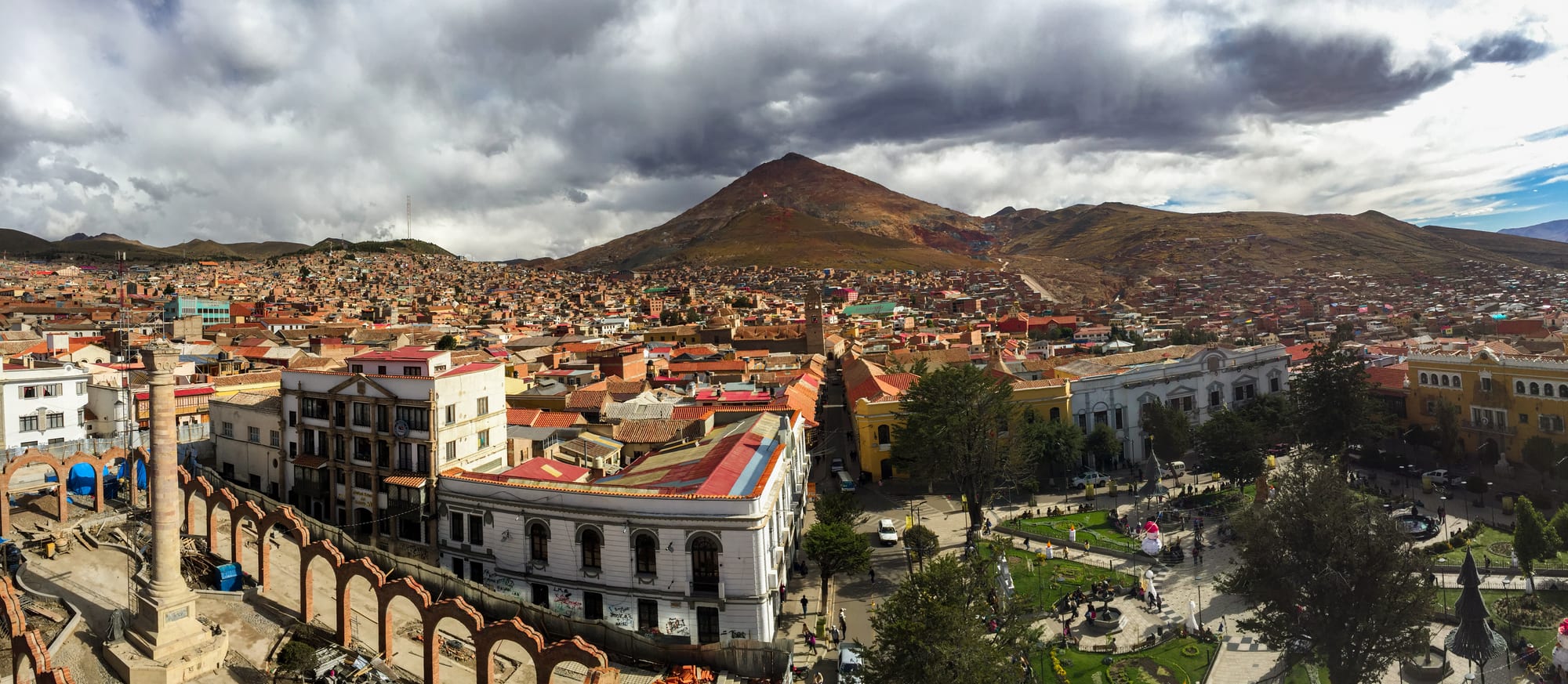
Panorama of Potosí's tiled roofs, white colonial buildings and a tree-filled square, with the red cone of Cerro Rico under heavy cloud

La Paz, Uyuni & the Altiplano, Bolivia

Potosí

Potosí's historic centre around Plaza 10 de Noviembre, with Cerro Rico rising behind the city. (EEJCC / Wikimedia Commons · CC BY-SA 4.0)

One of the highest cities in the world, at about 4,070 metres beneath the red cone of Cerro Rico, the mountain that was the Spanish Empire's major source of silver from 1545 until the 18th century. For a time one of the largest cities on earth, it keeps a colonial centre of churches, balconied streets and the royal mint, while cooperative miners still work the mountain above it.

Neighbourhoods

  • Plaza 10 de Noviembre and the centre
    • First-time visitors
    • Historic district
    • Museums

    The main square, with the neoclassical cathedral on one side, is the heart of the historic centre; the National Mint stands a block away. Most hotels, restaurants and tour agencies are within a few streets, and the Mercado Central is close by.

    Open in Maps
  • The colonial streets
    • Architecture
    • Walking

    Narrow streets such as Calle Ayacucho and Calle Tarija climb and fall around the centre between colonial houses with carved wooden balconies, carved church fronts and convent walls, including the Convento de Santa Teresa at the bottom of Calle Ayacucho.

    Open in Maps
  • The miners' districts below Cerro Rico
    • Local life
    • Mine tours

    The working-class barrios climbing towards the mountain, where many mining families live and the miners' market sells coca leaves, drinks and dynamite. Mine tours stop here before heading up the slopes to the cooperative mine entrances.

    Open in Maps

Things to do

Famous landmarks

  • Cerro Ricoattraction

    The 4,824-metre 'Rich Mountain', source of an estimated 85 per cent of the silver produced in the central Andes in colonial times; cooperative miners still work its tunnels, and guided tours enter some of the working mines.

    Open in Maps
  • Potosí Cathedrallandmark

    The neoclassical cathedral on Plaza 10 de Noviembre, built between 1809 and 1836 by the Franciscan architect Manuel de Sanahuja, with an organ donated by the tin magnate Simón Patiño and a museum of religious art.

    Open in Maps
  • Plaza 10 de Noviembrelandmark

    The tree-filled main square of the colonial city, with the cathedral and government buildings around it and Cerro Rico in view above the rooftops.

    Open in Maps
  • Calle Ayacuchoneighborhood

    A street of the colonial centre, with the Convento de Santa Teresa at its lower end.

    Open in Maps

Museums and convents

  • National Mint of Boliviamuseum

    The Casa Nacional de Moneda, the colonial mint whose silver coins gave Spanish the phrase 'valer un potosí', to be worth a fortune; the vast building is now a museum.

    Open in Maps
  • Convento de Santa Teresamuseum

    A colonial convent of Carmelite nuns at the bottom of Calle Ayacucho, part of which is open to visitors as a museum.

    Open in Maps

Mines and markets

  • Miners' marketmarket

    The market where miners buy their supplies and where mine tours stop so that visitors can buy gifts for the miners — coca leaves, drinks, cigarettes and dynamite.

    Open in Maps
  • Mercado Centralmarket

    The city's central market, the place for the cheapest meals in town and for a look at the food of the high Andes.

    Open in Maps

Short trips from the city

  • Ojo del Incaattraction

    Thermal springs at Tarapaya, in the countryside of the Potosí municipality, often visited by tourists; by tradition the Inca Huayna Capac came to bathe in the lagoon there.

    Open in Maps

Seasonal events

  • Ch'utillosLate August

    Potosí's great festival, in honour of Saint Bartholomew, when dance troupes from the city and the surrounding communities parade through the streets.

Eat and drink

Long-standing places and food districts in Potosí. Hours, ratings and directions come from your maps app, always current.

Potosí classics

  • Kala purkarestaurant

    Potosí's signature dish — a thick, spicy soup served with a hot stone in the bowl.

    Open in Maps
  • Salteña standsrestaurant

    Bakeries and stands selling salteñas, the juicy baked pasties of meat and potato eaten as a mid-morning snack across Bolivia.

    Open in Maps

Food districts and markets

  • Mercado Centralmarket

    Set lunches of soup and a main course, juices and api at the market counters, where much of the city eats its main meal of the day.

    Open in Maps

Experience Potosí

History

Potosí was born of a mountain. In 1545 Diego Huallpa, an Indigenous prospector, is traditionally credited with finding silver on Cerro Rico, and a mining town grew almost overnight at its foot. Within decades it was producing fabulous wealth: silver from the mountain, coined at the Potosí mint, was carried by llama and mule trains to the Pacific coast and on to Spain with the treasure fleets, or east to Buenos Aires and across the Pacific to Asia. Around 1600 it was one of the largest cities in the world, and its churches, mansions and gambling houses were famous across the empire. One theory holds that the city's mint mark is the origin of the dollar sign.

The wealth rested on forced labour. Under the mita, thousands of Indigenous men from across the Andes were conscripted each year to work in the mines, carrying ore to the surface in sacks and baskets, exposed to pneumonia, accidents and mercury poisoning; thousands fled their villages to escape the draft. In the 18th century Guanajuato in Mexico overtook Cerro Rico, and the city declined. During the independence wars it changed hands repeatedly, and Simón Bolívar is said to have waved a flag from the summit of the mountain.

Tin later revived mining across the department, and the city remained a provincial capital. The historic centre and Cerro Rico have been a UNESCO World Heritage Site since 1987, but in 2014 UNESCO placed the site on its list in danger because uncontrolled mining threatens to degrade the mountain.

Culture & Customs

Potosí's culture grows out of the mines. Miners, many of them Quechua, work in cooperatives on old seams, and underground they keep the custom of offering coca leaves, alcohol and cigarettes to El Tío, the lord of the underground, whose figures sit in the tunnels to protect those who work there. Above ground the Virgin and the saints are honoured, and the two worlds meet in ceremonies of thanks and protection for the mountain and those who enter it.

The colonial past is everywhere. Large churches with richly decorated interiors were built when Dominicans, Franciscans, Augustinians, Mercedarians and Jesuits all had houses in the city, and several churches have carved stone fronts. The mint holds colonial paintings, and the city has a long tradition of religious art and silverwork.

The year's great festival is Ch'utillos in late August, when dance troupes from the city and the surrounding communities parade through the streets. Northern Potosí's tinku, a ritual combat between communities, has become a popular folk dance across Bolivia, and music of charangos and panpipes accompanies most celebrations. Potosinos are reserved with strangers, proud of the city's place in world history and sharply aware of the price paid for its silver.

Daily Life

The municipality of Potosí had about 219,000 people at the 2024 census, making it the largest urban centre in its department. The city lies at about 4,070 metres, which makes it one of the highest cities in the world, and its streets climb from the colonial centre towards Cerro Rico, where many mining families live.

Mining still dominates the economy. Thousands of miners work the mountain, many of them in cooperatives, alongside the larger open-pit San Bartolomé mine on its slopes. Ore prices set the city's fortunes, and the degradation of the mountain by uncontrolled mining worries heritage bodies. Government offices, the university, commerce and tourism provide much of the rest of the work.

Days begin early and cold, with miners heading up the mountain and markets opening in the half-light, and the sun warms the streets by midday before the temperature drops sharply in the evening. The national shortages of fuel and US dollars, blockades and strikes are felt strongly in a city that depends on the price of minerals and on road links to the rest of the country.

Food

Potosí's best-known dish is kala purka, a thick, spicy soup served with a hot stone in the bowl; its Quechua name means 'boiling stone'. It belongs to the hearty cooking of the high Andes, built on corn, potatoes — including chuño, the freeze-dried potatoes of the Altiplano winter — quinoa and meat, and suited to a city where nights are cold all year.

The everyday main meal is lunch, often a set menu of soup and a main course, and the Mercado Central is the place for the cheapest meals in town, with counters serving soups, stews, juices and api, the hot purple-corn drink taken on cold mornings. Salteñas, the juicy baked pasties found across Bolivia, are eaten mid-morning, and street stalls sell fried snacks and grilled meat.

Coca tea is offered everywhere to ease the altitude, and the miners chew coca leaves through the working day, a practice tied to the work underground. Beer is the usual drink, and singani, Bolivia's white-grape brandy from the southern valleys, is drunk at celebrations and offered, with other spirits, to El Tío in the mines.

Planning tools

Budget

Potosí is one of the cheapest cities in Bolivia for rooms and food, with simple hotels in colonial houses and set lunches in the market. The main costs are a guided mine tour and the entrance fees to the mint and the convent museums. As elsewhere in Bolivia, the dollar shortage has made prices less predictable.

Daily Budget Midrange
USD 60–120 (hotel in a colonial house, restaurant meals, a private mine tour and museum visits)
Daily Budget Shoestring
USD 25–45 (hostel bed, market meals, a shared mine tour)

Carry small boliviano notes for museum entrances and gifts for the miners, and bring clean US dollar notes rather than relying on ATMs.

Best Time to Visit

May to October is dry and sunny, with clear skies over Cerro Rico, though nights are bitterly cold, especially in June and July. The wet season, roughly November to March, is a little warmer by night but brings afternoon storms. Ch'utillos fills the streets in late August.

Suggested Number of Days

Two days is enough for most first visits, including time to adjust to the altitude; three suit a slower pace or a trip just beyond the city. Arriving straight from the lowlands or from Sucre, lower down, adds a day for acclimatisation.

First Visit
2 days
With Surroundings
3 days

Transportation

The historic centre is small and best seen on foot. Taxis and minibuses cover the rest of the city, including the bus terminals on the edges of town, and mine tours include transport up to the mine entrances on the slopes of Cerro Rico.

Take a taxi to and from the bus terminals, especially at night or with luggage, and agree the fare first.

Airport & Station Connections

Most travellers arrive by bus: Sucre is about three and a half hours away, with shared taxis as a quicker option, and buses run from Uyuni and La Paz. Captain Nicolas Rojas Airport lies about 4 kilometres north-east of the city, but many air travellers fly into Sucre and continue by road.

Walkability

The colonial centre is compact and walkable, with most sights within a few blocks of Plaza 10 de Noviembre. At about 4,070 metres, though, every slope is hard work, the streets are narrow with narrow pavements, and the cold and wind make walking after dark uncomfortable.

Safety

Violent crime against tourists is relatively low, but manage the risks: fake-taxi and fake-police scams and express robberies occur in La Paz, Cochabamba, and on the Uyuni and Copacabana routes, and petty theft is common on overnight buses and in markets. Potosí is high enough to cause altitude sickness, and mine tours enter still-working cooperative mines, where the tunnels are cramped and the air is thin and dusty. Roadblocks and strikes can close the roads in and out of the city.

Rest on arrival, drink water, and think carefully about a mine tour with any tendency to claustrophobia, wear a disposable dust mask underground, and shop around among the tour agencies. Check current official travel advice before travelling.

Climate

Cold and dry for much of the year, with strong sun by day and frost on most nights in winter.

Summer
wet season, December to February at its peak: cool days of around 12–18°C, afternoon storms and cold nights
Winter
dry season, May to October: sunny days around 10–15°C and nights well below freezing

Local Customs

Potosí is a Quechua-speaking mining city as well as a colonial monument, and miners' customs are part of local life. Inside the mines workers leave coca leaves, alcohol and cigarettes for El Tío, the lord of the underground, to protect them, and visitors on tours are expected to bring small gifts for the miners. A greeting before a question is expected everywhere.

Ask before photographing miners, market vendors or people in church, treat the El Tío figures in the mines with respect, and dress modestly in churches and convents.

Common Payment Methods

The currency is the boliviano (Bs). A shortage of US dollars since about 2023 and the end of the boliviano's peg in June 2026 have made exchange rates and card payments unpredictable. Bring US dollars in good condition, change only what is needed, and keep small notes for markets, taxis and entrance fees.