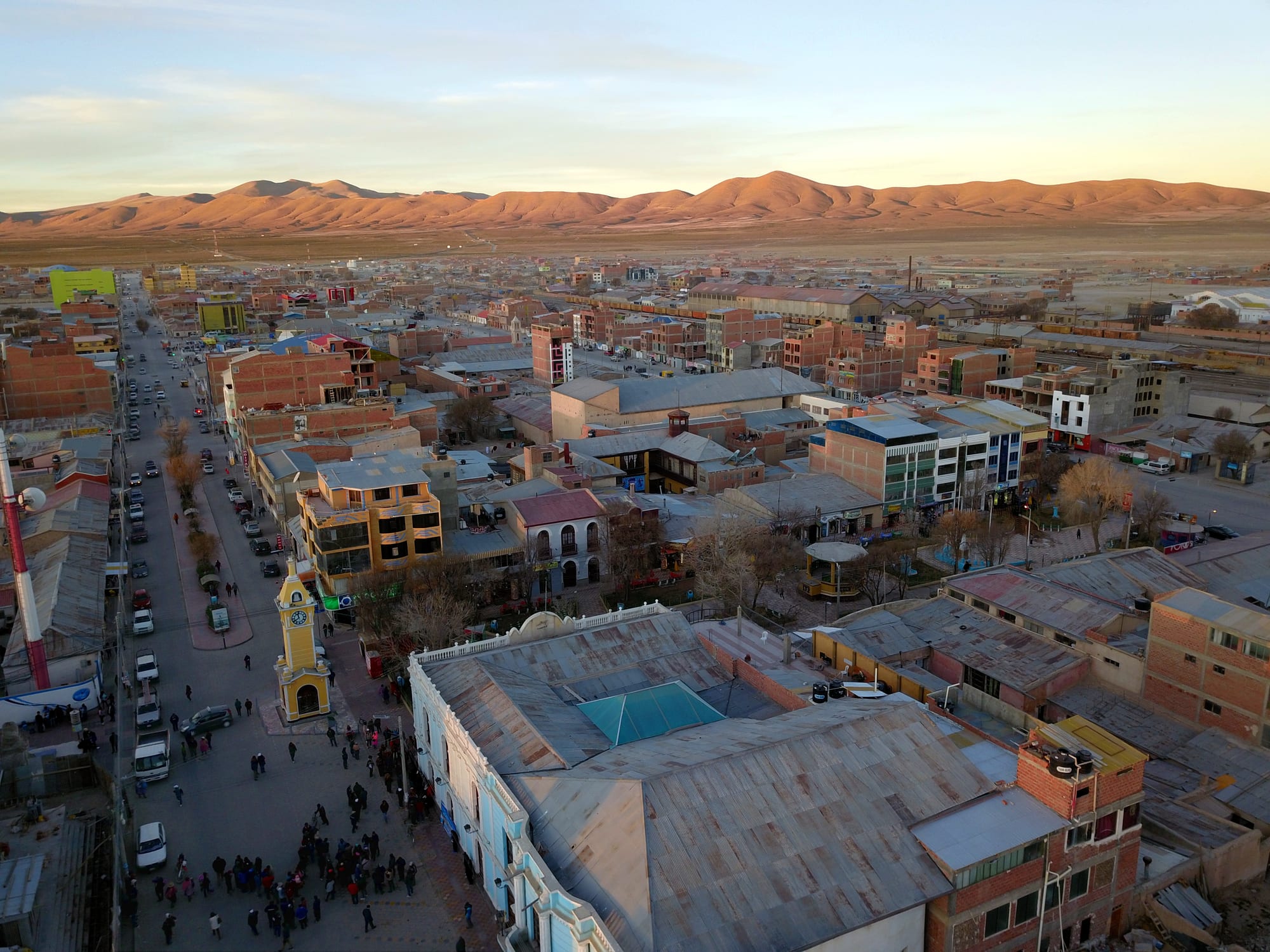
Low brick and concrete buildings of Uyuni spreading across a flat plain at dusk, with a yellow clock tower and bare pink hills beyond

La Paz, Uyuni & the Altiplano, Bolivia

Uyuni

Avenida Potosí and the clock tower in Uyuni, seen from above at sunset. (Jaimalalatete / Wikimedia Commons · CC BY-SA 4.0)

A railway town of low brick buildings at about 3,700 metres on the southern Altiplano, founded around 1890 where the line from the Pacific coast reached the Bolivian mines. Its old locomotives now rust outside town, and it lives mainly as the base for 4x4 tours across the Salar de Uyuni, the world's largest salt flat, and the lagoons to the south.

Neighbourhoods

  • Avenida Potosí and the clock tower
    • First-time visitors
    • Restaurants
    • Tour agencies

    The centre of town, along the main street and around the clock tower near the town hall. Most of the tour agencies, hostels, restaurants and shops are within a few blocks, and on Thursdays several blocks of Avenida Potosí become an open-air market.

    Open in Maps
  • Around the railway station
    • Close to public transport
    • Budget stays

    The streets along Avenida Ferroviaria and Avenida Arce by the station, where trains from Oruro and Villazón stop and the bus companies have their offices. Pizza places and cafés catering to tour groups line the avenue, and a small railway museum stands behind the station.

    Open in Maps
  • Colchani and the salt-flat edge
    • Quiet
    • Close to the Salar

    A small village about 20 kilometres north of town on the eastern shore of the Salar, home to the cooperative of salt workers. A few hotels built of salt blocks stand along this edge of the flat for those who would rather wake up beside it.

    Open in Maps

Things to do

In and around town

  • Train Cemeteryattraction

    About 3 kilometres from town beside the old line to Chile, dozens of rusting locomotives and wagons left behind when the mining traffic collapsed in the 1940s, some dating from the late 19th century.

    Open in Maps
  • Railway museummuseum

    A railway museum and interpretation centre behind the station, opened in 2016, telling the story of the railway that made the town.

    Open in Maps
  • Clock towerlandmark

    The clock tower on the main street, a few metres from the town hall, one of the images most often used to represent Uyuni.

    Open in Maps
  • Thursday marketmarket

    Each Thursday several blocks of Avenida Potosí turn into an open-air market selling a bit of everything, including handicrafts, alongside the regular market west of the railway.

    Open in Maps

Short trips from the town

  • Salar de Uyunipark

    The world's largest salt flat, about 10,600 square kilometres of salt crust over lithium-rich brine; after rain a thin sheet of still water turns it into a mirror of the sky.

    Open in Maps
  • Colchaniattraction

    The village at the gateway to the flat, home to the cooperative to which all the Salar's salt miners belong, with a salt museum visited by many tourists.

    Open in Maps
  • Isla Incahuasiviewpoint

    A rocky outcrop of an ancient volcano in the middle of the salt, once an island in a prehistoric lake, covered in giant cacti and with views across the white plain.

    Open in Maps
  • Pulacayoattraction

    A historic silver-mining settlement on the road to Potosí, around the old Huanchaca mine, where a train that Butch Cassidy and the Sundance Kid robbed is kept.

    Open in Maps

Eat and drink

Long-standing places and food districts in Uyuni. Hours, ratings and directions come from your maps app, always current.

Uyuni classics

  • Restaurants on Avenida Ferroviaria and Avenida Arceneighborhood

    Restaurants near the station cook for tour groups — pizzas, some topped with llama, alongside Mexican and vegetarian dishes.

    Open in Maps

Food districts and markets

  • Uyuni marketmarket

    The town market west of the railway tracks, busy from the morning.

    Open in Maps
  • Thursday street marketmarket

    The weekly Thursday market along Avenida Potosí, selling a bit of everything.

    Open in Maps

Experience Uyuni

History

Uyuni grew out of the railway. In the late 1880s President Aniceto Arce, convinced that Bolivia would flourish only with modern transport, backed a line built by British-sponsored companies from the Chilean port of Antofagasta to the silver mines of the Altiplano; construction ran from 1888 to 1892, and the first train from Chile reached the station at Uyuni in 1890. The settlement founded at the junction became a trading post and distribution hub, where ore from the mines was loaded for the Pacific coast, and British engineers formed a sizable community in the town.

Four lines came to meet here, from Oruro and La Paz, from Calama in Chile, from Potosí and from Villazón on the Argentine border, and it became an important railway junction. When the mining industry collapsed in the 1940s, partly through the exhaustion of the ores, many locomotives and wagons were simply left on sidings outside town, the beginning of today's Train Cemetery. The town's part in supporting the Chaco War of the 1930s was later recognised by the state.

The town's second life came with tourism to the Salar de Uyuni. As visitors arrived in growing numbers, agencies, hostels and restaurants filled the centre, an airport opened in 2011, and between 2014 and 2017 the Dakar Rally passed through. The brine beneath the salt holds most of Bolivia's lithium, about 22 per cent of the world's known resources as of 2024.

Culture & Customs

Uyuni is a town of the southern Altiplano, and its customs are those of the surrounding high country, where Andean ritual and Catholic practice run together. As elsewhere in Bolivia, offerings to Pachamama, Mother Earth, are buried under the foundations of many houses.

The railway gives the town much of its identity. Its people take pride in its role as a junction and in its history of railway workers and miners, and the old locomotives, the station and the museum behind it are part of how the town presents itself. The clock tower on the main street, a few metres from the town hall, is one of the images most often used to represent it.

The rest of everyday culture follows the Bolivian pattern: football on dusty pitches, Catholic feast days with processions and dancing, and a market day that brings people in from the surrounding villages. Tourism brings visitors from around the world, but beyond the agency streets it remains a quiet, reserved place, where the cold and the wind drive life indoors after dark.

Daily Life

The municipality of Uyuni had about 35,000 people at the 2024 census, most of them in the town itself, which grew from about 1,500 people in 1900 to about 24,100 in 2020. It stands at the edge of a wide plain, with more mountainous country to the east, and the cold desert climate keeps the town compact.

Tourism is the main business: tens of thousands of visitors a year pass through, keeping the agencies, drivers, cooks, hostels and restaurants of the centre busy, with the peaks in the dry winter months and the rainy mirror season. The town is also a gateway for trade with Chile, with a customs and immigration post in the centre. Around it, agriculture is limited to quinoa, llamas and sheep, and the salt miners of the Colchani cooperative work the Salar.

Days start cold and early as jeeps are loaded with fuel, water and luggage outside the agencies, and the streets empty as tours head out onto the salt. The national shortages of fuel and US dollars hit a town that runs on 4x4 vehicles and foreign visitors hard, and blockades on the highways from Oruro or Potosí can delay arrivals for days.

Food

Highland cooking in Uyuni is built on what the southern Altiplano produces: quinoa and llama meat. Quinoa real, royal quinoa, is grown in the Intersalar region between the Uyuni and Coipasa salt flats and is the main crop around Colchani, and llama appears on menus in town. Set lunches of soup and a main course are the everyday meal in market stalls and small restaurants.

The town's restaurant streets have adapted to the tour trade, with pizzerias, some offering llama as a topping, alongside Mexican and vegetarian dishes for travellers. On the tours themselves, cooks travelling with the jeeps serve hearty meals of meat, potatoes and soup, often eaten on the salt or in simple lodgings.

Api, the hot, sweet drink of morocho corn and cinnamon, is drunk with fried buñuelos, and coca tea is offered everywhere to ease the altitude. Salteñas are sold mid-morning. Beer and singani, the white-grape brandy of the southern valleys, are the usual drinks.

Planning tools

Budget

Uyuni itself is inexpensive, with simple hostels and set lunches, but the town's main cost is the salt-flat tour, from one day on the Salar to three days or more continuing south to the lagoons and the Chilean border. Prices depend on the vehicle, the group size, the food and the beds. Salt hotels at the edge of the flat cost much more than rooms in town.

Daily Budget Midrange
USD 60–120 (hotel in town or by the Salar, restaurant meals, a private or smaller-group tour)
Daily Budget Shoestring
USD 25–45 (hostel bed, market lunches, a shared one-day tour divided over the stay)

Agree exactly what a tour includes — vehicle, driver, food, sleeping bags, park fees — before paying, and choose an operator on recent reviews rather than price.

Best Time to Visit

May to October brings dry, clear weather, firm salt and open routes to the southern lagoons, with June to August the busiest and coldest at night. For the mirror effect, when rain leaves a thin layer of water on the salt, come in the wet season, roughly January to March, accepting that heavy rain can close some routes.

Suggested Number of Days

One or two days covers the town and a day on the salt flat. Allow three or four days for a multi-day tour south through the lagoon country. The season, the altitude and the wish to cross into Chile at the end of a tour change the number.

First Visit
1–2 days
With Surroundings
3–4 days

Transportation

The town is small enough to cross on foot, and there is no need for local transport except a taxi with luggage. Everything beyond it — the Salar, the islands and the lagoons — is reached in 4x4 vehicles with a driver, booked through agencies in the centre; there is no public transport onto the flat.

Check that a tour vehicle carries spare tyres, enough fuel and water, and a driver who will not drink; the cheapest tours have a poor safety record.

Airport & Station Connections

Joya Andina Airport, opened in 2011 just north-west of town, has flights from La Paz. A railway runs south from Oruro to Uyuni and on to Villazón on the Argentine border, and buses come overnight from La Paz and from Potosí and Sucre. Many travellers arrive or leave on tours that start or finish at the Chilean border for San Pedro de Atacama.

Walkability

The centre is flat and compact, with wide, dusty streets, and everything in town is within a short walk. The Train Cemetery is about 3 kilometres away along the tracks, walkable in daylight. The wind, the sun and the altitude make walking tiring, and nights are cold.

Safety

Violent crime against tourists is relatively low, but manage the risks: fake-taxi and fake-police scams and express robberies occur in La Paz, Cochabamba, and on the Uyuni and Copacabana routes, and petty theft is common on overnight buses and in markets. Uyuni tours have a record of accidents involving poorly maintained vehicles, and the town lies high enough to cause altitude sickness. Roadblocks can close the highways in and out of town.

Rest on arrival, drink water, use sun protection, keep valuables close on overnight buses, and pick a tour operator on its safety record. Check current official travel advice before travelling.

Climate

A cold desert climate at about 3,700 metres, with mild summers, cold winters and chilly nights all year. The sun is fierce at midday, the wind strong, and the temperature drops quickly after dark.

Summer
wet season, December to February at its peak: average temperatures peaking at about 21°C from November to January, rain and water on the Salar
Winter
dry season, May to October: clear skies, an average temperature of about 13°C in June, and cold nights that can fall to about −9°C

Local Customs

Uyuni is a working Altiplano town as well as a tour base. A greeting before any question is expected, and drivers and cooks on multi-day tours often receive a tip at the end.

Ask before photographing people, especially in the markets and the salt villages, and take all rubbish back off the salt flat.

Common Payment Methods

The currency is the boliviano (Bs). A shortage of US dollars since about 2023 and the end of the boliviano's peg in June 2026 have made exchange rates and cards unpredictable, and ATMs in a small town can run out. Bring US dollars in good condition and enough small boliviano notes for park fees, toilets and snacks on tour.