History · Argentina
Why does Buenos Aires look like Paris?
Grown rich on beef and grain around 1900, Argentina's elite rebuilt their capital on the model of Haussmann's Paris, with French architects, French stone and French taste.
By Globeway Editorial · 13 October 2026
The short answer
Buenos Aires looks like Paris because, between about 1880 and the 1920s, the people who ran it wanted it to. In those decades Argentina became one of the richest countries on earth, selling wheat and frozen beef to Europe, and its capital filled with money and immigrants. The ruling elite saw Europe as the model of civilisation. Their mayors cut new boulevards in the manner of Baron Haussmann's rebuilding of Paris, and wealthy families hired French architects to build mansions roofed in slate and fitted with marble, ironwork and chandeliers shipped from Europe.
The comparison is only half the story. Buenos Aires is an eclectic city, a mix of Parisian, Madrid-like and Italian styles, and many of its grandest public buildings were designed by Italians. Much of the French-style city was also torn down from the 1950s onwards. What survives, especially in Recoleta and along Avenida de Mayo and Avenida Alvear, is why it is still called the "Paris of South America".
A capital that suddenly grew rich
The look of the city dates from a single, extraordinary period. In 1880, after years of conflict, Buenos Aires was separated from its province and made the federal capital of Argentina. That same year a new governing elite, known as the Generation of '80, came to power and held it until 1916. Its leaders believed in replacing what they called "barbarism" with European "order" and "progress", and they encouraged European immigration on a vast scale.
The economy took off. Between 1870 and 1910 Argentina's wheat exports rose from 100,000 to 2.5 million tonnes a year, and frozen beef exports from 25,000 to 365,000 tonnes, helped by the invention of refrigerated ships in the 1870s. By 1913 Argentina was among the ten wealthiest countries in the world per person. Immigrants poured in, mostly from Italy and Spain, and the city's population tripled between 1887 and 1915, from 500,000 to 1.5 million. A rich, fast-growing capital needed new streets, new public buildings and new homes, and its leaders knew exactly which city they admired.
Haussmann on the River Plate
Paris itself had just been remade. Between 1853 and 1870 Georges-Eugène Haussmann, working for Napoleon III, demolished old neighbourhoods and drove wide avenues, parks and squares through the city, creating the look of central Paris today. In Buenos Aires the first mayor of the new capital, Torcuato de Alvear, who served until 1887, launched ambitious projects patterned on Haussmann's.
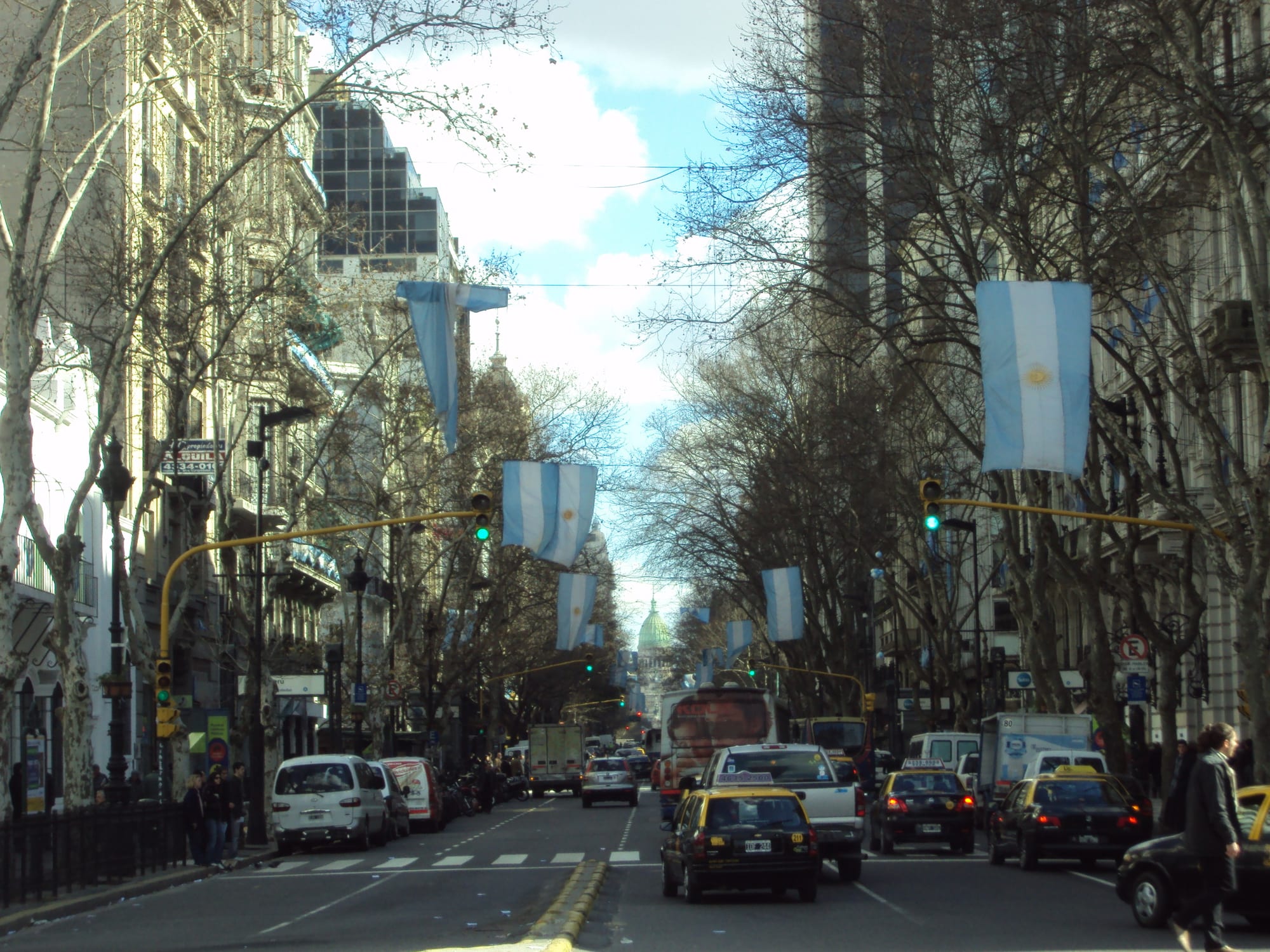
The clearest result is Avenida de Mayo. Begun in 1885 and opened in 1894, it was cut straight through existing city blocks to link the Plaza de Mayo with the square in front of the Congress, and part of the old colonial town hall, the Cabildo, was demolished in 1888 to make room. A later mayor, Miguel Cané, imposed strict rules on the buildings facing it, limiting them to 24 metres in height along a street 30 metres wide. Its Art Nouveau, neoclassical and eclectic facades invite comparisons with Paris, Barcelona and Madrid.
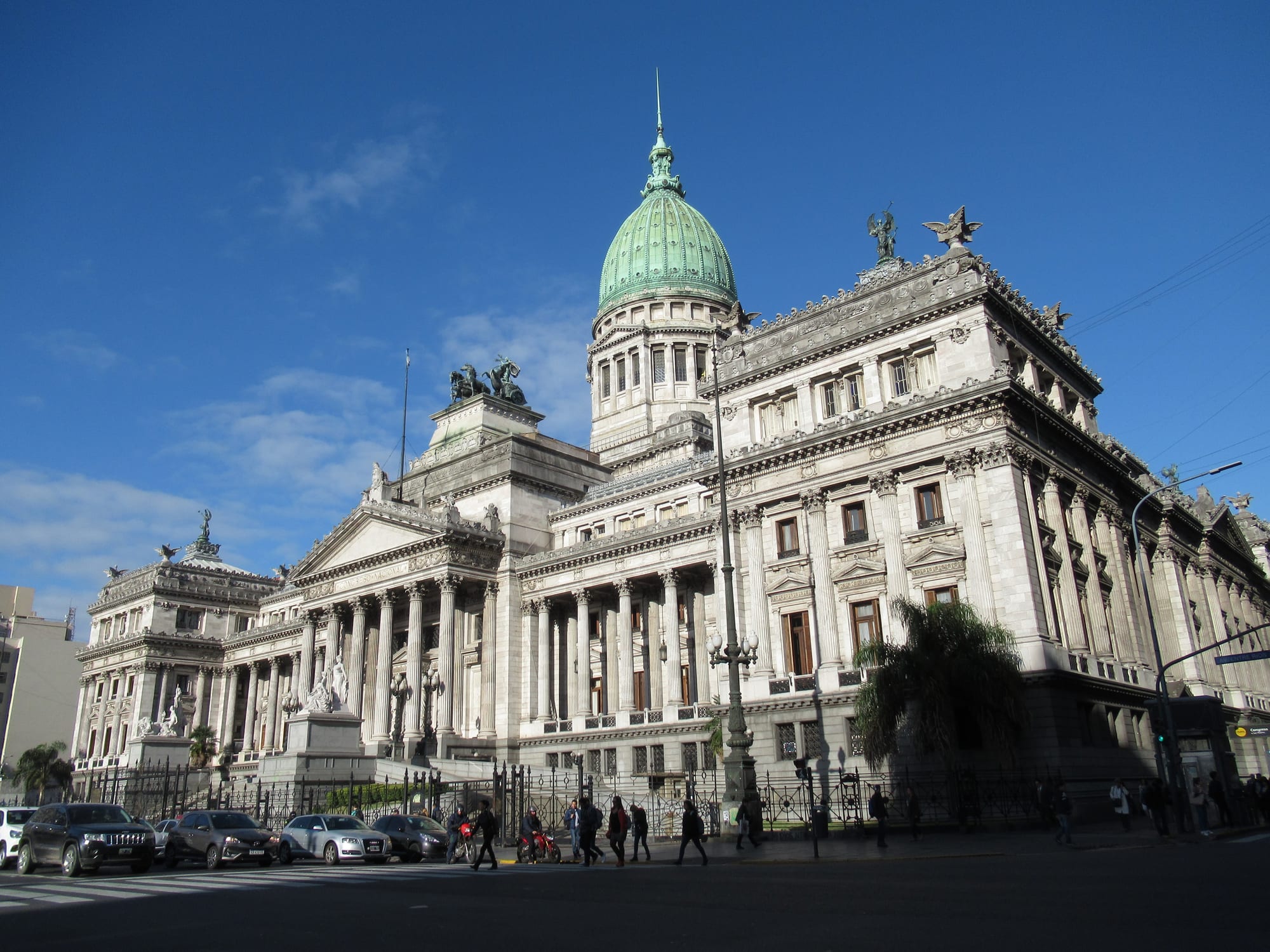
The Congress closes the view along Avenida de Mayo. Its bronze-plated dome rises 80 metres and has weathered to green.
The parks followed the same model. In 1891 the city appointed a Paris-born landscape architect, Carlos Thays, as its director of parks and walkways. Over the following decades he planted street trees and designed or remodelled many of the city's parks and plazas, including the Plaza de Mayo and the Plaza del Congreso, and his French background shows so strongly that they are often compared with their counterparts in Paris.
Palaces imported from France
The most Parisian part of the city grew out of an epidemic. When yellow fever struck Buenos Aires in 1871, the wealthy left the old southern districts for the higher ground of Recoleta, in the north. There, from the late nineteenth century to the early 1920s, they built Parisian-style townhouses, called petits hôtels, and even "châteaux" imitating those of France's Loire valley, almost always designed by architects of French origin. Most of the materials came from Europe: carved wood panelling, slate roof tiles, marble staircases, chandeliers and gilded mirrors.
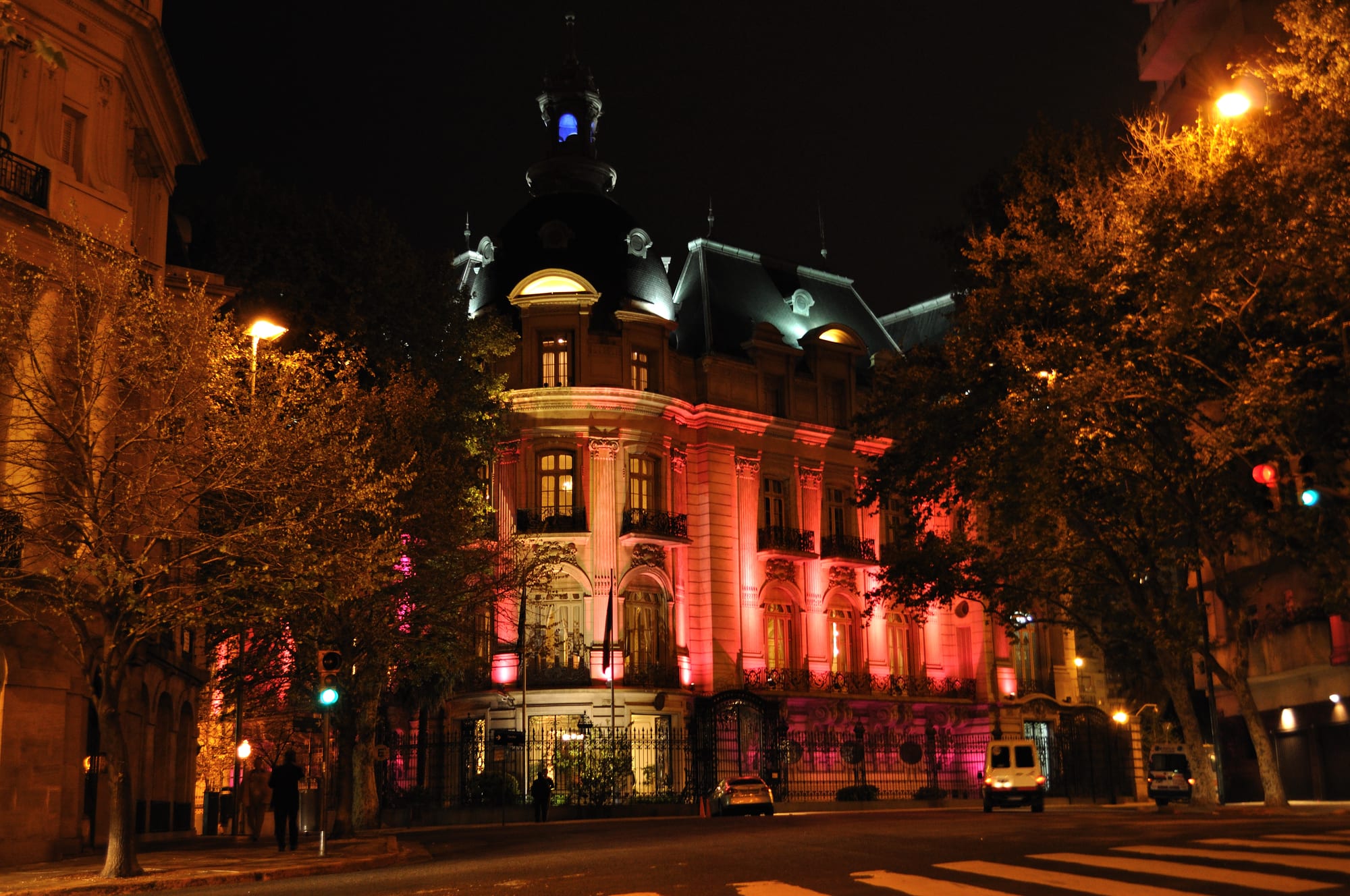
Avenida Alvear, begun in 1885, is lined with such mansions in the French academic style that was in vogue in the wealthy north of the city around 1900.
Some owners went straight to Paris for their designs. In 1911 Matías Errázuriz, a diplomat who had served as ambassador to France, and his wife Josefina de Alvear commissioned the French architect René Sergent to design their mansion. Its facade borrows from the French neoclassicism of Louis XV's court architect, and its dining room was modelled on the Hercules Room at Versailles. Nearby, Ernesto Bosch, back from six years as Argentina's ambassador to France, and his wife Elisa hired the same architect so that their new home would evoke their years in Paris.
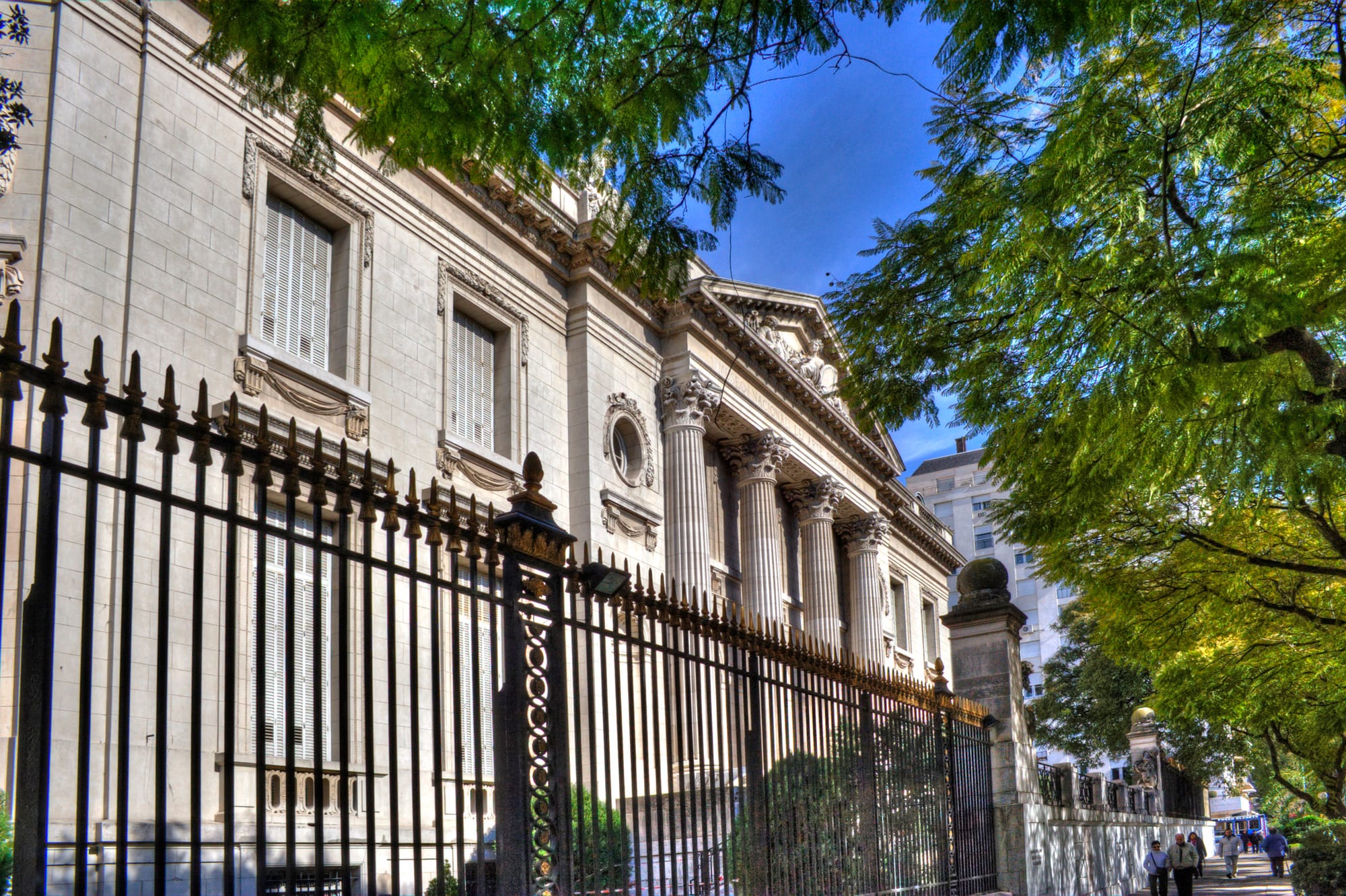
Designed in 1911 and slowed by the First World War, it was finished in 1917. The state bought the house and its collections in 1937.
Even the dead were housed in Parisian style. In Recoleta Cemetery, whose plan was laid out in 1822 by a French engineer, most of the materials used for tombs between 1880 and 1930 were imported from Paris and Milan.
Paris, Madrid and Milan
Calling Buenos Aires a copy of Paris flattens a more mixed city. Its architecture blends colonial, Art Deco, Art Nouveau, neo-Gothic and French styles, with elements that recall Madrid as much as Paris, and most of the immigrants who poured in were Italian and Spanish. The National Congress was designed by the Italian architect Vittorio Meano. The Teatro Colón, the opera house that opened in 1908, was designed by Francesco Tamburini and Meano as a theatre in the Italian style. The Palacio Barolo on Avenida de Mayo, completed in 1923 for an Italian immigrant who had made his fortune in knitted fabrics, was laid out according to Dante's Divine Comedy.
The French-style city has also shrunk. Many of the great Recoleta mansions were demolished from the 1950s onwards, because several ordinary apartment blocks could be built on the land of one private palace. In 1937 a whole block of Avenida de Mayo came down for the new Avenida 9 de Julio, now the widest avenue in the world at 110 metres. To halt further losses, Avenida de Mayo was declared a National Historic Site in 1997, and its facades can no longer be changed without approval.
What remains is still striking: the slate roofs and petits hôtels of Recoleta, the embassies on Avenida Alvear, the ornate facades of Avenida de Mayo, and the plazas Thays planted. Together they preserve the moment, a little over a century ago, when one of the world's richest young cities decided to dress itself as the capital of Europe.