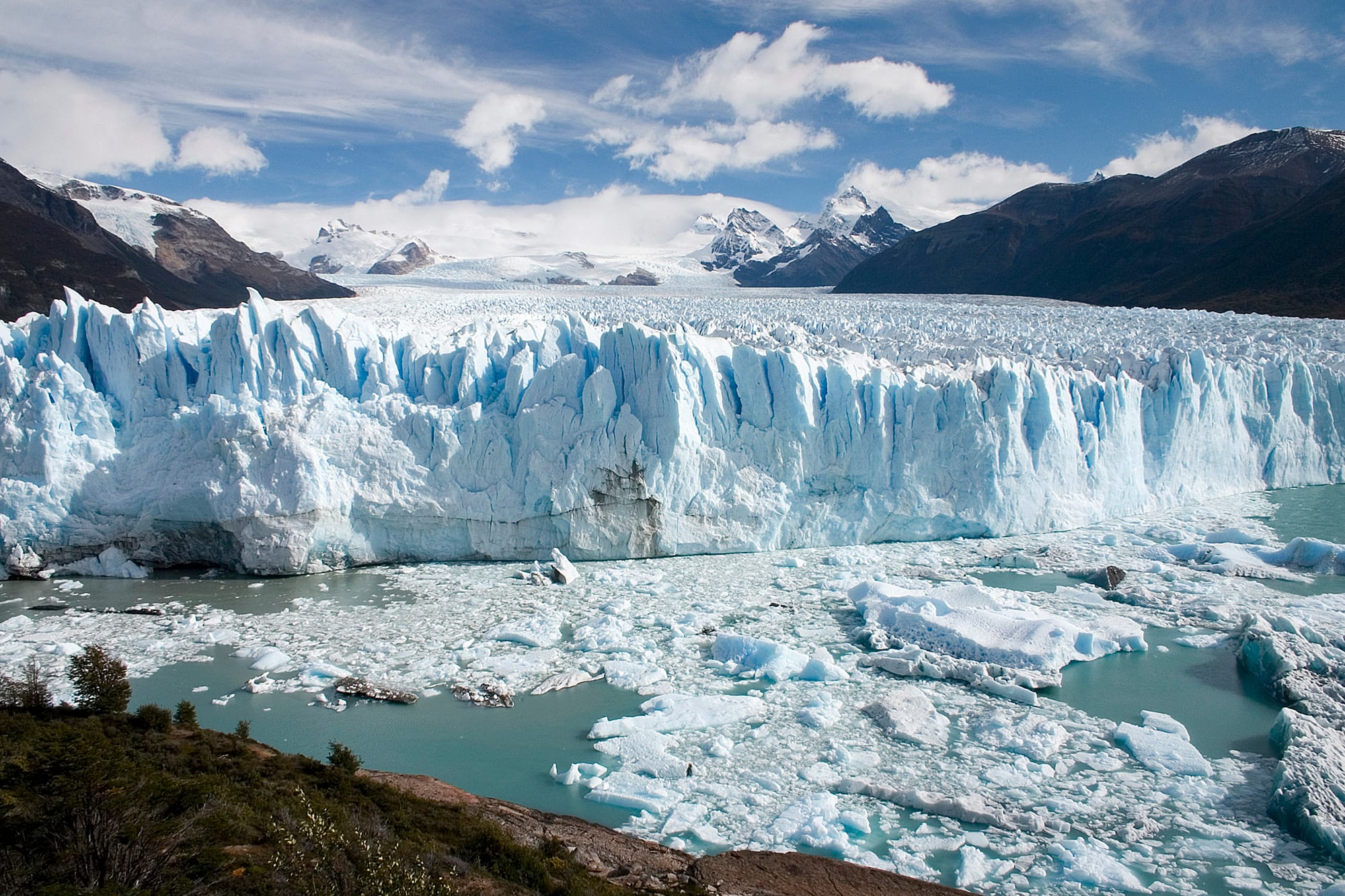
The jagged blue-white face of the Perito Moreno Glacier meeting grey lake water beneath forested hills

Argentina

The Perito Moreno Glacier in Los Glaciares National Park, Santa Cruz Province — long one of the few glaciers to hold its ground, though its northern front has been retreating since 2020. (Luca Galuzzi (www.galuzzi.it) / Wikimedia Commons · CC BY-SA 2.5)

The second-largest country in South America, running from subtropical falls and high-Andean desert to the wind-scoured glaciers of Patagonia, with a European-inflected culture centred on Buenos Aires.

Explore Argentina

History

The land was home to many Indigenous peoples — the Diaguita in the northwest, the Guaraní in the northeast, and the Mapuche, Tehuelche, and Selk'nam across the Pampas and Patagonia. Spanish settlement from the sixteenth century left Buenos Aires a smugglers' outpost until 1776, when Spain made it capital of a new Viceroyalty of the Río de la Plata. The May Revolution of 1810 began the break with Spain, and independence was declared at Tucumán in 1816.

Decades of civil war between centralists and federalists followed, easing with the 1853 constitution and settled by the country's reorganisation as a federation in 1880, after which came a long period of growth. Between about 1880 and 1930, millions of European immigrants, Italians and Spaniards above all, arrived, and the military "Conquest of the Desert" seized Patagonia from its Indigenous inhabitants. By 1908 Argentina ranked among the ten wealthiest countries in the world.

The twentieth century was turbulent: a first military coup in 1930, the rise of Juan and Eva Perón in the 1940s and a movement that still defines politics, more coups, and the 1976–83 military dictatorship, whose "Dirty War" disappeared an estimated 15,000 to 30,000 people and which fell after losing the 1982 Falklands/Malvinas War. Democracy returned in 1983. Economic crises have recurred — hyperinflation in 1989, a catastrophic default in 2001 — and the tension between Peronism and market reform, sharpened under President Javier Milei since he took office in December 2023, remains the central divide.

  • Argentina: From the Pampas to Perón — Indigenous nations, a Spanish backwater that became a breadbasket, the country that was nearly the richest in the world, and the long shadow of 1976

Culture & Customs

Argentina sees itself as a nation of immigrants, and Buenos Aires — the "Paris of South America" in its own telling — dominates the national image, though the Andean northwest, the Litoral, and Patagonia all have strong regional cultures. The country is historically Catholic (Pope Francis was Archbishop of Buenos Aires) but markedly secular in practice, with sizeable Jewish and evangelical communities.

Certain things are near-universal. Mate, the bitter herbal infusion shared from a gourd and metal straw, is drunk everywhere by everyone. Football is a consuming passion, from Maradona and Messi to the Boca–River rivalry and three World Cup titles. Tango, born in the port neighbourhoods in the late nineteenth century, is both a museum piece for tourists and a living social dance in the city's milongas.

The gaucho — the horseman of the Pampas — is the rural national symbol, and the asado, the long weekend barbecue, is its social ritual. Argentina also has an outsized literary tradition (Borges, Cortázar) and an unusual mainstream enthusiasm for psychoanalysis. Human-rights memory, carried by the Madres de Plaza de Mayo, runs deep.

  • Argentina: The Gourd Goes Round — A kiss on the cheek for everyone in the room, a shared gourd of mate passed hand to hand, roadside shrines to saints the Church never named, and a round of applause for whoever tended the fire

Daily Life

More than a quarter of Argentines live in Greater Buenos Aires, a sprawling metropolis of café-lined avenues, bookshops, and apartment blocks. Life runs late: lunch is unhurried, dinner rarely starts before 9 or 10 p.m., and nightclubs fill after 2 a.m. The afternoon merienda of coffee and medialunas bridges the long gap between meals.

Coping with inflation is a daily skill. People hold savings in US dollars, spend pesos quickly, compare prices constantly, and joke about it darkly. Public universities are a national institution, healthcare is universal if uneven, and the café remains a genuine social institution rather than just a place to buy coffee.

Outside the capital, life is quieter and cheaper — provincial cities like Córdoba, Rosario, Mendoza, and Salta, farming towns on the Pampas, and small, spread-out settlements in Patagonia where distances are measured in hundreds of kilometres and the wind is a constant companion.

Food

Beef is the centre of the table. The asado or parrilla runs through cuts like bife de chorizo and asado de tira, plus chorizo, morcilla (blood sausage), and achuras (offal), all eaten with chimichurri. Empanadas, baked or fried and stuffed with meat, cheese, or corn, vary by province, and the milanesa, a breaded cutlet, is the everyday standby.

The Italian inheritance is just as strong: thick, cheese-heavy Buenos Aires pizza, fresh pasta, and ñoquis traditionally eaten on the 29th of the month. Locro, a hearty stew of corn, squash, beans, and meat, has spread from the northwest and Cuyo to the rest of the country. Dulce de leche — milk caramel — is in the alfajores, the ice cream, and the pancakes.

To drink: Malbec from Mendoza and Torrontés from Salta, Fernet mixed with cola, strong espresso, and mate at every hour. Argentine ice cream, made in the Italian style, is among the best in the world and taken seriously.

  • Argentina: Food and the National Dish — Beef cooked slowly over wood embers, a century of Italian immigration baked into the pasta and pizza, and a shared gourd of yerba mate passed around every gathering

Attractions & Natural Wonders

Two natural wonders bracket the country. In the far northeast, Iguazú Falls — a nearly three-kilometre line of cascades on the Brazilian border, shared as a national park on each side — is the largest waterfall system on Earth. In the far south, the Perito Moreno Glacier in Los Glaciares National Park calves ice into a lake in full view of a boardwalk, and in the park's northern sector the town of El Chaltén sits under the granite spires of Fitz Roy and Cerro Torre, some of the best trekking in South America.

Patagonia holds more: the whale-watching peninsula of Península Valdés, the Welsh-founded towns of Chubut, the Lake District around Bariloche, and Ushuaia, which claims the title of the world's southernmost city and is one of the main gateways to Antarctica. The Andean northwest offers the painted rock strata of the Quebrada de Humahuaca and the blinding Salinas Grandes salt flats; further south, in Cuyo, the wine roads of Mendoza lie beneath Aconcagua, the highest peak outside Asia.

In the west are the desert parks of Talampaya and Ischigualasto (the "Valley of the Moon"); in the northeast, the rewilded Iberá wetlands with their returning jaguars; and in the centre, Córdoba's colonial Jesuit block. And there is Buenos Aires itself — San Telmo's Sunday market, the painted houses of La Boca, the Recoleta cemetery, the Teatro Colón, and the milongas that go on until dawn.

Planning basics

Budget

Argentina's cost is a moving target because of chronic inflation and a history of multiple exchange rates. For years, paying with US dollars cash at the unofficial "blue" rate made the country cheap; since the currency market was liberalised the official and parallel rates have stayed close to each other. Any figure here will be out of date quickly.

Source
Traveller reports and exchange-rate tracking — this is the most volatile figure in the guide; verify before you travel.
Patagonia Premium
El Calafate, El Chaltén, and Ushuaia cost markedly more than the rest of the country
Daily Budget Midrange
USD 100–180 (hotel, some domestic flights, restaurant asados, guided trips)
Daily Budget Shoestring
USD 45–75 (hostel, long-distance buses, set-menu lunches, self-catering)

Check the current exchange rate shortly before you travel, carry a card as well as some clean US dollar bills, and treat every price in pesos as provisional.

Source: Traveller reports and exchange-rate tracking — this is the most volatile figure in the guide; verify before you travel.

Visa Requirements

Citizens of the United States, Canada, the United Kingdom, the EU, Australia, and most of Latin America enter visa-free for up to 90 days, and the stay can usually be extended at a migration office. Some nationalities are visa-free only within a set window, such as 90 days in any 180.

Typical Stay
90 days on entry, visa-free, usually extendable

Do not overstay; keep the entry stamp or electronic record, and check the rules for your own passport before you fly.

Safety

Argentina is relatively safe by regional standards, and violent crime against visitors is uncommon. The real issue is theft in Buenos Aires and other cities — bag-snatching, phone grabs, distraction scams, and "motochorros" on motorbikes. The countryside and Patagonia are very safe.

Demonstrations
Protests and transport strikes are frequent, usually announced in advance, and centre on Plaza de Mayo and the Congreso in Buenos Aires.

Keep phones and bags out of sight in the city, use app-based or radio taxis at night, watch for counterfeit peso notes, and avoid the edges of demonstrations.

Climate

Enormous range, and the seasons are those of the southern hemisphere — summer is December to February. Buenos Aires is humid subtropical with hot, sticky summers and mild winters. The northwest and northeast are subtropical; the Andes and the Puna are high desert; Patagonia is cool, dry, and relentlessly windy, with snow in the far south.

Patagonia
cool even in summer, very windy; many trekking and glacier services close in winter, though Bariloche is a major ski centre
Buenos Aires Summer
hot and humid, often above 30°C
Buenos Aires Winter
mild, about 8–17°C, rarely freezing

Transportation

Distances are continental. Domestic flights on Aerolíneas Argentinas and low-cost carriers save days. The long-distance bus network (micros) is excellent, with fully reclining "cama" seats for overnight hauls. Passenger rail is limited to a few slow long-distance lines, though Buenos Aires has extensive commuter trains and the Subte metro.

Buses
Comfortable and comprehensive; book ahead in peak season
Main Hub
Ministro Pistarini International Airport (Ezeiza), Buenos Aires, with Aeroparque for most domestic flights

For Patagonia, plan around limited flights and long distances; parts of the Ruta 40 are still gravel.

Best Time to Visit

Spring (October–November) and autumn (March–April) are ideal for Buenos Aires and the wine country. Patagonia's trekking and glacier country is at its best from November to March, while Bariloche also draws skiers from June to September. The northwest — Salta, Jujuy — is best in the dry, clear winter from May to September. Iguazú is hot and busy year-round.

Avoid
Patagonia's trekking country outside the November–March window; Buenos Aires in the January holiday lull, when the city half-empties.

Currency

The currency is the Argentine peso (ARS). Inflation has been high for years, though it has eased since 2024, and the exchange rate has often had official and unofficial versions; how you pay can significantly change what you spend.

Symbol
$
Cash To Bring
Cards for most things, plus some US dollars in good condition as a backup
Currency Code
ARS — Argentine peso

Language

Spanish is the language of government and daily life — official in practice, though the constitution names no official language — in its distinctive Rioplatense form: "vos" instead of "tú," a "sh" sound for "ll" and "y," and an Italian-like intonation from a century of immigration. Italian, German, and Welsh are spoken in some communities, along with Indigenous languages such as Quechua, Guaraní, and Mapudungun.

English
Common among younger people and in tourism; less so generally
Other Languages
Italian, Welsh (in Chubut), Quechua, Guaraní, Mapudungun
Official Language
Spanish (Rioplatense)