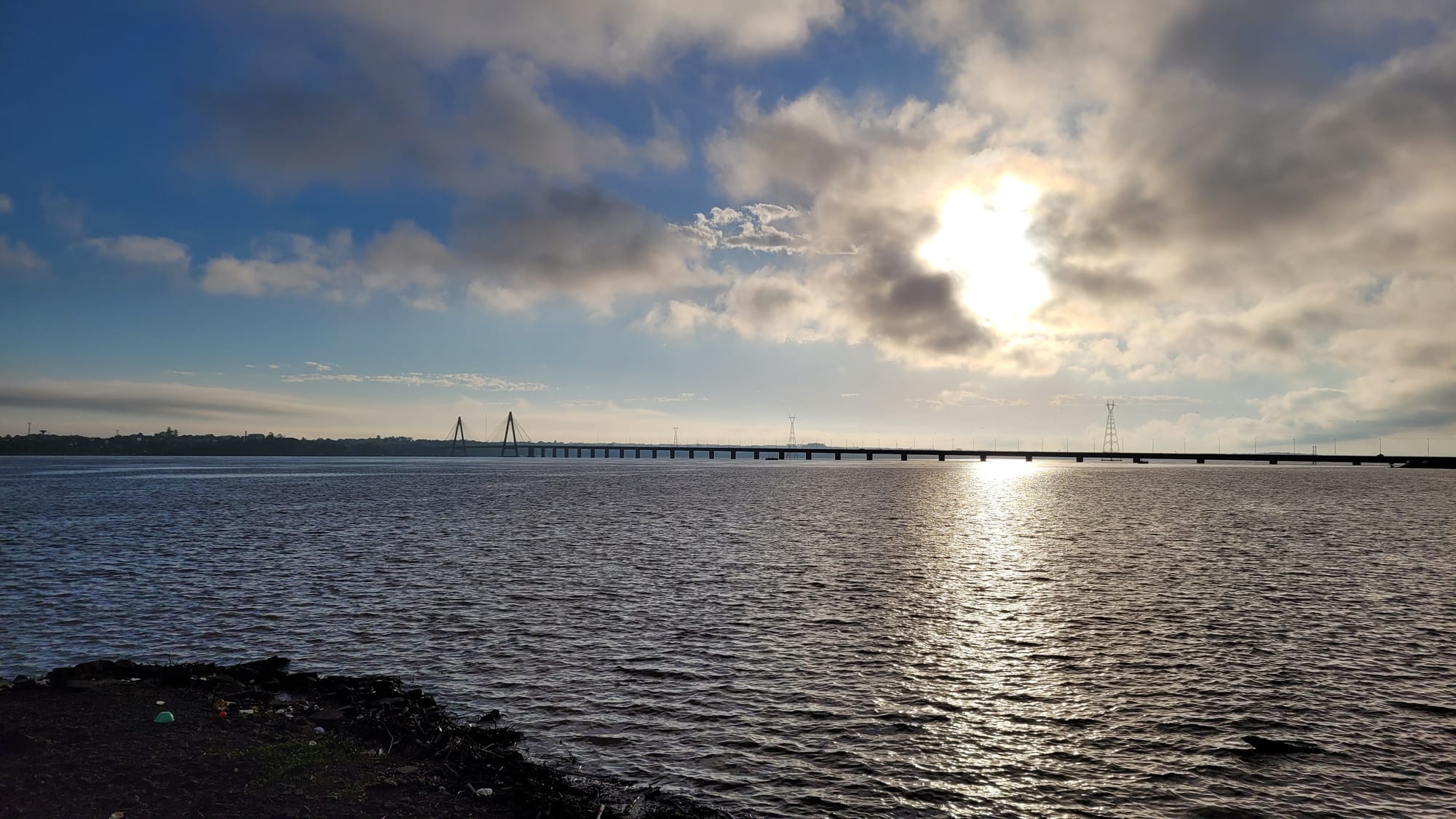
Morning sun breaking through clouds over the wide Paraná River, with the long cable-stayed bridge to Paraguay on the horizon

Iguazú & the Northeast, Argentina

Posadas

Sunrise over the Paraná at Posadas, with the San Roque González de Santa Cruz Bridge to Encarnación in the distance. (Horacio Cambeiro / Wikimedia Commons · CC BY-SA 4.0)

The capital of Misiones Province, on the left bank of the Paraná opposite Encarnación in Paraguay, to which it is joined by a long road-and-rail bridge. A frontier settlement that grew from the Paraguayan War, it shipped the province's yerba mate and timber and is now a fast-growing administrative and university city with a long riverside promenade.

Neighbourhoods

  • The city centre
    • First-time visitors
    • Historic district
    • Close to public transport

    The grid around Plaza 9 de Julio, where the cathedral and the provincial Government House face the square. Shops, banks, cafés and most hotels are in the surrounding blocks, along with the city's small museums and the Bosetti walk.

    Open in Maps
  • The Costanera and the Bajada Vieja
    • Waterfront
    • Best for food
    • Evenings out

    The riverside avenue that runs for kilometres along the Paraná, with room for walking and cycling, the old Villa Lanús railway station turned museum and views across to Encarnación. The Bajada Vieja, the old way down to the port, is the city's best-known walk, and restaurants and bars line the promenade.

    Open in Maps
  • Villa Lanús and the south
    • Local life
    • Close to the bus station

    The southern side of the city, towards the long-distance bus station and the main road to Corrientes. Villa Lanús, which grew around the old Miguel Lanús railway station, was long a separate settlement and is now a residential district of the growing city.

    Open in Maps

Things to do

The river and the bridge

  • San Roque González de Santa Cruz Bridgelandmark

    The 2.5-km cable-stayed road and rail bridge across the Paraná to Encarnación, proposed as part of the Yacyretá dam agreements and opened in April 1990 after a decade of delays.

    Open in Maps
  • Posadas–Encarnación International Traintransit hub

    An 8-km commuter train that crosses the bridge to Paraguay in a little under ten minutes, running since January 2014.

    Open in Maps
  • Costanerapark

    The riverside avenue opened in 1999 and extended in stages, built with funds from the binational Yacyretá dam authority; it is where the city walks, runs, cycles and watches the sun set over the river.

    Open in Maps
  • Bajada Viejaattraction

    The old descent from the town to the port, with a rock outcrop covered in honeysuckle and the monument to Andresito, now the city's most emblematic walk down to the river.

    Open in Maps

Landmarks and museums

  • Posadas Cathedrallandmark

    The Cathedral of St Joseph on the main square, built in 1876, after an army battalion had raised a chapel to St Joseph in the area in 1867, and given its present front and twin towers in a renovation that ended in 1937.

    Open in Maps
  • Museo Regional Aníbal Cambasmuseum

    The city's regional museum, a long-standing introduction to the history and peoples of Misiones.

    Open in Maps
  • Museo Histórico y Arqueológico Andrés Guacurarímuseum

    A museum of history and archaeology named after Andrés Guacurarí, Andresito, the Guaraní leader who governed Misiones during the independence wars.

    Open in Maps

Parks

  • Jardín Botánico de Posadaspark

    An 11-hectare botanical garden in the city, beside the Alberto Roth park.

    Open in Maps
  • Parque República del Paraguaypark

    A city park listed among the sights of Posadas, alongside the Bajada Vieja and the botanical garden.

    Open in Maps

Short trips from the city

  • Encarnaciónattraction

    Paraguay's third-largest city, across the bridge, with wide beaches and a waterfront boardwalk on the river.

    Open in Maps
  • Candelariaattraction

    A village upriver on the Paraná, long disputed between Argentina and Paraguay and fortified by the Paraguayans until it returned to Argentina in 1870.

    Open in Maps
  • Jesuit Missions of Trinidad and Jesúslandmark

    Two Jesuit mission ruins in Paraguay's Itapúa department, a UNESCO World Heritage Site since 1993, reached by bus from Encarnación.

    Open in Maps
  • San Ignacio Minílandmark

    The best preserved of the Argentine Jesuit missions, a UNESCO World Heritage Site since 1984, whose red sandstone church front is carved in the Guaraní baroque style.

    Open in Maps
  • Oberáattraction

    A city founded by Swedish and other European immigrants, with a Park of the Nations of houses built in the styles of the immigrant communities.

    Open in Maps
  • Yacyretá Damlandmark

    The large Argentine–Paraguayan hydroelectric dam on the Paraná, whose reservoir raised the river along the city's shore and paid for much of the Costanera.

    Open in Maps

Eat and drink

Long-standing places and food districts in Posadas. Hours, ratings and directions come from your maps app, always current.

Posadas classics

  • Chipácafe

    Small cheese breads made with cassava starch, sold by street vendors and bakeries across the city.

    Open in Maps
  • Surubí and river fishrestaurant

    The large catfish of the Paraná, grilled, stewed or breaded as a milanesa, along with pacú and dorado cooked over coals.

    Open in Maps

Food districts

  • Restaurants on the Costaneraneighborhood

    Parrillas, fish restaurants and bars along the riverside avenue, busiest in the evening when the heat eases and families come out to walk by the water.

    Open in Maps

Experience Posadas

History

Posadas traces its earliest roots to 25 March 1615, when the Jesuit Roque González de Santa Cruz founded a mission called Anunciación de Itapúa on this bank of the Paraná; ten years later it was moved across the river to the site of today's Encarnación. In the 19th century the left bank was disputed between Paraguay and Argentina. Between 1838 and 1840 the Paraguayan ruler Gaspar Rodríguez de Francia built a defensive wall here, and the trinchera gave the place the name Trincheras de San José; the settlement grew as a supply post for the allied armies in the War of the Triple Alliance from 1865.

In 1870 Corrientes made the village the head of a new department, and on 22 September 1879 it was renamed Posadas after Gervasio Antonio de Posadas, an early supreme director of the United Provinces. In 1884 Congress transferred it to the new national territory of Misiones as its capital. Its river port shipped out the province's yerba mate and timber, and in 1953 Misiones became a province with Posadas as its capital.

The National University of Misiones was founded here in 1973. On 2 April 1990 the San Roque González de Santa Cruz Bridge opened to Encarnación, after a decade of delays, and the Yacyretá dam downstream raised the river along the shore. Its binational authority financed the Costanera, opened in 1999 and extended through 2012, and in 2014 an international commuter train began running across the bridge.

Culture & Customs

Misiones has the peculiarity of sharing about 90 per cent of its borders with other countries, and Posadas lives that closeness. Families, shoppers and workers cross the bridge to Encarnación every day, the local Spanish is full of Guaraní words, and music, food and habits are shared between the two banks. Andresito, the Guaraní leader Andrés Guacurarí who governed Misiones during the independence wars, is the city's hero, with a monument by the river and a museum in his name.

The city also reflects the immigrant history of the province. Swedish, Polish, Ukrainian and other European settlers arrived in Misiones from the end of the 19th century, and their descendants live alongside Guaraní and Paraguayan families and migrants from the interior of the province. The city's Manuel Antonio Ramírez amphitheatre hosts the Festival Nacional de la Música del Litoral.

Posadas is a student city as well as a government one, and life gathers by the river. Carnival brings comparsas, costumed dance troupes, to the streets, and on warm evenings the Costanera fills with people walking, cycling, fishing and sharing tereré, with the lights of Encarnación across the water.

Daily Life

The municipality of Posadas counted about 327,500 people at the 2022 census and the metropolitan area about 391,500, close to a third of the province's 1.28 million people. It was the fastest-growing city in Argentina in the decade to 2010, and new housing estates and districts have spread across the municipality.

The provincial government, the university, hospitals and commerce are the main employers, along with yerba mate and rice mills, citrus juice plants and other light industry. Trade with Paraguay is a constant, rising and falling with the exchange rate, and when prices favour one side, queues build at the bridge. The Costanera has made the riverside districts sought after, while informal settlements that first appeared in the 1960s, after a crisis in yerba mate farming pushed families off the land, are still part of the city.

The heat sets the pace: early starts, a long break after lunch when shops close, and busy evenings. Schools, offices and shops reopen in the late afternoon, and at night people gather on the Costanera and in the squares of the centre.

Food

The food of Posadas belongs to the upper Paraná and is shared with Paraguay across the river. Chipá, small cheese breads made with cassava starch, are sold by vendors on the streets and buses. Sopa paraguaya, a dense cornbread with cheese and onion despite its name, chipá guazú, made with fresh maize, and mbeyú, a cassava-starch pancake with cheese, are everyday foods, and reviro is a simple dish of the region.

River fish are the pride of the table. Surubí, a large catfish, is grilled, stewed or breaded as a milanesa, and pacú and dorado are cooked over coals or wrapped in foil. Mandioca, cassava, is boiled or fried as a side, and chicharrón, fried pork, is common. Asado, often with beef from the grasslands of Corrientes, is the weekend meal, and the parrillas on the Costanera serve it every evening.

Yerba mate is the product of Misiones, grown on plantations in the province, and it is drunk hot as mate in the cool hours and cold as tereré, often with herbs, through the day. Sweets include dulce de mamón, papaya in syrup, and cakes of cassava flour.

Planning tools

Budget

Posadas is one of the cheaper cities in the north-east, with inexpensive set menus, chipá from street vendors and cheap buses and taxis. The main extra costs are trips to the mission ruins and across the border. Peso prices change quickly with inflation, and shopping across the river rises or falls in value with the exchange rate.

Daily Budget Midrange
USD 90–170 (city-centre hotel, restaurant dinners on the Costanera, taxis or a hire car to the missions)
Daily Budget Shoestring
USD 35–55 (hostel or budget hotel, set-menu meals, city buses)

Carry identification for the border, and allow extra time for queues on the bridge.

Best Time to Visit

March to May and August to November are the most comfortable months, warm but not oppressive. Summer, from December to February, is long and very hot, with heavy storms and mosquitoes, though the Costanera is lively on summer evenings. Winters are mild, with occasional cold spells.

Suggested Number of Days

The city itself needs a day or two. Allow three or four days to add the mission ruins on both sides of the river and a crossing into Paraguay; border queues, the heat and bus connections set the pace more than distance.

First Visit
1–2 days
With Surroundings
3–4 days

Transportation

City buses link the centre with the bus station, the airport and the train station, and taxis are plentiful; the centre itself is best seen on foot. An international city bus and the commuter train cross the bridge to Encarnación. Long-distance buses and a hire car are the ways to reach the missions and the rest of Misiones.

Carry identification for the border controls on the bridge, and make sure of the entry and exit stamps on both sides.

Airport & Station Connections

Libertador General José de San Martín Airport is about 7 km from the city, with flights to Buenos Aires and Córdoba, and a city bus links it to the bus station. Long-distance buses run from the bus station south of the centre to Buenos Aires in around ten hours, and to Puerto Iguazú in about five.

Walkability

The centre is compact and flat enough to cover on foot, from Plaza 9 de Julio down the Bajada Vieja to the river, and the Costanera is a long, pleasant promenade for walking, running and cycling. The bus station and the outer districts need a bus or taxi, and summer heat makes the middle of the day hard going.

Safety

Argentina is relatively safe by regional standards, and violent crime against visitors is uncommon. In Posadas the usual urban risks apply: petty theft in busy streets and around the bus station. Mosquito-borne dengue has caused large outbreaks in the region in recent years, and the summer heat is a real hazard.

Use insect repellent day and night, drink plenty of water in summer, keep phones and bags out of sight, and carry identification near the border. Check current official travel advice before travelling.

Climate

Subtropical and humid, with rain in every season. Summer is December to February and long and very hot; winters are mild, with occasional cold snaps.

Summer
hot and humid, with highs around 31.5°C, lows around 21°C and frequent thunderstorms
Winter
mild, with highs around 22.5°C and lows around 12°C, and occasional cold spells

Local Customs

Posadas shares much with Encarnación across the river: Guaraní words fill the local Spanish, families cross the bridge to shop and visit, and tereré, cold mate, is drunk all day in the heat. The long midday break empties the streets in summer, and the city comes out to the Costanera in the evening.

Leaving around 10 per cent in restaurants is customary. Dress modestly in churches, and ask before photographing people.

Common Payment Methods

The currency is the Argentine peso; Encarnación uses the Paraguayan guaraní. Cards and app payments are widely accepted in shops and restaurants, while street vendors, buses and small businesses prefer cash. ATMs are common in the centre; carry some clean US dollar notes as a backup.