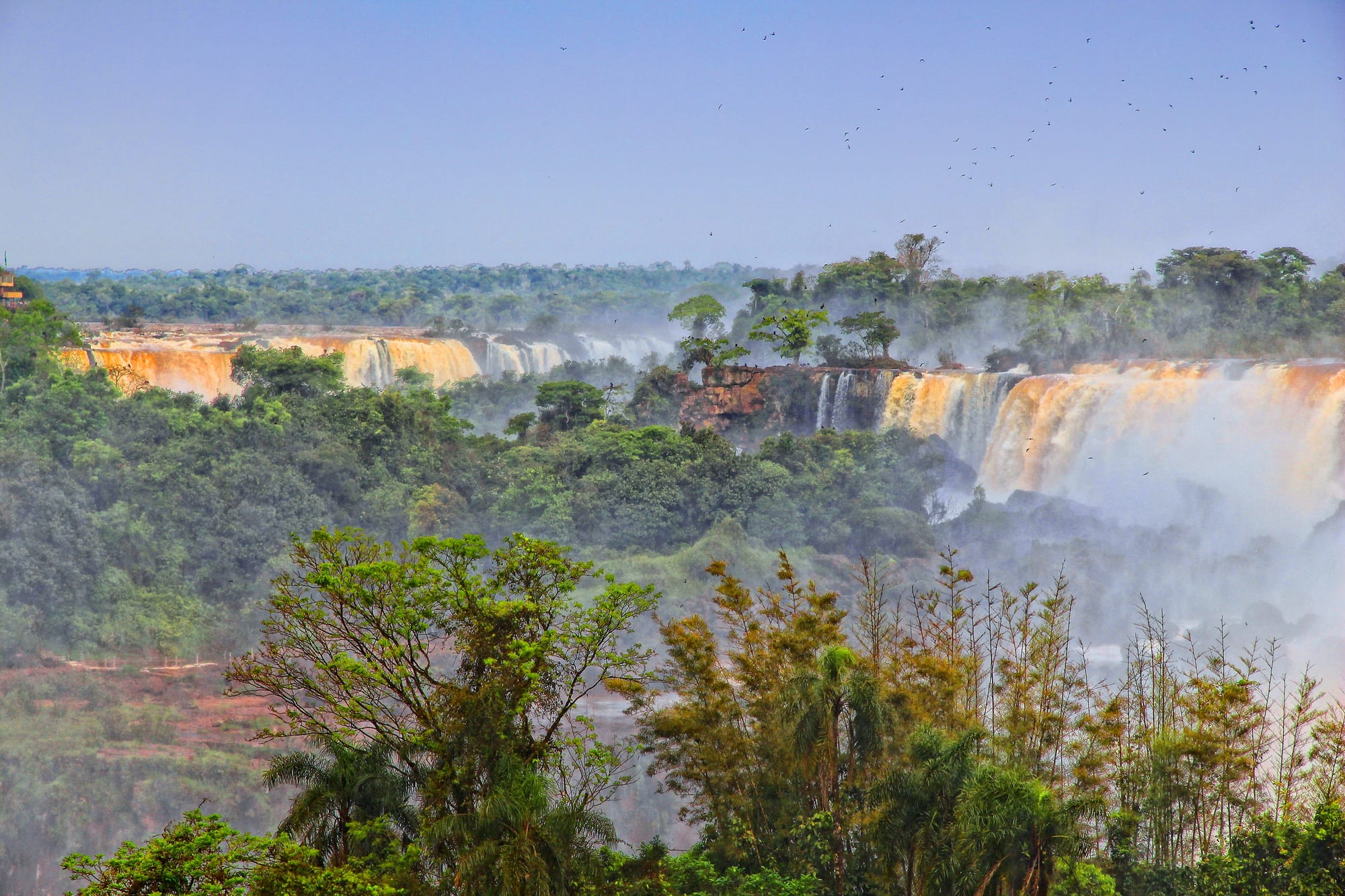
Several broad waterfalls pouring over cliffs into misty gorges, surrounded by dense green subtropical forest

Argentina

Iguazú & the Northeast

The Iguazú falls seen from the Argentine side, in Iguazú National Park, Misiones Province. (Marek Ślusarczyk / Wikimedia Commons · CC BY 3.0)

The subtropical northeast of Argentina — Misiones, Corrientes, Chaco and Formosa — bordered by Paraguay, Brazil and Uruguay, with the Argentine side of the Iguazú falls, the ruined Jesuit missions of the Guaraní, the Iberá wetlands, a strong Guaraní-speaking culture and the dry forests of the Chaco.

Explore Iguazú & the Northeast

History

Before Europeans arrived, the forests and rivers of the northeast were home to Guaraní farming communities, and the Chaco to hunter-gatherer and fishing peoples such as the Qom (Toba), Wichí, Mocoví and Pilagá. Spanish explorers reached the rivers in the 16th century, and Corrientes was founded in 1588 on the Paraná.

From the early 17th century the Jesuits gathered Guaraní communities into reductions, mission towns where tens of thousands lived and worked, and whose militias defended them against slave raiders from Brazil. The Jesuits were expelled in 1767, and the missions declined; their ruins in Misiones, together with one in Brazil, are now a UNESCO World Heritage Site. José de San Martín was born in 1778 at Yapeyú, a former mission town in Corrientes. After independence, Misiones and Corrientes were fought over, and in the War of the Triple Alliance of 1864–70 Paraguayan forces occupied Corrientes city.

The Chaco and Formosa remained Indigenous lands until army campaigns in the late 19th and early 20th centuries, and were administered as national territories until they became provinces in the 1950s. Cotton farming drew settlers, and in 1924 police and ranchers killed hundreds of Toba (Qom) and Mocoví people at Napalpí in the Chaco, a massacre a federal court declared a crime against humanity in 2019; a 2022 truth trial found the Argentine state responsible. Misiones filled with immigrants from Poland, Ukraine, Germany and Scandinavia in the early 20th century.

Culture & Customs

The Guaraní heritage is everywhere. Guaraní is co-official with Spanish in Corrientes, many place names are Guaraní, and the local Spanish is full of Guaraní words and a distinctive accent. Chamamé, the accordion-led folk music of Corrientes, is listed by UNESCO as intangible heritage; its national festival fills Corrientes each January, and its players are famous for the sapucay, a long, high cry of joy.

The northeast is also the home of the Gauchito Gil, a folk saint said to have been a 19th-century gaucho executed near Mercedes in Corrientes. His red flags and roadside shrines appear all over Argentina, and each January huge crowds of pilgrims visit his sanctuary near Mercedes. Corrientes also stages one of the country's biggest carnivals, in a style close to Brazil's carnivals.

Misiones is a mix of cultures: Polish and Ukrainian churches, German towns such as Eldorado, and Oberá's national immigrants' festival sit beside Guaraní villages selling crafts along the roads. In the Chaco, the Qom and Wichí produce weaving, pottery and carved wood, and Resistencia calls itself the city of sculptures, with hundreds on its streets and a biennial sculpture festival.

Daily Life

Resistencia, with around 400,000 people in its metropolitan area, faces Corrientes, of similar size, across the Paraná. Posadas, the capital of Misiones, lies on the Paraná opposite Encarnación in Paraguay, and Formosa is the fourth provincial capital. Puerto Iguazú is a small town that lives from the falls, and Oberá and Eldorado are Misiones's other main towns.

The region is the country's main source of yerba mate, grown on plantations in Misiones and north-eastern Corrientes, along with tea, tobacco, timber and citrus. The Chaco grows cotton and soybeans, and cattle graze the grasslands of Corrientes. The border towns thrive on trade with Paraguay and Brazil, which rises and falls with exchange rates.

The heat sets the pace: early starts, long siestas and busy evenings on the riverfront costaneras. Tereré, mate with cold water and often with herbs, is drunk all day. The northeast, especially the Chaco and Formosa, has some of Argentina's highest poverty rates, and Indigenous communities face poor access to water, health care and land.

Food

The region's food shares much with neighbouring Paraguay. Chipá are small cheese breads made with cassava starch, sold by street vendors everywhere. Sopa paraguaya is, despite its name, a dense, savoury cornbread with cheese and onion, and chipá guazú is a similar dish made with fresh maize. Mbeyú is a cassava-starch pancake with cheese, and reviro is a simple, cheap dish of the region.

River fish are the pride of the table. Surubí, a large catfish, is grilled or served in stews and milanesas, and pacú and dorado are cooked over coals or wrapped in foil. Mandioca (cassava) is boiled or fried as a side, and chicharrón, fried pork, is common. Asado here often includes beef from the Corrientes grasslands.

Yerba mate is drunk hot as mate and cold as tereré, and it is also grown and processed locally, with visits possible to yerba and tea plantations in Misiones. Sweets include dulce de mamón, papaya in syrup, and cakes of cassava flour.

Attractions & Natural Wonders

The Iguazú falls form the border with Brazil, and Iguazú National Park, created in 1934 and a UNESCO World Heritage Site, protects the Argentine side. Its upper and lower circuits of walkways pass the falls at close range, a small train and walkway reach the Garganta del Diablo, where the river plunges into a U-shaped chasm, and boat trips run up to the base of the falls. The surrounding forest holds toucans, coatis and hundreds of butterfly species.

The Jesuit missions lie along the Paraná south of the falls: San Ignacio Miní, with its carved church façade and museum, and the ruins of Santa Ana, Nuestra Señora de Loreto and Santa María la Mayor. East of them, the Saltos del Moconá are unusual falls that run lengthwise along the Uruguay River.

In Corrientes, the Iberá wetlands, protected as provincial and national parks, are explored by boat from Colonia Carlos Pellegrini and other entry points; the rewilding project there has reintroduced jaguars, giant anteaters and other animals. Corrientes city has its riverside Costanera and colonial churches, and Yapeyú the San Martín birthplace memorial. In the Chaco, El Impenetrable National Park and the Campo del Cielo meteorite field near Gancedo draw visitors, and Formosa's Bañado La Estrella is a large wetland of drowned forests and birdlife.

Cities in Iguazú & the Northeast

Planning basics

Budget

Costs are close to the national average. Puerto Iguazú has hostels and mid-range hotels as well as expensive jungle lodges, and entry to the national park is priced higher for foreigners than for Argentines. Iberá's lodges around Colonia Carlos Pellegrini are costly, often on full-board terms, while Corrientes, Resistencia, Posadas and Formosa are cheap.

Daily Budget Midrange
USD 100–200 (hotel or lodge, guided boat trips, park entry and transfers)
Daily Budget Shoestring
USD 35–60 (hostel, set-menu meals, buses)

Allow a full day for the Argentine side of Iguazú, arrive at opening time to beat the tour groups, and carry cash as well as cards in Puerto Iguazú.

Safety

The northeast is generally calm, with petty theft the main urban risk. The Triple Frontier around Puerto Iguazú is a smuggling area with frequent police and border controls. Mosquito-borne dengue has caused large outbreaks in the region in recent years, and the heat is a real hazard. At the falls, coatis bite and should not be fed.

Use insect repellent day and night, drink plenty of water in summer, and keep food away from the coatis at Iguazú. Check current official travel advice before travelling.

Climate

The northeast is subtropical and humid, and it is the wettest part of Argentina, with rain in every season in Misiones. Summers are long and very hot everywhere, and the Chaco and Formosa often record some of the highest temperatures in the country. Winters are mild, with occasional cold snaps and frosts in the south.

Summer
hot and humid, 30–35°C and often higher in the Chaco, with heavy thunderstorms
Winter
mild, 15–22°C by day, cooler at night, with occasional cold spells

Transportation

Puerto Iguazú has an airport with flights of about two hours from Buenos Aires, and Posadas, Corrientes, Resistencia and Formosa have airports too. Long-distance buses connect all the cities, though Buenos Aires to Puerto Iguazú takes most of a day. Local buses run from Puerto Iguazú to the park entrance. Iberá's main village, Colonia Carlos Pellegrini, is reached by gravel road from Mercedes or via the Posadas side, and the Chaco forests need a 4x4 or a tour.

Carry identification near the borders, and check road conditions to Iberá after rain.

Best Time to Visit

March to May and August to November are the most comfortable months, warm but not oppressive. The falls flow year-round, fullest after heavy rain, and are crowded in January and during Argentine holidays. Summer brings Corrientes's carnival and the chamamé festival but also intense heat and mosquitoes. Winter is the best time for the Chaco.