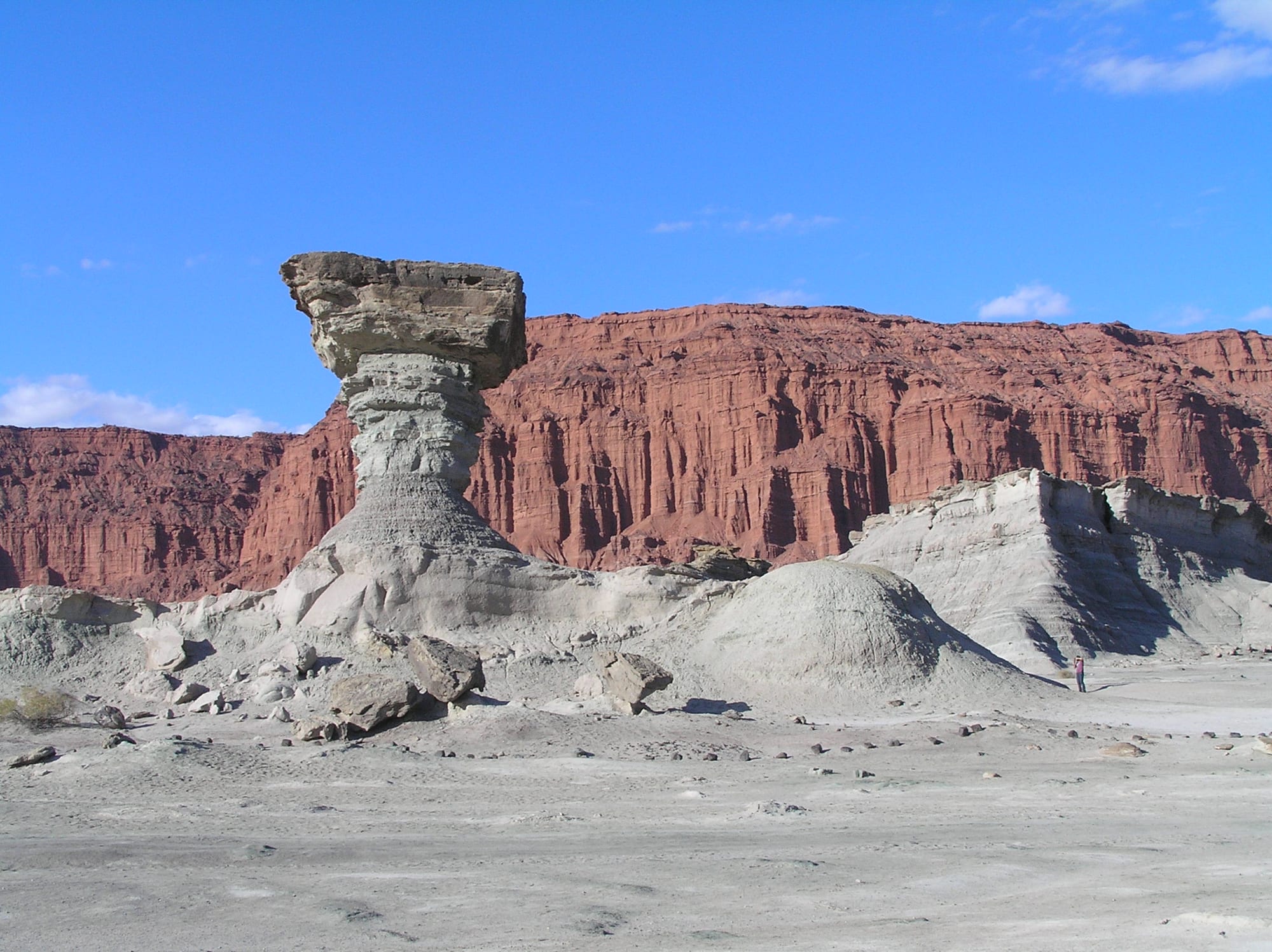
A pale mushroom-shaped rock pillar on grey desert ground in front of tall red sandstone cliffs under a blue sky

Argentina

Mendoza & Cuyo

El Hongo, a wind-carved rock in Ischigualasto Provincial Park, San Juan Province. (M.Bustos / Wikimedia Commons · CC BY-SA 4.0)

The dry west-central provinces of Mendoza, San Juan, San Luis and La Rioja, under the highest stretch of the Argentine Andes — irrigated oasis country that produces most of the nation's wine, with Aconcagua above Mendoza and the fossil-rich desert parks of Ischigualasto and Talampaya in the north.

Explore Mendoza & Cuyo

History

The Huarpe people farmed the oases of Mendoza and San Juan with irrigation channels, and in the 15th century the Incas pushed their road network and authority south into the region; high-altitude Inca shrines have been found on peaks in the Andes above Cuyo. The Spanish arrived from Chile: Pedro del Castillo founded Mendoza in 1561, San Juan followed in 1562 and San Luis in 1594, and Cuyo belonged to the Captaincy General of Chile until it was transferred to the new Viceroyalty of the Río de la Plata in 1776. La Rioja, founded in 1591, came from the north.

José de San Martín governed Cuyo from 1814 and raised the Army of the Andes at El Plumerillo outside Mendoza, leading it across the mountains in 1817 to win Chilean independence before marching on Peru. The region then produced two very different figures of Argentine history: Facundo Quiroga, the caudillo of La Rioja, and Domingo Faustino Sarmiento of San Juan, who attacked him in his book Facundo and later became president.

Earthquakes have shaped the cities. The 1861 quake levelled Mendoza, which was rebuilt with broad avenues, large plazas and tree-lined irrigation ditches, and the 1944 earthquake destroyed San Juan; at a relief fundraiser for it, Juan Perón met Eva Duarte. The arrival of the railway in the 1880s and Italian and Spanish immigrants turned Mendoza into Argentina's wine capital. Carlos Menem, president through the 1990s, came from La Rioja.

Culture & Customs

Cuyanos are known across Argentina for a slower, calmer manner than people in Buenos Aires, and for an accent and idioms of their own. Their folk music is the tonada and the cueca cuyana, played on guitars, and it sounds different from the music of the northwest.

The year turns on wine. Mendoza's Fiesta Nacional de la Vendimia, held in late February or early March, begins with the blessing of the grapes and parades through the city and ends with a staged show in the Frank Romero Day amphitheatre and the election of a harvest queen from the departments of the province. Smaller harvest festivals follow in San Juan and La Rioja.

Popular religion runs strong. The shrine of the Difunta Correa at Vallecito in San Juan, where, as the story goes, a woman died of thirst while her baby survived at her breast, draws huge numbers of pilgrims, and bottles of water left for her line roadsides across the country. Lorry drivers are among her most devoted followers. In La Rioja the Tinkunaco, an encounter ceremony held at New Year, recalls the colonial meeting of Diaguita and Spanish.

Daily Life

Greater Mendoza has about 1.1 million people and is the region's main city, spread across several departments such as Godoy Cruz, Las Heras, Guaymallén, Maipú and Luján de Cuyo. Greater San Juan has around half a million, and the provincial capitals of San Luis and La Rioja are smaller. San Rafael and Villa Mercedes are the other significant towns.

Wine dominates the economy and the landscape: Mendoza produces most of Argentina's wine, and San Juan much of the rest, along with table grapes and raisins. Olives, fruit, garlic and vegetables grow in the irrigated valleys, Mendoza has oil fields, and San Juan has developed gold mining in the high Andes, which remains controversial because of its demands on water.

Life follows the heat. Shops close for a long afternoon siesta and reopen into the evening, when the plazas and pavement cafés fill. Water is the constant issue: drought and shrinking glaciers threaten the snowmelt on which every vineyard, tree-lined street and city depends.

Food

Malbec is the region's signature. Brought from France in the 19th century, it thrives on Mendoza's high, sunny slopes and is now Argentina's best-known wine, alongside Cabernet Sauvignon, Bonarda and, in San Juan, Syrah. La Rioja grows Torrontés Riojano, a fragrant white grape, and San Juan also makes brandies.

Cuyo's food is simple and hearty. Mendoza's empanadas are large, with olives and garlic in the filling, while San Juan's are juicy with plenty of onion. Chivito, young goat, is roasted over an open fire, and La Rioja's empanadas are often made with goat meat. Tomaticán is a dish of tomato and egg, and sopaipillas are fried dough.

Olives and olive oil come from the valleys of La Rioja, San Juan and Mendoza, and Aimogasta in La Rioja is known for its olive groves. The region also produces dried fruit, quince paste (dulce de membrillo) and nuts, and the tortitas mendocinas, small baked breads, are a Mendoza speciality.

Attractions & Natural Wonders

Mendoza's wineries spread across three zones: Maipú, where visitors cycle between bodegas and olive-oil producers; Luján de Cuyo, home to many of the older and larger houses; and the Valle de Uco, an hour or more south-west, where the vineyards of Tupungato, Tunuyán and San Carlos run to the foot of the Andes. The city itself has the huge Parque General San Martín and the Cerro de la Gloria monument to the Army of the Andes.

The road west towards Chile climbs past Uspallata to Puente del Inca, a natural rock bridge coloured by mineral springs, and the entrance to Aconcagua Provincial Park, where a short walk leads to a view of the mountain's south face across the Horcones valley. Further south, San Rafael has the Cañón del Atuel, and Malargüe the ski resort of Las Leñas and the volcanic plains of La Payunia.

San Juan has Ischigualasto Provincial Park, whose eroded rocks and Triassic fossils, among them early dinosaurs such as Eoraptor, form a UNESCO World Heritage Site together with Talampaya National Park in La Rioja, a canyon of red sandstone walls with ancient petroglyphs. La Rioja also has the old mining town of Chilecito and its cable railway, and San Luis the red badlands of Sierra de las Quijadas National Park and the hill town of Merlo.

Cities in Mendoza & Cuyo

Planning basics

Budget

Mendoza city is moderately priced, but wine tourism is not: tasting fees, winery lunches and lodges in the Valle de Uco can cost as much as anywhere in Argentina. San Juan, San Luis and La Rioja are noticeably cheaper, though Ischigualasto and Talampaya are remote and are usually visited by tour or hire car. Aconcagua climbs require a paid park permit and usually a guiding and mule-support package.

Daily Budget Midrange
USD 100–220 (hotel, winery lunches and tastings, a hire car or tours)
Daily Budget Shoestring
USD 35–60 (hostel, cycling between Maipú wineries, buses)

Book winery visits in advance, and share a hire car or tour for the long day trips to Ischigualasto and Talampaya.

Safety

Cuyo is one of the calmer parts of Argentina; theft in central Mendoza and San Juan is the main urban risk. The natural hazards are more serious: altitude sickness and severe weather on Aconcagua, which kills climbers most seasons, extreme heat and dehydration in the desert parks, and earthquakes, which have destroyed Mendoza and San Juan in the past.

Acclimatise slowly and go with experienced guides on Aconcagua, carry plenty of water in the desert, and never drink and drive after tastings. Check current official travel advice before travelling.

Climate

Cuyo is semi-desert, with very little rain, abundant sunshine, hot summers and cold, clear winters. Vineyards survive on snowmelt channelled through irrigation canals. The zonda, a hot, dry wind off the Andes, can blow for days. Altitude changes everything: the high Andes are icy and snowbound much of the year.

Summer
hot and dry, 30–35°C in the cities and hotter in the desert parks; afternoon storms in the mountains
Winter
sunny and cool days of around 12–16°C, frosty nights, and heavy snow in the high Andes

Transportation

Mendoza has the region's main airport, about two hours by air from Buenos Aires, and a large bus station with services across Argentina and over the Andes to Chile. San Juan, San Luis and La Rioja also have airports and bus links. Ischigualasto and Talampaya are hours from the provincial capitals and poorly served by public transport, so most visitors join tours or hire a car. The high road to Chile through the Andes can close in winter snow.

Check the pass status before any winter crossing towards Chile, and cycle or take a tour rather than drive between tastings.

Best Time to Visit

Autumn (March–April) is the classic season, with the grape harvest and Mendoza's Vendimia festival in late February or early March. Spring (September–November) is also good for the wineries and desert parks. Aconcagua's climbing season runs from about December to March, and the ski season at Las Leñas and Penitentes from roughly June to September. Midsummer is very hot in Ischigualasto and Talampaya.