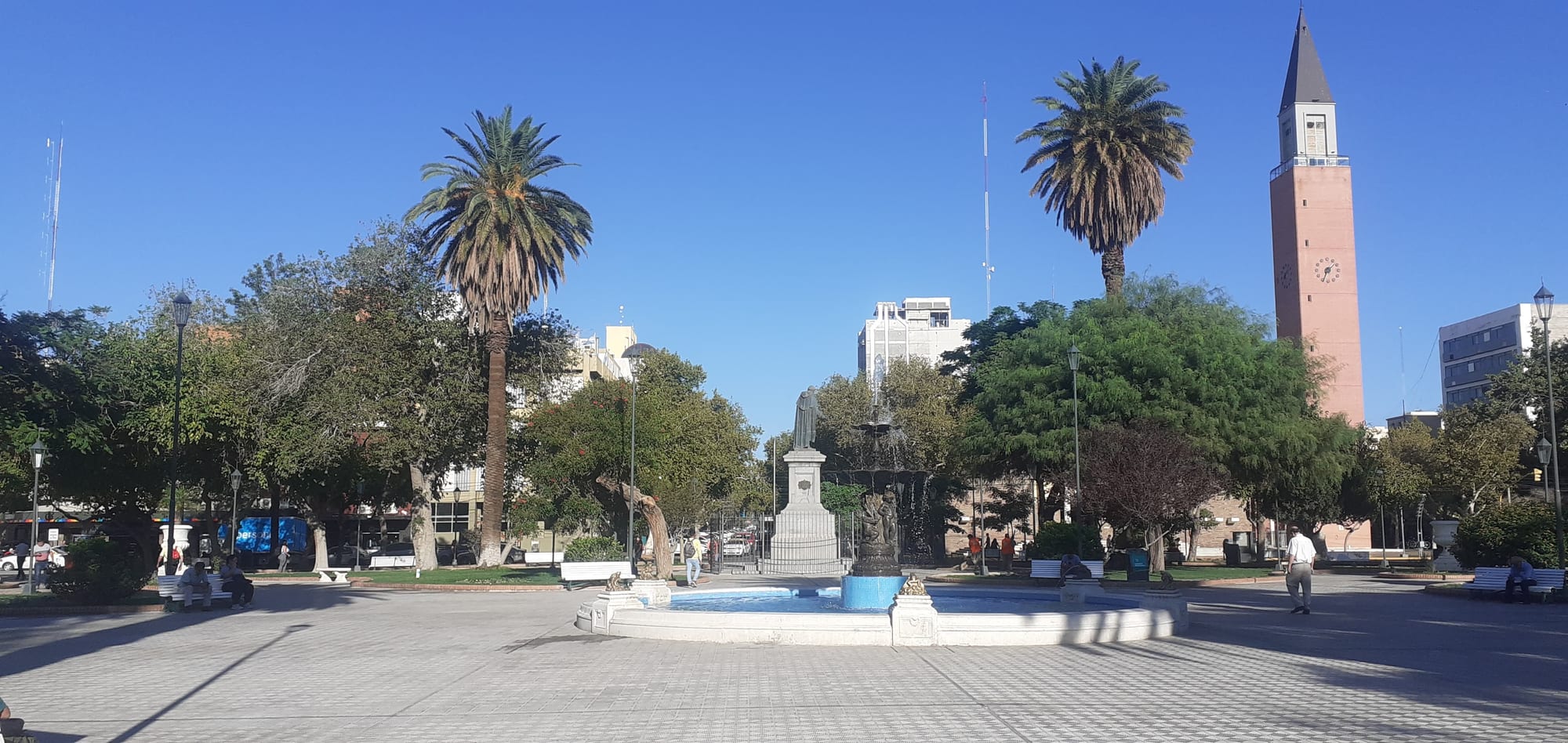
A paved square with a fountain, palm trees and a statue, and a tall red-brick bell tower rising on the right under a clear sky

Mendoza & Cuyo, Argentina

San Juan

Plaza 25 de Mayo in the centre of San Juan, with the cathedral's bell tower. (Enrique Guardia / Wikimedia Commons · CC0)

The capital of San Juan Province, in the irrigated Tulum Valley beneath the Andes about 170 km north of Mendoza. Founded in 1562 and the birthplace of Domingo Faustino Sarmiento, it was almost entirely destroyed by the earthquake of 1944 and rebuilt as a low, modern city of wide, tree-lined avenues — the centre of Argentina's second wine province and the base for the desert parks to the north.

Neighbourhoods

  • The centre and Plaza 25 de Mayo
    • First-time visitors
    • Museums
    • Cafés

    The main square, with statues of Sarmiento and Fray Justo Santa María de Oro, the cathedral and its bell tower, and partly pedestrianised streets running towards Plaza Aberastain. Sarmiento's birthplace, the Franklin library and most cafés and hotels are within a few blocks.

    Open in Maps
  • Parque de Mayo and the civic centre
    • Parks
    • Culture
    • Families

    The large park west of the centre, created under a law of 1910 to mark the centenary of the May Revolution, with an artificial lake and cycling paths, close to the natural-science museum, the Teatro del Bicentenario and the provincial government buildings.

    Open in Maps
  • Rivadavia
    • Quiet and residential
    • Close to the hills

    A separate city about 7 km west of the centre and part of Greater San Juan, mostly residential, at the foot of the Sierra Chica de Zonda and on the road to the Quebrada de Zonda and the Ullum reservoir.

    Open in Maps
  • The wine departments
    • Wine country
    • Rural landscapes

    The vineyards of the Tulum Valley spread around the city through departments such as Pocito, Rawson and Albardón, where wineries open for visits along the San Juan wine routes.

    Open in Maps

Things to do

Landmarks and museums in the centre

  • Plaza 25 de Mayopark

    The main square on the site chosen when the city was moved in 1593, shaded by palms, with century-old statues of Sarmiento and Fray Justo Santa María de Oro.

    Open in Maps
  • San Juan Cathedrallandmark

    The cathedral of St John the Baptist, completed in 1979 to replace the church ruined in 1944, with a 51-metre red-brick bell tower that has a lift to a viewpoint at the top.

    Open in Maps
  • Casa Natal de Sarmientomuseum

    The adobe house where Domingo Faustino Sarmiento was born in 1811, built by his mother Paula Albarracín, who wove under a fig tree in its courtyard; Argentina's first national historic monument, declared in 1910.

    Open in Maps
  • Museo Provincial de Bellas Artes Franklin Rawsonmuseum

    The city's main art museum, named after the San Juan-born 19th-century painter Franklin Rawson and regarded as one of the leading fine-arts museums in Argentina.

    Open in Maps
  • Biblioteca Franklinlandmark

    A public library founded in 1866 on Sarmiento's initiative, the oldest popular library in South America, a block from the main square.

    Open in Maps

Parks and science

  • Parque de Mayopark

    The city's main park, created under a law of May 1910, with an artificial lake and island, a cycling circuit and many statues.

    Open in Maps
  • Museo de Ciencias Naturalesmuseum

    The natural-science museum in the old Belgrano railway station near Parque de Mayo, focused on dinosaurs, with the cleaning of fossils on view.

    Open in Maps

Short trips: dams, hills and motor racing

  • Quebrada de Ullúm Damviewpoint

    An embankment dam on the San Juan River, opened in 1980 about 18 km upstream of the city, whose reservoir supplies irrigation for the valley and is used for water sports and outings.

    Open in Maps
  • Punta Negra Damviewpoint

    A 101-metre dam on the San Juan River about 28 km west of the city, built for irrigation and hydroelectric power.

    Open in Maps
  • Autódromo Eduardo Copelloattraction

    The motor-racing circuit known as El Zonda, opened in 1967 in the Quebrada de Zonda gorge west of the city, a regular venue for TC 2000 races.

    Open in Maps
  • Estadio San Juan del Bicentenarioattraction

    The provincial football stadium in Pocito, a venue of the 2011 Copa América, also used for rugby and field hockey.

    Open in Maps
  • Museo Arqueológico Mariano Gambiermuseum

    An archaeology museum at La Laja in Albardón, about 25 km north, covering the prehistory of San Juan from its first human settlers to the Spanish conquest.

    Open in Maps
  • Difunta Correa shrinelandmark

    The roadside sanctuary at Vallecito of the Difunta Correa, a folk saint not recognised by the Church, full of offerings — among them bottles of water — left by pilgrims.

    Open in Maps

Seasonal events

  • Fiesta Nacional del Sollast week of February

    A five-day festival first held in 1972 and national since 1993, with parades of carriages, themed exhibitions, concerts and the election of the Queen of the Sun from candidates of the nineteen departments.

Eat and drink

Long-standing places and food districts in San Juan. Hours, ratings and directions come from your maps app, always current.

San Juan classics

  • Tabletas sanjuaninascafe

    San Juan's own version of the alfajor, a local sweet widely sold in the city.

    Open in Maps
  • Empanadas and grill restaurantsrestaurant

    Juicy, onion-rich San Juan empanadas, and grills serving chivito, young goat, and beef.

    Open in Maps

Cafés and wine

  • Cafés around Plaza 25 de Mayoneighborhood

    The partly pedestrianised streets off the main square hold the city's older cafés, busy in the morning and again after the siesta.

    Open in Maps
  • San Juan wine routesneighborhood

    Wineries in the departments around the city, known for Syrah, that open for tastings and tours.

    Open in Maps

Experience San Juan

History

The Huarpe farmed the Tulum Valley with irrigation channels before the Spanish arrived from Chile. On 13 June 1562 Juan Jufré founded San Juan de la Frontera, naming it after his patron saint, John the Baptist, and laid out a grid of 25 blocks; Jufré himself returned to Chile the same year. At the end of 1593 the San Juan River swept the town away, and it was moved 25 blocks south to its present site around what is now Plaza 25 de Mayo.

The city's most famous son, Domingo Faustino Sarmiento, was born here in 1811 in the adobe house his mother had built. A fierce critic of the caudillos, he wrote Facundo in exile, governed the province in the 1860s and became president of Argentina in 1868; in 1866 his initiative founded the Franklin library. Irrigated vineyards made the valley wine country.

On the evening of 15 January 1944 an earthquake centred north of the city, near La Laja, destroyed some 90 per cent of the city's buildings, most of them adobe, and killed about 10,000 people. At a fundraiser for the victims Juan Perón met Eva Duarte. San Juan was rebuilt under a new seismic building code. Another earthquake in 1977 destroyed the town of Caucete; the new cathedral was completed in 1979, and the Ullum dam followed in 1980.

Culture & Customs

Sarmiento is everywhere: his statue stands on the main square, his birthplace became Argentina's first national historic monument in 1910, and the province's identity is bound up with his cause of public education. The Franklin library, the Franklin Rawson fine-arts museum and the Teatro del Bicentenario near Parque de Mayo anchor a cultural life that is busy for a city of its size.

The great annual celebration is the Fiesta Nacional del Sol, held over five days in the last week of February since 1972, with parades of carriages, themed exhibitions, concerts and the election of a queen from the nineteen departments. Cuyo's folk music, the tonada and the cueca cuyana, is the local sound, and the grape harvest brings its own celebrations.

Popular religion runs strong. The shrine of the Difunta Correa at Vallecito, east of the city, draws huge crowds of pilgrims, and bottles of water left for her line roads across Argentina. Sport means football — San Martín, founded in 1907, is the province's best-known club — and motor racing at El Zonda, the circuit opened in the Quebrada de Zonda in 1967 and best known for its TC 2000 races. Sanjuaninos share the Cuyo reputation for a calm, unhurried manner.

Daily Life

Greater San Juan had about 547,000 people at the 2022 census, the eighth-largest urban area in Argentina, spreading from the small central Capital department into Rivadavia, Chimbas, Rawson, Santa Lucía and other neighbouring departments. Most people live in low houses on wide, tree-lined streets, with taller blocks only in the centre.

Agriculture is the base of the economy, and about two-thirds of the valley's farm production is linked to wine: San Juan is Argentina's second wine-producing province and also grows olives, figs, fruit and vegetables. Gold mining in the high Andes has grown into a major industry, and there is evidence that it may be harming the province's glaciers. Provincial government, the National University of San Juan, commerce and services employ much of the city.

Life follows the heat and the water. Rain is rare, so every garden, tree and vineyard depends on the San Juan River and its dams. Shops close for the afternoon siesta and the plazas fill in the evening. When the zonda blows, temperatures jump and dust fills the air, and people stay indoors until it passes. As across Argentina, inflation and the cost of living shape household budgets.

Food

Wine is the province's pride. San Juan is best known for Syrah, which suits its hot, sunny valleys, alongside Malbec and other reds, and the province also produces brandies, sherry-style wines and vermouth. Its vineyards lie at altitudes of roughly 600 to 1,400 metres and depend on irrigation from the San Juan and Jáchal rivers, and olive oil comes from the same irrigated valleys.

The local empanada is juicy and full of onion, and chivito, young goat roasted over an open fire, is the celebratory meat, alongside the beef asado shared across Argentina. Cuyo dishes such as tomaticán, a stew of tomato and egg, and sopaipillas, rounds of fried dough, are everyday home cooking.

The sweet speciality is the tableta sanjuanina, the local version of the alfajor, widely sold in the city. In the sunny oases, quinces, peaches and melons ripen early. Cafés around Plaza 25 de Mayo serve coffee and pastries in the morning and fill again in the early evening, after the siesta.

Planning tools

Budget

San Juan is noticeably cheaper than Mendoza, with lower prices for rooms, meals and winery visits. The main costs are excursions: the desert parks to the north are remote and usually visited by tour or hire car, so a shared car or a tour is the biggest single expense of most stays.

Daily Budget Midrange
USD 100–220 (hotel, winery visits and grill dinners, a hire car or tours to the desert parks)
Daily Budget Shoestring
USD 35–60 (hostel or budget hotel, empanadas and set lunches, city buses)

Share a hire car or tour for the long trips north; the plazas, the park and several museums are free or cheap.

Best Time to Visit

Spring (September–November) and autumn (March–May) are the best seasons, warm and dry without the summer extremes. Summer is very hot but brings the Fiesta del Sol in late February and the grape harvest. Winter days are mild and sunny with cold nights, a good time for the desert, though the zonda can blow.

Suggested Number of Days

Two days cover the city's museums, plazas and a nearby dam or winery. Four or five allow for the long journeys to the desert parks and the Andean valleys of the west; the distances, not the number of sights, decide the length of a stay.

First Visit
2 days
With Surroundings
4–5 days

Transportation

The centre is compact and walkable, and city buses, taxis and remises cover Greater San Juan. The dams, the Quebrada de Zonda and the wineries are a short drive away. Ischigualasto Provincial Park, a day's round trip of several hundred kilometres to the north-east, is reached by tour or hire car, often combined with Talampaya in La Rioja.

Start long desert drives early, carry water and fuel, and never drive after wine tastings.

Airport & Station Connections

Domingo Faustino Sarmiento Airport, outside the city in the 9 de Julio Department, has flights from Buenos Aires. The bus terminal, about 1.5 km east of the centre, has services across the country; Mendoza is about 170 km south on National Route 40, and Buenos Aires about 1,100 km away.

Walkability

The rebuilt centre is flat, with wide pavements, shaded streets and irrigation channels, and the main square, the cathedral, the museums and Parque de Mayo are all within walking distance. Walking is hard work in the summer heat around midday and during zonda days.

Safety

Argentina is relatively safe by regional standards, and violent crime against visitors is uncommon. In San Juan the urban risk is petty theft in the centre. The natural hazards matter more: summer heat and dehydration, the zonda's dust and heat, and earthquakes, which destroyed the city in 1944.

Drink plenty of water in summer and on desert trips, stay indoors when the zonda is strong, and learn the earthquake procedures at the place of stay. Check current official travel advice before travelling.

Climate

Desert-dry and sunny, with very little rain, hot summers and mild winters. Summer is December–February. The zonda, a hot, dry foehn wind from the Andes, can blow for hours at a time, and on and off for two or three days, raising temperatures and dust.

Summer
hot and dry, averaging between 19°C and 35°C, with occasional storms
Winter
mild sunny days and cold nights, averaging between 1°C and 16°C

Local Customs

Shops close for a long siesta in the early afternoon and reopen into the evening, and dinner is late. Sanjuaninos are proud of Sarmiento, of their wine and of their resilience after the 1944 earthquake. Folk Catholicism is strong, and the Difunta Correa is widely venerated.

A tip of around 10 per cent is usual in restaurants. Greet with a single kiss on the cheek once introduced, and dress modestly in churches and shrines.

Common Payment Methods

The currency is the Argentine peso (ARS). Inflation has been high for years, though it has eased since 2024, so prices change often. Cards are widely accepted in hotels, restaurants and larger shops; kiosks, bakeries and small businesses may prefer cash, and ATMs are common in the centre. Carry some clean US dollar bills as a backup.