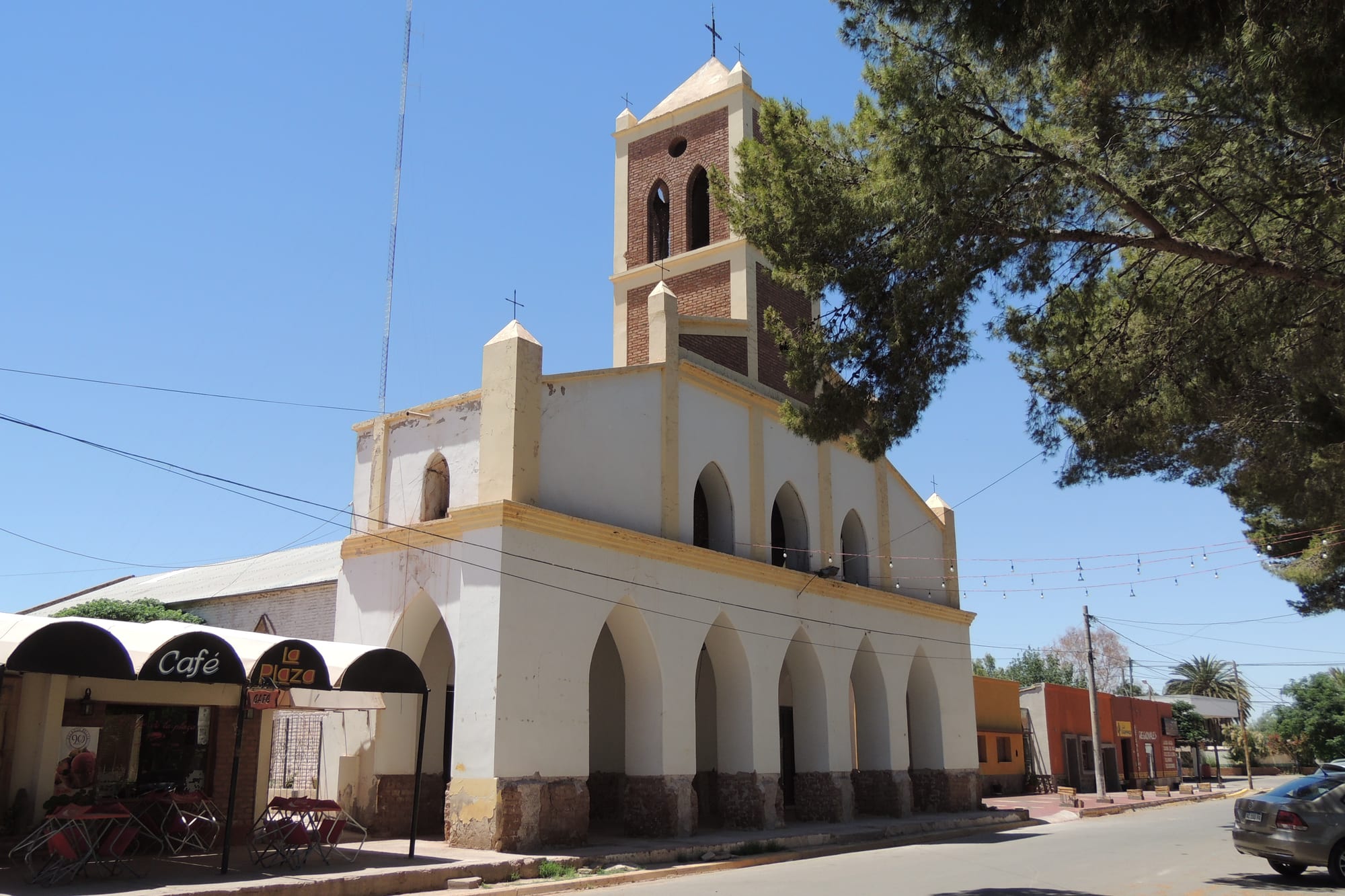
A white arcaded parish church with a brick bell tower beside a café, under pine trees and a clear blue sky

Mendoza & Cuyo, Argentina

Villa Unión

The parish church of Nuestra Señora del Rosario on the main square of Villa Unión, La Rioja. (miroab / Wikimedia Commons · CC BY-SA 2.0)

A small farming town in the Bermejo Valley of western La Rioja, at more than 1,100 metres between the Sierra de Famatina and the Andean foothills. Founded as Los Hornillos and renamed in 1881, it lives from grapes, fruit and fodder, and has grown into the main base for the red canyons of Talampaya National Park.

Neighbourhoods

  • The town centre and plaza
    • First-time visitors
    • Close to the bus station
    • Places to eat

    A grid of low streets around the main square and the parish church of Nuestra Señora del Rosario, with Avenida Nicolás Dávila as the main street. Guesthouses, shops selling regional produce, cafés and the taxis that run to the parks are all within a few minutes' walk.

    Open in Maps
  • Banda Florida
    • Quiet and rural
    • Rock formations

    A small village just west of the town, on the Bermejo River, among red rock. Its rock formations and ancient petroglyphs make an easy outing.

    Open in Maps

Things to do

In and around the town

  • Banda Floridaattraction

    The neighbouring village west of town, with red rock formations and petroglyphs carved by the valley's earlier inhabitants.

    Open in Maps

Short trips from the town

  • Talampaya National Parkpark

    A national park since 1997 and a UNESCO World Heritage Site since 2000, whose gorge has red sandstone walls up to about 143 metres high, with petroglyphs at the mouth of the canyon.

    Open in Maps
  • Ischigualasto Provincial Parkpark

    The Valle de la Luna, across the border in San Juan, a desert basin of eroded rocks whose Triassic beds hold some of the earliest known dinosaur fossils.

    Open in Maps
  • Guandacolattraction

    The older village of the valley, home of the Diaguita people of Guandacol before the Spanish conquest and the department's first main town.

    Open in Maps
  • Chilecitoattraction

    A La Rioja town and old mining centre on the far side of the Sierra de Famatina, reached by the winding mountain road over the Cuesta de Miranda.

    Open in Maps

Seasonal events

  • Festival del Peón ViñadorCarnival, February or March

    The town's harvest festival, celebrating the vineyard workers and the traditional way of making wine by treading the grapes.

  • Fiesta de la Virgen del RosarioOctober

    The Catholic feast of Our Lady of the Rosary, on 7 October, to whom the parish church on the plaza is dedicated.

Eat and drink

Long-standing places and food districts in Villa Unión. Hours, ratings and directions come from your maps app, always current.

Villa Unión classics

  • Regional produce shopsmarket

    Shops around town selling productos regionales — the valley's dried fruit, preserves and vino patero, the foot-trodden local wine.

    Open in Maps
  • Restaurants around the plazaneighborhood

    Simple grills, cafés and bars near the main square, serving grilled meat, empanadas and sandwiches to visitors back from the parks.

    Open in Maps

Experience Villa Unión

History

The Bermejo Valley was the land of Diaguita peoples, among them the Indians of Guandacol, who resisted the Spanish when they entered the valley around 1634. In 1636 Gerónimo Luis de Cabrera punished their resistance by expelling them to the slopes of the Famatina range, and many died on the way; the land was formally returned to them in 1650. A small settlement of Spanish colonists grew up early in the 17th century at Los Hornillos, named after the kilns on the banks of the Bermejo where people baked their bread.

Around 1750 three families from Chile settled at Guandacol, then moved to Los Hornillos, where local families gave them protection and land. That welcome is remembered in the town's name. When La Rioja was divided into departments in 1869, Guandacol was the head town and Los Hornillos one of its districts; on 9 September 1881 the department was renamed and Los Hornillos, renamed Villa Unión, became its capital.

An earthquake in 1854 had already left the original settlement in ruins and pushed it a little to the north, onto three long north–south streets. Through the 20th century Villa Unión stayed an agricultural town of vineyards and orchards. Tourism arrived with the protection of Talampaya, made a provincial reserve in 1975 and a national park in 1997, and the World Heritage listing it shares with Ischigualasto in 2000.

Culture & Customs

Villa Unión is a country town of the La Rioja highlands, where the year is set by the grape harvest and the Catholic calendar. The parish church of Nuestra Señora del Rosario stands on the plaza; the Virgin of the Rosary's feast falls on 7 October.

At Carnival the town holds the Festival del Peón Viñador, honouring the vineyard workers and the old way of making wine by treading grapes underfoot. The result, vino patero, is one of the products sold all over town alongside dried fruit and preserves. As elsewhere in western Argentina, folk music rather than tango fills local festivals, and evenings are spent outdoors around the plaza once the heat has gone.

Popular devotion also runs deep. In the town cemetery lies Miguel Ángel Gaitán, a mummified child who died in 1967 and is believed by many to perform miracles; his glass-lidded coffin is visited by people from across Argentina. The town's identity is also bound up with the parks: local people work as guides, drivers and hosts for the travellers who come to see the canyons.

Daily Life

Villa Unión had about 5,000 people at the 2010 census, and is the main town of the Coronel Felipe Varela Department. Agriculture remains the base of the economy: about half of it is grape growing, the grapes high in alcohol content thanks to the climate, with the rest given over to fruit, cereals and fodder. Livestock is kept only for local needs. The mountains around the valley have been mined for clay, barytes, talc, marble and other minerals.

Tourism has grown into the town's second pillar, with guesthouses, tour operators and taxis serving visitors to Talampaya and the other parks. The National University of La Rioja has a campus here. An international route to Copiapó in Chile, with a paved road and a tunnel across the Andes, has been under construction.

The day follows the climate: early starts, a long afternoon siesta behind closed shutters, and shops and the plaza busy again in the evening. Summer storms can bring floods that cut roads, and the zonda, a hot, dry wind full of dust, blows down from the Andes.

Food

Food here is the plain, hearty cooking of La Rioja. Grilled meat, empanadas — the La Rioja kind made with hard-boiled egg, red pepper, olives and raisins — and roast chivito, young kid cooked over an open fire, are the standard dishes, and stews such as locro are typical of the region. Tomaticán, tomato cooked with egg, is typical of neighbouring Cuyo, and sopaipillas, fried dough, are made across Argentina.

The valley's own products are sold everywhere as productos regionales: dried fruits, fruit preserves and vino patero, the strong, rustic wine made by treading the grapes. Torrontés Riojano, the most common and most aromatic of Argentina's three Torrontés varieties, grows in the province and gives fragrant white wines.

Restaurants and cafés gather around the plaza and along the main avenue, serving grills, pizzas and sandwiches to visitors returning from the parks, and dinner starts late, as everywhere in Argentina. Local tables also offer roast chivito, homemade bread and wine, with the area's sweets and walnuts.

Planning tools

Budget

Villa Unión is a cheap place to sleep and eat compared with the wine country around Mendoza. The real costs are getting to the parks: Talampaya is visited on the park's own guided excursions, and Ischigualasto and the high country beyond need a tour, a shared taxi or a hire car.

Daily Budget Midrange
USD 80–170 (hotel, sit-down dinners, park excursions and a hire car or tours)
Daily Budget Shoestring
USD 30–55 (hostel or simple guesthouse, empanadas and set lunches, shared taxis)

Travelling in a group of three or more makes a taxi or hire car to the parks better value than separate tour seats.

Best Time to Visit

Autumn (March–May) and spring (September–November) bring warm days and cool nights, the easiest conditions for the canyons. Summer is very hot and is also the rainy season, when floods can cut the valley roads; winter days are sunny and mild but nights are cold.

Suggested Number of Days

Two days cover the town and its nearest park. Allow three or four to add the second desert park across the provincial border and the mountain road east; the distances are long and the excursions take most of a day each.

First Visit
2 days
With Surroundings
3–4 days

Transportation

The town itself is small enough to cross on foot. Taxis wait on the north side of the plaza and also make the longer runs to the parks and nearby villages. Buses connect the town with La Rioja city, Chilecito and San Juan.

Carry water and fill the tank before driving to the parks, where services are few.

Airport & Station Connections

The nearest airline airport is Capitán Vicente Almandos Almonacid Airport on the edge of La Rioja city, with flights from Buenos Aires. Villa Unión is about 275 km west of the provincial capital by National Route 76, a drive of several hours, and long-distance buses run from La Rioja, Chilecito and San Juan to the town's bus station.

Walkability

The centre is a few flat blocks around the plaza and is easy to walk, though summer afternoons are too hot for long walks and the shade is limited. Banda Florida is within reach by bicycle or a short taxi ride.

Safety

Argentina is relatively safe by regional standards, and violent crime against visitors is uncommon. Villa Unión is a quiet small town, and the real hazards are natural: heat and dehydration in the desert parks, summer floods on the valley roads, and the dusty zonda wind.

Carry plenty of water and sun protection into the parks, and avoid driving flooded roads in the rainy season. Check current official travel advice before travelling.

Climate

A mountain-desert climate with a large difference between day and night temperatures. In the southern hemisphere summer is December–February; it is hot here, with January and February the wettest months, while winter is dry and cool. The average yearly temperature is about 17°C.

Summer
hot, with rain and occasional floods in January and February; extremes above 40°C have been recorded
Winter
dry and sunny by day, cold at night, with frosts down to about −7°C at the extreme

Local Customs

Life follows the heat: shops close for a long siesta in the afternoon and reopen into the evening, when the plaza fills. Greetings are warm and unhurried, and a kiss on the cheek is normal between acquaintances. A tip of about 10 per cent is usual in restaurants.

Dress modestly in the church, and leave petroglyphs and rock formations untouched — they are protected.

Common Payment Methods

The currency is the Argentine peso. Cards are taken in hotels and some shops, but a small town runs largely on cash and transfers, so it is wise to arrive with enough pesos from La Rioja or San Juan.