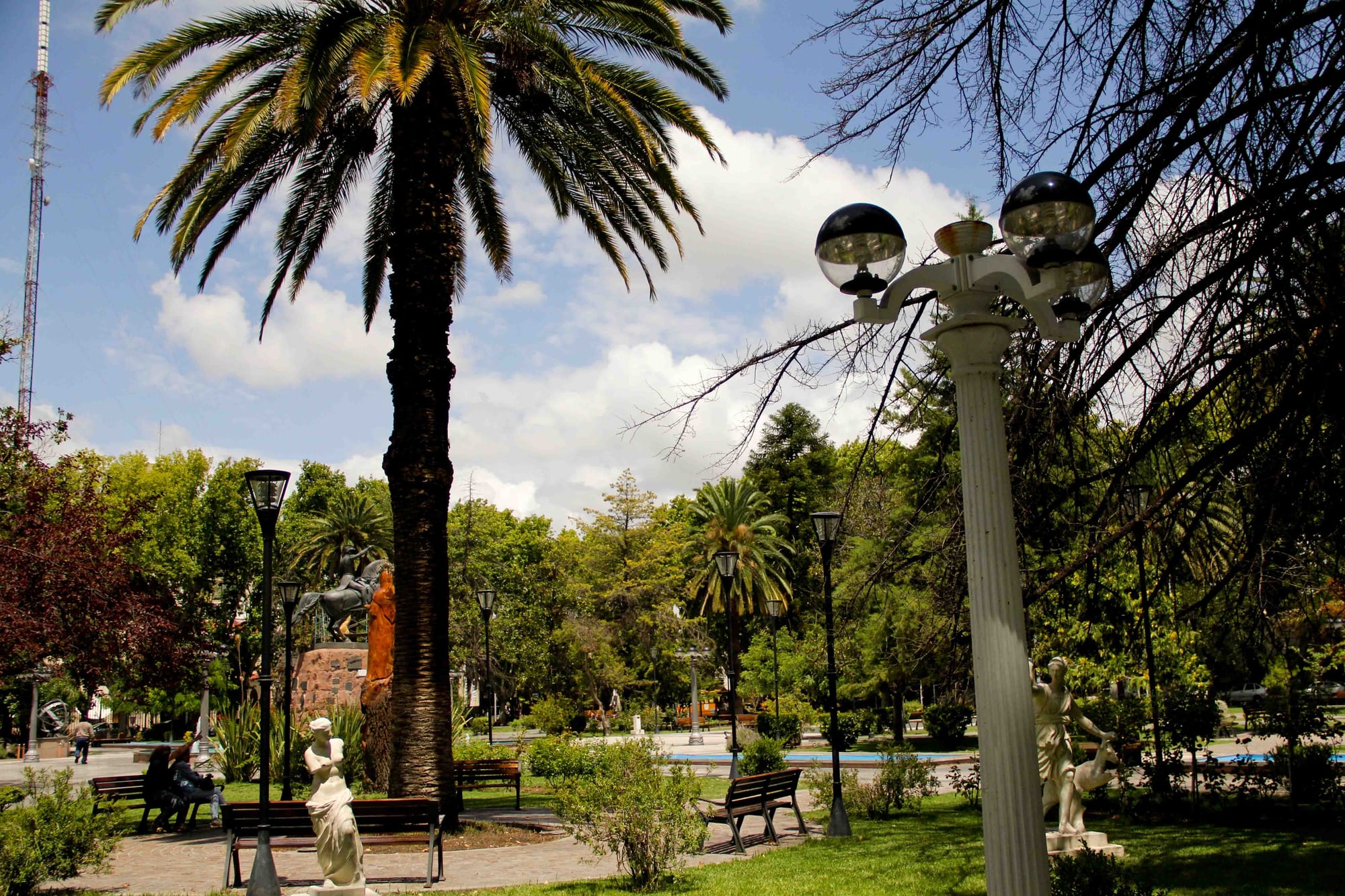
Palm trees, white lamp posts and classical statues along the paths of a leafy plaza under a blue summer sky

Mendoza & Cuyo, Argentina

San Rafael

Plaza San Martín in the centre of San Rafael. (Lautaro Sanchez / Wikimedia Commons · CC BY-SA 3.0)

The main city of southern Mendoza Province, in an irrigated oasis between the Diamante and Atuel rivers about 240 km south of the provincial capital. It grew from a frontier fort of 1805 into a farming colony shaped by French, Italian and Spanish settlers, and is now a wine and fruit town and the base for the canyon and reservoirs of the Atuel.

Neighbourhoods

  • The centre
    • First-time visitors
    • Shopping
    • Best for food

    A grid of broad, tree-lined avenues around Plaza San Martín, with the cathedral, shops, cafés and restaurants. Most of the town's services and its busiest evening streets are here.

    Open in Maps
  • La Isla and the Diamante River
    • Parks
    • Families
    • Quiet and residential

    The district on the Diamante River, which forms the edge of the city, with Parque Mariano Moreno, a zoo and a campsite.

    Open in Maps
  • Valle Grande
    • Outdoors
    • River sports
    • Cabins and campsites

    The valley around the Valle Grande reservoir and the lower Atuel Canyon, about 30 km south of the city, lined with cabins, campsites and rafting bases. A place to stay for those who come mainly for the river.

    Open in Maps

Things to do

In the city

  • Plaza San Martínpark

    The main square, laid out in 1925 on a Spanish model, in the heart of the centre.

    Open in Maps
  • Museo de Historia Natural de San Rafaelmuseum

    The municipal natural history museum, whose collections include archaeology, palaeontology, mineralogy, botany and zoology.

    Open in Maps

Short trips: reservoirs and dams

  • Valle Grandeviewpoint

    A reservoir on the Atuel about 30 km south of the city, held back by a 115-metre dam and ringed by steep, rocky hills — a popular place for swimming and picnics.

    Open in Maps
  • Los Reyunos Damviewpoint

    A 130-metre embankment dam on the Diamante River, opened in 1984, whose reservoir is used for fishing, windsurfing and canoeing, with hiking in the hills around it.

    Open in Maps
  • El Nihuil reservoirviewpoint

    The largest reservoir in Mendoza Province, at the top of the Atuel Canyon, known for its colour and its water sports.

    Open in Maps

Short trips: the canyon and the old fort

  • Atuel Canyontrail

    A narrow canyon of eroded, coloured rock, around 260 metres deep, whose rapids of class II to IV are used for rafting and kayaking; a road follows it up past a chain of dams.

    Open in Maps
  • Villa 25 de Mayoattraction

    A village about 25 km west of the city on the site of the Fort San Rafael del Diamante of 1805, the first seat of the department.

    Open in Maps

Eat and drink

Long-standing places and food districts in San Rafael. Hours, ratings and directions come from your maps app, always current.

San Rafael classics

  • Grill restaurantsrestaurant

    Chivito, young goat, and racks of beef ribs, costillares, roasted over embers — the local grill specialities.

    Open in Maps
  • Wine routes of San Rafaelneighborhood

    Wineries around the city that open for tastings.

    Open in Maps

In town

  • The centre's cafés and restaurantsneighborhood

    Cafés, ice-cream shops and restaurants on the avenues around the main square, busiest in the evening after the siesta.

    Open in Maps

Experience San Rafael

History

The valleys of the Diamante and Atuel lay on the southern frontier of Spanish Cuyo. Francisco de Villagra's expedition from Chile reached the Diamante in 1551, but for more than two centuries the land to the south belonged to the Pehuenche and other Indigenous peoples. After repeated conflict, a treaty of 1804 with the viceroy Rafael de Sobremonte opened the way for a fort, and on 2 April 1805 the Fuerte San Rafael del Diamante was built on the north bank of the Diamante, named in the viceroy's honour. Its site is today's Villa 25 de Mayo, which remained the seat of the department for a century.

The modern city was the work of immigrants. Around 1870 the French engineer Julio Gerónimo Balloffet settled in the area, built a fortified ranch and promoted irrigation, roads and public works; with his support his compatriot Rodolfo Iselin founded a French colony, and Italian and Spanish settlers formed colonies of their own nearby. By 1900 the orchards and vineyards had made the area prosperous. The railway arrived in November 1903, the seat of the department moved to the growing colony, and in 1922 it was formally declared a city.

The rail link brought fruit-packing and food industries, and the Plaza San Martín was laid out in 1925; the cathedral was built between 1935 and 1952. The rivers were then put to work: the Los Nihuiles hydroelectric system on the Atuel created the large El Nihuil reservoir, and Los Reyunos Dam on the Diamante followed in 1984. The reservoirs and the canyon between them turned San Rafael into southern Mendoza's tourist centre.

Culture & Customs

San Rafael's identity mixes the wine culture of Mendoza with a frontier town's attachment to the outdoors. The French, Italian and Spanish colonies left family names, wineries and farming traditions across the department, and the town's fine arts museum, founded in 1919, and its natural history, military and railway museums reflect a provincial city proud of its own past.

Like every department of Mendoza, San Rafael chooses a harvest queen who goes on to compete at the provincial Vendimia, and the grape harvest shapes the autumn calendar. Cuyo's folk music, the tonada and the cueca cuyana, is played at local festivals and gatherings. Motor sport has a following too: since 1968 the city's autodrome has staged rounds of national touring-car championships, including TC 2000.

Outdoor life is central. Families spend summer weekends at the reservoirs of Valle Grande and Los Reyunos, the Atuel's rapids have made the town a rafting and kayaking centre, and the hills around the dams draw walkers, climbers and anglers. The mountains near the city are also the source of condor agate, a brightly banded stone first described in 1993 and now prized by collectors and jewellers.

Daily Life

About 140,000 people lived in the city at the 2022 census, and about 215,000 in the department, making San Rafael the second-largest city in Mendoza Province. It lies about 236 km south of the provincial capital and has the feel of an independent regional centre, with its own airport, hospitals, a branch of the National University of Cuyo, and services for a wide farming hinterland.

The economy rests on irrigated agriculture — vineyards, fruit orchards and the packing and food-processing plants that serve them — together with hydroelectricity from the Atuel and Diamante dams, commerce and tourism. Water from the two rivers, carried through a network of canals, makes the oasis possible.

Daily life follows the Cuyo rhythm. Shops close for the afternoon siesta and reopen in the evening, when the plazas and avenues fill; summer weekends are spent at the reservoirs and riverbanks. The surrounding area lies in the same earthquake country as the rest of Cuyo, and building codes have been tightened over the years. Inflation and the cost of living weigh on household budgets as they do across Argentina.

Food

Wine is the centre of the table. San Rafael, south of the city of Mendoza, has long been one of the province's important wine centres and gained its own DOC status in 1993; wineries around the city open for tastings.

The local speciality is meat roasted over embers: chivito, young goat, and costillares, racks of beef ribs, cooked slowly at the grill. Mendoza's large empanadas, made with olives and garlic, are everyday food, and the weekend asado is a family ritual here as across Argentina. Cuyo home cooking such as tomaticán, a dish of tomato and egg, and sopaipillas, rounds of fried dough, is found here too.

The orchards supply plums, peaches and nuts of high quality, and olive trees, planted even along the city's pavements, give Mendoza's olive oil. Mate is drunk at every hour, and in summer the ice-cream shops around the main square stay busy late into the evening.

Planning tools

Budget

San Rafael is cheaper than Mendoza city. Cabins, campsites and modest hotels are the usual places to stay, and the main extra costs are rafting and excursions on the Atuel and a hire car or tour to reach the canyon and reservoirs. Summer holidays and Easter are the busiest times.

Daily Budget Midrange
USD 100–220 (hotel or cabin, grill dinners, wine tastings, rafting or a hire car)
Daily Budget Shoestring
USD 35–60 (hostel or campsite, empanadas and set lunches, buses)

Book rafting and winery visits ahead in summer; the canyon road and the reservoirs' shores cost nothing to visit.

Best Time to Visit

Summer, from December to February, is the season for the reservoirs and for rafting; it is hot and busy. Autumn brings the grape harvest and milder days, and spring is pleasant for the wineries and the canyon. Winters are cold, clear and quiet.

Suggested Number of Days

Two or three days cover the town, a few wineries and a visit to the nearest reservoir. Four or five allow time for the full canyon road and for river sports; having a car makes the biggest difference.

First Visit
2–3 days
With Surroundings
4–5 days

Transportation

The centre is compact and flat, and local buses and taxis cover the city. The canyon, the reservoirs and the wineries are spread out across the department, so most visitors hire a car or join excursions.

Drive the canyon road slowly and in daylight, and never drive after wine tastings.

Airport & Station Connections

San Rafael Airport is about 6 km west of the city, with flights from Buenos Aires. Most visitors arrive by road: the city is about 236 km south of Mendoza, a few hours by long-distance bus or car, and about 990 km from Buenos Aires.

Walkability

The centre is flat and easy on foot, with shaded avenues and irrigation ditches along the streets, and the main square is within walking distance of most central hotels. Everything beyond the town — the reservoirs, the canyon, the wineries — needs transport.

Safety

Argentina is relatively safe by regional standards, and violent crime against visitors is uncommon. San Rafael is a calm provincial town where petty theft is the main urban risk. The real hazards are outdoors: rapids on the Atuel, summer heat, and narrow mountain roads.

Raft only with registered operators, swim only where it is permitted at the reservoirs, carry water in summer, and remember that Cuyo is earthquake country. Check current official travel advice before travelling.

Climate

A cold semi-arid climate: dry, sunny and continental, with hot summers, cold winters and little rain. Summer is December–February.

Summer
hot and dry, well above the annual mean of about 15°C, with occasional storms
Winter
sunny, cool days and cold nights, well below the annual mean of about 15°C

Local Customs

The town keeps the Cuyo timetable, with shops closed for a long siesta in the early afternoon and busy evenings. People are known for an unhurried, courteous manner. Mate and wine are both part of daily life.

A tip of around 10 per cent is usual in restaurants. Greet with a single kiss on the cheek once introduced, and dress casually but neatly.

Common Payment Methods

The currency is the Argentine peso (ARS). Inflation has been high for years, though it has eased since 2024, so prices change often. Cards are accepted in most hotels, restaurants and wineries; campsites, rafting operators and small shops may prefer cash, and ATMs are in the centre. Carry some clean US dollar bills as a backup.