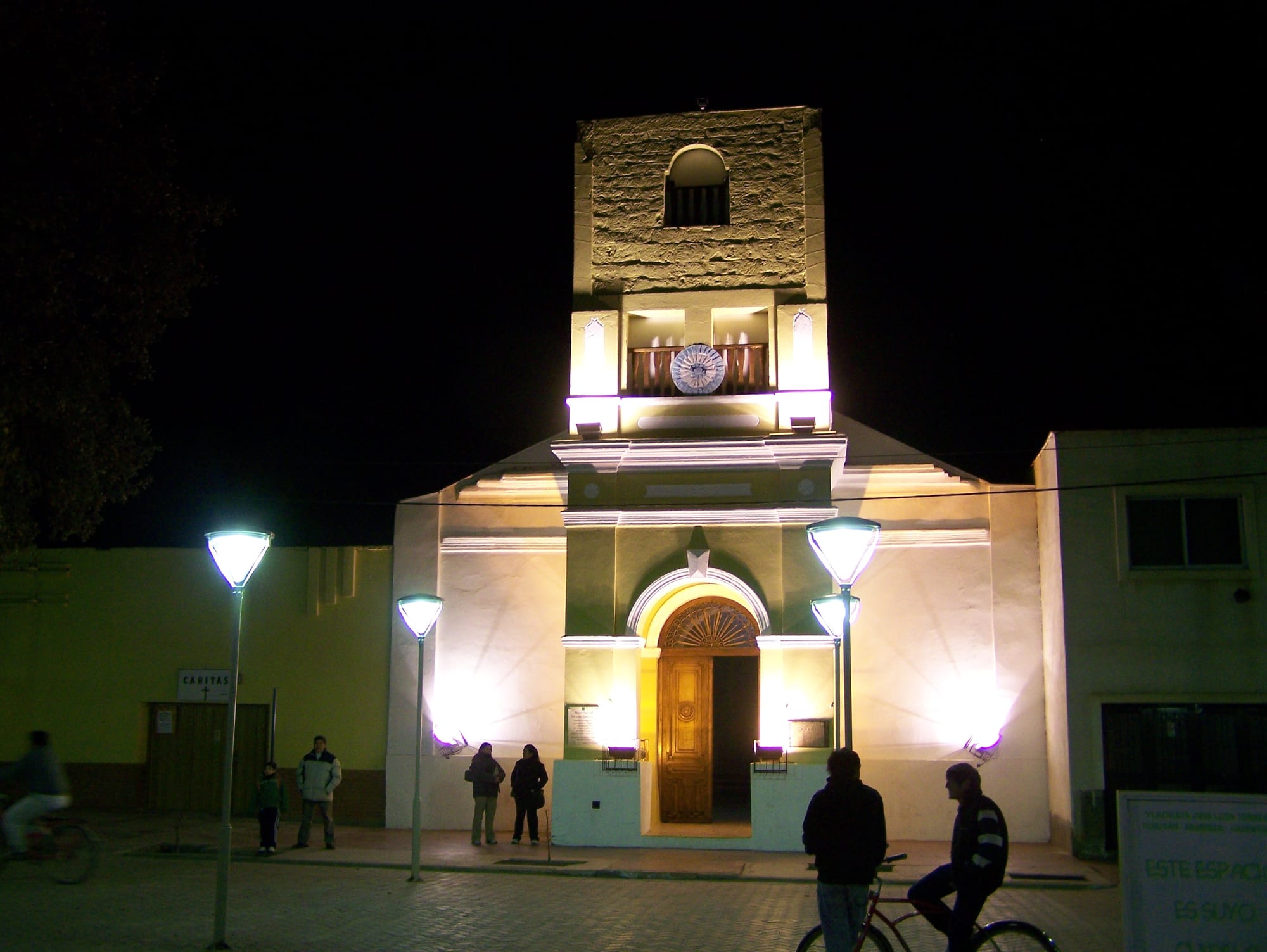
A whitewashed church with a square bell tower lit up at night above a paved square with street lamps and passers-by

Mendoza & Cuyo, Argentina

Tunuyán

The parish church of Tunuyán, lit up at night. (Cornelius Kibelka from Berlin, Germany / Wikimedia Commons · CC BY-SA 2.0)

A farming town on the Tunuyán River about 80 km south of Mendoza, the main town of the Valle de Uco. Long a centre for apples, peaches and walnuts, it has been transformed since the 2000s by high-altitude vineyards and wineries spread across the valley floor below the snow-capped Andes, while the town itself remains a quiet provincial market centre.

Neighbourhoods

  • The town centre
    • First-time visitors
    • Close to public transport
    • Shopping

    The grid around Plaza General San Martín, a shaded square with benches and a large children's play area, with the parish church, the bus terminal, shops, bike-hire businesses and restaurants along Avenida San Martín.

    Open in Maps
  • The Uco Valley wine country
    • Wine country
    • Andes views
    • Quiet stays

    The vineyards that spread west of the town towards the foothills at 900 to 1,200 metres, with wineries, estates and lodges facing the Andes. Distances are long and public transport scarce, so a car is the usual way around.

    Open in Maps

Things to do

In the town

  • Plaza General San Martínpark

    The central square, shaded by trees, the place where the town meets in the evening.

    Open in Maps
  • Anfiteatro Municipalattraction

    The town's open-air amphitheatre, used for concerts, festivals and cultural events, including the tonada festival.

    Open in Maps

River and vineyards

  • Tunuyán Riverattraction

    The river that rises on Mount Tupungato and flows past the town, with class III rapids used for whitewater rafting.

    Open in Maps
  • Uco Valley wine routeattraction

    One of Argentina's leading wine regions, where high altitude, Andean irrigation, long sunny seasons and cold nights produce Malbec and Sémillon, explored by car, bicycle or on horseback.

    Open in Maps

Short trips into the foothills

  • Manzano Históricolandmark

    A wooded site in the foothills at about 1,200 metres where the monument 'Retorno a la Patria', inaugurated in 1950, marks San Martín's return across the Andes in 1823.

    Open in Maps
  • San Carlosattraction

    A neighbouring town, head of San Carlos Department, one of the three departments of the Uco Valley wine region.

    Open in Maps

Seasonal events

  • Retorno a la Patrialast Sunday of January

    The commemoration of San Martín's return to his homeland, held at the Manzano Histórico.

  • Festival Nacional de la Tonadaearly February

    A national festival of the tonada, the sung folk music of Cuyo, held in the town.

  • Vía Crucis de la Montañalate April

    A mountain Stations of the Cross procession at the Manzano Histórico.

  • Fiesta Provincial de la Cerezaearly December

    The provincial cherry festival, celebrating the harvest of the valley's orchards.

Eat and drink

Long-standing places and food districts in Tunuyán. Hours, ratings and directions come from your maps app, always current.

Tunuyán classics

  • Winery restaurants of the Uco Valleyneighborhood

    Many wineries in the valley serve meals paired with their own wines, often with views of the Andes.

    Open in Maps
  • Avenida San Martínneighborhood

    The town's main avenue, with everyday restaurants, among them one known for its milanesas.

    Open in Maps
  • Fruit and nut stallsmarket

    Apples, peaches, cherries and walnuts from the surrounding orchards, sold in season.

    Open in Maps

Experience Tunuyán

History

The Uco Valley was Huarpe land, watered by the rivers coming down from the Andes, and lay on the southern edge of colonial Mendoza. The valley sat on one of the routes across the mountains: in 1817, as José de San Martín led the Army of the Andes into Chile, a column of his troops crossed by the Portillo pass to the west. In January 1823, after the campaigns in Chile and Peru, San Martín came back across the Andes to Mendoza, and the Manzano Histórico in the foothills west of Tunuyán commemorates that return; its monument, Retorno a la Patria, was inaugurated on 31 December 1950.

The town grew as the head of Tunuyán Department and a service centre for the farms of the valley, which irrigated the plain from the Tunuyán River and became known for apples, peaches, walnuts and vines. From the late 19th century fruit growing and the vine shaped the valley, and farm trade shaped the town.

Since about 2000, investment drawn by the valley's mix of altitude, soils and climate has changed it more than anything since irrigation. Vineyards were planted high up towards the foothills, wineries and lodges followed, and the Uco Valley — Tunuyán, Tupungato and San Carlos — became one of Argentina's most important regions for high-quality wine and wine tourism. The town grew by a third between the 2010 and 2022 censuses.

Culture & Customs

Tunuyán's cultural life follows the rural calendar and Cuyo's folk traditions. The town hosts the Festival Nacional de la Tonada in early February, a national festival of the tonada, the sung guitar music of Cuyo, held in the municipal amphitheatre. A departmental Vendimia elects a harvest queen who goes on to the provincial festival in Mendoza, and the Fiesta Provincial de la Cereza celebrates the cherry harvest each December.

San Martín is the town's hero. Each year, on the last Sunday of January, people gather at the Manzano Histórico to mark his return to his homeland, and his death is commemorated on 17 August. In late April a mountain Stations of the Cross, the Vía Crucis de la Montaña, is walked at the same site, and climbers meet at the Cajón de Arenales in the mountains.

The painter Carlos Alonso was born in the town. The arrival of wine tourism has brought international visitors, chefs and winemakers to a valley that still keeps the unhurried manner and the asado-and-mate weekends of rural Mendoza.

Daily Life

About 38,000 people lived in the town at the 2022 census, up from about 29,000 in 2010. It lies at about 870 metres above sea level on the Tunuyán River, about 83 km south of Mendoza, and serves a wide rural area with its shops, schools, bus terminal and banks.

Agriculture is the economy. Vineyards cover more and more of the valley, but apples, peaches, cherries and walnuts are still grown. Wine tourism has added hotel, restaurant, guiding and transport jobs, and seasonal work peaks at harvest time.

The rhythm is that of a country town: shops close for the afternoon siesta and the plaza fills in the evening. Water from the Andes is everything here. The Tunuyán River, one of the province's great sources of water, rises on Mount Tupungato, runs past the town and is dammed downstream at El Carrizal; its flow comes from melting snow and, in some years, glaciers. Inflation and the cost of living shape household budgets as across Argentina.

Food

Wine leads. The Uco Valley's vineyards, at 900 to 1,200 metres, are planted mostly with Malbec and Sémillon, with Bonarda and Barbera in smaller amounts, and the wide gap between day and night temperatures favours high-quality grapes. Many wineries serve long lunches with dishes paired to their wines.

In town, the food is everyday Mendoza: milanesas, the breaded cutlets that are a national standby, pasta, grilled beef and the large empanadas of the province, made with olives and garlic. Chivito, young goat, roasted over an open fire, is the celebratory meal, and the weekend asado is a ritual. Cuyo home cooking such as tomaticán, a dish of tomato and egg, and sopaipillas, rounds of fried dough, is found here too.

The orchards supply the rest. Apples, peaches, plums and cherries come from the valley's orchards, whose stone-fruit plantings have grown in recent years, and walnuts are a local speciality. Mate is drunk throughout the day.

Planning tools

Budget

The town itself is cheap, with modest hotels, hostels and everyday restaurants, but the wine country around it is expensive to visit: tasting fees, winery lunches and lodges in the Valle de Uco add up quickly. A hire car is the other main expense.

Daily Budget Midrange
USD 100–220 (hotel, winery lunches and tastings, a hire car or tours)
Daily Budget Shoestring
USD 35–60 (hostel or budget hotel, set lunches, buses, a hired bicycle)

Book winery visits in advance, and stay in town to save money while visiting the valley by car.

Best Time to Visit

Autumn, from March to May, brings the harvest and the vineyards' changing colours; spring is pleasant and quiet. Summer is hot by day and cool at night, with festivals in January and February and rafting at its best. Winters are cold, with snow on the mountains and frost in the valley.

Suggested Number of Days

Two days allow for the town and a couple of winery visits. Three or four give time for the foothills and the wider valley; because wineries are far apart and need booking, the number of visits planned decides the length.

First Visit
2 days
With Surroundings
3–4 days

Transportation

The town centre is small and walkable. Wineries are in rural areas with little public transport, so most visitors hire a car; a bicycle works for nearby wineries on the flat, paved main roads, though rural roads are often gravel. Some stables offer guided rides into the foothills.

Never drive after tastings — share driving, hire a driver or join a tour.

Airport & Station Connections

The nearest airport with commercial flights is Mendoza's El Plumerillo. Tunuyán is about 83 km south of Mendoza, and several bus companies run frequent services between the two cities' terminals, a journey of around an hour or more.

Walkability

The centre around the plaza is flat and easy to walk, with shops and restaurants close together. Anything beyond the town — the vineyards, the river, the foothills — is too far to reach on foot.

Safety

Argentina is relatively safe by regional standards, and violent crime against visitors is uncommon. Tunuyán is a quiet country town. The main risks are on the roads — long rural drives, gravel and drink-driving after tastings — together with strong sun at altitude and the earthquakes that affect all of Cuyo.

Use sun protection and carry water in the foothills, and drive rural roads with care. Check current official travel advice before travelling.

Climate

Dry and sunny, with more than 200 days of sunshine a year and an annual average temperature of about 14°C. Summer is December–February. The altitude brings large differences between hot days and cool nights.

Summer
warm to hot days, well above the annual mean of about 14°C, with cool nights
Winter
cool, sunny days and cold nights, well below the annual mean of about 14°C, with snow in the mountains

Local Customs

Life keeps the Cuyo timetable, with a long siesta in the early afternoon and an evening return to the plaza. The town is proud of its link with San Martín and of its folk music. Wine and mate are part of daily life.

A tip of around 10 per cent is usual in restaurants. Greet with a single kiss on the cheek once introduced, and dress neatly for winery lunches.

Common Payment Methods

The currency is the Argentine peso (ARS). Inflation has been high for years, though it has eased since 2024, so prices change often. Wineries, hotels and larger restaurants take cards; small shops and kiosks may prefer cash, and ATMs are in the centre. Carry some clean US dollar bills as a backup.