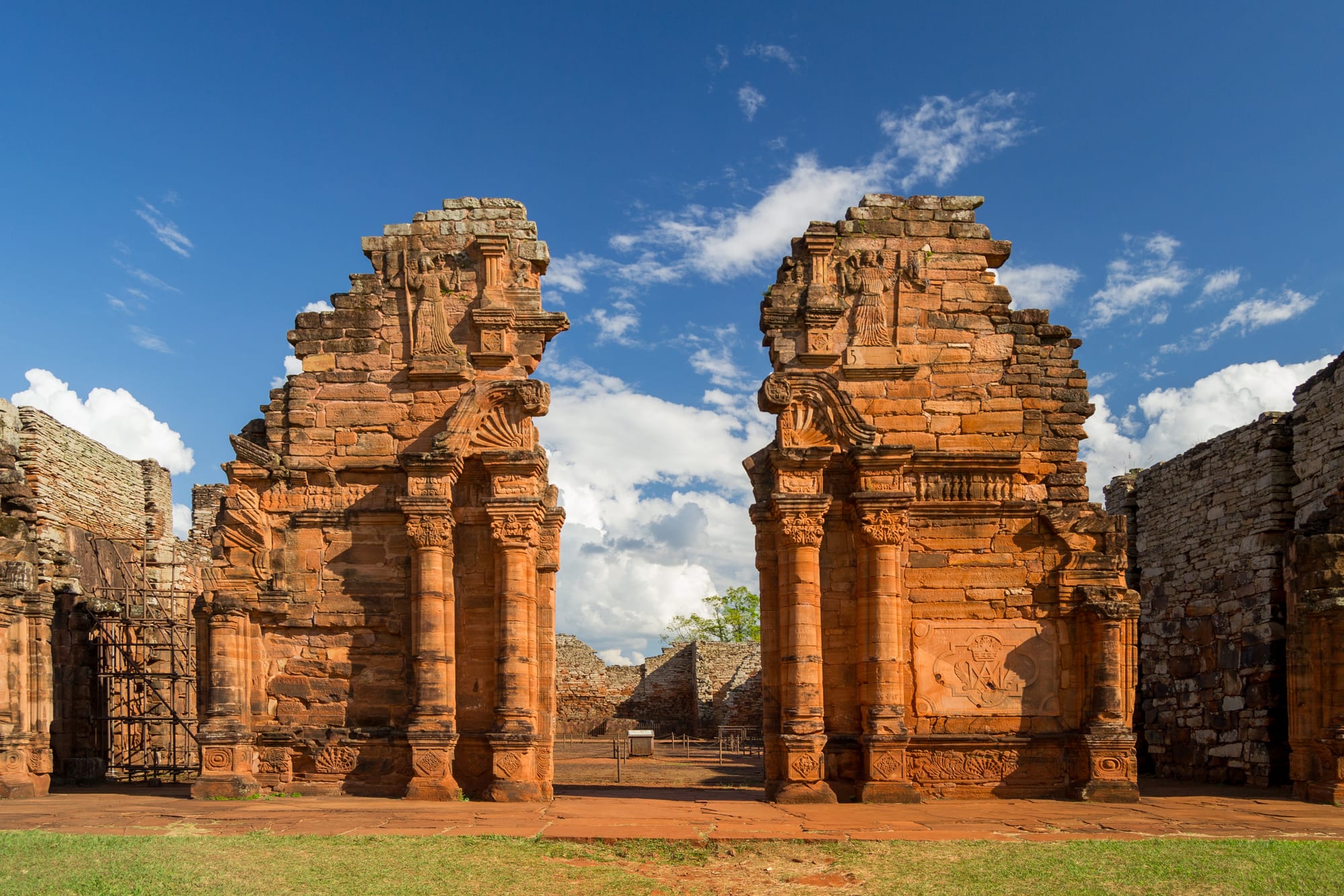
Two carved red sandstone pillars of a ruined church front with columns and reliefs, under a blue sky with white clouds

Iguazú & the Northeast, Argentina

San Ignacio

The carved front of the ruined church of San Ignacio Miní, San Ignacio, Misiones. (Fernando / Wikimedia Commons · CC BY-SA 4.0)

A small town on National Route 12 in Misiones, near the Paraná about 60 km north-east of Posadas, built beside the red sandstone ruins of San Ignacio Miní. The Jesuit mission was destroyed in 1817 and rediscovered under the forest in 1897; the modern town, founded in 1907, lives from yerba mate, forestry and visitors to the ruins.

Neighbourhoods

  • The town and the ruins
    • First-time visitors
    • Historic district

    The modern grid of low houses, shops and guesthouses grew up beside the mission, and the ruins of San Ignacio Miní stand in the town centre. Craft stalls and small restaurants stand near the site.

    Open in Maps
  • Puerto Nuevo and the river
    • Nature
    • Beaches

    The road down to the Paraná leads to Puerto Nuevo, about 3 km from the centre, with a sandy river beach, and on to the river viewpoints of Osununú and the hill of Teyú Cuaré.

    Open in Maps

Things to do

The mission

  • San Ignacio Minílandmark

    The ruins of a Jesuit mission settled on this site in 1696, among the best preserved in the region, with a 74-metre church in red sandstone designed by Juan Brasanelli and carved in the Guaraní baroque style; a UNESCO World Heritage Site since 1984, with a museum on the site.

    Open in Maps
  • Sound-and-light showattraction

    An evening show at the ruins that retells mission life in the 17th and 18th centuries with narration, music and images projected onto screens of water mist.

    Open in Maps

The river and Horacio Quiroga

  • Museo Provincial Horacio Quirogamuseum

    The farm where the Uruguayan short-story writer lived, with a replica of the wooden house he built himself and his second house of stone and glass, holding some of his furniture and belongings.

    Open in Maps
  • Teyú Cuaré Provincial Parkpark

    A nature reserve of almost 80 hectares on the banks of the Paraná around the rock of Teyú Cuaré, with steps up the hill to wide views.

    Open in Maps
  • Osununúviewpoint

    Viewpoints over the Paraná on the road to Teyú Cuaré; the Guaraní name, meaning thunder, recalls the logs once rolled down the slopes to the river to be floated downstream as rafts.

    Open in Maps

Short trips

  • Santa Ana mission ruinslandmark

    The ruins of another 17th-century Jesuit mission, part of the same UNESCO World Heritage Site, south-west of the town on the road to Posadas.

    Open in Maps
  • Nuestra Señora de Loreto ruinslandmark

    The remains of the first Jesuit mission of the province of Paraguay, founded in 1610 and known for its printing press; less well preserved than San Ignacio and overgrown by vegetation.

    Open in Maps
  • Posadasattraction

    The capital of Misiones on the Paraná, with the bridge to Encarnación in Paraguay.

    Open in Maps

Eat and drink

Long-standing places and food districts in San Ignacio. Hours, ratings and directions come from your maps app, always current.

San Ignacio classics

  • Chipá and regional foodrestaurant

    Small restaurants near the ruins serve the food of Misiones: chipá, the cassava-starch cheese breads, river fish such as surubí, mandioca and grilled meat.

    Open in Maps
  • Yerba matemarket

    The town's main crop, processed locally and sold in shops and stalls, drunk hot as mate and cold as tereré.

    Open in Maps

Experience San Ignacio

History

The mission began far from here. Around 1610 the Jesuits José Cataldino and Simón Maceta founded San Ignacio among the Guaraní of the Guayrá region, in what is now the Brazilian state of Paraná. Raids by bandeirante slave hunters from São Paulo forced the communities to flee south in 1632, when Antonio Ruiz de Montoya led thousands of Guaraní down the rivers to new sites near the Yabebirí stream. After further moves the mission settled on its present site in 1696, and it was called Miní, small in Guaraní, to distinguish it from San Ignacio Guazú in Paraguay.

In the 18th century around 3,000 people, mostly Indigenous, lived in the mission. They made crafts and other goods that were traded along the Paraná, and built a church 74 metres long in red sandstone to the design of the Italian Jesuit Juan Brasanelli. After the Society of Jesus was suppressed in 1767 the Jesuits left, the mission declined, and in 1817 it was destroyed, along with other missions in the area.

The ruins disappeared under forest until they were found in 1897. The modern town was founded on 18 January 1907 with the arrival of the first colonists, and the writer Horacio Quiroga settled on a farm by the Paraná in these years. Formal excavation and restoration of the ruins began only in 1940, and in 1984 San Ignacio Miní became part of a UNESCO World Heritage Site with other Jesuit missions in Argentina and Brazil.

Culture & Customs

San Ignacio's identity is bound to the mission. The carved red sandstone church front is a celebrated example of the Guaraní baroque style. An interpretation centre at the site tells the story of the Guaraní and the reductions, and an evening sound-and-light show uses projections on screens of water mist to recreate mission life. Craft stalls near the ruins sell local handicrafts.

The town is also linked with Horacio Quiroga, the Uruguayan master of the short story, who bought land here on the upper Paraná, served as justice of the peace in the civil registry of San Ignacio and drew on the forest and its people for many of his stories, among them the Jungle Tales for children published in 1918. His farm is now a provincial museum and cultural centre with an auditorium.

Daily culture is that of rural Misiones: Spanish with a Guaraní accent, chamamé at dances, tereré in the heat and the asado at weekends. Life is calm and neighbourly, and on summer weekends families head down to the river beach at Puerto Nuevo.

Daily Life

San Ignacio is a small country town and the head of San Ignacio Department; its municipality includes rural settlements such as Domingo Savio, linked by a provincial road. National Route 12, the main road between Posadas and Puerto Iguazú, runs past it, and buses, lorries and tourist coaches pass through all day.

The local economy rests on yerba mate, grown on farms around the town and processed in local mills, together with forestry, some mining and tourism to the ruins. A large share of residents work for the municipal, provincial or national state. When the price of yerba mate fell, many small farmers sold their land or turned to subsistence crops such as beans, maize and mandioca.

The rhythm of the day follows the heat: early starts on the farms, a long midday rest when the streets empty, and life outdoors again in the evening. Tourism brings a steady trade to guesthouses, restaurants and craft stalls near the ruins.

Food

The food of San Ignacio is the cooking of rural Misiones, close to Paraguay's. Chipá, small cheese breads made with cassava starch, are eaten at breakfast and sold by street vendors. Sopa paraguaya, a dense cornbread with cheese and onion despite its name, and mbeyú, a cassava-starch pancake, are everyday foods, and mandioca, cassava, comes boiled or fried with almost every meal.

River fish from the Paraná are a treat: surubí, a large catfish, is grilled or stewed, and pacú and dorado are cooked over coals. Asado and chicharrón, fried pork, fill out the weekend table, and reviro is a simple, cheap dish of the region.

Yerba mate is the crop the town lives on, and it is drunk hot as mate in the cool hours and cold as tereré, often with herbs, through the heat of the day. Sweets include dulce de mamón, a papaya preserve, and cakes of cassava flour.

Planning tools

Budget

San Ignacio is inexpensive. Guesthouses, campsites and simple restaurants cost less than in Puerto Iguazú, and the main spending is entry to the ruins and the evening show, plus transport from Posadas. Peso prices change quickly with inflation.

Daily Budget Midrange
USD 80–150 (guesthouse or small hotel, ruins and show tickets, restaurant meals, a hire car or taxi)
Daily Budget Shoestring
USD 35–55 (hostel or campsite, set meals, regional buses)

Staying overnight allows both a daytime visit to the ruins and the evening show without a late drive.

Best Time to Visit

March to May and August to November are the most comfortable months, warm but not oppressive for walking around the ruins. Summer, from December to February, is very hot and humid, with heavy storms, though the river beach is busy; winters are mild.

Suggested Number of Days

A single day, or a night, covers the town. Allow two or three days to take in the other ruins nearby and time by the river; bus connections and the summer heat decide how much fits.

First Visit
1 day
With Surroundings
2–3 days

Transportation

The town and the ruins are easy to walk. Long-distance and regional buses along National Route 12 stop at San Ignacio on the way between Posadas and Puerto Iguazú. The river, Teyú Cuaré and the other mission ruins are easiest with a car or taxi.

Carry water and sun protection at the ruins, where there is little shade.

Airport & Station Connections

San Ignacio lies on the paved National Route 12, about 60 km north-east of Posadas, which has the nearest airport, with flights to Buenos Aires. Regional buses run from Posadas, and long-distance buses heading north towards Puerto Iguazú also stop here.

Walkability

The town is small and flat around the ruins, and everything in the centre is a short walk. The river at Puerto Nuevo is about 3 km away, a walk on hot roads; Teyú Cuaré and the Quiroga house are further and are usually reached by car, taxi or bicycle.

Safety

Argentina is relatively safe by regional standards, and violent crime against visitors is uncommon. In San Ignacio the practical hazards are heat, strong sun and mosquitoes; dengue has caused large outbreaks in the region in recent years. The Paraná is wide and its currents strong, so swim only where locals do.

Use insect repellent day and night, drink plenty of water, and take care on unlit roads after dark. Check current official travel advice before travelling.

Climate

Subtropical and humid, with rain in every season. Summer is December to February and long and very hot; winters are mild, with occasional cold spells.

Summer
hot and humid, often 30–35°C, with heavy thunderstorms
Winter
mild, around 15–22°C by day and cooler at night, with occasional cold snaps

Local Customs

San Ignacio is a quiet country town where the long midday break is respected and people greet strangers. The mission is part of Guaraní history as well as a monument. Tereré is drunk all day in the heat.

Leaving around 10 per cent in restaurants is customary. Do not climb on the ruins, and ask before photographing people.

Common Payment Methods

The currency is the Argentine peso. Cards are accepted at larger businesses, but small restaurants, craft stalls and buses often prefer cash, and cash machines are few. Bring pesos from Posadas, and some clean US dollar notes as a backup.