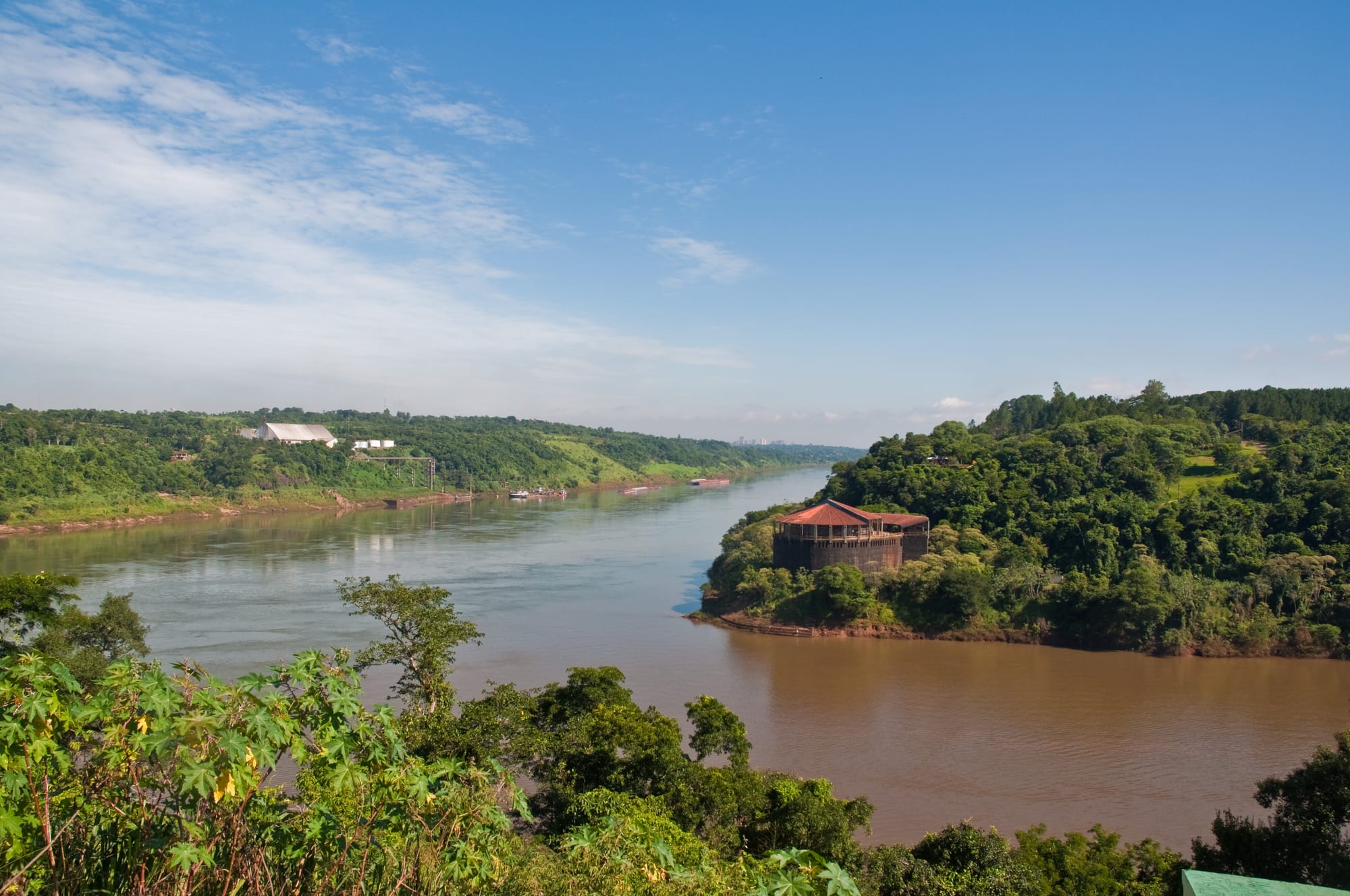
Brown river water at the meeting of two rivers between forested banks, with Paraguay on the left and Brazil on the right

Iguazú & the Northeast, Argentina

Puerto Iguazú

The meeting of the Iguazú and Paraná rivers seen from Puerto Iguazú, with Paraguay on the left and Brazil on the right. (Phillip Capper from Wellington, New Zealand / Wikimedia Commons · CC BY 2.0)

A border town in the far north of Misiones, where the Iguazú River meets the Paraná and Argentina faces Brazil and Paraguay. Founded in 1902 as Puerto Aguirre on land long home to the Guaraní, it grew up around the Iguazú falls 18 km away and now lives almost entirely from the visitors who come to see them.

Neighbourhoods

  • The town centre
    • First-time visitors
    • Close to public transport
    • Best for food

    A compact grid of low streets around the bus terminal, where buses leave for the falls and across the border. Hostels, guesthouses, restaurants, tour agencies and shops are all within a few blocks, and the evening crowd gathers at the Feirinha market.

    Open in Maps
  • The Tres Fronteras riverside
    • Viewpoints
    • Sunsets

    The northern edge of town, where the streets run downhill to the bluff above the meeting of the Iguazú and Paraná rivers. The Hito Tres Fronteras monument looks across the water to Brazil and Paraguay, and the area is busiest in the early evening.

    Open in Maps
  • The road to the falls
    • Nature
    • Quiet stays

    National Route 12 runs south-east from town through forest towards the airport and the national park. Lodges and resort hotels stand among the trees along it, along with the Güirá Oga wildlife rescue centre; it is quieter than the town but depends on buses, taxis or transfers.

    Open in Maps

Things to do

The falls and the national park

  • Iguazú Fallslandmark

    The largest waterfall system in the world, mostly on the Argentine side. The one-kilometre Paseo Garganta del Diablo walkway leads over the river to the edge of the Devil's Throat, the deepest chasm, through which about half the river's flow falls.

    Open in Maps
  • Iguazú National Parkpark

    The park created in 1934 to protect the Argentine side of the falls, a UNESCO World Heritage Site since 1984, with upper and lower walkway circuits, boats to San Martín Island and forest home to coatis, toucans and many butterflies.

    Open in Maps
  • Rainforest Ecological Traintransit hub

    The small train inside the national park that carries visitors through the forest to the walkways and the start of the Devil's Throat trail.

    Open in Maps

In and around town

  • Hito Tres Fronterasviewpoint

    The Argentine border marker on the bluff above the confluence of the two rivers, painted in the national colours, with Brazil and Paraguay's markers visible on the opposite banks.

    Open in Maps
  • Güirá Ogaattraction

    A rescue, rehabilitation and breeding centre for wild animals and birds in the forest on the road to the falls, where injured and confiscated animals are cared for and, when possible, released.

    Open in Maps

Short trips across the border and beyond

  • Iguaçu National Parkpark

    The Brazilian side of the falls, a separate UNESCO World Heritage Site since 1986, where a walkway along the canyon has an extension to the lower base of the Devil's Throat.

    Open in Maps
  • Foz do Iguaçuattraction

    The much larger Brazilian city across the Tancredo Neves Bridge, opened in 1985, with its own airport and a population of about 258,000 from many backgrounds.

    Open in Maps
  • Itaipu Damlandmark

    The huge hydroelectric dam on the Paraná, shared by Brazil and Paraguay and completed in 1984, among the largest producers of hydroelectric power in the world.

    Open in Maps
  • Wandaattraction

    A town on National Route 12 south of Puerto Iguazú, known for its mines of precious and ornamental stones, a regular stop for visitors touring the province.

    Open in Maps

Eat and drink

Long-standing places and food districts in Puerto Iguazú. Hours, ratings and directions come from your maps app, always current.

Puerto Iguazú classics

  • Surubí and river fishrestaurant

    Surubí, a large river catfish, grilled, stewed or breaded as a milanesa, along with pacú and dorado cooked over coals — the pride of the region's tables.

    Open in Maps
  • Chipácafe

    Small, chewy cheese breads made with cassava starch, sold by street vendors and bakeries for breakfast or a snack.

    Open in Maps

Food districts and markets

  • Feirinha (La Feria)market

    A market of delicatessen stalls with a strongly Brazilian flavour that sets out tables in the late afternoon for beers, picadas of salami, cheese and olives, grilled meat and empanadas.

    Open in Maps

Experience Puerto Iguazú

History

For centuries before Europeans arrived, the forests around the falls were home to Guaraní communities, and the name Iguazú comes from Guaraní or Tupí words meaning big water. The first European to record the falls was the Spanish conquistador Álvar Núñez Cabeza de Vaca in 1541, but the area remained Guaraní land, outside colonial settlement, until the late 19th century.

Settlers began arriving after 1880. One of the early backers, Victoria Aguirre, paid for the first road into the settlement in 1901, and on 10 September 1902 it was formally established as Puerto Aguirre in her honour. A police post, a civil registry and a post office followed over the next decades. The national government created Iguazú National Park in 1934 to protect the Argentine side of the falls, and in 1943 the town took its present name.

Tourism shaped everything after that. The Iguazú National Reserve was created inside the municipality in 1970, the falls were declared a UNESCO World Heritage Site in 1984, and in 1985 the Tancredo Neves Bridge opened across the Iguazú River to Foz do Iguaçu, tying the town into the wider Triple Frontier with Brazil and Paraguay. Gem mining at Wanda to the south added a second, smaller draw.

Culture & Customs

Puerto Iguazú is a frontier town in its daily habits. Portuguese is widely heard in the shops and at the Feirinha, Brazilian grills and beers share the tables with empanadas, and Brazilians have been part of the town since its beginnings. Paraguayans are the largest immigrant group, and the region's Guaraní-influenced Spanish, chipá and tereré are shared across all three borders.

The Mbyá Guaraní are the oldest community here. Five Mbyá villages lie within the municipality, one of them, Fortín Mbororé, practically inside the town, with about 2,000 people between them. Stories are part of the place too: a legend tells that a deity, enraged when Naipí fled with her mortal lover Tarobá, sliced the river to form the falls, condemning the lovers to an eternal fall.

The town's rhythm is set by visitors and by the heat. Mornings start early for the park buses and tours; in the late afternoon people walk down to the Tres Fronteras viewpoint to watch the sun set over the rivers, and the evening moves to restaurants and the market tables.

Daily Life

Puerto Iguazú had 82,227 people at the 2010 census, making it the fourth-largest city in Misiones after Posadas, Oberá and Eldorado. Tourism is the main economic activity: hotels and commerce are the main sources of jobs, and incomes rise and fall with visitor numbers and with exchange rates between the peso and the Brazilian real.

Cross-border trade is the other constant. People shop on whichever side of the river is cheaper at the time, and the bridge to Foz do Iguaçu carries a steady stream of buses, taxis and private cars through border controls on both sides. The Triple Frontier's smuggling routes mean police and border checkpoints on the main roads.

Outside the tourist centre, many residents live in plain neighbourhoods of single-storey houses, while many international hotels have been built along the banks of the Iguazú River. Dengue outbreaks in recent years have made mosquito control a public concern, and the long, humid summers keep the middle of the day quiet.

Food

The food of Puerto Iguazú is the food of the upper Paraná, close to Paraguay's and Brazil's. Chipá, small cheese breads made with cassava starch, are sold warm by street vendors in the morning. Sopa paraguaya, a dense cornbread with cheese and onion despite its name, and mbeyú, a cassava-starch pancake with cheese, come from the same tradition, and mandioca (cassava) is boiled or fried as a side to almost anything.

River fish are the speciality of the town's restaurants. Surubí, a large catfish, is grilled, stewed or breaded as a milanesa, and pacú and dorado are cooked over coals or wrapped in foil. Beef from the grasslands of Corrientes keeps the Argentine parrilla going, and the Brazilian influence shows in the grills and picadas, shared plates of cheese, salami and olives, served at the Feirinha.

Yerba mate is grown and processed in Misiones, and it is drunk hot as mate in the cool hours and cold as tereré, often with herbs, through the heat of the day. Sweets include dulce de mamón, papaya cooked in syrup.

Planning tools

Budget

Puerto Iguazú costs about the national average, but entry to the national park is priced higher for foreigners than for Argentines, and boat trips and transfers add up. Hostels and simple guesthouses in town are good value; lodges along the road to the falls are expensive. Peso prices move quickly with inflation.

Daily Budget Midrange
USD 110–200 (hotel in town, park entry, a boat trip, restaurant dinners and taxis)
Daily Budget Shoestring
USD 40–65 (hostel bed, chipá and set-menu meals, the park bus)

Allow a full day for the Argentine side and arrive at opening time to beat the tour groups; carry cash as well as cards.

Best Time to Visit

March to May and August to November are the most comfortable months, warm without the full summer heat. The falls flow all year and are fullest after heavy rain. January, Easter and the July winter holidays bring the biggest crowds, and summer, from December to February, is very hot and humid.

Suggested Number of Days

Two or three days cover the Argentine side of the falls and the town. Allow three or four to see the Brazilian side as well; border queues and the weather, which can close walkways after storms, are what most often add time.

First Visit
2–3 days
With Surroundings
3–4 days

Transportation

Local buses run frequently from the town's bus terminal to the park entrance, and buses also cross to Foz do Iguaçu and Ciudad del Este. Taxis and remises work on fixed fares within town and to the park. The town centre is small enough to cover on foot.

Carry a passport on any trip towards the border, and keep the papers given at immigration; taxi drivers know the border routine.

Airport & Station Connections

Cataratas del Iguazú International Airport lies in the forest about 16 km south-east of town and 6 km from the falls, with several flights a day from Buenos Aires; buses, minibuses and taxis meet flights. Foz do Iguaçu's airport across the border is an alternative. Long-distance buses from Buenos Aires take most of a day.

Walkability

The town centre, the bus terminal, the Feirinha and the Tres Fronteras viewpoint are all within a walk of each other, though the streets climb and the heat and humidity are tiring. Inside the national park the falls are seen on foot along long walkways and trails; the park itself is 18 km from town and needs a bus or taxi.

Safety

Argentina is relatively safe by regional standards, and violent crime against visitors is uncommon. The Triple Frontier around Puerto Iguazú is a smuggling area with frequent police and border controls. Mosquito-borne dengue has caused large outbreaks in the region in recent years, the heat is a real hazard, and at the falls coatis bite and should not be fed.

Use insect repellent day and night, drink plenty of water, keep food away from the coatis and stay on the marked walkways. Check current official travel advice before travelling.

Climate

Subtropical and humid, with no dry season: every month has more than 100 mm of rain. Summer is December to February and long and very hot; winters are mild, with occasional cold spells.

Summer
hot and humid, often 30–35°C, with heavy thunderstorms
Winter
mild, with June highs averaging about 21°C and lows about 11°C, and occasional cold snaps

Local Customs

Spanish is the language of the town, but Portuguese is widely understood and Brazilian visitors are everywhere. Five Mbyá Guaraní villages lie in and around the town; they are homes, not attractions. Tereré, cold mate, is drunk all day in the heat.

Leaving around 10 per cent in restaurants is customary. Ask before photographing Mbyá Guaraní people or their villages.

Common Payment Methods

The currency is the Argentine peso. Cards are accepted in most hotels, restaurants and at the national park, but cash is useful for buses, taxis, markets and small shops. ATMs are found in the town centre; carry some clean US dollar notes as a backup.