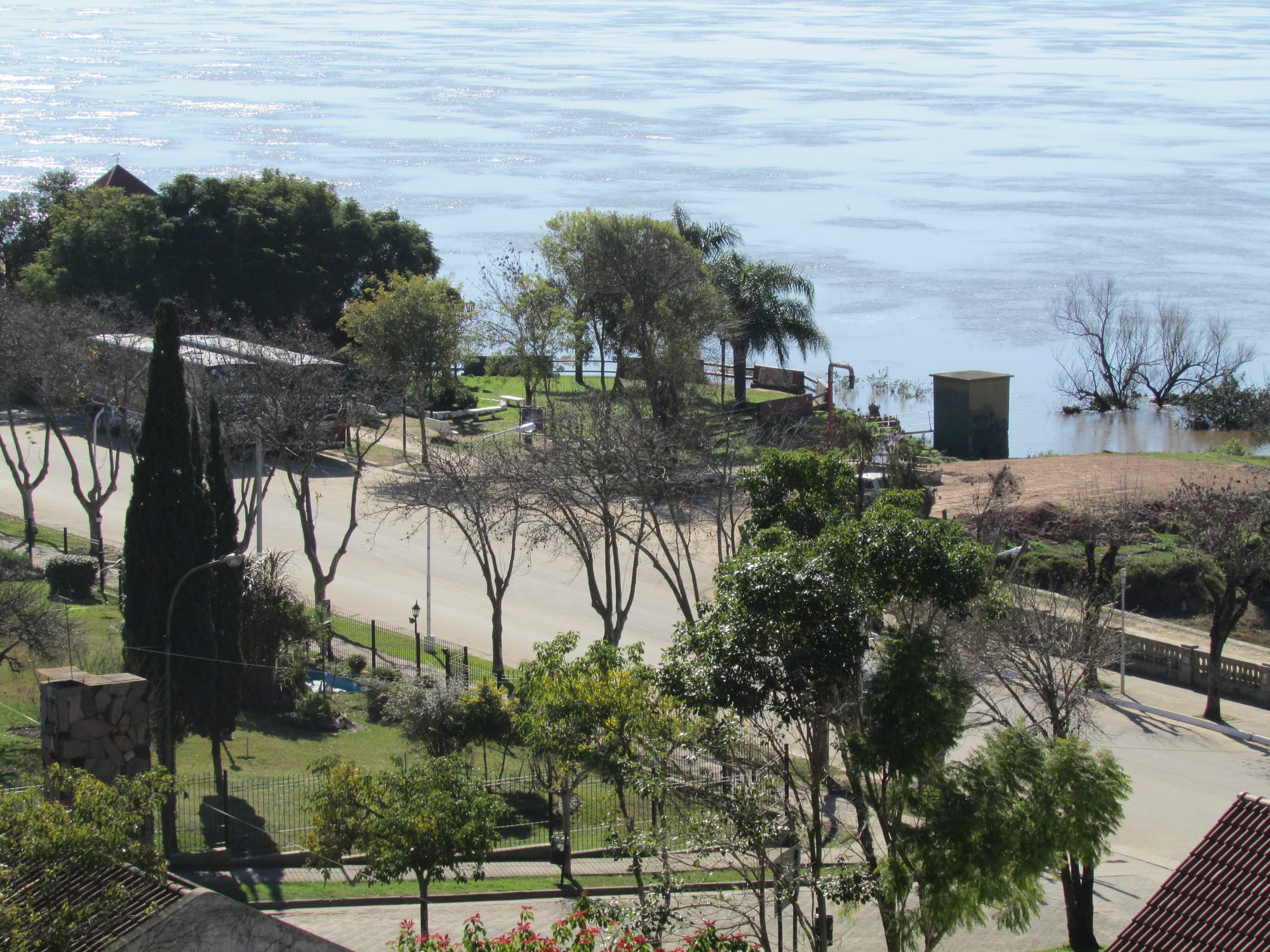
A tree-lined riverside avenue and small park beside the wide, sunlit Uruguay River in Colón

Córdoba & the Pampas, Argentina

Colón

Avenida Costanera and the Uruguay River in Colón, Entre Ríos. (Dario Alpern / Wikimedia Commons · CC BY-SA 4.0)

A small river town on the Argentine bank of the Uruguay River in Entre Ríos, opposite Paysandú in Uruguay. Founded by Justo José de Urquiza in 1863 as the port of a Swiss and French farming colony, it now lives on tourism — sandy river beaches, thermal pools fed from deep underground and the palm groves of El Palmar National Park to the north.

Neighbourhoods

  • Town centre and Calle 12 de Abril
    • First-time visitors
    • Best for food
    • Shopping

    The commercial heart of the town, along Calle 12 de Abril and around Plaza San Martín, with shops, cafés, ice-cream parlours and restaurants. Plaza Washington, a few blocks away, is where the summer carnival parades gather.

    Open in Maps
  • The Costanera and the beaches
    • Beaches
    • River views
    • Families

    The riverside avenue that follows the Uruguay past the port. The town's sandy river beaches, together about 14 kilometres of shore, run along this side of town, with campsites and cabins behind them.

    Open in Maps
  • Parque Quirós
    • Crafts
    • Views
    • Sport

    A raised park above the river, built as a sports ground for the town's schools by the politician Herminio Quirós, with grounds for football, tennis, basketball and rugby. It is the home of the national crafts festival.

    Open in Maps

Things to do

In and around the town

  • General Artigas Bridgelandmark

    The 2,350-metre cantilever road bridge across the Uruguay River to Paysandú, opened in 1975 and named after the father of Uruguayan independence.

    Open in Maps
  • Molino Forclazmuseum

    A Dutch-style windmill near the old road between Colón and San José, built by the Swiss settler Juan Bautista Forclaz; the local winds proved too weak to work it, so grinding went on in a mule-driven mill beside it. A national historic monument and provincial museum.

    Open in Maps
  • San Joséattraction

    The neighbouring town that grew from Colonia San José, the farming colony Urquiza founded for Swiss and French immigrants in 1857, with a regional history museum and its own thermal pools.

    Open in Maps
  • Pueblo Liebigattraction

    A quiet village near Colón that grew around a meat-salting works and then the plant of Liebig's Extract of Meat Company, an English-owned business.

    Open in Maps

Short trips from the town

  • Paysandúattraction

    Uruguay's fourth-largest city, directly across the river and reached over the General Artigas Bridge with a passport, known as 'La Heroica' for its resistance in the siege of 1864–65.

    Open in Maps
  • Palacio San Josémuseum

    Urquiza's Italianate country residence, built between 1848 and 1858 with two courtyards and 38 rooms; he was assassinated here in 1870, and it is now a museum and national monument.

    Open in Maps
  • Concepción del Uruguayattraction

    The older river city to the south, founded in 1783, home of the Colegio del Uruguay, the secular school Urquiza created in 1848.

    Open in Maps
  • El Palmar National Parkpark

    A national park created in 1966 to preserve its yatay palm trees, with capybaras, rheas, foxes and viscachas.

    Open in Maps

Seasonal events

  • Fiesta Nacional de la Artesaníasummer

    A crafts fair that began with small displays in the 1960s, became a national festival in 1986 and is now held in Parque Quirós, each year honouring a different craft.

  • Corsos colonensesJanuary and February

    The town's carnival, with parades, drummers and costumes around Plaza Washington, and children armed with spray foam.

Eat and drink

Long-standing places and food districts in Colón. Hours, ratings and directions come from your maps app, always current.

Colón classics

  • River-fish restaurantsneighborhood

    Surubí, pacú, boga and dorado from the Uruguay River, grilled, fried or cooked in a stew.

    Open in Maps
  • Parrillasrestaurant

    Grill restaurants serving the beef cuts, sausages and offal of the Argentine asado.

    Open in Maps

Food streets and shops

  • Calle 12 de Abrilneighborhood

    The main street, with the town's cafés, ice-cream shops and restaurants.

    Open in Maps
  • Regional productsmarket

    Shops selling alfajores, local cheeses and salami, honey, and mate gourds and straws.

    Open in Maps

Experience Colón

History

The Uruguay River was the frontier and the highway of eastern Entre Ríos long before Colón existed. In 1857 a group of Swiss and French immigrants landed at the Calera de Espiro, a lime-burning site on the river bank, and Justo José de Urquiza, the caudillo of the province and president of the Argentine Confederation, settled them on his own land as Colonia San José — one of the first agricultural colonies for immigrants in Argentina. The colonists farmed and raised cattle inland and brought their produce to the landing to be shipped.

As more people gathered around the landing, Urquiza decided a new town was needed there, and on 12 April 1863 he founded Colón on the site that is now its port. It grew as a river trading post for the colony's goods; the creation of the Villa de Colón was formally promulgated in 1871, its municipal government was installed in 1873, and the parish of Santos Justo y Pastor followed in 1876. Nearby, a meat-salting works grew into a plant of the English-owned Liebig's Extract of Meat Company, around which the village of Pueblo Liebig formed.

In the 20th century the town became a first-class municipality after the provincial constitution was reformed in 1933, and Herminio Quirós, who became governor of Entre Ríos in 1930, gave it the park that bears his name. The opening of the General Artigas Bridge to Paysandú in December 1975 tied Colón to Uruguay. Today its river beaches and its thermal pools, fed by water from the Guaraní Aquifer more than 750 metres down, make it one of the province's main holiday towns.

Culture & Customs

Colón calls itself the provincial capital of tourism, and its identity is that of a river resort with deep immigrant roots. The Swiss, Savoyard and French families of Colonia San José shaped the surrounding countryside: in San José the colonists founded what is regarded as the first shooting club in South America in 1859, and a Savoyard cultural centre and a regional history museum keep their story. The Forclaz windmill, built by one of the founding families, is a national historic monument.

Crafts are the town's particular pride. The Fiesta Nacional de la Artesanía grew from small displays in the municipal building and stalls in Plaza Washington in the 1960s; it was recognised as a national festival in 1986 and moved to Parque Quirós in the 1990s. Each edition honours one craft — plant fibres, silverwork and leather have all had their year — and craftspeople from other provinces and neighbouring countries take part.

Summer belongs to the corsos, the carnival parades that fill the streets around Plaza Washington in January and February with drummers, costumes and spray foam. Basketball has a strong following, with two local clubs, La Armonía and La Unión, and Entre Ríos is chamamé and carnival country.

Daily Life

Colón had about 23,000 people at the 2010 census, and the Colón Department around it about 75,000 at the 2022 census, including the neighbouring towns of San José and Pueblo Liebig. It is a low-rise town of family houses and gardens on a grid behind the river, with the commercial streets around Plaza San Martín and newer cabins and holiday homes towards the beaches.

Tourism drives the economy: hotels, cabins, campsites, a casino, the thermal complex with its indoor and outdoor pools and water park, restaurants and crafts. Around it, the farms of the old colonies grow grain and raise livestock, and the port, which handles river traffic on the Uruguay, has a natural depth that rarely needs dredging. Paysandú across the bridge is close enough for shopping and family visits.

The year swings between a crowded summer and a quiet winter. In the holiday season the population swells, the beaches and the Costanera are busy until late, and carnival takes over the weekends; out of season the town settles back into a slow provincial rhythm of afternoon siestas, evening walks by the river and mate on the doorstep. As elsewhere in Argentina, inflation and the cost of living shape household budgets.

Food

The river sets the menu. Surubí and pacú, large fish of the Uruguay and Paraná, are grilled whole or cut into steaks, and boga and dorado are fried or cooked in chupín, a tomato-based fish stew of the Litoral. Sport fishing on the Uruguay draws visitors, and local guides run fishing trips on the river.

Beef remains central, as everywhere in Argentina: parrillas grill bife de chorizo, asado de tira, chorizo and morcilla, served with chimichurri, and the weekend asado is a family ritual. Empanadas and milanesas are everyday food, and pasta reflects the Italian side of the province's immigration.

The colonies left their mark on the local larder. Shops sell cheeses and salami from the surrounding farms, honey and alfajores. Entre Ríos is known for its citrus, and ice-cream parlours are a fixture of summer evenings on the main street. To drink, there is mate at every hour, beer on the beach and wine from Argentina's western vineyards.

Planning tools

Budget

Colón is cheaper than Buenos Aires, and a stay is built around cabins, campsites and modest hotels. Prices rise in the January holidays, at carnival time and on long weekends, when visitors from Buenos Aires and the rest of Entre Ríos fill the town. A car is the main extra cost for reaching El Palmar and the Palacio San José.

Daily Budget Midrange
USD 80–150 (hotel or cabaña, parrilla and river-fish dinners, thermal pools, a hire car for day trips)
Daily Budget Shoestring
USD 35–60 (campsite or hostel bed, bakery and set-menu meals, regional buses)

Book cabins early for January, Easter and long weekends; the beaches and the riverside are free.

Best Time to Visit

Summer is the beach season, busiest in January and at carnival time, when the river and the pools are at their best but the town is crowded. Spring and autumn are quieter and pleasant for El Palmar and the historic sights. In winter the beaches empty, but the thermal pools stay open and draw visitors.

Suggested Number of Days

Two days cover the town, the riverside and the pools. Three or four allow time for the palm groves to the north, Urquiza's palace and a crossing to Uruguay; a car makes the surrounding sights easier to combine.

First Visit
2 days
With Surroundings
3–4 days

Transportation

The town centre, the Costanera and Parque Quirós are close enough to walk between. Taxis and remises cover longer hops within town, and regional buses run along the river towns. The countryside sights — El Palmar, the Palacio San José and the old colony villages — are easiest by car or on an organised excursion.

Carry a passport for any crossing of the bridge into Uruguay, and allow time for the border controls.

Airport & Station Connections

Colón is about 324 km north of Buenos Aires by road, reached on National Route 14 and then Route 135; most visitors arrive by long-distance bus or car, a drive of around four hours. From Uruguay the town is reached across the General Artigas Bridge from Paysandú.

Walkability

The centre is compact and flat, laid out on a grid, and the river is a short walk from the main street. Walking along the Costanera to the beaches is pleasant in the mild seasons; in summer the midday heat makes early mornings and evenings the time to be on foot.

Safety

Argentina is relatively safe by regional standards, and violent crime against visitors is uncommon. Colón is a quiet resort town, and the everyday risks are minor theft from beaches and cars, strong currents in the river, and summer heat and sun.

Swim only at the supervised beaches, keep valuables out of sight in cars, and use plenty of sun protection in summer. Check current official travel advice before travelling.

Climate

Humid and temperate, with hot summers and mild winters and rain spread through the year. Summer is December–February.

Summer
hot and humid, often 30–35°C, with thunderstorms
Winter
mild days of around 15–20°C and cold nights, with occasional frost

Local Customs

Life follows the Argentine timetable: a long afternoon break in summer, when many shops close, and dinner late in the evening. Mate is shared everywhere, including on the beaches, and an offered gourd is passed back to the person serving it. Greetings among acquaintances are a single kiss on the cheek.

A tip of around 10 per cent is usual in restaurants. Dress is casual, but beachwear belongs on the beach and at the pools.

Common Payment Methods

The currency is the Argentine peso (ARS). Inflation has been high for years, though it has eased since 2024. Cards are widely accepted in hotels, restaurants and larger shops, while small kiosks, campsites and stalls often prefer cash; ATMs are in the town centre. Uruguayan pesos are used across the river in Paysandú.